One of the key debates in European social policy has been that between multiculturalism and assimilationism. French ‘assimilationist’ policies are generally seen as the polar opposite of British-style multiculturalism. French politicians pride themselves in having rejected the divisive consequences of multiculturalism. Unlike in the rest of Europe, they insist, in France every individual is treated as a citizen, not as a member of a particular racial or cultural group.
The question of French social policy, and of social divisions, has come sharply into focus in the wake of the recent tragic events in Paris. Assimilationists have long held multiculturalists policies responsible for nurturing ‘homegrown’ jihadists in Britain. Now, they are forced to answer why such terrorism has been nurtured in assimilationist France, too.
I have long been a critic of British multiculturalism. But I am no more enamoured of French assimilationism. The two outlooks are far more similar than…
(This has been written as the momentous results of the Research Excellence Framework, known to all and sundry as the dreaded REF, are about to be announced, and as careers hang in the balance depending on who are the winners and losers.)
Anthem for Doomed Academics
(with apologies to Wilfred Owen)
What lasting hell for these who try as authors? Only the monstrous anger of the dons. Only the stuttering academic’s crippled cursor Can patter out career horizons. No metrics now for them; no citations nor reviews; Nor any voice of warning save the choirs, – The shrill, demented choirs of wailing peers; And lost opportunities calling them from sad HEIs. What meetings may be held to speed them all? Not in the hand of managers but in their eyes Shall shine the unholy glimmers of goodbyes. The cost of student fees shall be their pall; Their inheritance the frustrations of indebted minds, And each damned REF a drawing-down of blinds.
This week, Oct 9th – 15th 2014, marked Baby Loss Awareness week. On the 15th I went to see, and participate in the post-show discussion of ‘I Hate This’ a one-man play by the American writer David Hansen, produced by Freerange Theatre at The Lowry Theatre in Manchester. It is a wonderful, tragic, at times darkly comic play – originally performed by Hansen himself – about his experiences before, during and after the stillbirth of his and his wife Toni’s baby in 2001.
Just before the performance started, the director announced that the actor originally cast to perform the show had had to withdraw, and that another member of the company had been drafted in – with very little notice – to perform the play. Because of this he would perform the whole play with the script in his hand. The director hoped this would not detract from the performance. He was more than right.
What fascinated me was not only did the fact of reading from the script not detract at all from the play, it actually – in a strange way – enhanced it, aided by a very strong performance from the actor.
In the bar after the show, I congratulated the actor on his performance. He said that there were a couple of weeks before the next performance, which would give him time to learn all the words and throw away the script.
I (humbly) suggested that the play works really well keeping the script in full view.
Normally, the custom in theatre is for the audience and actors to conspire together to pretend there isn’t a script, that the characters are ‘real’, and that the words that they speak ‘trippingly on the tongue’ are spontaneous. But in the case of ‘I Hate This’, it’s clear that this is very much David Hansen’s own story. The actor obviously isn’t David Hansen, but he is telling David Hansen’s story. Rather than playing the ‘pretence’ game, by holding on to and acting out the script the actor introduces what, in Brechtian terms, might be referred to as an ‘alienating’ element, providing both a certain distance and also an opportunity to really empathise with the story itself rather than the performer/performance.
So, it’s not always necessary to throw away the script.
Due to the way their respective religious calendars work, important Jewish and Islamic festivals occasionally coincide. For example, in 2014 while Jews around the world observed the fast of Yom Kippur/Day of Atonement, the holiest day of the Jewish year, Moslems around the world celebrated the festival of Eid Ul-Adha. Both festivals concern forgiveness and salvation and both include the story of Abraham’s willingness to sacrifice his son.
Our Mosaic religions, unsurprisingly, have a great deal in common.
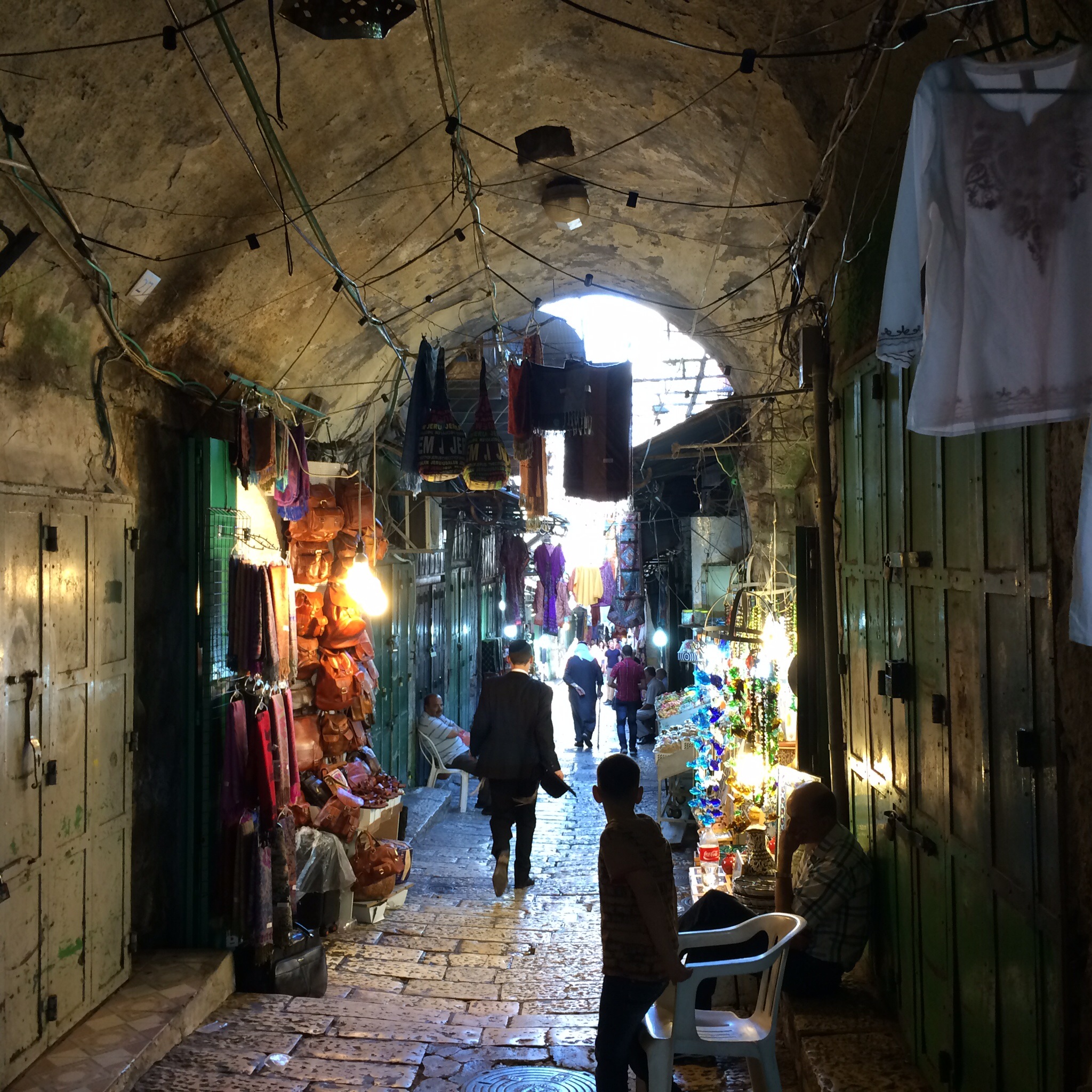
Not long ago I was visiting Jerusalem, and took a long walk around the Old City, passing through the Four Quarters: Armenian, Christian, Moslem and Jewish. It was late afternoon, towards the end of the Jewish Sabbath, and the ancient narrow streets were relatively quiet. The tourists had gone, and a number of the Arab shopkeepers down the Street of the Chain, that forms the central ‘spine’ of the Old City, were relaxing around small tables outside their shops and stalls playing cards or backgammon.
It felt as if I had the ancient streets and alleyways almost to myself.
Descending down that steep, narrow street of shops with its steps and ramps polished by millions of footsteps, I turned left into the broad, open street of the Muristan with its cafés and shops selling leather goods and entered the Christian quarter. As I walked past the entrance of the Church of the Holy Sepulchre, I heard male voices singing, the sound spreading out from the church into the enclosed square in front of the entrance. Just inside the entrance stood a circle of priests, each holding a candle, and chanting prayers. I stood for a while, marvelling at both the sound and the sight.
I carried on back down the Street of the Chain towards the Har haBáyit / Haram al-Sharif (Temple Mount / Noble Sanctuary) the most important religious site in Jerusalem for both Jews and Moslems. However, I knew that for many years there has been a police barrier near the entrance and that – as a Jew – I would not be allowed to enter the wide acres of the Haram al-Sharif.
In 1969, when I first visited the city, there was no such barrier, and I was able not only to walk up onto the large plaza but also to respectfully enter the Dome of the Rock and the Al-Aqsa mosque. As (then) a rather typical ‘long-haired hippy’ but also very aware of where I was, I felt no animosity. A man asked, in English, if I needed any help. I explained I was visiting the city and was interested to see these famous and holy sites. He said I was most welcome, but to remember to take off my shoes when entering the mosques.
I was recalling that memory as I neared the barrier. Resisting the temptation to carry straight on, I turned right, following the sign to the Kotel/Western Wall, the last remnants of the Temple, and the holiest site for Jews. For centuries it was known as the Wailing Wall: a place where Jews lamented the destruction of the Temple. It was nearing sundown, and as I passed through the security barrier and entered the huge plaza in front of the wall, the Adhan, the Moslem call for prayer, rang out from the towers high on the Haram al-Sharif, the extraordinarily evocative sound echoing around the city and bouncing off the walls of the buildings that rise up high above the plaza. A number of those buildings are Jewish yeshivot or religious seminaries, and as sundown marked the end of the Jewish Sabbath, the air now filled with the sound of chanting and singing as the evening prayers began and the sound streamed out from the many open windows.
In that clear, warm, golden Jerusalem air, I stood absolutely still; caught, wonderfully, in a swirl of voices from two religions, two very different worlds. But it wasn’t a competition, and while I am not a particularly religious person, I was mesmerised by what was a mutual celebration of religious and spiritual belief.
I happened to be standing near a tree, and suddenly the two-way stream of sound was joined by a third as the dozens of birds in the tree started to sing. It was truly a magical and very moving moment.
After a while I moved on, and carried on walking up through the Jewish quarter, passing the remains of the Cardo, the pillared main thoroughfare of Roman Jerusalem: a reminder that Jerusalem has always been a city of different civilisations and religions. I headed towards the Armenian Quarter and left the Old City via the Lion Gate, the outside of the gate still pockmarked with bullet holes from the 1967 war.
One abiding thought from that evening’s walk is that while it may be Jerusalem’s fate ever to be the focus of, sometimes bitter and tragic, religious and political struggle, there is a common thread that binds us all together. And, whatever one’s position on Israel, it remains one of the few cities in the Middle East where the songs and prayers of Christianity, Islam and Judaism can co-exist in relative harmony.



 Stumbling with Confidence