
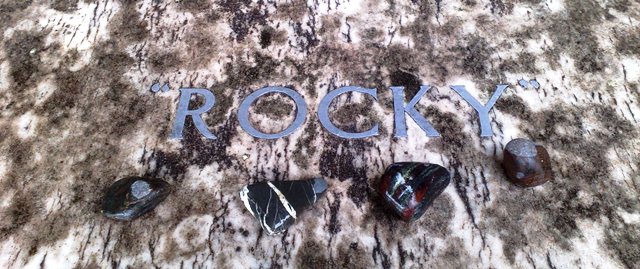
A stone for Rocky

On a visit to the cemetery and the kindness of strangers. Our story for Baby Loss Awareness Week.

The cemetery where our baby son is buried is a relatively new one, and for a number of years his grave lay alone in the children’s section, by the fence on the far side of the cemetery, well away from the small but slowly increasing number of adult graves.

If we decide to visit – which we do once or perhaps twice a year – then we’ll bring our thoughts, some cleaning materials, and four small stones. Our thoughts are our own, but we’ll use the cleaning stuff to clear away the debris and discolourations left by the seasons, the overhanging trees, and the local wildlife – both animal and human.

And when we’re ready to leave, and as flowers are not encouraged, we’ll follow Jewish custom and place the four stones on the grave: one each for my wife, myself and our two surviving children as a sign of respect and remembrance.

Some time ago, at the same cemetery, I attended the funeral of an elderly member of our community. At the end of the service, as people drifted away, I headed across the open expanse of grass towards the childrens’ section and our baby’s grave. We hadn’t visited for a long while, and I was expecting to see the usual untidiness. However, as I approached I noticed that the grave looked particularly clean and tidy. As I got nearer I saw that someone had left a single stone by our son’s name. This perplexed me as I knew that the stones we’d left ages before would have disappeared, and I knew of no one else who might wish to visit.

Standing there, lost in thought, I became aware of someone approaching. I turned to see an elderly lady who must have been at the funeral. She touched my arm and asked, in a precise English still tinged with the German of her youth “Are you the father?”.

Managing to suppress the urge – even in that situation – to make a smart-alec and totally inappropriate response, I answered simply that I was.

She smiled and said, “I’m so glad. I wasn’t sure if there was family, and I couldn’t bear the thought of this little chap all alone over here”.

It turned out that on her regular visits to her husband’s grave, she would come over to our baby’s grave, clean up what she could, say a little prayer, and leave a stone as a sign that someone had visited , that someone cared.

In a time of increasing fear for ourselves and for the world at large, it is all-too-easy to turn in on ourselves and focus on that which is ours. We forget at our peril that it is so often the kindness of strangers, the selfless reaching out to help others, that is a real force for good in the world. If, when doing nothing is by far the easier option, we each made that extra effort to help the stranger, to welcome the ‘other’ then we might go some way to mend at least some of the many wounds and sorrows of our age and our planet.

(We were wonderfully supported by and have supported Sands, the Stillbirth and Neo-Natal Death charity http://www.sands.org.uk)
On the loss of a child and the kindness of strangers

(This is an adaptation of a piece written for BBC Radio and first broadcast in 2000 as the Radio 4 Listeners’ Christmas Message. At the time we received wonderful support from Sands – the UK charity that provides support for bereaved parents and their families, which we now, in turn, support.)

Thirty years ago, on a bright, blue, cold winter’s morning, I walked out of the maternity hospital in the city where we live, and headed towards the registry office in the centre of town. I went there to register the birth, and death, of our first child, a baby boy who had been born and who had died a few hours previously. I had to be there in order to complete the paperwork that would allow us to bury him within 24 hours according to Jewish custom.

I remember, in that rather dark, forbidding wood-panelled waiting room, sitting next to a happy young couple who had come to register the birth of their new baby, who lay sleeping happily in his mother’s arms, and opposite a family, all dressed in black, grieving for a close and dear relative. I also remember, with immense gratitude, the kindness of the official who carefully and sympathetically took down all the necessary details. She was only doing her job but doing it in a way which make me feel – for the moment at least – a little bit easier with myself and with the world.

Now, thirty years later, though the number of years is wholly immaterial, amidst the hurly burly and complex logistics of daily life – juggling home, work, family, friends – rarely does a day go by without something or someone causing me to think back to that cold, blue morning.

The death of our child made me acutely aware of just how thin and fragile is the surface covering everyday normality, and how easily the fabric of that covering can be torn and ruptured…sometimes in seconds.

In particular I’ve come to understand the real importance of small acts of kindness. Those spontaneous, generous, unselfish acts that help to maintain that fragile fabric. I’ve learned – though sometimes it’s still a struggle – to give people the benefit of the doubt, to try and be more tolerant, to try and listen more. I’ve learned that others, too, may have large cracks and holes in their lives, and they – like me sometimes – are relying on that fabric not being torn in order to just get them through the day. The smile, the greeting, the welcome, the thank you, the helping hand, the small talk before getting down to business are all, in their way, small acts of kindness that bind us together and strengthen the fabric of our lives.

But before I am accused, in the face of a harsh and sometimes brutal world, of a utopian let’s-just-all-be-nice-to-each-other idealism, our baby’s death, conversely, made me less tolerant…of arrogance, ignorance, triviality and sheer stupidity. If there’s one quality we need, sometimes desperately, to develop, it is an active, rigorous tolerance, which is not the same as prejudiced silence or passive indifference. Understanding and respect for others grows out of a willingness to engage actively with the world. But it also means knowing, recognising and, importantly, doing something positive about not only those things that will make the world a better, happier place but acting to prevent those things that make it worse.

May the support of friends and family, and the kindness of strangers bring some comfort to you at this sad time.

On the loss of a child and the kindness of strangers

Twenty nine years ago, on a bright, blue, cold winter’s morning, I walked out of the maternity hospital in the city where we live, and headed towards the registry office in the centre of town. I went there to register the birth, and death, of our first child, a baby boy who had been born and who had died a few hours previously. I had to be there in order to complete the paperwork that would allow us to bury him within 24 hours according to Jewish custom.

I remember, in that rather dark, forbidding wood-panelled waiting room, sitting next to a happy young couple who had come to register the birth of their new baby, who lay sleeping happily in his mother’s arms, and opposite a family, all dressed in black, grieving for a close and dear relative. I also remember, with immense gratitude, the kindness of the official who carefully and sympathetically took down all the necessary details. She was only doing her job but doing it in a way which make me feel – for the moment at least – a little bit easier with myself and with the world.

Now, twenty nine years later, though the number of years is wholly immaterial, amidst the hurly burly and complex logistics of daily life – juggling home, work, family, friends – rarely does a day go by without something or someone causing me to think back to that cold, blue morning.

The death of our child made me acutely aware of just how thin and fragile is the surface covering everyday normality, and how easily the fabric of that covering can be torn and ruptured…sometimes in seconds.

In particular I’ve come to understand the real importance of small acts of kindness. Those spontaneous, generous, unselfish acts that help to maintain that fragile fabric. I’ve learned – though sometimes it’s still a struggle – to give people the benefit of the doubt, to try and be more tolerant, to try and listen more. I’ve learned that others, too, may have large cracks and holes in their lives, and they – like me sometimes – are relying on that fabric not being torn in order to just get them through the day. The smile, the greeting, the welcome, the thank you, the helping hand, the small talk before getting down to business are all, in their way, small acts of kindness that bind us together and strengthen the fabric of our lives.

But before I am accused, in the face of a harsh and sometimes brutal world, of a utopian let’s-just-all-be-nice-to-each-other idealism, our baby’s death, conversely, made me less tolerant…of arrogance, ignorance, triviality and sheer stupidity. If there’s one quality we need, sometimes desperately, to develop, it is an active, rigorous tolerance, which is not the same as prejudiced silence or passive indifference. Understanding and respect for others grows out of a willingness to engage actively with the world. But it also means knowing, recognising and, importantly, doing something positive about not only those things that will make the world a better, happier place but acting to prevent those things that make it worse.

May the support of friends and family, and the kindness of strangers bring some comfort to you at this sad time.

(This is an adaptation of a piece written for BBC Radio and first broadcast in 2000. At the time we received wonderful support from Sands – the UK charity that provides support for bereaved parents and their families, which we now, in turn, support.)


The death of a baby, the kindness of strangers, and a seasonal message

As the year ends and as families gather together to celebrate, amidst the good cheer and good will there is often sadness and grief at the loss and absence of a loved one. Recent events have brought back a lot of memories and thoughts about the death at birth of our own baby boy – known to all and sundry as ‘Rocky’ (real name Alexander) – in January 1990.

In 2000, as a complement or counterpoint to the traditional Queen’s Christmas Message, BBC Radio 4 offered a listener an opportunity to deliver their own seasonal message to the nation. It was coming up to the anniversary of Rocky’s death, and it was also one the rare years when the festivals of Christmas, Chanukah, and Eid coincided.

So I wrote something down and emailed it off, thinking that’d be the end of it.

A couple of weeks later, just before Christmas, I got a phone call to say my piece had been selected. So I recorded it in what seemed like a broom cupboard at BBC Manchester on Oxford Road,and it went out, and seemed to have had some impact.

Here is that recording:

The Kindness of Strangers

http://youtu.be/m3pqCtqGaSAahttp://www.youtube.com/watch?v=m3pqCtqGaSA

Selma Connections: A King, a Rabbi and a Caution

image      image

Like many, I’ve been watching the commemorations and celebrations of the 50 years since the momentous ‘Bloody Sunday’ on 7 March 1965 in Selma.

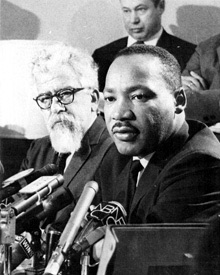
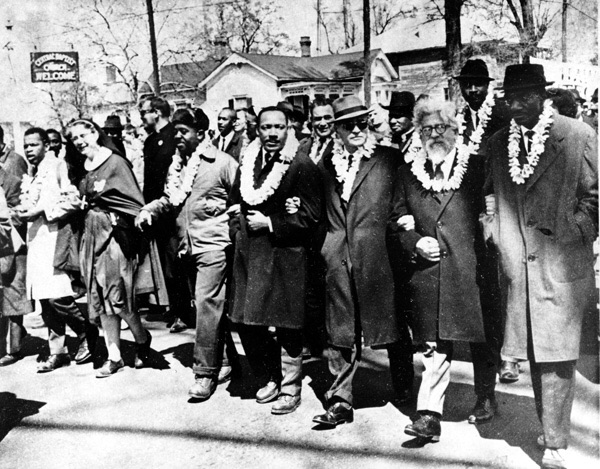
Looking at the various films and photographs from that time and place, you may have noticed that in a number of them, standing or sitting next to Dr. Martin Luther King is an elderly white man, wearing glasses and with a shock of white hair and long beard. His name is Rabbi Abraham Joshua Heschel, which is the anglicised version of his Hebrew name: Avraham Yehoshua Heschel….which was also my father’s Hebrew name. They were both named after a famous 17th century Polish rabbinical mystic.

Rabbi Heschel was a leading figure in American Judaism and also a very active social activist. He believed strongly that one’s spirituality must have legs. At the invitation of Martin Luther King Jr., Heschel participated in the opening day of the 1965 civil rights march from Selma to Montgomery for voting rights. The photograph of Heschel walking alongside King and other religious and political leaders is considered an emblem of the civil rights movement and of Black-Jewish relations of that era.

After the march, Heschel wrote about the experience in a private memo, “I felt my legs were praying.”

Jumping to the present, and the particulars horrors emanating from the so- called Islamic State, with its violent, barbaric intolerance of anyone and anything that does not fit with its particular world view, Heschel’s caution about the dark side of religion has a particular resonance:

“…when religion speaks only in the name of authority rather than with the voice of compassion, its message becomes meaningless.”