Grief crept up on me, unexpectedly: a story of Christmas Eve.

As a Jewish family, we don’t really do Christmas. Yes, we’ll gather together, have a big meal, play board games, and watch far too much television. But that’s because it’s a holiday, everything is closed, and there’s not much else to do.  Coming up to Christmas that year we’d just had some building work done, and there was still loads of cleaning up, making good, re-decorating to do. So it was looking like a DIY Christmas and new year.

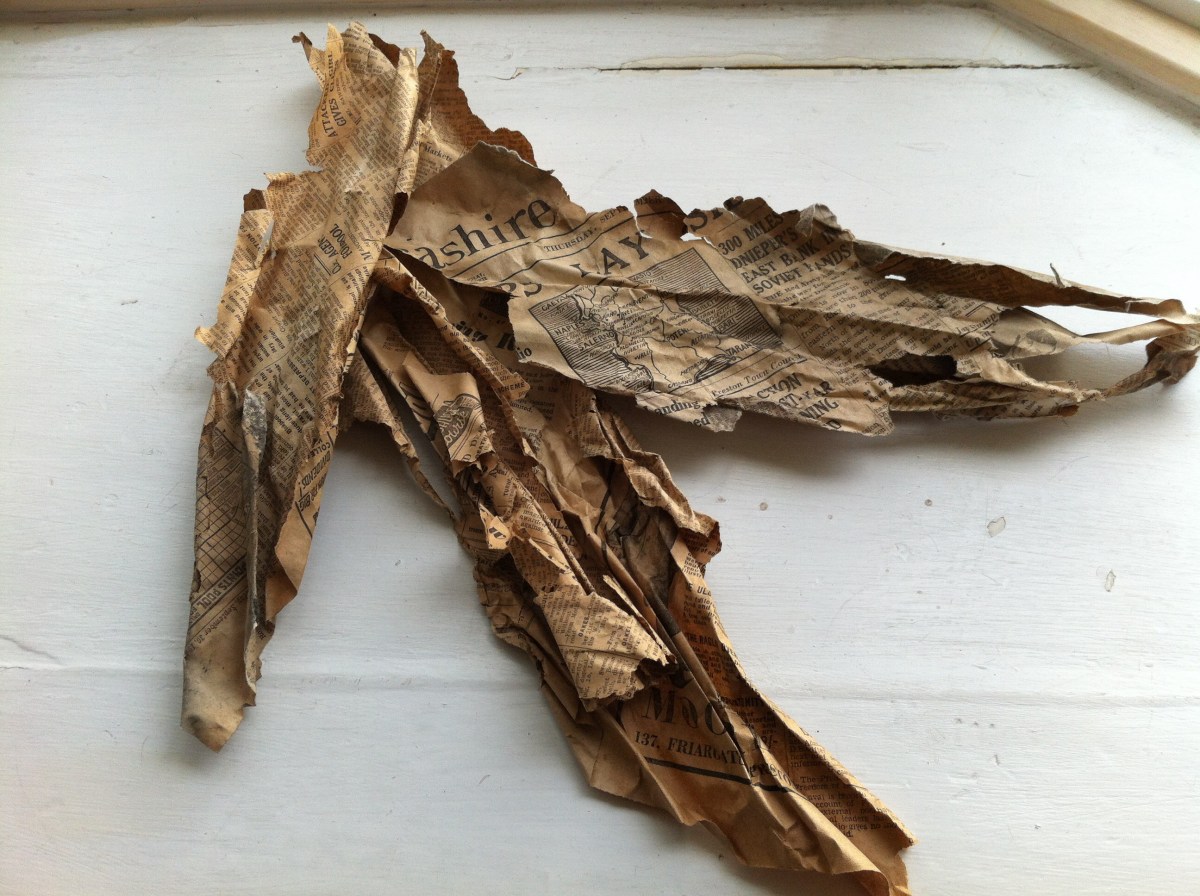
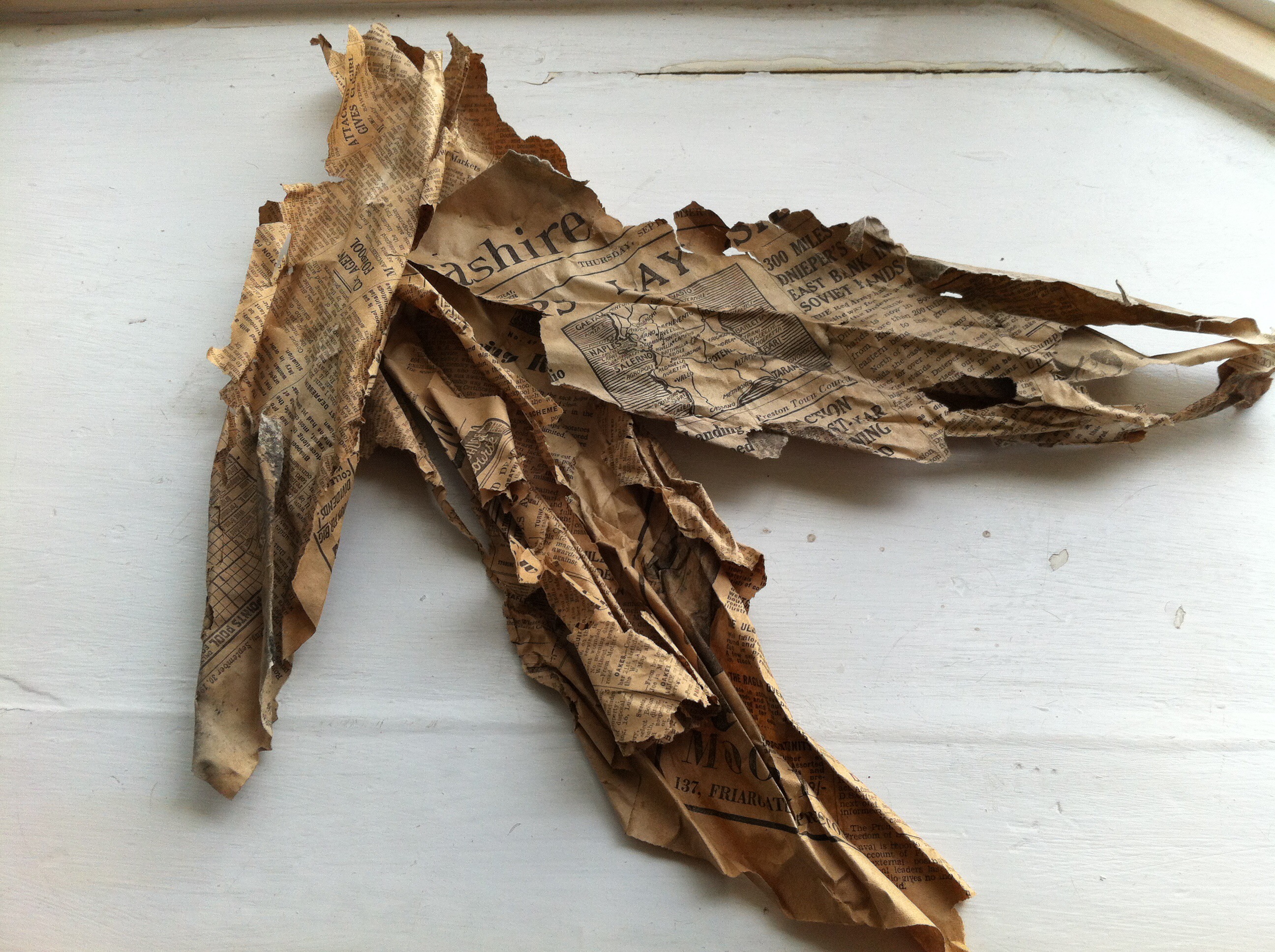
As it happens, the builders had found an old, crumpled newspaper stuffed into the gap between the window and the wall our bedroom. When they first found it, it reminded me of a dead bird.

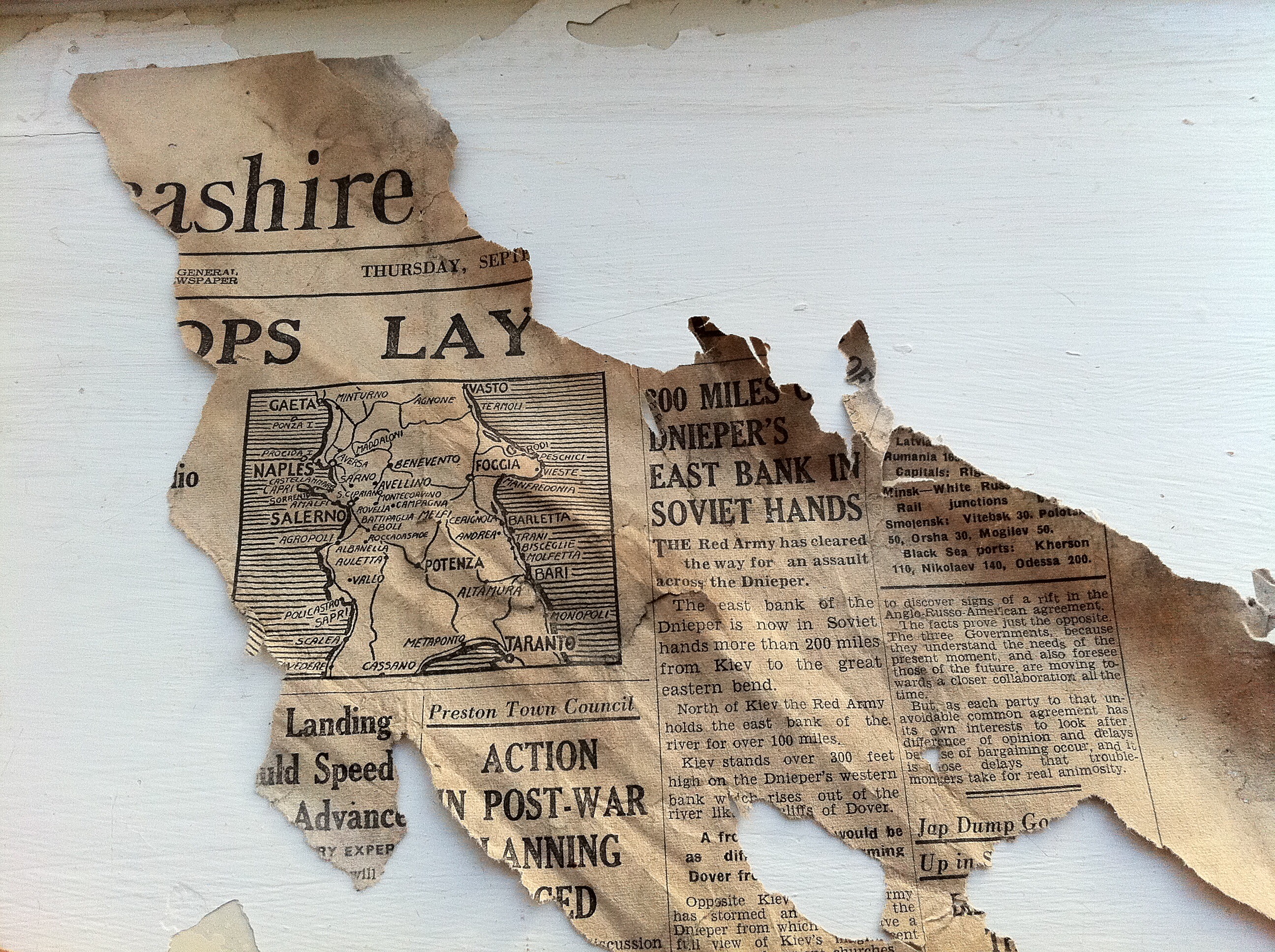
On the afternoon of Christmas Eve I decided to have a go at ‘uncrumpling’ it using our steam iron. It turned out to be the Lancashire Post from 30th September 1943. The paper was very fragile – I suspect they didn’t use the best quality newspaper during the war years – and I became absorbed in the task of slowly but surely flattening the paper one careful centimetre at a time. I wasn’t even aware that the radio was burbling quietly away on the other side of the room.

As each piece revealed its flattened secrets, I read about the Fifth Army’s losses in North Africa, the Russian advances along the Dneiper, a successful bombing raid over Germany (only eight missing in action). I also read about a local woman fined for fiddling ration books, and a Polish aircraft man convicted of drunk driving.
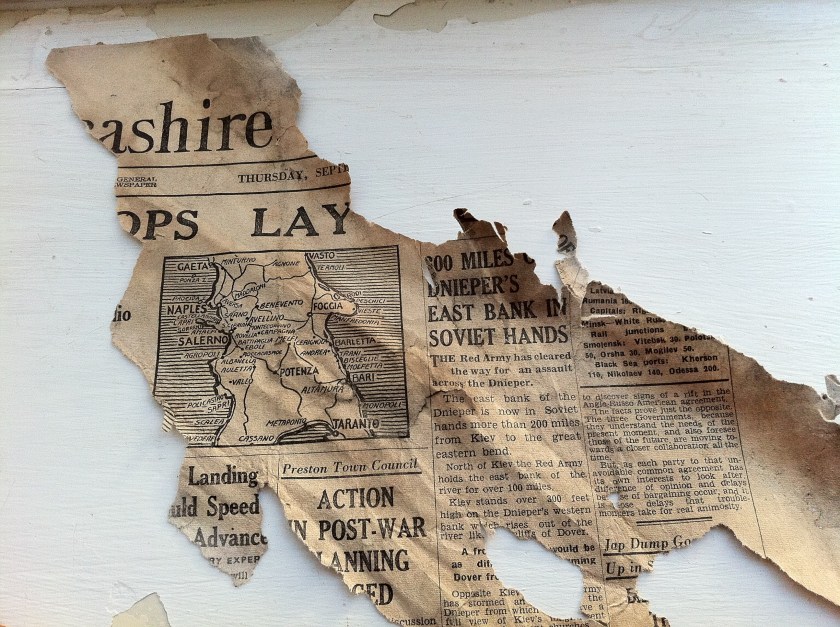
6B36571F-B19A-4FAF-9A7A-0D972EE9726C

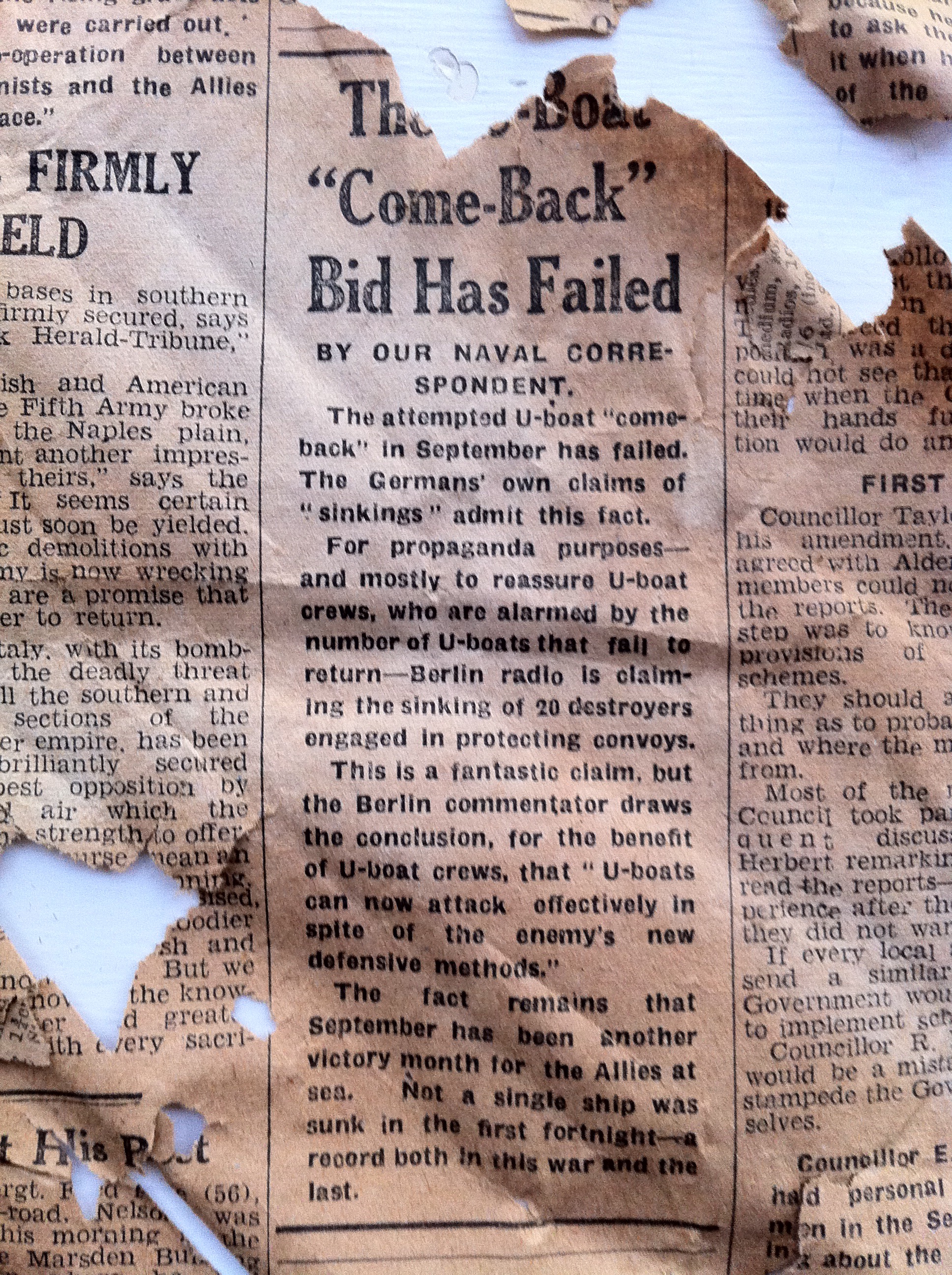
There was also a small item about how the German U-boats had failed to sink a single ship in the previous month. 70 years later, on Christmas Eve, the newspapers and television were full of the news about the Royal pardon given to Alan Turing, the man who had ‘cracked’ the German Enigma code used by the U-boats and, by doing so, had in no doubt saved thousands of lives and perhaps helped to end the war. But Turing was gay at a time when it was illegal, and had been found guilty of gross indecency, jailed, chemically castrated, and forbidden to undertake any work linked to national security. He was and should have been hailed as a national hero. Instead, he committed suicide two years later in 1954, and full recognition has only come very recently.

Those U-boat failures, reported on the front page of that 1943 Lancashire Post, were a direct result of the work Turing had undertaken at Bletchley Park.
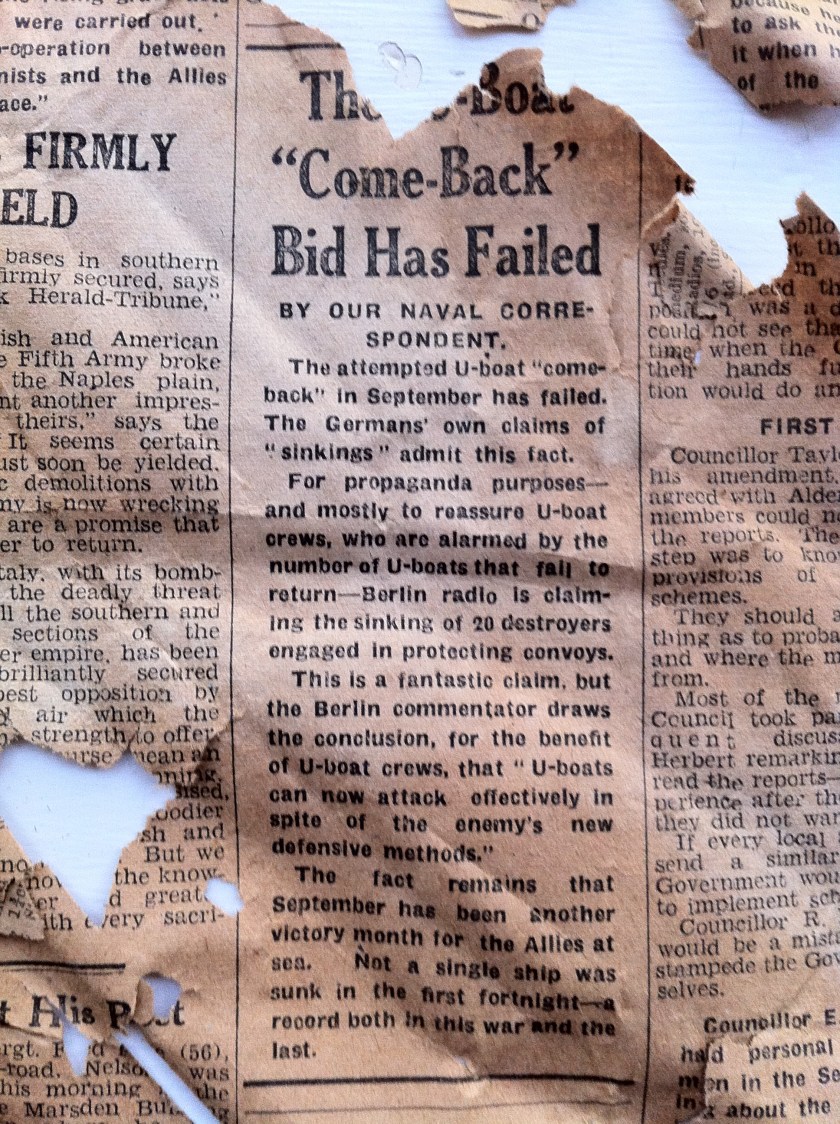
7D82AF71-CB37-4FD9-91B3-88A0DF5D6033

Absorbed in the task and on this fascinating window on history, I suddenly became aware of a beautiful, solo treble voice filling the room, singing “Once in Royal David’s City….”. It was three o’clock in the afternoon and the start of that wonderful, traditional Christmas Eve ‘Festival of Nine Lessons and Carols’ from King’s College Chapel in Cambridge. And as that pure, high voice soared…..I burst into uncontrollable sobs. A veritable tsunami of grief poured over, into and through me: disturbing and disruptive in its power and intensity.

It took me a while to realise what it was.

When my mother died, I cried no more than a couple of times, and that was around the time when it all happened and usually  in response to an individual’s kindness and sympathy. But nothing like this.

Though, obviously, Jewish and very proud of her traditions, my mother also had a deep love for many things that were quintessentially English. Among them she had a particularly high regard for and interest in the great cathedrals and churches of England. After she passed away I discovered, amidst the thousands of documents she left, a neatly stacked pile of guides to virtually all the English cathedrals and some other churches, all annotated with her distinctive handwriting. I always smile when I see those guides as my father did not approve of my mother’s interest in Christianity, and I know he would not step inside a church. So I have a very clear picture of my mother wandering around inside with her guide, no doubt quizzing whoever she could find about the history of the building and making notes, while my father sat patiently on a nearby bench doing his Times crossword.

Just before three o’clock in the afternoon on Christmas eve, without fail, and though Jews – on the whole – don’t do Christmas, my mother would sit herself in her favourite chair, turn on the radio, quite loudly, and wait until that beautiful, soaring, solo treble voice filled the room, singing the first verse of the carol, followed by the choir and then the congregation. Earlier in the day she would have called me to remind me NOT to call her between 3pm and 5pm.

As that deep pang of grief and my sobbing subsided, and I was able to collect my thoughts, I wondered how that boy’s voice could trigger such intense emotion. I remembered how some of Mark Rothko’s last paintings, those gigantic fields of deep colour, have a similar effect on some individuals, and I recalled that in some therapeutic contexts music and song are used to enable individuals and groups to confront severe trauma.

In my case, that moment triggered an intense ‘remembrance of things past’ and a huge sense of both loss and love. I suspect we all have those triggers, those Proustian ‘Madeleine biscuit’ moments, when something – perhaps completely unexpected – plunges us into the deep well of memory, love and loss.

That afternoon, as I ironed that old newspaper (something my mother would have loved – the newspaper not the ironing!) and listened to that young boy singing those famous words, I probably missed her more than I’ve done at any other time.
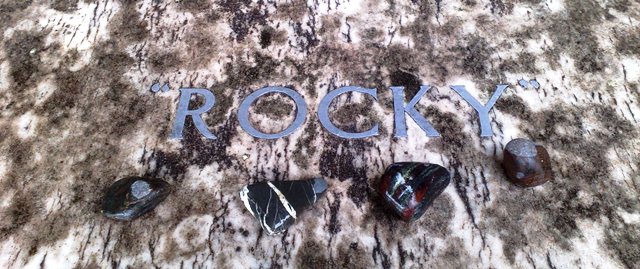
A stone for Rocky

On a visit to the cemetery and the kindness of strangers. Our story for Baby Loss Awareness Week.

The cemetery where our baby son is buried is a relatively new one, and for a number of years his grave lay alone in the children’s section, by the fence on the far side of the cemetery, well away from the small but slowly increasing number of adult graves.

If we decide to visit – which we do once or perhaps twice a year – then we’ll bring our thoughts, some cleaning materials, and four small stones. Our thoughts are our own, but we’ll use the cleaning stuff to clear away the debris and discolourations left by the seasons, the overhanging trees, and the local wildlife – both animal and human.

And when we’re ready to leave, and as flowers are not encouraged, we’ll follow Jewish custom and place the four stones on the grave: one each for my wife, myself and our two surviving children as a sign of respect and remembrance.

Some time ago, at the same cemetery, I attended the funeral of an elderly member of our community. At the end of the service, as people drifted away, I headed across the open expanse of grass towards the childrens’ section and our baby’s grave. We hadn’t visited for a long while, and I was expecting to see the usual untidiness. However, as I approached I noticed that the grave looked particularly clean and tidy. As I got nearer I saw that someone had left a single stone by our son’s name. This perplexed me as I knew that the stones we’d left ages before would have disappeared, and I knew of no one else who might wish to visit.

Standing there, lost in thought, I became aware of someone approaching. I turned to see an elderly lady who must have been at the funeral. She touched my arm and asked, in a precise English still tinged with the German of her youth “Are you the father?”.

Managing to suppress the urge – even in that situation – to make a smart-alec and totally inappropriate response, I answered simply that I was.

She smiled and said, “I’m so glad. I wasn’t sure if there was family, and I couldn’t bear the thought of this little chap all alone over here”.

It turned out that on her regular visits to her husband’s grave, she would come over to our baby’s grave, clean up what she could, say a little prayer, and leave a stone as a sign that someone had visited , that someone cared.

In a time of increasing fear for ourselves and for the world at large, it is all-too-easy to turn in on ourselves and focus on that which is ours. We forget at our peril that it is so often the kindness of strangers, the selfless reaching out to help others, that is a real force for good in the world. If, when doing nothing is by far the easier option, we each made that extra effort to help the stranger, to welcome the ‘other’ then we might go some way to mend at least some of the many wounds and sorrows of our age and our planet.

(We were wonderfully supported by and have supported Sands, the Stillbirth and Neo-Natal Death charity http://www.sands.org.uk)

Grief crept up on me on Christmas Eve….unexpectedly.

As a Jewish family, we don’t really do Christmas. Yes, we’ll gather together, have a big meal, play board games, and watch far too much television. But that’s because it’s a holiday, everything is closed, and there’s not much else to do.  Coming up to Christmas that year we’d just had some building work done, and there was still loads of cleaning up, making good, re-decorating to do. So it was looking like a DIY Christmas and new year.

As it happens, the builders had found an old, crumpled newspaper stuffed into the gap between the window and the wall our bedroom. When I first saw it lying on the floor where they had dropped it, I thought they had found a dead bird.

E09A2B69-4E25-468E-B831-7B66BF619E8D

On the afternoon of Christmas Eve I decided to have a go at ‘uncrumpling’ it using our steam iron. It turned out to be the Lancashire Post from 30th September 1943. The paper was very fragile – I suspect they didn’t use the best quality newspaper during the war years – and I became absorbed in the task of slowly but surely flattening the paper one careful centimetre at a time. I wasn’t even aware that the radio was burbling quietly away on the other side of the room.

As each piece revealed its flattened secrets, I read about the Fifth Army’s losses in North Africa, the Russian advances along the Dneiper, a successful bombing raid over Germany (only eight missing in action). I also read about a local woman fined for fiddling ration books, and a Polish aircraft man convicted of drunk driving.

6B36571F-B19A-4FAF-9A7A-0D972EE9726C


There was also a small item about how the German U-boats had failed to sink a single ship in the previous month. 70 years later, on Christmas Eve, the newspapers and television were full of the news about the Royal pardon given to Alan Turing, the man who had ‘cracked’ the German Enigma code used by the U-boats and, by doing so, had in no doubt saved thousands of lives and perhaps helped to end the war. But Turing was gay at a time when it was illegal, and had been found guilty of gross indecency, jailed, chemically castrated, and forbidden to undertake any work linked to national security. He was and should have been hailed as a national hero. Instead, he committed suicide two years later in 1954.

Those U-boat failures, reported on the front page of that 1943 Lancashire Post, were a direct result of the work Turing had undertaken at Bletchley Park.

7D82AF71-CB37-4FD9-91B3-88A0DF5D6033

Absorbed in the task and on this fascinating window on history, I suddenly became aware of a beautiful, solo treble voice filling the room, singing ‘Once in Royal David’s City….”. It was three o’clock in the afternoon and the start of that wonderful, traditional Christmas Eve ‘Festival of Nine Lessons and Carols’ from King’s College Chapel in Cambridge. And as that pure, high voice soared…..I burst into uncontrollable sobs. A veritable tsunami of grief poured over, into and through me; disturbing and disruptive in its power and intensity.

It took me a while to realise what it was.

When my mother died the year before, I cried no more than a couple of times, and that was around the time when it all happened and in response to an individual’s kindness and sympathy. But nothing like this.

Though, obviously, Jewish and very proud of her traditions, my mother also had a deep love for many things that were quintessentially English. Among them she had a particularly high regard for and interest in the great cathedrals and churches of England. After she passed away I discovered, amidst the thousands of documents she left, a neatly stacked pile of guides to virtually all the English cathedrals and some other churches, all neatly annotated with her distinctive handwriting. I always smile when I see those guides as my father did not approve of my mother’s interest in Christianity, and I know he would not step inside a church. So I have a very clear picture of my mother wandering around inside with her guide, no doubt quizzing whoever she could find about the history of the building, while my father is sitting on a park bench nearby doing his Times crossword.

Just before three o’clock in the afternoon on Christmas eve, without fail, and though Jews – on the whole – don’t do Christmas, my mother would sit herself in her favourite chair, turn on the radio, quite loudly, and wait until that beautiful, soaring, solo treble voice filled the room, singing the first verse of the carol, followed by the choir and then the congregation. Earlier in the day she would have called me to remind me NOT to call her between 3pm and 5pm.

As that deep pang of grief and my sobbing subsided, and I was able to collect my thoughts, I wondered how that boy’s voice could trigger such intense emotion. I remembered the reports of how some of Mark Rothko’s last paintings, those gigantic fields of deep colour, have a similar effect on some individuals. I recalled that in some therapeutic contexts music and song are used to enable individuals and groups to confront severe trauma.

In my case, it triggered an intense ‘remembrance of things past’ and a huge sense of both loss and love. I suspect we all have those triggers, those Proustian ‘Madeleine biscuit’ moments, when something – perhaps completely unexpected – plunges us into the deep well of memory, love and loss.

That afternoon, as I ironed that old newspaper (something my mother would have loved – the newspaper not the ironing!) and listened to that young boy singing those famous words, I probably missed her more than I’ve done at any other time.
The death of a baby, the kindness of strangers, and a seasonal message

As the year ends and as families gather together to celebrate, amidst the good cheer and good will there is often sadness and grief at the loss and absence of a loved one. Recent events have brought back a lot of memories and thoughts about the death at birth of our own baby boy – known to all and sundry as ‘Rocky’ (real name Alexander) – in January 1990.

In 2000, as a complement or counterpoint to the traditional Queen’s Christmas Message, BBC Radio 4 offered a listener an opportunity to deliver their own seasonal message to the nation. It was coming up to the anniversary of Rocky’s death, and it was also one the rare years when the festivals of Christmas, Chanukah, and Eid coincided.

So I wrote something down and emailed it off, thinking that’d be the end of it.

A couple of weeks later, just before Christmas, I got a phone call to say my piece had been selected. So I recorded it in what seemed like a broom cupboard at BBC Manchester on Oxford Road,and it went out, and seemed to have had some impact.

Here is that recording:

The Kindness of Strangers

http://youtu.be/m3pqCtqGaSAahttp://www.youtube.com/watch?v=m3pqCtqGaSA

Why is it so damn hard to get rid of books?


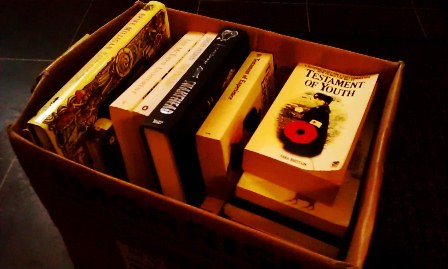
There it sits in the middle of our hallway, awaiting departure to the local charity bookshop. A box full of books. Behind the picture is a tale of heartache and hesitation, each book the cause of ineffable uncertainty.

Why is it so damn difficult?

Stanislavski, the great theatre director, started his ‘method’ of actor training by asking the question ‘What if?’. Well, even the odd duplicate book (e.g. the Vera Brittain ‘Testament of Youth’), which ought to be a straighforward job of straight into the box, proved problematic.

“OK, we don’t need two of the same….but what if?….”. And a whole number of possible scenarios unfold as the book in my hand hangs in limbo between shelf and box.

We have far too many books. No. Correction. We have far too many books for the size of our house (and it’s not a small house). And we have books that we shall never….sorry….that it is highly unlikely that I or we shall ever read again. But yet, as the eye and the hand travel across the serried ranks of fact and fiction, art and science, politics and philosophy, plays and poety, education and entertainment, and a plethora of other categories including miscellaneous, it is so easy to keep on moving, to avoid the obvious decision, to keep the box’s destiny unfulfilled.

Admittedly, there’s one decision that is easy to make: it’s not my book. It’s my wife’s or my daughter’s or my son’s. (The last of those has, anyway, always taken a minimalist approach to books – at least in tangible paper form. The shelves in his room are, however, full…..of my books).

Recently I read an article by someone who had managed to get their collection of several hundred books down to 20. Their ‘light bulb’ moment was the realization that “I was not so much attached to the stories and words themselves, but the physical books sitting on the shelves. Once I had that realization, I began to let go of some of my books”.

My problem is precisely that I AM attached to the fact of the books sitting there on the shelf. Their very presence comforts and reassures me. But it’s a bit more than that. Each one – and I’ve read or certainly delved into all of them at one time or another – contains a little bit of me, my history. Each title contains and reflects back to me a fragment of my life, a moment in time. Each one has – to a lesser or greater degree – a sort of Proustian ‘Madeleine’ biscuit effect, conjuring up the past.

Nevertheless, notwithstanding the above, I managed to fill that single box. The key to selecting those few books (and I inspected every shelf we have) was that each one was entirely silent in relation to my life. A closed book, literally and metaphorically.

It seems once I get beyond the obvious ‘keeps’…and I suspect there’s already too many of them, I’m stuck with ’emotional resonance’ as the key criteria. Perhaps books, like dogs, are “not just for Christmas but for life”.