Every menorah tells a story

image This is one of our menorahs (more properly a chanukiah, a menorah has seven branches, but nearly everyone calls the eight branch version a menorah) ) that we light on Chanukah, the Jewish ‘Festival of Light’ that Jews around the world celebrate. The festival lasts for eight days, and you start lighting one candle on the first night, and end with lighting eight candles on the last night. The candles are lit by a candle known as the shamas. 

Menorahs come in all shapes, sizes and materials: from the traditional eight branch candelabra plus the shamas candle made in brass or silver, to ultra-modern designs of great ingenuity and beauty. Essentially anything goes as long as the basics are met i.e. eight candles in some form of row plus the shamas candle, and many designers have taken up the challenge.

We have acquired several menorahs over the years. Some were gifts. Some we’ve inherited from parents and grandparents. A few we’ve bought.

(Here are some of the menorahs we’ve acquired, with their stories: Eight Days of Chanukah)

But this menorah,  quite large and made of brass, which we call our ‘Irish menorah’ is my favourite one.

Several years ago, when our now adult children were really just children, we were on holiday in the far south west of Ireland. West Cork to be precise. We were staying on a very small island called Long Island in Roaringwater Bay and, as there were no shops, we had to cross over by boat to the small village of Schull on the mainland to get supplies. I say ‘we’, but I have to admit that it was my partner, Jo, who usually went off to do the shopping while I stayed and supervised – from a very relaxed distance – the children, as they played amongst the rock pools and went off with the small gang of other children also staying on the island.

Among the few shops in the village there an ‘antique shop’, which was actually more of a junk shop. Jo stopped one day, and looked into the shop. And there, amongst the usual bric-a-brac, was a brass menorah. She could see the label which said: ‘8 branch candelabra with extra candle holder’. Amazed, and knowing there were very few if any Jews in that part of Ireland, she asked the shop owner where it had come from. The woman didn’t know, and really didn’t know what it was, despite the Star of David in the centre of the menorah. So Jo bought it, for the ridiculous price of £8.00

When we got it back to our little holiday cottage and looked at it closely we realised that it was designed to come apart. By turning the Star of David, which was attached to a long, thin screw, we could unscrew it from the heavy base, and then everything came apart. It was, of course, designed to be taken apart, and the various parts placed in a case – which had obviously disappeared somewhere along the menorah’s long journey to a junk shop window in West Cork.

We reckoned, after a bit of googling, that it was c. 120 years old, had probably originated in Central Europe, and the chances were that it had belonged to one of the many thousands of families – like our own families – who came to the then British Isles and beyond to escape antisemitism, pogroms and persecution and to seek a new life.

Of course we’ll never really know the real story. But as I watch that old brass menorah glow as the candles burn and flicker, I feel a extraordinary link to the past: a link in a chain that remains – despite the tribulations and tragedies of history – unbroken.
Grief crept up on me on Christmas Eve….unexpectedly.

As a Jewish family, we don’t really do Christmas. Yes, we’ll gather together, have a big meal, play board games, and watch far too much television. But that’s because it’s a holiday, everything is closed, and there’s not much else to do.  Coming up to Christmas that year we’d just had some building work done, and there was still loads of cleaning up, making good, re-decorating to do. So it was looking like a DIY Christmas and new year.

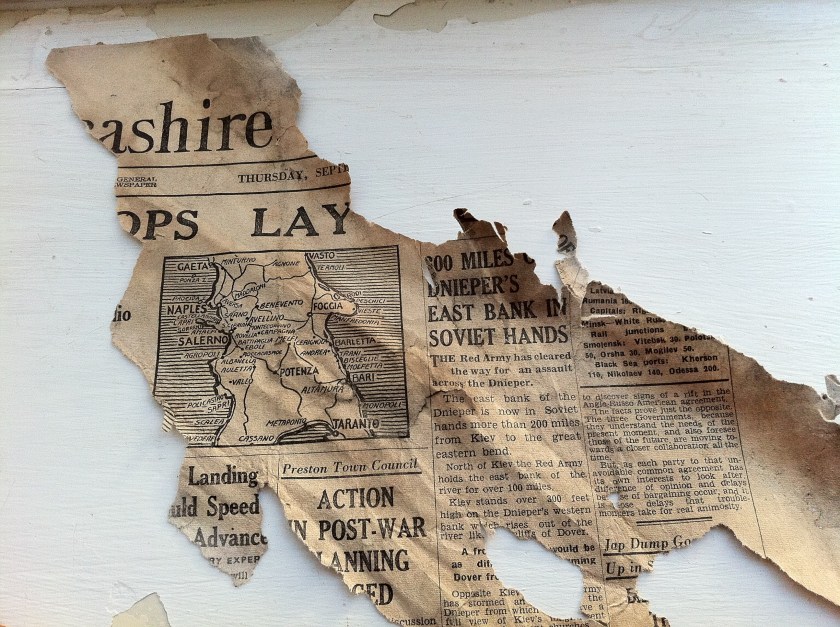
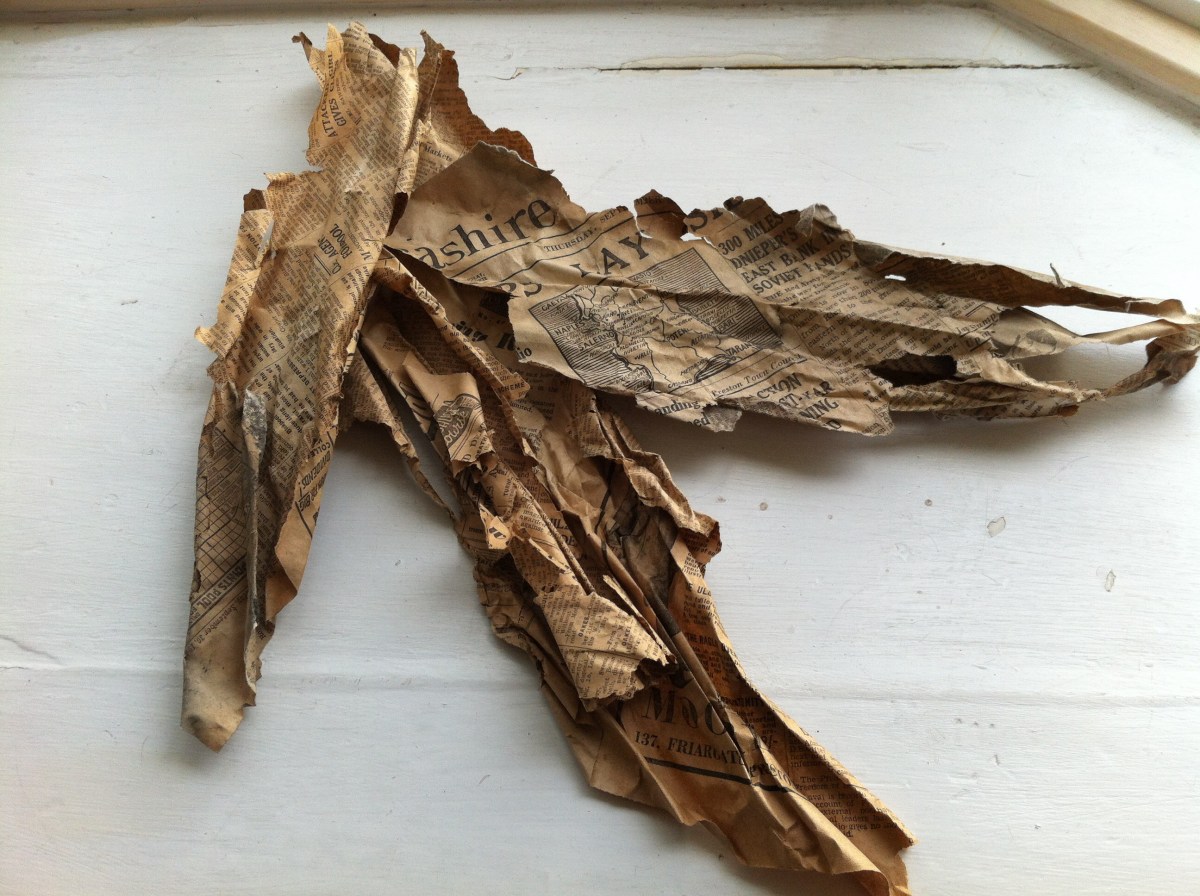
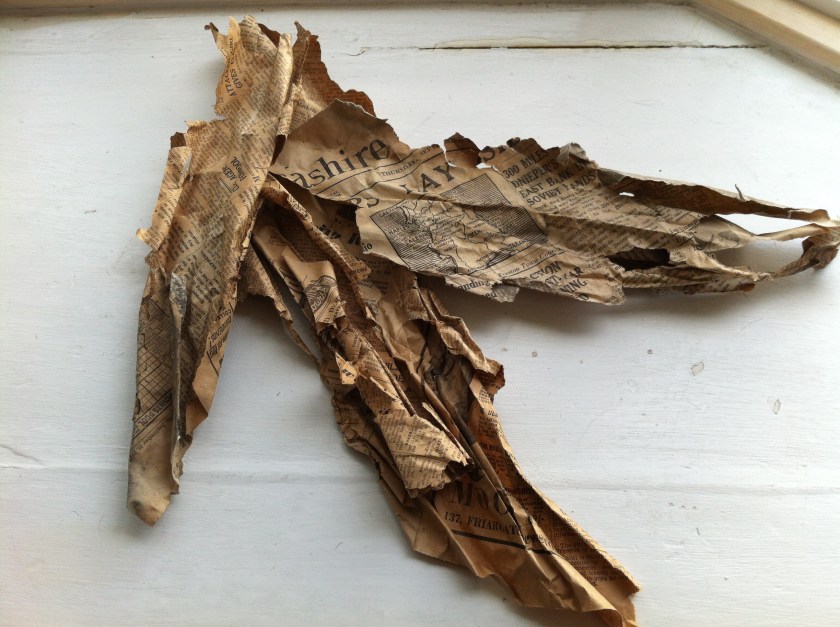
As it happens, the builders had found an old, crumpled newspaper stuffed into the gap between the window and the wall our bedroom. When I first saw it lying on the floor where they had dropped it, I thought they had found a dead bird.

E09A2B69-4E25-468E-B831-7B66BF619E8D

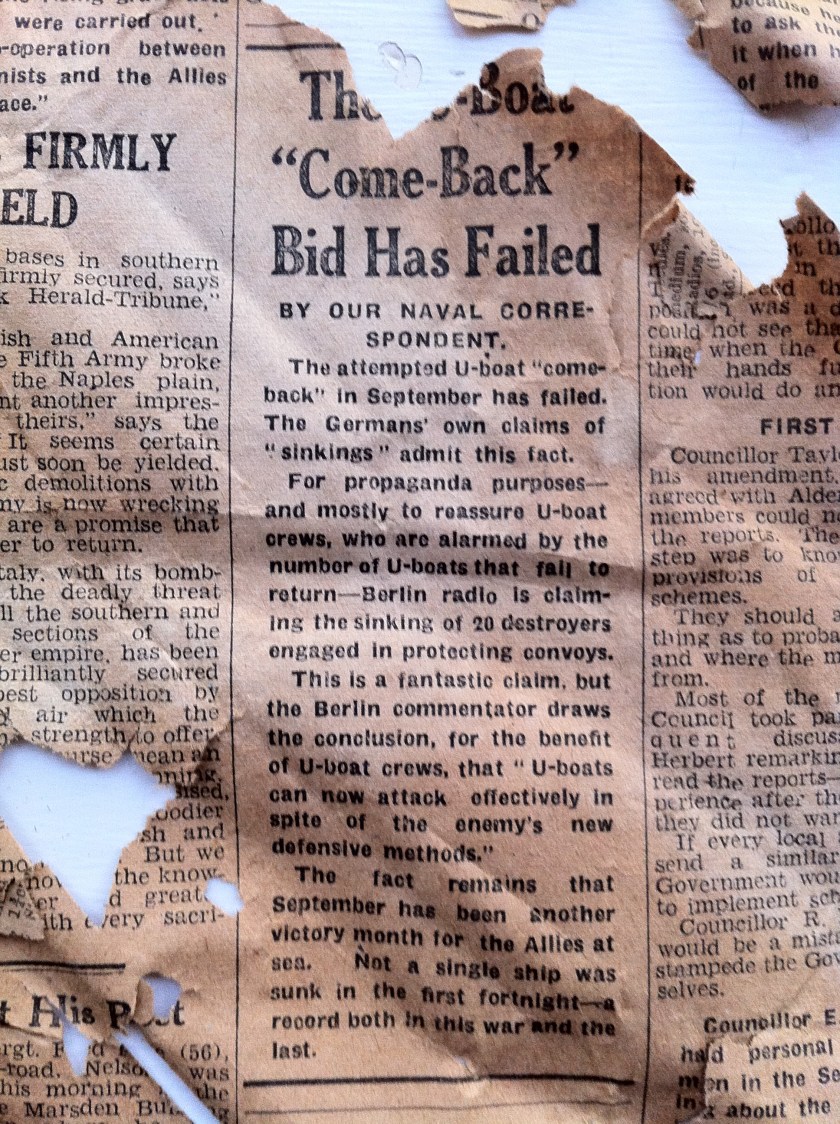
On the afternoon of Christmas Eve I decided to have a go at ‘uncrumpling’ it using our steam iron. It turned out to be the Lancashire Post from 30th September 1943. The paper was very fragile – I suspect they didn’t use the best quality newspaper during the war years – and I became absorbed in the task of slowly but surely flattening the paper one careful centimetre at a time. I wasn’t even aware that the radio was burbling quietly away on the other side of the room.

As each piece revealed its flattened secrets, I read about the Fifth Army’s losses in North Africa, the Russian advances along the Dneiper, a successful bombing raid over Germany (only eight missing in action). I also read about a local woman fined for fiddling ration books, and a Polish aircraft man convicted of drunk driving.

6B36571F-B19A-4FAF-9A7A-0D972EE9726C


There was also a small item about how the German U-boats had failed to sink a single ship in the previous month. 70 years later, on Christmas Eve, the newspapers and television were full of the news about the Royal pardon given to Alan Turing, the man who had ‘cracked’ the German Enigma code used by the U-boats and, by doing so, had in no doubt saved thousands of lives and perhaps helped to end the war. But Turing was gay at a time when it was illegal, and had been found guilty of gross indecency, jailed, chemically castrated, and forbidden to undertake any work linked to national security. He was and should have been hailed as a national hero. Instead, he committed suicide two years later in 1954.

Those U-boat failures, reported on the front page of that 1943 Lancashire Post, were a direct result of the work Turing had undertaken at Bletchley Park.

7D82AF71-CB37-4FD9-91B3-88A0DF5D6033

Absorbed in the task and on this fascinating window on history, I suddenly became aware of a beautiful, solo treble voice filling the room, singing ‘Once in Royal David’s City….”. It was three o’clock in the afternoon and the start of that wonderful, traditional Christmas Eve ‘Festival of Nine Lessons and Carols’ from King’s College Chapel in Cambridge. And as that pure, high voice soared…..I burst into uncontrollable sobs. A veritable tsunami of grief poured over, into and through me; disturbing and disruptive in its power and intensity.

It took me a while to realise what it was.

When my mother died the year before, I cried no more than a couple of times, and that was around the time when it all happened and in response to an individual’s kindness and sympathy. But nothing like this.

Though, obviously, Jewish and very proud of her traditions, my mother also had a deep love for many things that were quintessentially English. Among them she had a particularly high regard for and interest in the great cathedrals and churches of England. After she passed away I discovered, amidst the thousands of documents she left, a neatly stacked pile of guides to virtually all the English cathedrals and some other churches, all neatly annotated with her distinctive handwriting. I always smile when I see those guides as my father did not approve of my mother’s interest in Christianity, and I know he would not step inside a church. So I have a very clear picture of my mother wandering around inside with her guide, no doubt quizzing whoever she could find about the history of the building, while my father is sitting on a park bench nearby doing his Times crossword.

Just before three o’clock in the afternoon on Christmas eve, without fail, and though Jews – on the whole – don’t do Christmas, my mother would sit herself in her favourite chair, turn on the radio, quite loudly, and wait until that beautiful, soaring, solo treble voice filled the room, singing the first verse of the carol, followed by the choir and then the congregation. Earlier in the day she would have called me to remind me NOT to call her between 3pm and 5pm.

As that deep pang of grief and my sobbing subsided, and I was able to collect my thoughts, I wondered how that boy’s voice could trigger such intense emotion. I remembered the reports of how some of Mark Rothko’s last paintings, those gigantic fields of deep colour, have a similar effect on some individuals. I recalled that in some therapeutic contexts music and song are used to enable individuals and groups to confront severe trauma.

In my case, it triggered an intense ‘remembrance of things past’ and a huge sense of both loss and love. I suspect we all have those triggers, those Proustian ‘Madeleine biscuit’ moments, when something – perhaps completely unexpected – plunges us into the deep well of memory, love and loss.

That afternoon, as I ironed that old newspaper (something my mother would have loved – the newspaper not the ironing!) and listened to that young boy singing those famous words, I probably missed her more than I’ve done at any other time.

‘See me. Feel me. Touch me.’ (Pt. 1)

Object lessons and reflections on the HEA Arts & Humanities conference 2016

Brighton-HEA3

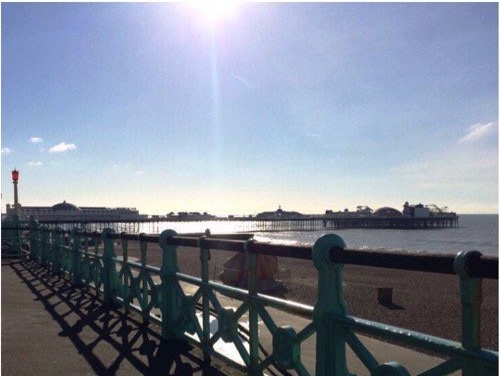
Early March. Brighton is an alluring place, despite the chill in the air.  The sun is shining, the sea is blue, the promenade and beach lie temptingly just across the road from the conference venue, and the esoteric shops, cafés and bars of The Lanes are just a couple of minute’s walk away. So it was a testament to the commitment of the participants and the quality of the many and varied sessions on offer that so many were able to resist the temptation to ‘skip school’.

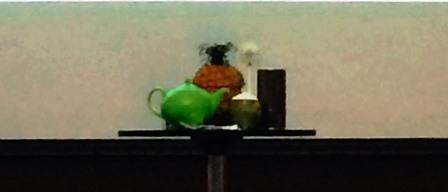
While, in some sessions and in Jonathan Worth’s fascinating keynote on the second day, there was an inevitable and valuable focus on the digital and the virtual, the most powerful message – for me – was the extraordinary pedagogic power of the physical, tangible object. From Kirsten Hardie’s opening keynote with accompanying green plastic teapot, pineapple ice bucket and toilet brush, to the Lego sessions of Contemplative Pedagogies, by way of Simon Heath’s wonderful drawings (see image below) that captured the essences of the whole event, it was the object that held centre stage. And there were plenty more sessions that focused on making and doing as a pedagogic activity, not just a practical or physical one.

Photo left: Hannah Cobb @ArchaeoCobb


I have written elsewhere (‘On history and all that’ ) on the power of objects to engage the imagination, to generate stories and lines of enquiry, to provoke philosophical, political, ethical debates, and to provide learning experiences that really ‘stick’. I still recall clearly the ‘History of Decoration’ seminars from my art student days when ‘Simi’ (Ms. Simeon the lecturer) would enliven her lectures on, say, Ancient Egypt, by taking a vase or piece of jewellery or some other artefact out of the cardboard box she always brought. She would casually hand the object to someone to examine and then pass around the room with the words ‘Do try to be careful, dear, that’s three and half thousand years’ old’. This would be repeated every session, whether the topic was Ancient Rome (jewellery), Medieval Europe (a crucifix) or Tudor England (a lace ruff). I only realised what we had been passing round  when I heard that, on her death , Simi’s large collection of “just something to look at while I’m talking” had been bequeathed to and enthusiastically accepted by the V&A museum.

What also became clear during the conference, is that ‘object lessons’ are not just the preserve of the creative arts community. Every discipline clearly has its associated artefacts which can be used not only to enhance the teaching of an ‘academic’ subject, but to act as foci for the characteristics and qualities of the sort of learning that Kirsten Hardie talked about: learning that engages, amazes, provokes, exhilarates, takes risk, liberates.

imageOne of the things I remember from those, now distant, art history sessions is something I frequently refer to in my work on curriculum design and assessment. In one her first seminars, Simi passed round an Ancient Greek vase that was covered head to foot in decoration. The reason, she said, for filling every possible square inch was ‘horor vacui’ – fear of open space – because it was through open space that the ‘Evil Eye’ enters the world. That might well be one of the reasons (though I would avoid mentioning the ‘Evil Eye’ or the Devil in module specifications and handbooks) why we insist on filling our curricula with content: ‘Idle hands make the devil’s workshop’ and all that. But we also know that deep learning, creativity and innovation require time and space to incubate and develop.
Objects, importantly, enable us to slow down time: to observe, to really look, to touch, to feel, to explore. Simon Piasecki, at the conference, talked about how he gets his performance students to slow right down and focus on the minutiae of what they are doing, and the artist Marina Abramovich – one of whose concerns is the fact that we don’t stop to really look any more –  has a number of exercises she uses with those who come to view her work to achieve the same slowing down. When I worked at the Liverpool Institute of Performing Arts (LIPA), one of the first year ‘options’ that I established – open to any student – was a traditional life-drawing class. All the students that participated in that quiet, contemplative two hours on a Wednesday evening, amidst an extraordinarily hectic timetable (‘horor vacui’!), reported that they understood that it wasn’t about being able to draw. It was about having the time and space to slow down and really observe not only the ‘object’ (usually another student) but also themselves….and to ‘take a line for a walk’ in Paul Klee’s famous phrase.

Ken Robinson, in his now famous TEDTalk on creativity and education, jokes about academics generally seeing their bodies as a form of transportation to get them to meetings. He, among others, stresses the importance of mind and body, the intellectual and the emotional, the psychological and the physiological. What came through so strongly at the HEA Arts and Humanities conference was that objects – in all their glorious variety – and our close interactions with them, provide a means to engage powerfully in deep, meaningful learning experiences.  Objects both inhabit space and create space. We just need the space,  the time and, impotently, the confidence to engage in our own object lessons.

Brighton- HEA2

Photos by Paul Kleiman unless otherwise stated
Conference Twitter hashtag: #HEAArts16

The death of a baby, the kindness of strangers, and a seasonal message

As the year ends and as families gather together to celebrate, amidst the good cheer and good will there is often sadness and grief at the loss and absence of a loved one. Recent events have brought back a lot of memories and thoughts about the death at birth of our own baby boy – known to all and sundry as ‘Rocky’ (real name Alexander) – in January 1990.

In 2000, as a complement or counterpoint to the traditional Queen’s Christmas Message, BBC Radio 4 offered a listener an opportunity to deliver their own seasonal message to the nation. It was coming up to the anniversary of Rocky’s death, and it was also one the rare years when the festivals of Christmas, Chanukah, and Eid coincided.

So I wrote something down and emailed it off, thinking that’d be the end of it.

A couple of weeks later, just before Christmas, I got a phone call to say my piece had been selected. So I recorded it in what seemed like a broom cupboard at BBC Manchester on Oxford Road,and it went out, and seemed to have had some impact.

Here is that recording:

The Kindness of Strangers

http://youtu.be/m3pqCtqGaSAahttp://www.youtube.com/watch?v=m3pqCtqGaSA

Musings on a ‘monsterous’ conference call

Something more near
Though deeper within darkness
Is entering the loneliness. . .

(Ted Hughes, “The Thought-Fox”)


In the wake of the recent announcement and call for contributions for the HEA’s Arts & Humanities ‘Heroes and Monsters” conference, there have been a number of posts and blogs on various sites wrestling with what the call is actually about!One that caught my eye was by Susan Deacy.

Dr. Deacy writes “The particulars make clear that the event is looking for ways to challenge current ways of learning and teaching to ‘make strange’ academic practice and challenge what is taken for granted by its practitioners. On the conference’s definition, monsters dwell in realms just beyond our own; they can come into our world to ‘unnerve’ us and ‘innervate’ us, and thus a ‘monstrous pedagogy’ can ‘disrupt habits’ and ‘articulate…different ways of being’. But who are ‘we’?”

There is a strong implication in the conference description, that ‘we’ are the ones who are disrupted and unnerved. But ‘we’ are, or can be, or may wish to be also the monsters and/or heroes (heroic monsters? monstrous heroes?). The teacher as Theseus and/or the Minotaur?

What has struck me in recent weeks (and, before I proceed further, I need to declare my interest as a member of the HEA’s Arts and Humanities team) is that I have newly encountered and had conversations about not just our own ‘Heroes & Monsters’ conference, but also the influence of Punk and the punk aesthetic in learning and teaching (did you know there’s an active group of scholars called Punkademics?); the establishment of a university Centre for Gothic Studies; and a course entitled Vampire Studies.

I do wonder, as the significant pressures of standardisation, marketisation, consumerisation, etc. in higher education bear increasingly down on us (then again, who are ‘we’?), whether this is a form of resistance.

But we don’t resist change, per se. We resist loss, and we replace that loss not with the known, the common, the understood, the accepted. We replace it with ‘the other’ or, better, ‘an other’: one that has genuine meaning in an environment in which so many things have become de-referentialised, that strikes a chord, that ‘chimes with the times’.

It is also no accident that the ‘Heroes and Monsters’ conference call connects directly with the allure and fascination of the myth and the quest. As I’ve got a book chapter to write on key aspects of teaching and learning in dance, drama and music, I’ll end (I may return, hauntingly) as I began, with Ted Hughes, and this in his essay ‘Myth and Education’:

“The myths for [Plato] were not very different from what they are for us, imaginative exercises about life in a world full of supernatural figures and miracles that never happened, never could happen. Yet these, he suggested, were the ideal grounding for the future wise and realistic citizen. We can imagine what would happen if we proposed now that all education in England up to the school age of 11 be abolished and there be put in its place a huge system of storytelling.

If we think of that we can see how far the wisdom in our educational system differs from what Plato would have called wisdom. Our school syllabus of course is one outcome of 300 years of rational enlightenment, which had begun by questioning superstitions and ended by prohibiting imagination itself as a reliable mental faculty, branding it more or less as a criminal in the scientific society. And what this has ended in is a completely passive attitude of apathy in face of material facts. The scientific attitude, which is the crystallisation of the rational attitude, has to be passive in the face of the facts if it is to record the facts accurately.

Such is the prestige of the scientific style of mind that this passivity in the face of the facts, this detached, inwardly inured objectivity, has become the prevailing mental attitude of our time. It is taught in schools as an ideal.

The result is something resembling mental paralysis”.