

2 Jews, 3 Arabs and 5 cups of tea

More years ago than I care to remember, five men sat around a hissing stove in a campsite outside Sofia in Bulgaria. It was 1969 and Robert and I were two Jewish lads from North London driving from London to Israel via Turkey. We were discussing life, the universe and the future of the Middle East with three Arabs: two Jordanians and a Syrian. Three teachers. Three friends on holiday together.

We had arrived at the campsite quite late in the day, set up our tent and cooked ourselves a meal. Then, as usual, we had a wander around the campsite. We noticed that a number of cars had Arabic number plates. Some of the other campers were walking around the site, and no doubt some must have seen – because it was difficult to avoid – the big sign on our windscreen which said ‘London to Tel Aviv’. To be honest, I thought the sign was a bit of a mistake, especially as it was only two years since the ‘6 Day War’ or ‘June War’ when Israel had defeated the armed forces of Egypt, Jordan and Syria, and had occupied the Sinai, the West Bank and the Golan Heights. But it was Robert’s car, and I wasn’t going to argue.

As darkness fell and we boiled up the kettle for a brew, three figures appeared. One said, in perfect English: “Apologies for disturbing you, but my friends and I saw the sign on your car. Are you really going to Israel?”

“Yes, we are”, Robert said.

“Are you Jewish?”

An awkward moment and an awkward pause. But I had one of those ‘well, in for a penny, in for a pound’ moments, and said “Yes, we are. My name is Paul. This is my friend Robert. We’re making some tea. Please join us…but I’m afraid we only have two cups”.

The first man spoke briefly in Arabic to the other two, who nodded assent, and one of them turned and walked away. Then he turned back to us: “Thank you. We will join you. I am Ibrahim, I am a teacher from Amman in Jordan. These are my friends, they are also teachers.” And pointing in the direction of the man who had walked away: “He has gone to bring some cups”.

When the man returned we all shook hands, introduced ourselves properly, sat around the stove and poured the tea.

At first the conversation was the normal campsite conversation: Where do you live? What do you do? Which football team do you support? (they knew the names of most of the Manchester United players – Best, Charlton, etc.). Then, inevitably, we came to the not insignificant matter that we were about to travel to a country that had recently defeated their countries in war and had occupied parts of their countries.

What struck me then, and has stayed with me all these years, was that there was no obvious bitterness. These were individuals who just wanted a decent life for themselves and their families. Who wanted to teach, and to do good in the world. They did not see us, as Jews, as their enemies; neither did we see them, as Arabs, as our enemies. As we sat and talked, about our lives and our hopes for a peaceful future (and football), there was a strong sense of a shared humanity; that by moving beyond the shackles of politics, religion and history, we were just five individuals, enjoying each other’s company, respecting our differences, sipping tea under the stars.
Selma Connections: A King, a Rabbi and a Caution

image      image

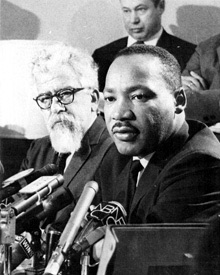
Like many, I’ve been watching the commemorations and celebrations of the 50 years since the momentous ‘Bloody Sunday’ on 7 March 1965 in Selma.

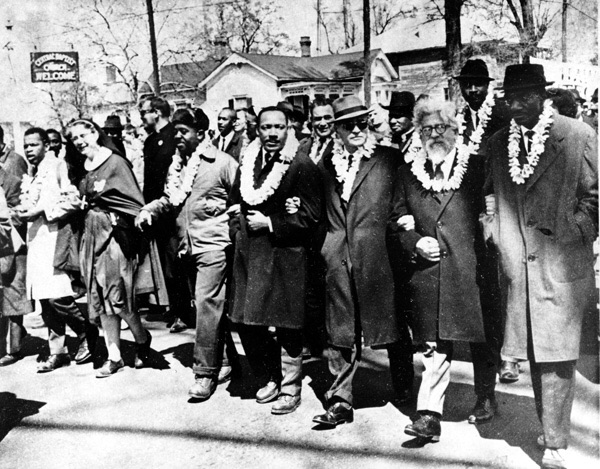
Looking at the various films and photographs from that time and place, you may have noticed that in a number of them, standing or sitting next to Dr. Martin Luther King is an elderly white man, wearing glasses and with a shock of white hair and long beard. His name is Rabbi Abraham Joshua Heschel, which is the anglicised version of his Hebrew name: Avraham Yehoshua Heschel….which was also my father’s Hebrew name. They were both named after a famous 17th century Polish rabbinical mystic.

Rabbi Heschel was a leading figure in American Judaism and also a very active social activist. He believed strongly that one’s spirituality must have legs. At the invitation of Martin Luther King Jr., Heschel participated in the opening day of the 1965 civil rights march from Selma to Montgomery for voting rights. The photograph of Heschel walking alongside King and other religious and political leaders is considered an emblem of the civil rights movement and of Black-Jewish relations of that era.

After the march, Heschel wrote about the experience in a private memo, “I felt my legs were praying.”

Jumping to the present, and the particulars horrors emanating from the so- called Islamic State, with its violent, barbaric intolerance of anyone and anything that does not fit with its particular world view, Heschel’s caution about the dark side of religion has a particular resonance:

“…when religion speaks only in the name of authority rather than with the voice of compassion, its message becomes meaningless.”

Sad, strange days…of comfort but little joy.

A few weeks ago we were standing by the luggage carousel at Malaga Airport waiting for our cases to arrive. Next to us, also waiting, were a middle aged man and a young woman. We got chatting – as you do – and it turned out they were a father and daughter, off to spend a long weekend at a villa he owned nearby. We had a lovely chat, about this and that, especially with the daughter who was in her first year at university. She was fun, vibrant, and immediately likeable.

It also turned out that they were Jewish and lived only a few miles from us in Manchester.

In a few days, while we were in Spain, it was to be the first anniversary of my mother’s death, when it is customary to go to synagogue to say memorial prayers. We knew there was a synagogue in Malaga, and as he was sort of ‘local’, I asked him if he knew anything about it. He said he did, and that he’d text me the details. So we swapped names and numbers and, when our luggage arrived, we said our goodbyes.

He never did get back to me, but we found the synagogue anyway.

Yesterday, in Manchester, we heard through a close friend that the daughter of someone she knew through her work had gone to a beauty salon, had suffered a severe asthma attack, and had died. She mentioned the devastated family’s name, and I knew immediately that it was that lovely, vibrant young woman at the airport.

We’ve just returned from paying our respects to the family at their home. A heartbreaking and heartrending scene, but also one that showed the strength of community as well over a hundred people waited patiently, both inside the house and outside in the rain, to pay their respects.

We approached the father to say the traditional words of comfort. Even in his grief he looked at us that way you look at someone who approaches you as if they know you, but you haven’t the faintest idea who they are. I told him who we were, and how and where we met. He stood up from his low wooden ‘mourning’ chair and hugged me, and smiled, and thanked us for being there…and he asked me if I’d found a synagogue and apologised for not getting back to me. I said I had, and thanked him for pointing us in the right direction. His wife said it was the first time she’d seen him smile.

They both seemed genuinely touched and overwhelmed that a couple of complete strangers should make the effort to visit them and to say words of comfort.

Walking away from the house, we met a couple we knew. He said “It’s just crap, isn’t it? But it makes you stop , doesn’t it?”

Yes, it does, and it also reminded me of something I wrote some years ago, also at a sad time:

‘We forget at our peril just how thin and fragile is the layer of everyday normality, and how easily that layer can be torn and ruptured, sometimes in a matter of seconds…and just how important small acts of kindness are: the smile, the greeting, the helping hand, the thank you, the small talk before getting down to business, are all, in their way, small acts of kindness that bind us together and strengthen the fabric of our lives’.

I know it sounds a bit soppy and clichéd, but give a hug to the people you love and care about, and tell them how much you love and care about them…and do it every day, or certainly whenever the opportunity arises.