Grief crept up on me, unexpectedly: a story of Christmas Eve.

As a Jewish family, we don’t really do Christmas. Yes, we’ll gather together, have a big meal, play board games, and watch far too much television. But that’s because it’s a holiday, everything is closed, and there’s not much else to do.  Coming up to Christmas that year we’d just had some building work done, and there was still loads of cleaning up, making good, re-decorating to do. So it was looking like a DIY Christmas and new year.

As it happens, the builders had found an old, crumpled newspaper stuffed into the gap between the window and the wall our bedroom. When they first found it, it reminded me of a dead bird.

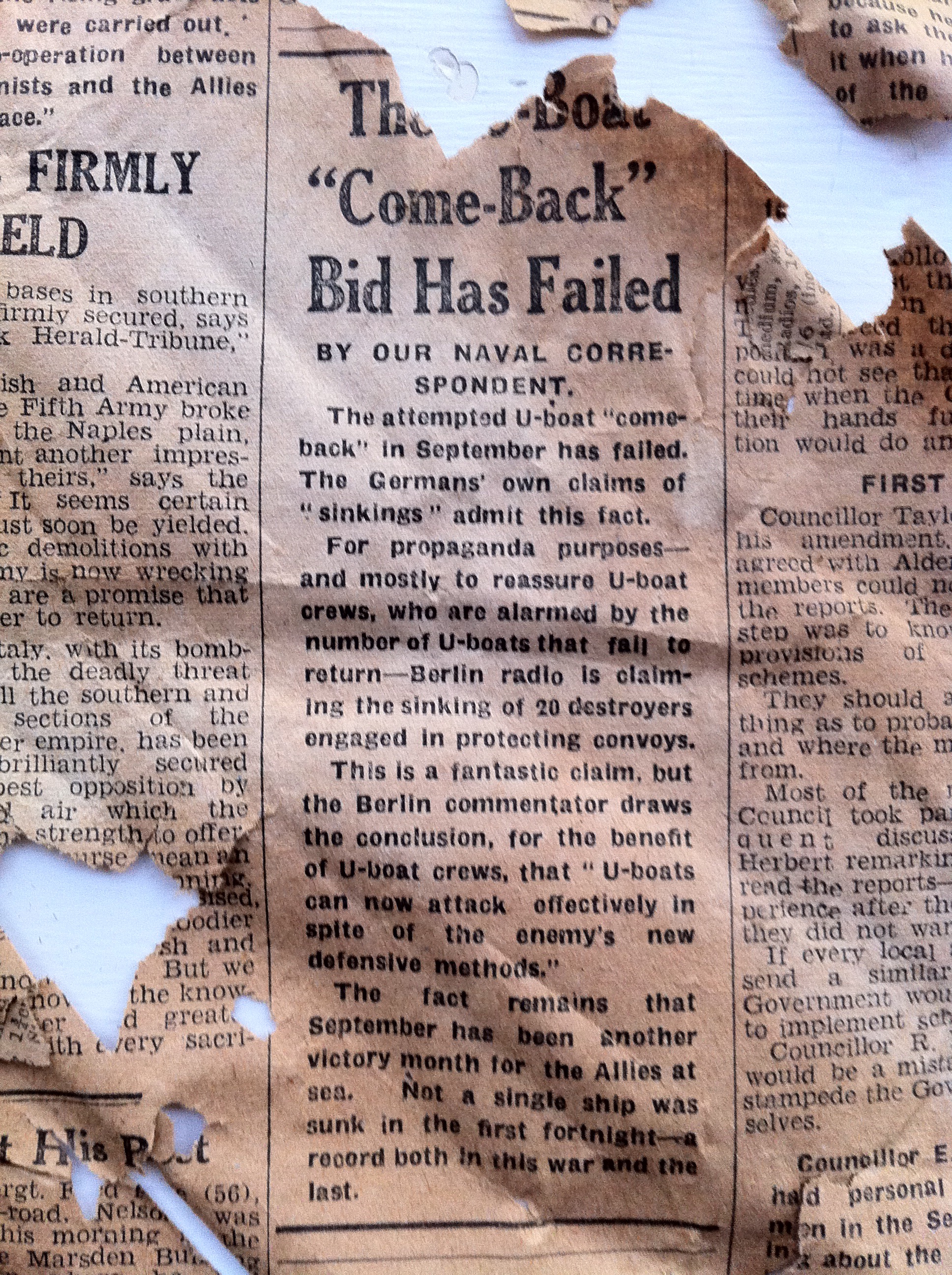
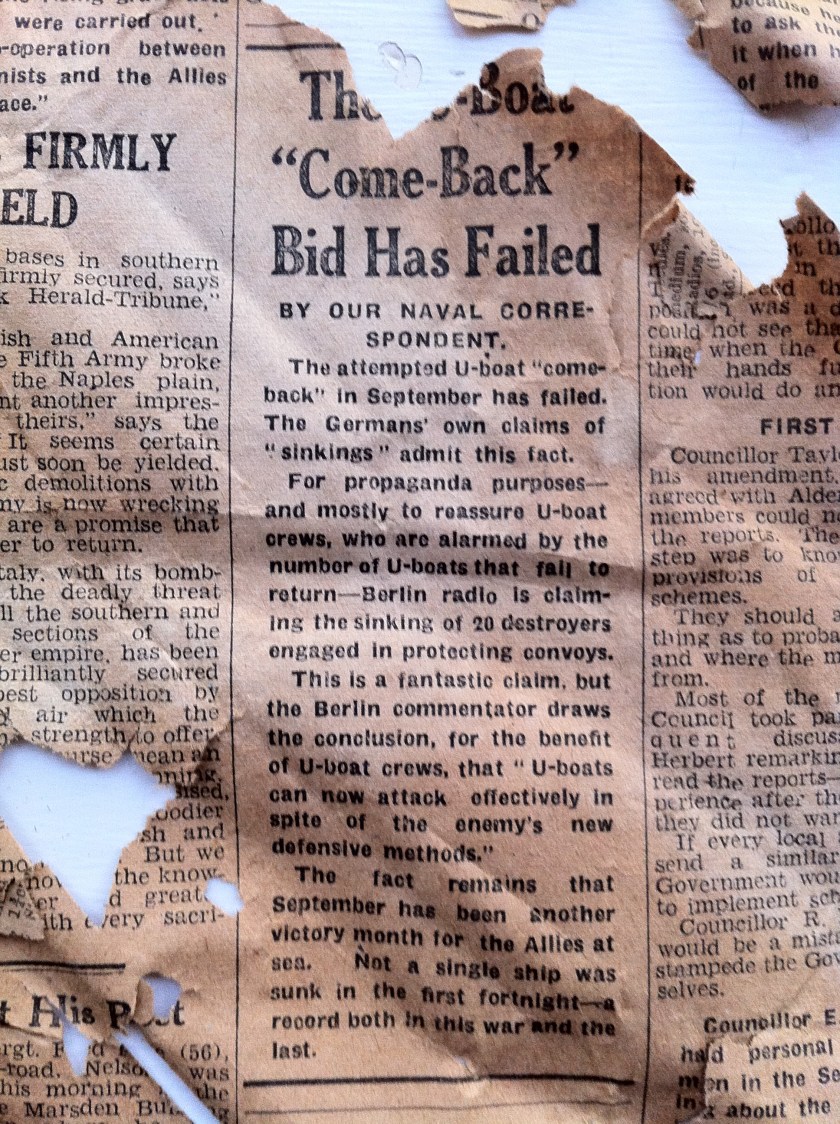
On the afternoon of Christmas Eve I decided to have a go at ‘uncrumpling’ it using our steam iron. It turned out to be the Lancashire Post from 30th September 1943. The paper was very fragile – I suspect they didn’t use the best quality newspaper during the war years – and I became absorbed in the task of slowly but surely flattening the paper one careful centimetre at a time. I wasn’t even aware that the radio was burbling quietly away on the other side of the room.

As each piece revealed its flattened secrets, I read about the Fifth Army’s losses in North Africa, the Russian advances along the Dneiper, a successful bombing raid over Germany (only eight missing in action). I also read about a local woman fined for fiddling ration books, and a Polish aircraft man convicted of drunk driving.

6B36571F-B19A-4FAF-9A7A-0D972EE9726C

There was also a small item about how the German U-boats had failed to sink a single ship in the previous month. 70 years later, on Christmas Eve, the newspapers and television were full of the news about the Royal pardon given to Alan Turing, the man who had ‘cracked’ the German Enigma code used by the U-boats and, by doing so, had in no doubt saved thousands of lives and perhaps helped to end the war. But Turing was gay at a time when it was illegal, and had been found guilty of gross indecency, jailed, chemically castrated, and forbidden to undertake any work linked to national security. He was and should have been hailed as a national hero. Instead, he committed suicide two years later in 1954, and full recognition has only come very recently.

Those U-boat failures, reported on the front page of that 1943 Lancashire Post, were a direct result of the work Turing had undertaken at Bletchley Park.
7D82AF71-CB37-4FD9-91B3-88A0DF5D6033

Absorbed in the task and on this fascinating window on history, I suddenly became aware of a beautiful, solo treble voice filling the room, singing “Once in Royal David’s City….”. It was three o’clock in the afternoon and the start of that wonderful, traditional Christmas Eve ‘Festival of Nine Lessons and Carols’ from King’s College Chapel in Cambridge. And as that pure, high voice soared…..I burst into uncontrollable sobs. A veritable tsunami of grief poured over, into and through me: disturbing and disruptive in its power and intensity.

It took me a while to realise what it was.

When my mother died, I cried no more than a couple of times, and that was around the time when it all happened and usually  in response to an individual’s kindness and sympathy. But nothing like this.

Though, obviously, Jewish and very proud of her traditions, my mother also had a deep love for many things that were quintessentially English. Among them she had a particularly high regard for and interest in the great cathedrals and churches of England. After she passed away I discovered, amidst the thousands of documents she left, a neatly stacked pile of guides to virtually all the English cathedrals and some other churches, all annotated with her distinctive handwriting. I always smile when I see those guides as my father did not approve of my mother’s interest in Christianity, and I know he would not step inside a church. So I have a very clear picture of my mother wandering around inside with her guide, no doubt quizzing whoever she could find about the history of the building and making notes, while my father sat patiently on a nearby bench doing his Times crossword.

Just before three o’clock in the afternoon on Christmas eve, without fail, and though Jews – on the whole – don’t do Christmas, my mother would sit herself in her favourite chair, turn on the radio, quite loudly, and wait until that beautiful, soaring, solo treble voice filled the room, singing the first verse of the carol, followed by the choir and then the congregation. Earlier in the day she would have called me to remind me NOT to call her between 3pm and 5pm.

As that deep pang of grief and my sobbing subsided, and I was able to collect my thoughts, I wondered how that boy’s voice could trigger such intense emotion. I remembered how some of Mark Rothko’s last paintings, those gigantic fields of deep colour, have a similar effect on some individuals, and I recalled that in some therapeutic contexts music and song are used to enable individuals and groups to confront severe trauma.

In my case, that moment triggered an intense ‘remembrance of things past’ and a huge sense of both loss and love. I suspect we all have those triggers, those Proustian ‘Madeleine biscuit’ moments, when something – perhaps completely unexpected – plunges us into the deep well of memory, love and loss.

That afternoon, as I ironed that old newspaper (something my mother would have loved – the newspaper not the ironing!) and listened to that young boy singing those famous words, I probably missed her more than I’ve done at any other time.


The plagiarism (and plagiarised) iceberg

I once attended a conference on academic integrity. Full of academics and university managers all concerned about the rising tide of plagiarism, cheating and the exponential growth of services and products aimed at providing their users the means with which to ‘game’ the system. 

As is customary at such gatherings, there was a keynote presentation from an expert in such matters. In this case it was a senior academic and university leader talking about the way their university had approached the ‘problem’. The presentation, accompanied by the inevitable Powerpoint slides of charts and bullet points, was going well and had my full attention until the first photographic image appeared. It was a stunning image of an iceberg, showing the relatively small, visible above water section in contrast to the immense invisible section below the water line, used to illustrate the point that what we see and catch in terms of plagiarism, cheating, collusion etc. is only the ‘tip of the iceberg’.

I immediately recognised the image, and if you Google ‘iceberg’ and select ‘images’ you’ll see it amongst the first set of images. It’s also – because it’s a great image – promiscuously plagiarised on dozens of websites and blogs. I recognised it, because I’ve also ‘stolen’ it for a satiric poster…but that’s another story.

But here we had a patently plagiarised image, with no acknowledgment as to its source, being used to illustrate a presentation on tackling and preventing plagiarism, given by an expert in the field at a large conference where the ‘fair use’ conditions don’t apply.

A wee bit ironic.

But the thing is, I’m sure we’ve all done it at some point. Let’s ‘spice up’ our otherwise visually boring Powerpoint presentations with some nice ‘visuals’. Isn’t that what we’re encouraged to do? And doesn’t something like Google images or Flickr make it so easy? 

But is it so hard (and ignoring, for the moment, issues of copyright and fair use) to acknowledge one’s sources? There’s even less excuse when there are now several websites ( e.g. Unsplash, Openverse, Creative Commons, Freerange, Pixabay etc.)  that provide access to millions of images that are free to use but usually request that you cite the source.

Perhaps, when it comes to plagiarism, we should try just a bit harder to practise what we preach when we present our work – whether to students or colleagues. 

 Image: “Iceberg in the Arctic with its underside exposed” by AWeith is licensed under CC BY-SA 4.0.

 ~~~~~~~~~~~~

(See also ‘Is a picture worth a thousand words? Incorporating the visual into your teaching https://stumblingwithconfidence.wordpress.com/2023/12/15/2095/

Grief crept up on me on Christmas Eve….unexpectedly.

As a Jewish family, we don’t really do Christmas. Yes, we’ll gather together, have a big meal, play board games, and watch far too much television. But that’s because it’s a holiday, everything is closed, and there’s not much else to do.  Coming up to Christmas that year we’d just had some building work done, and there was still loads of cleaning up, making good, re-decorating to do. So it was looking like a DIY Christmas and new year.

As it happens, the builders had found an old, crumpled newspaper stuffed into the gap between the window and the wall our bedroom. When I first saw it lying on the floor where they had dropped it, I thought they had found a dead bird.

E09A2B69-4E25-468E-B831-7B66BF619E8D

On the afternoon of Christmas Eve I decided to have a go at ‘uncrumpling’ it using our steam iron. It turned out to be the Lancashire Post from 30th September 1943. The paper was very fragile – I suspect they didn’t use the best quality newspaper during the war years – and I became absorbed in the task of slowly but surely flattening the paper one careful centimetre at a time. I wasn’t even aware that the radio was burbling quietly away on the other side of the room.

As each piece revealed its flattened secrets, I read about the Fifth Army’s losses in North Africa, the Russian advances along the Dneiper, a successful bombing raid over Germany (only eight missing in action). I also read about a local woman fined for fiddling ration books, and a Polish aircraft man convicted of drunk driving.

6B36571F-B19A-4FAF-9A7A-0D972EE9726C


There was also a small item about how the German U-boats had failed to sink a single ship in the previous month. 70 years later, on Christmas Eve, the newspapers and television were full of the news about the Royal pardon given to Alan Turing, the man who had ‘cracked’ the German Enigma code used by the U-boats and, by doing so, had in no doubt saved thousands of lives and perhaps helped to end the war. But Turing was gay at a time when it was illegal, and had been found guilty of gross indecency, jailed, chemically castrated, and forbidden to undertake any work linked to national security. He was and should have been hailed as a national hero. Instead, he committed suicide two years later in 1954.

Those U-boat failures, reported on the front page of that 1943 Lancashire Post, were a direct result of the work Turing had undertaken at Bletchley Park.

7D82AF71-CB37-4FD9-91B3-88A0DF5D6033

Absorbed in the task and on this fascinating window on history, I suddenly became aware of a beautiful, solo treble voice filling the room, singing ‘Once in Royal David’s City….”. It was three o’clock in the afternoon and the start of that wonderful, traditional Christmas Eve ‘Festival of Nine Lessons and Carols’ from King’s College Chapel in Cambridge. And as that pure, high voice soared…..I burst into uncontrollable sobs. A veritable tsunami of grief poured over, into and through me; disturbing and disruptive in its power and intensity.

It took me a while to realise what it was.

When my mother died the year before, I cried no more than a couple of times, and that was around the time when it all happened and in response to an individual’s kindness and sympathy. But nothing like this.

Though, obviously, Jewish and very proud of her traditions, my mother also had a deep love for many things that were quintessentially English. Among them she had a particularly high regard for and interest in the great cathedrals and churches of England. After she passed away I discovered, amidst the thousands of documents she left, a neatly stacked pile of guides to virtually all the English cathedrals and some other churches, all neatly annotated with her distinctive handwriting. I always smile when I see those guides as my father did not approve of my mother’s interest in Christianity, and I know he would not step inside a church. So I have a very clear picture of my mother wandering around inside with her guide, no doubt quizzing whoever she could find about the history of the building, while my father is sitting on a park bench nearby doing his Times crossword.

Just before three o’clock in the afternoon on Christmas eve, without fail, and though Jews – on the whole – don’t do Christmas, my mother would sit herself in her favourite chair, turn on the radio, quite loudly, and wait until that beautiful, soaring, solo treble voice filled the room, singing the first verse of the carol, followed by the choir and then the congregation. Earlier in the day she would have called me to remind me NOT to call her between 3pm and 5pm.

As that deep pang of grief and my sobbing subsided, and I was able to collect my thoughts, I wondered how that boy’s voice could trigger such intense emotion. I remembered the reports of how some of Mark Rothko’s last paintings, those gigantic fields of deep colour, have a similar effect on some individuals. I recalled that in some therapeutic contexts music and song are used to enable individuals and groups to confront severe trauma.

In my case, it triggered an intense ‘remembrance of things past’ and a huge sense of both loss and love. I suspect we all have those triggers, those Proustian ‘Madeleine biscuit’ moments, when something – perhaps completely unexpected – plunges us into the deep well of memory, love and loss.

That afternoon, as I ironed that old newspaper (something my mother would have loved – the newspaper not the ironing!) and listened to that young boy singing those famous words, I probably missed her more than I’ve done at any other time.