
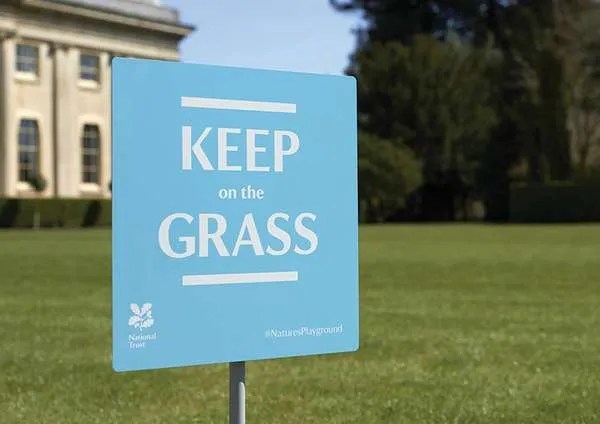
If you visit a National Trust property here in the UK, you will often see signs saying things like ׳Keep off the Grass’, ‘Don’t Touch This’, ‘Don’t Touch That’, ‘Keep to the Path’. It’s all in the negative and proscriptive. But, in a few places, as an experiment they kept the signs but changed the language. Now it’s Dos instead of Don’ts accompanied by some encouraging words. Rules are there for a reason, but rather than focus only on what people can’t do, try to point them in the direction of what they can do. If you need to impose a restriction zone, for example around a fragile object, then simply explain why and direct visitors to where they can take a closer look at the detail (for example, online). People tend to be more relaxed and understanding when they feel informed and can make a choice.
There was a recent short exchange on Twitter with an HE colleague looking for better word or words than ‘Delivery’ in regard to teaching and learning. I distinctly remembered the late Ken Robinson wondering in regard to the obsession with ‘delivery’: “When did education become a branch of FedEx?”
In my own research into creativity in higher education, when I asked colleagues from across a whole range of disciplines, for the words and phrases they used to describe creativity or being creative in regard to learning and teaching, the top twenty words and phrases contained words that never appear in programme or module specifications or any Teaching, Learning and Assessment strategies.
Words like joy, play, fun, passion, excitement, adventure and let’s admit they sit alongside words like anxiety, stress, disorientation, which are also part of learning.
Learning and studying should involve all of those…..and so should assessment.
So, instead of hitting students as soon as they start with dire warnings about plagiarism and cheating, let’s talk about integrity, trust, responsibility, partnership, collaboration, and so on.
I’d also like to suggest that we stop using the word failure. It’s such a loaded word. Much better, in my own mind and practice, to be able to say to a student: “OK, that didn’t work, and here’s why, but what have you learned from the experience? And design an approach to assessment that rewards the learning instead of penalising the so- called failure.

So, returning to the idea of ‘Keep on the Grass’ and extending the metaphor, perhaps it would be much better for everyone if we start seeing and talking about higher education as less like a machine for learning and more like a garden and words like growth, flourishing, blossoming, ecology and transformation.

 Stumbling with Confidence