Beyond the Debatable Hills: is it curtains for the arts in education?


As yet another major UK university announces significant course closures and redundancies – mainly affecting arts and humanities – it’s worth being reminded that entries for A level arts subjects: dance, design & technology, drama, music among others, have reached the lowest since at least 2011.

Exactly ten years ago, I presented at an arts conference and wrote an associated journal article  ‘Predictive Texts’ that took a look into the future of the arts in the UK in 2026 based on the then current trends. I described a cultural landscape in which the arts had largely been stripped out of the educational experience of children and young people. I described the consequences of that policy on the live performing arts sector which was now being by-passed by a generation of students who had not received consistent, or in many cases any, arts education through primary and secondary education where the focus was on STEM education. I reflected on how that educational neglect had led to a kind of cultural blindspot or illiteracy which, in turn, had led to a severe decline in arts attendance as that generation of millenials now sought other avenues for their entertainment and spending.

There have been many dozens of articles written in the last few years voicing concern about state and future of the arts in the UK, particularly in education. Tory policy towards the arts threatened the existence of the entire creative sector, particularly those parts of the sector in which live performance is an integral part of their raison d’etre: live theatre, dance and music. Today, despite the change in government, almost daily there is news of another university cutting its creative and performing arts courses.

The decision to cut arts funding in higher education by the last Tory government signalled not only a drastic diminution of the arts in education but also, as a consequence of this and other policies, an acceptance that whole sections of the creative sector could be allowed ‘go to the wall’ despite the fact that the sector as whole contributes massively to the GDP. The contrast with the then government’s support of the fishing industry, which played such a huge role in Brexit, is stark. At present the fishing industry contributes around £0.5m to the economy. In contrast, the  creative industries contribute around £146 billion to the economy (Gross Value Added data from the Office for National Statistics 2024 figures)

The 2024 election of the Labour Government and the accompanying positive statements about supporting the arts and creativity in education provided some indication of a change for the better (we’re still waiting). In the meantime a bleak future for the arts beckons. The creative industries are fed via a pipepline of skills and talent that are nurtured in our education system. Reducing or stopping the flow of creative talent along that pipeline ensures that the creative industries, and certainly those parts of the sector that are seen to be less ‘valuable’ in economic terms, wither on the vine. It also ensures that access to the arts and arts training increasingly becomes the preserve of the wealthy and privileged and those who have social, cultural and economic capital.

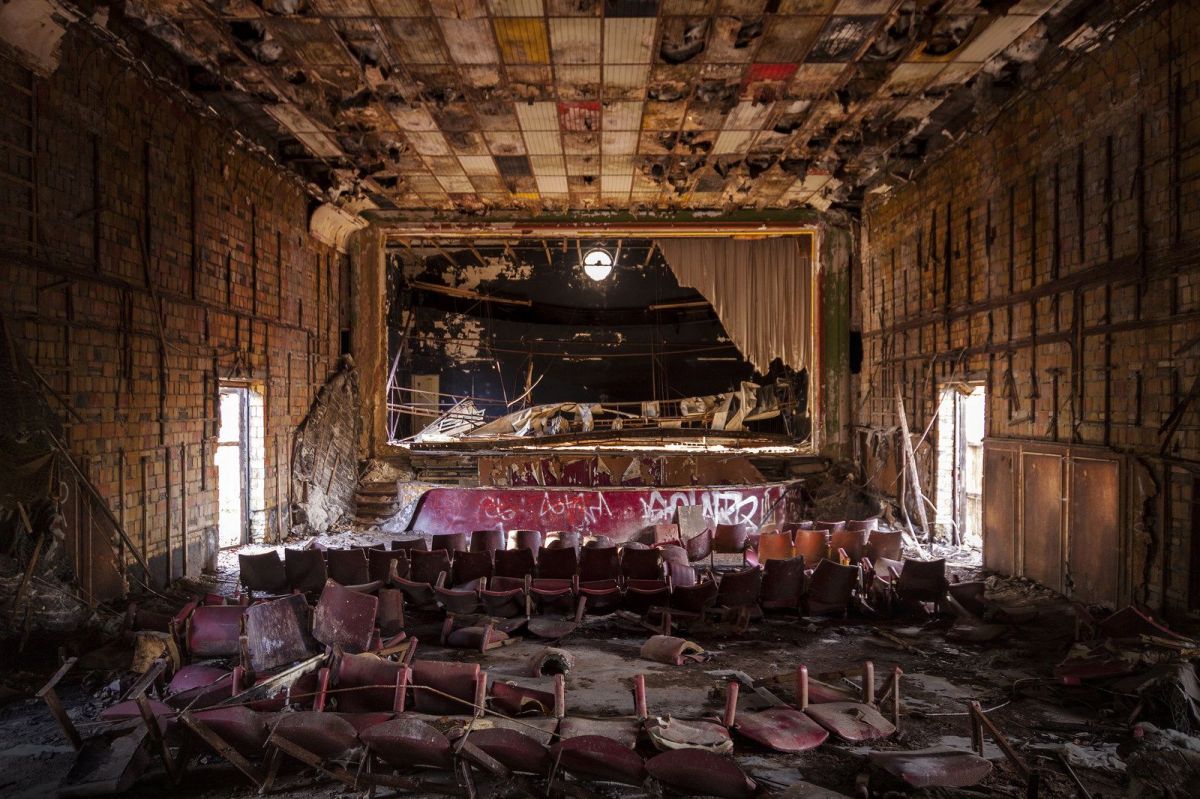
There’s a sentence from the 2015 book by the eminent producer and impresario Michael Kaiser titled ‘Curtains? The Future of the Performing Arts in America’ that sticks in the mind. Examining the trends, Kaiser describes a ‘doomsday scenario’ in which, across America, many theatres, arts centres and other performance venues, hit by the decline in audiences and/or funding, “sit vacant, reminders of a different era, not unlike the Colosseum in Rome and the Parthenon in Athens”. 

Thinking about all this I was reminded of a book I read years ago, which remains one of my favourite books (it’s also on Neil Gaiman’s list of all-time favourites, so I’m in good company). The book is called Lud-in-the-Mist, written exactly 100 years ago by Hope Mirrlees. Mirrlees was a classicist, and much of her work dealt with the contested boundaries of Art and Life.

In Lud-in-the-Mist there are two countries. There is the land of Dorimare, a nation of stolid burghers, merchants and artisans. It’s a rather prim and very proper place, where everyone knows their place, where the motto is essentially ‘it’s the economy, stupid’, and where the arts are relegated to activities such as needlework and country dancing: pursuits for the refinement of gentlewomen and gentlemen.

On the border of Dorimare, however, on the other side of the Debatable Hills, lies the land of Faerie, a strange, dark land full of mysteries and wonders…not all of them pleasant. The upright citizens of Dorimare so fear the land that lies beyond those dread hills, that the word ‘Faerie’ is never to be uttered.

Dorimare’s main city of Lud-in-the-Mist lies at the confluence of two rivers: the Dapple and the Dawl. The Dawl is like any other commercial river, but the Dapple happens to flow out of the land of Faerie, and brings with it fairy fruit, that is smuggled into Dorimare.  Eating fairy fruit has a terrible effect on the upright citizens of Lud-in-the-Mist: it causes people to start singing strange songs, to spout poetry, to dance with abandon. In other words, it turns them mad.

The plot revolves around the disappearance of a group of young ladies and the Mayor’s son who have been kidnapped and taken to the land of Faerie, and the attempt by the Mayor, a bumbling, self-important, rather fatuous man to rescue them. (Any resemblance to a real persons is entirely coincidental).  As a consequence of that quest, fundamental changes are wrought – to the Mayor and to Dorimare itself.

In Lud-in-the-Mist, Mirrlees is dealing with the division of the world into Apollonian and Dionysian aspects: the homely and the wild. There is also the long battle between Classicism and Romanticism, and Freud’s theories of the conscious and unconscious mind, and the relationship between terror and beauty.

The actor Mark Rylance, in an interview, said that the arts are essentially ‘mysterious’ which is why they frighten  politicians and policy-makers, because they can’t control them, they can’t measure them.

I imagine the educational curriculum in Dorimare’s schools is very much what like the one demanded by Gradgrind in Dickens’ Hard Times;

“Now, what I want is Facts. Teach these boys and girls nothing but Facts. Facts alone are wanted in life. Plant nothing else, and root out everything else. You can only form the mind of reasoning animals upon Facts: nothing else will ever be of any service to them.“

And if you think that’s rather extreme, consider this – handed to parents at a primary school in London:

‘The new programme of study in English is knowledge-based, this means its focus is on knowing facts rather than developing skills and understanding. It is also characterised by an increased emphasis on the technical aspects of language and less on the creative aspects.”

So, alongside schools dropping all ‘non-core’ subjects i.e. arts subjects and a few others from the school curriculum, we’ve also had catastrophic cuts to arts subjects in higher education in line with the political and ideological insistence that all higher education programmes must align with  “economic and societal needs” – which successive governments have believed will only be met by STEM (Science, Technology, Engineering and Maths) programmes and some others such medicine and agriculture. 

One can only look with envy at the financial support some other countries are putting into supporting their creative and cultural sectors as they recognise the importance and value of those sectors to the well-being of society as a whole.

I was thinking about Lud-in-the-Mist because it seems to me we are increasingly living in a country which is becoming more Dorimare-like by the day, where the arts are increasingly banished to the equivalent of the land of Faerie, where creativity is associated with the creation of goods and wealth, where any hint of an artistic or genuinely creative spirit is dismissed as bad influence, and to be actively discouraged and eliminated.

Across our education system, from primary through to tertiary, there is now a very real danger, evidenced by the course and departmental closures in higher education, the significant drop in the take-up of arts subjects, and the spectre of subjects like art, dance, drama and music disappearing entirely from the curriculum. The clear and present danger for the wider creative arts sector will be the cutting off the pipeline of interest, skills and talent on which the sector relies. We are facing the prospect, in many areas of the country, of the spectre of a cultural wasteland, not unlike Kaiser’s ‘doomsday’ scenario.

A hundred years ago, in Lud-in-the-Mist, Hope Mirrless asked how might we truly embrace the arts in all their wondrous, dangerous, life-affirming glory along with the eccentrics and mavericks?  Or are we fated to banish them, their works and deeds, to that strange, wonderful, forbidden land beyond the Debatable Hills?

The final, celebratory chapter of Lud-in-the-Mist, as the citizens of Dorimare throw open the gates of the city to allow those mysterious, dangerous, life-affirming Faeries to enter, provides the answer.

Image: Abandoned Cinema by JOSOK
Design for Learning: a case for detangling education?

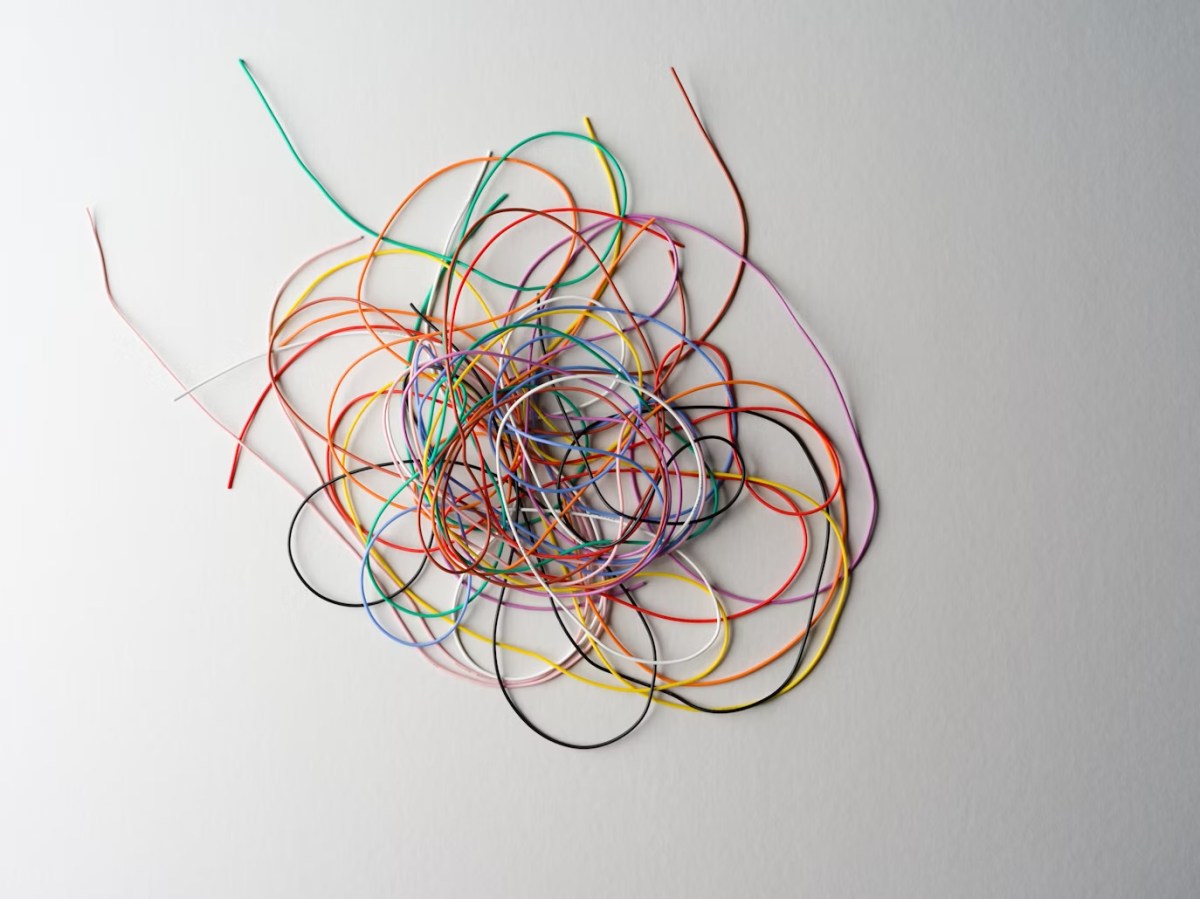
Academics, eh? We may be great teachers. We may be great researchers. We may even be great managers and administrators. But that does not make us great educational designers….and I write this as someone who trained and worked as a designer before I stumbled into teaching design and some other subjects in higher education. Once inside academia I was immediately struck by the fact that a great number of things just didn’t seem to work very well. I was surrounded by talented, skilful, intelligent, committed and passionate colleagues who appeared to spend an inordinate amount of time and energy just getting things to work for them and their students.

It didn’t take me long to work out that one of the primary causes of all this inefficiency and waste and the bang-head-on-desk frustration that resulted, was frequently and simply a tangle of poor design. The plethora of complex systems, labyrinthine processes and perplexing protocols that extend to every corner of our educational endeavours all too often have been created by individuals and groups who – with the best will in the world – are not well acquainted, if at all, with the basic principles of good design.

An awareness and appreciation of concepts such as ‘good design enhances the users’ experience’, or ‘good design is logical e.g. form follows function’, or ‘good design is minimal design e.g. as little as possible and only as much as absolutely necessary’, or ‘good design is consistent right down to the fine details’ was and is often entirely lacking.

There is also an aesthetic quality to good design, but I’ve yet to hear or read that word, or anything similar, when it comes to discussing the crucially important task of designing the educational experiences of students.

If we are to be architects of educational experiences, then we must accept that not only do we need to embrace the principles and practices of good design, but – crucially – we either need to become skilled educational architects and designers ourselves or ensure that at least some of us have or develop those skills so that we can help our colleagues and institutions not only detangle the knots that bind us but also, and more importantly, to create and support the wonderful educational experiences that our students truly deserve.

Paul Kleiman Design for Learning

Image by Kier in Sight Archives on Unsplash


About me:

I am an independent higher education consultant and co-founder of the educational consultancy Ciel Associates specialising in organisational and transformational change and enhancing learning, teaching and assessment. I have over thirty years experience in a wide range of higher education providers both as a consultant and, before that, in a number of management, leadership and strategic roles. My work is informed by my belief in the transformational power of education and a commitment to enabling institutions to create meaningful and sustainable change. Contact me at Ciel Associates .

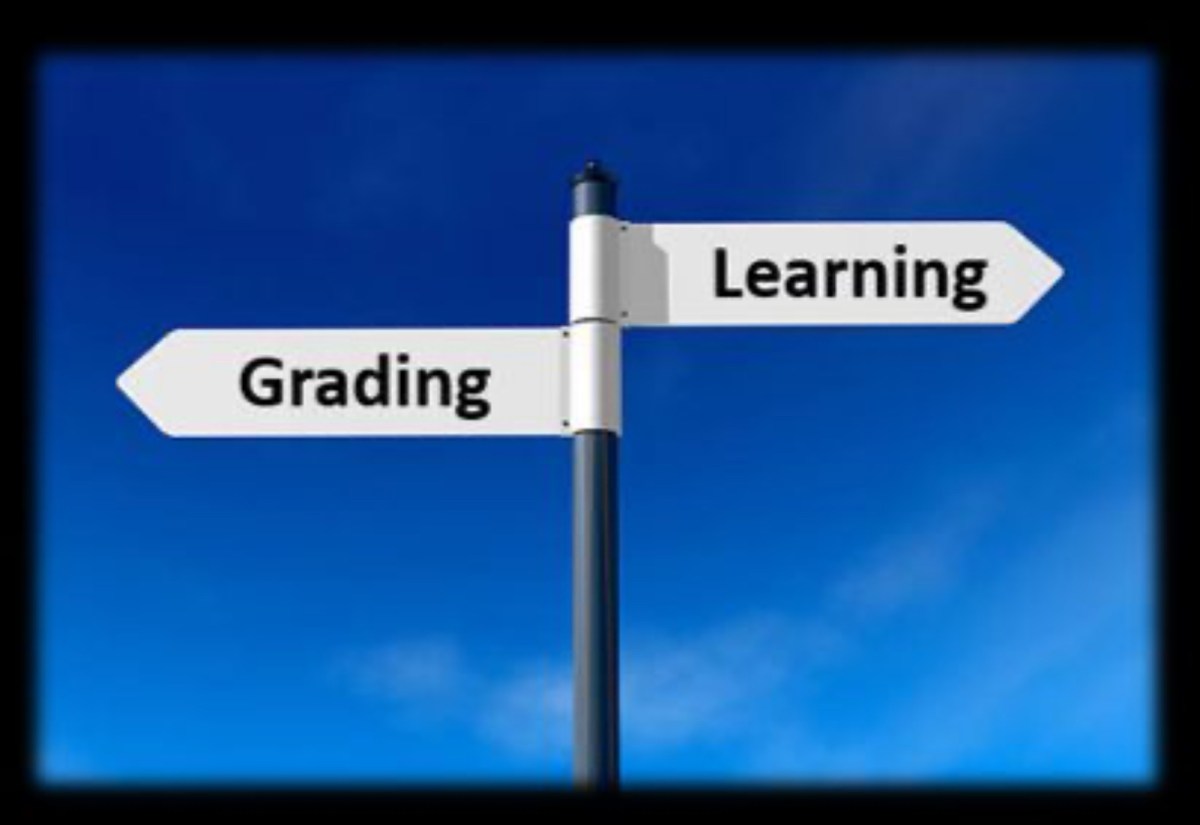
Separate grading from learning!

One of our engrooved or deep-seated beliefs in higher education is that grades are important because they motivate students to do the work. Take them away, and students won’t do anything.
 
But oddly, for a discipline that says it relies on evidence-based research, there is little to no evidence or research that demonstrates that grades make students learn more or work harder. In fact, there is ample evidence that grades actually do the opposite: They hurt academic motivation and inhibit learning.

We’ve known for a long time, well before Covid, that the way we do assessment is damaged and creaking at the seams. But over what is now several decades of well-researched, evidence-based critiques of assessment, insitutions and academics are still assessing the same old way….with a few enhancing tweaks. Plus ça change, plus c’est la même chose.  Covid started to point the way, and now GenerativeAI is providing the catalst and impetus we need to let go of outdated, obsolete practices that are well past their sell-by date, and embrace those that are genuuinely fit for purpose to meet the challenges we and our students face.

What we do know is that students  – and we are all students, lifelong learners – work harder, learn more and are much more likely to thrive and achieve when we are intrinsically motivated. When we have some real autonomy, real choices. When we feel we are in control of our learning. It means being given meaningful choices and engaging, authentic tasks to choose from. It means feeling empowered to choose, as students, where to invest our time and energy. It also means feeling encouraged and supported even if that means, receiving feedback that is uncomfortable but honest and that comes from a good place.

Autonomy also means that our own autonomy, our own academic identity has to shift, from the keepers and transmitters of knowledge to facilitators of learning.

Also, we all like to feel we are continually growing, improving, developing new skills and understandings. Our own students are no different, so the question for us as teachers and assessors is how best can we focus both our and our students’ skills, time and energy on helping them build the skills they are genuinely motivated to learn and practise?

A sense of relatedness, a sense of genuine belonging is also critical. We desperately need to find ways of enabling our students to understand they are not just a number, not just cogs in a vast machine but valued as individuals and as part of a larger community… that they matter far more than their grades. If we can do that, they will respond and realise they don’t need the carrot and stick of grades, warning and penalties to care about their learning.

So…let’s leave grading to recede in the rear-view mirror, and focus on the road ahead and where that might lead.

Lessons from the Garden

There’s a corner of our garden where I keep a number of pots and containers that have nothing in them except some earth or compost and the occasional weed. It’s a sort of limbo (perhaps graveyard) for plants that once bloomed but have now have departed this horticultural coil. Some have been there since we moved into our new home a couple of years ago. Others have been emptied, cleaned, re-potted and moved to another area of the garden.

When out in the garden, especially in the spring, I wander over to this somewhat desolate corner to see if, by chance, there might be a sign of some growth that is not a weed (though I always bear in mind that weeds are simply plants in their natural environment!). I even water the barren earth if it’s dry, just in case. The particular pot I am thinking about was a relatively small terracotta pot, full of earth, that had shown no sign of life for nearly two years. The only reason I hadn’t repotted it is that it is a bit too small for the plants I have bought or acquired.

I had got to the point where I thought I’d just empty, clean it and repot it and plant something small that would fit. But when I went to pick it up, lo and behold, I saw a tiny shoot that had broken through the surface. I had no idea what it might be, so I left it. As is the way with plants, it grew slowly and eventually began to form leaves. It was then that I was able to identify that it was a begonia….so I left it to carry on and it graced our garden with beautiful yellow flowers.

And the lesson?

You know that student who you have sort of ‘written off’. They appear to be in educational limbo, they don’t seem engaged, they don’t contribute much, their work is just passable…or not even that. Well, don’t write them off too soon. They may well be, like my begonia, a very late developer with a lot going on under the surface, needing only the right conditions – and a bit of ‘watering’/nurturing to break through to the surface and bloom.

Only 280,000 Jews murdered in the Holocaust? Really?


Understanding Holocaust Denial: Debunking the 280,000 Victim Figure

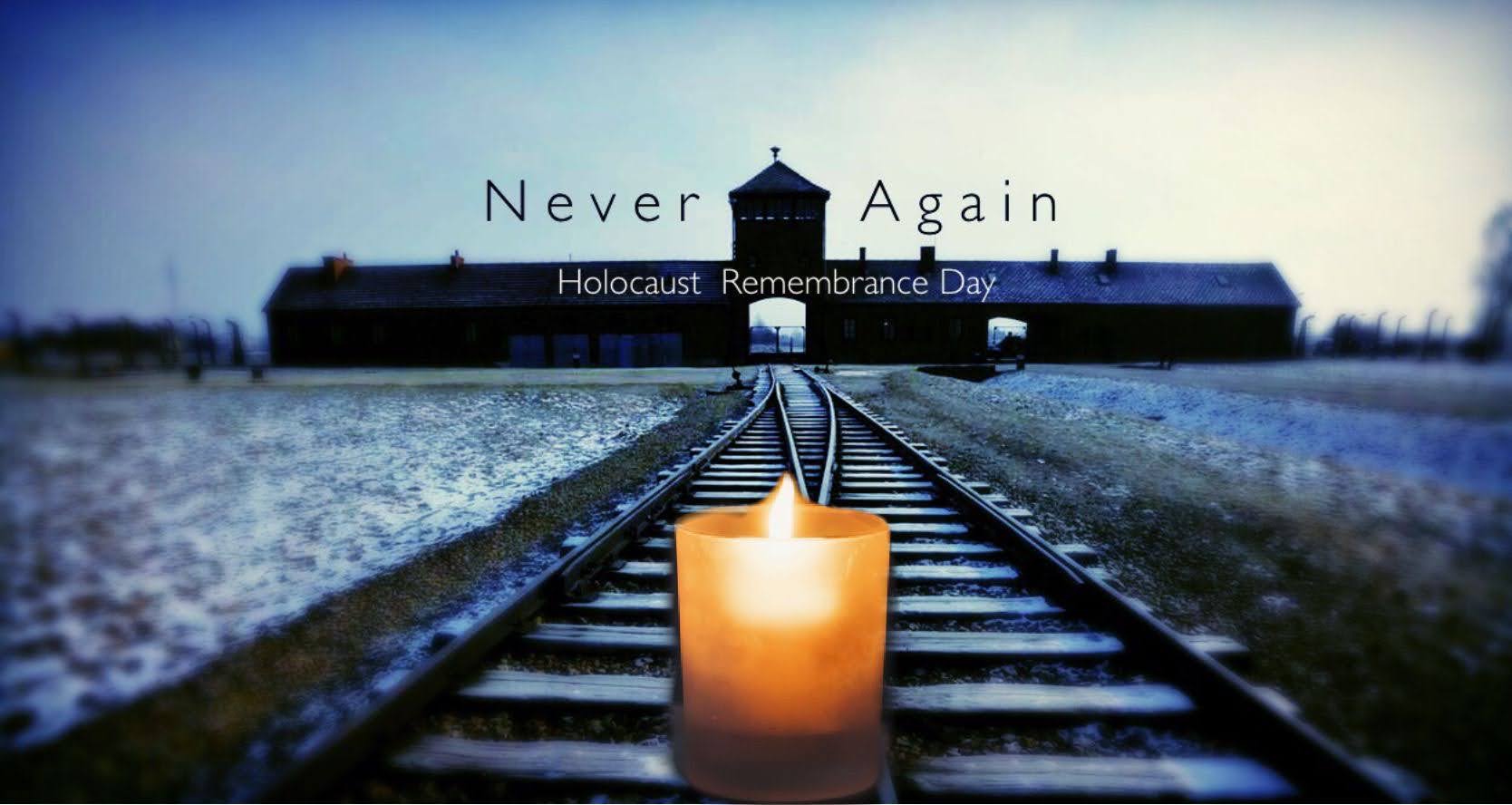
With Holocaust Memorial Day approaching on the 27th January, the febrile atmosphere around Israel, Palestine and Gaza has been accompanied by both a worldwide increase in antisemitism and an increase in Holocaust scepticism and outright denial. In particular, across social media, the figure of (only) 270,000- 280,000 Jews killed in the Holocaust is being widely quoted. I hadn’t seen it before so I wondered where does this figure originate?

That figure – often also cited as 270,000, 271,000, 271,301, or around 280,000 – originates, unsurprisingly, from Holocaust denial and distortion circles where it is (mis)represented as the ‘true’ or ‘official’ total number of Jewish victims. This low figure has circulated in Holocaust denial literature since at least the 1980s (e.g., in pamphlets like ‘Did Six Million Really Die?’ and related neo-Nazi/revisionist materials) and is frequently and falsely attributed  to the Red Cross to provide credibility. This number comes from the deliberate selection and malign misrepresentation of a genuine document held in German archives and the attribution to the International Committee of the Red Cross (ICRC) has been repeatedly dismissed by the ICRC who accept the 6 million figure.

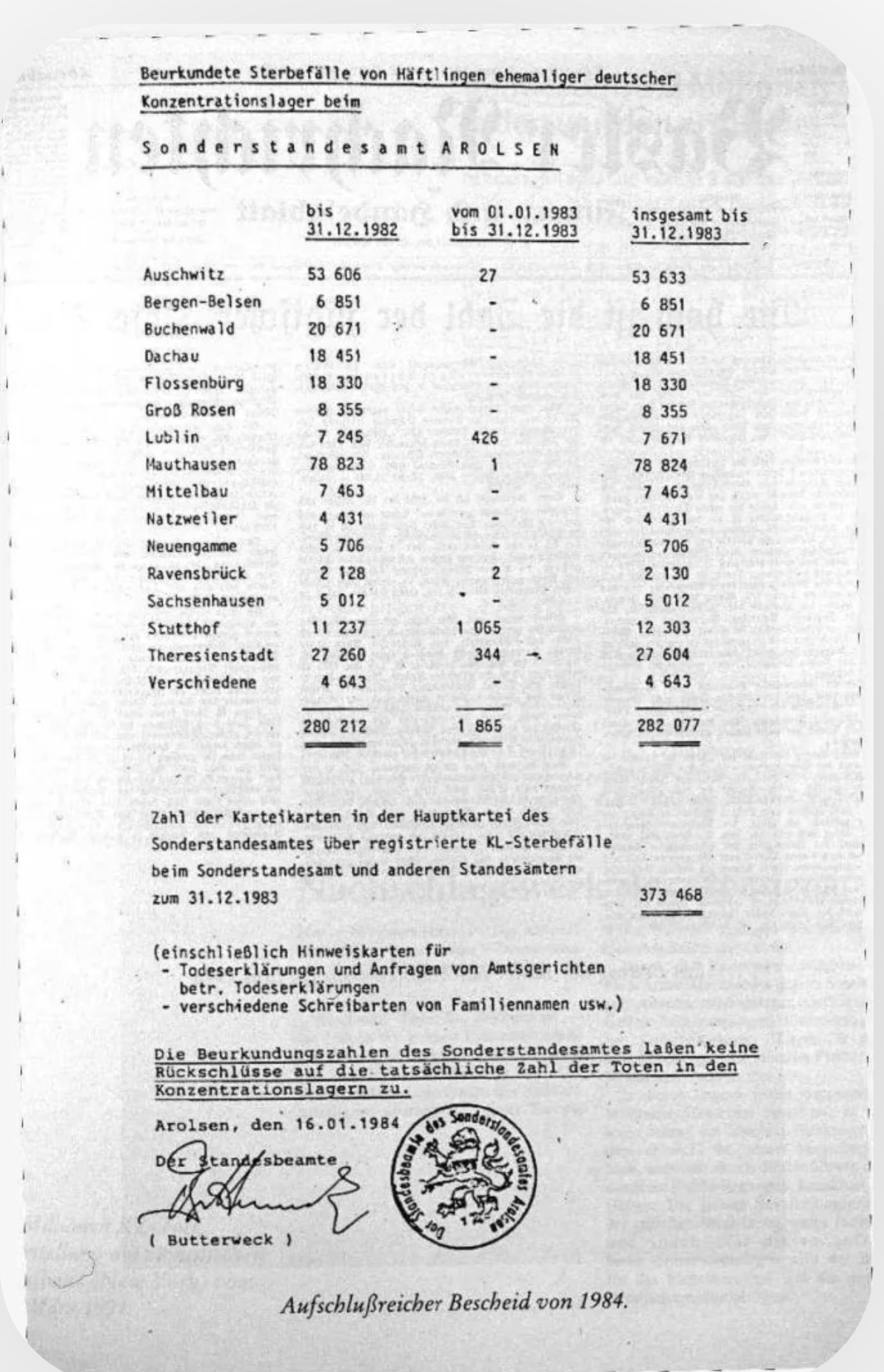
The figure of c. 280,000 refers specifically to a document dated 16 January 1984 issued by the Special Registry Office in Bad Arolsen, Germany which was set up in 1949 as the International Tracing Service. The organisation is now known as the Arolsen Archives and contains c. 40 million documents regarding victims of Nazi persecution. 

Screenshot

In regard to the document relating to the figure of 280,000, the Arolsen Archives state “The document is genuine and comes from the Special Registry Office in Bad Arolsen. It lists the numbers of death certificates issued upon application for prisoners from concentration camps, such as Dachau, Buchenwald, and Bergen-Belsen. The figures do not include the millions of Jews murdered in extermination camps like Auschwitz-Birkenau or those who died in mass shootings.”

What is clear is that the document the Holocaust deniers are using to produce that figure of c. 280,000 provides information on the number of Jewish prisoners murdered in a number of German concentration camps (not the main extermination camps) for whom death certificates were issued retrospectively by the Special Registry Office. The SRO is the only body authorized to issue death certificates for people who died under these circumstances and requires an application from victims’ next of kin….if they exist. 

Underlined, at the bottom of the document is the following:

Screenshot
The registration figures from the special registry office do not allow for any conclusions to be drawn about the actual number of deaths in the concentration camps.

Arolsen, January 16, 1984

Crucially the records held at the Special Registry Office exclude the vast majority of murders in the main extermination camps like Auschwitz-Birkenau, Treblinka, Sobibor, Belzec, Chelmno, and Majdanek, where most victims were killed immediately upon arrival, usually via the gas chambers, without registration or death certificates. They also exclude the 1.5-2 million Jews shot in mass executions by the Einsatzgruppen and other units across Western Russia and Eastern Europe (for example at sites like Babi Yar in the Ukraine where 33,000 Jews were shot over two days in September 1941), they exclude deaths in ghettos from starvation and disease, they exclude deaths in the many work camps, and they exclude deaths and killings during the forced marches and evacuations.

The scholarly consensus, based on decades of research, is that in the 1930s there were approximately 9.5 million Jews in all of Europe and by 1945 there were about 3.3-3.8 million Jews left. Do the maths.