
In higher education (and in education generally) we obsess about excellence. So what does excellence mean?
Going by the result of the debate on excellence at an academic conference, there is a clear majority who feel that the term has lost credibility and value. When all institutions are either ‘excellent’ or, at the very least, ‘striving for excellence’ (see university mission statements below) then we are witnessing a lot of sound, but hopefully not fury, signifying nothing. Excellence, in Bill Readings’1 memorable term, has become ‘de-referentialised’. Turning to the dictionary provides little assistance. In the Concise Oxford ‘to excel’ is defined as to surpass or to be pre-eminent (i.e. to be better than the majority), whereas ‘excellence’ is defined as ‘very good’.
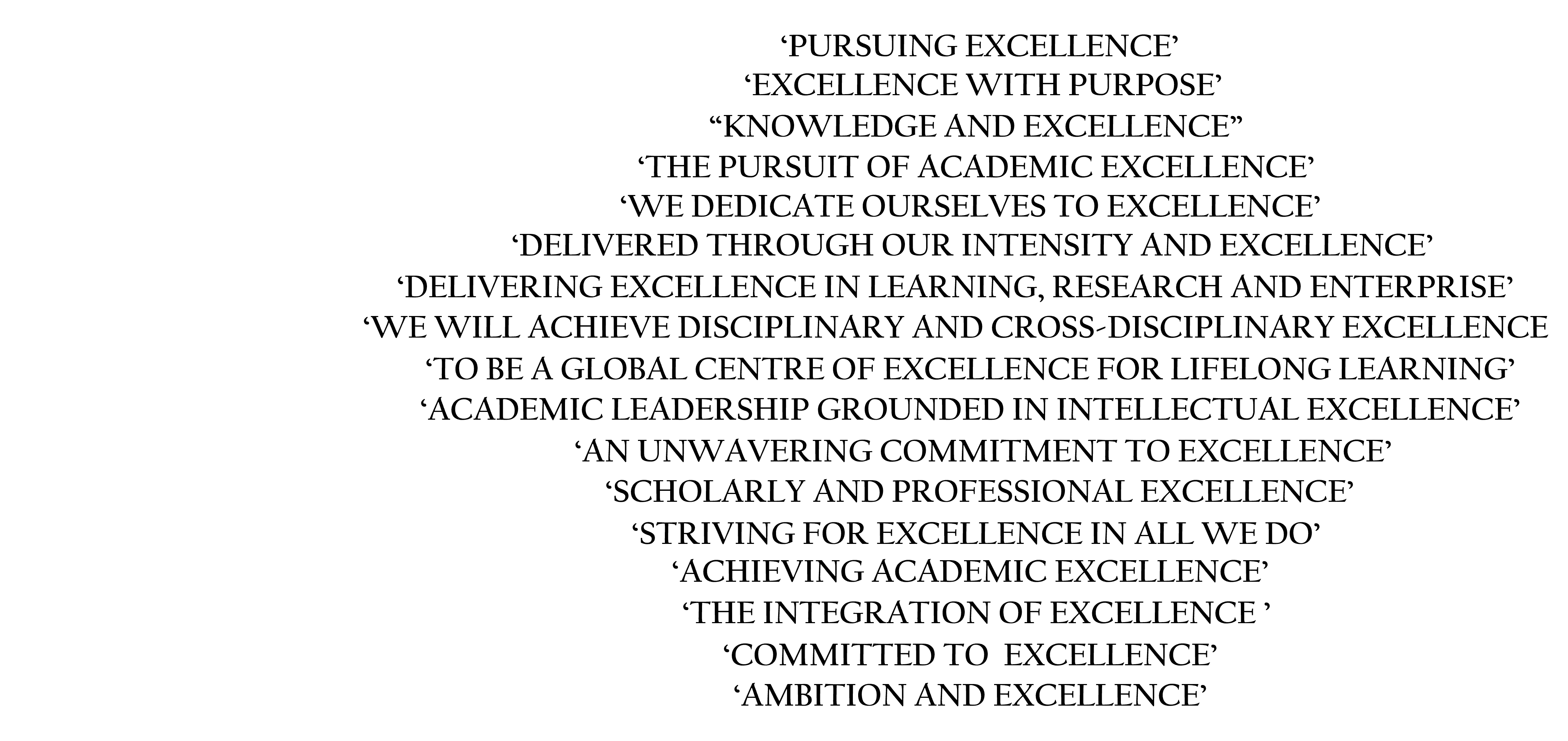
Whatever meaning ‘excellence’ once had has become lost in a blizzard of hyperbole. The fate of excellence follows in the tradition of other terms such as ‘community’ and, more recently, ‘creativity’, whose meaning has become devalued and decontextualised through over- and inappropriate use.
In the arts, the term excellence is rarely if ever used as a descriptor except – and this may be relevant in considering educational achievement – in relation to the application or demonstration of skill or craft. Academics, students and arts practitioners tend to avoid the ‘E’ word. The theatrical cliché has never been: “You were excellent, darling”. ‘Wonderful’ is truly a much better word than ‘excellent’ to describe high artistic achievement. Rather than excellent’s rather hard-edged, triumphalist implication of being better than others, ‘wonderful’, i.e. full of wonder, has a sense of the remarkable, the extraordinary, the truly successful that is the mark of the highest quality work.
Excellence, it must be said, is much favoured by arts politicians and bureaucrats who use it both aspirationally and as a justification for funding. Excellence attracts rewards and prizes. But the use of the term has more to do with product branding (as it has in higher education) than with a real concern with the subtle complexities of quality and value.
Here is a typical example: one of our leading UK arts funding bodies, in its mission statement, states: “We believe the arts to be the foundation of a confident and cultured society. They challenge and inspire us. They bring beauty, excitement and happiness into our lives. They help us to express our identity as individuals, as communities and as a nation”.
Wonderful! But then they go and ruin it by reverting to corporate-speak and saying they are going to “serve the people … by fostering arts of excellence through funding, development, research and advocacy”. An external examiner I knew, having seen what was – by general consensus – a remarkable, successful, extraordinary, inspiring … yes, wonderful piece of final-year practical work was dismayed to find that the two internal examiners, who also thought the work was remarkable, successful etc had agreed a mark of 75%. He asked them to start at 100%, and argue persuasively for marks to be deducted. With the assessment criteria in their hands they struggled to get below 95%. To describe that work as merely ‘excellent’ would have been insufficient. It was beyond excellence.
That is perhaps what we should be striving for and, in doing so, we need to look beyond our obsession with trying to define, achieve, assess and reward excellence.
As the old saying goes: education is, or ought to be, a wonder-full thing.
References
1 Readings, B. (1997) The University in Ruins. Harvard University Press

 Stumbling with Confidence