
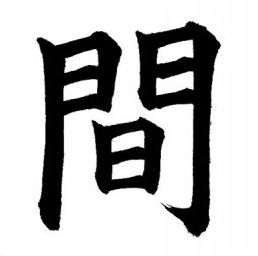
Like many, I am fascinated by Japan and Japanese culture. That fascination, in my case, goes back a long way. My father used to do business in Japan and often visited with my mother. We had Japanese art and artefacts in our house and we often hosted Japanese students who came to study here in the UK. I’ve also had the opportunity to visit Japan myself in the course of my work.
I recently watched James Fox’s series of documentaries about Japanese art and culture and also Monty Don’s programmes about Japanese gardens and garden design. Both presenters commented on the importance of the Japanese idea of ’Ma’ – often translated as ‘negative space’ but it is much more than that. One way of understanding ‘ma’ is as the space between tangible things that gives those things meaning. It is not so much empty or negative space, but rather it a space full of energy, potential and promise. The character for “Ma” (間) combines the character for “gate” 門 with the character for “sun” 日 – an image of light beaming through the empty space of a doorway.
One of Britain’s most influential post war graphic designers, Alan Fletcher, refers to Ma in his introspective book The Art of Looking Sideways
“Space is substance. Cézanne painted and modelled space. Giacometti sculpted by “taking the fat off space”. Mallarmé conceived poems with absences as well as words. Ralph Richardson asserted that acting lay in pauses… Isaac Stern described music as “that little bit between each note – silences which give the form”… The Japanese have a word (ma) for this interval which gives shape to the whole. In the West we have neither word nor term. A serious omission.”

In the western tradition and culture we have nothing like the idea of ‘Ma’. Instead, we dislike a void, and tend to fill it. One of the few things I remember from my student art history days are the large, ancient storage jars called Attic Vases. They are often covered from head to toe in decoration. The reason for that was the belief that the Evil Eye enters through empty space. Perhaps that notion is still hidden deep within our Western psyche?
Having trained as a designer and with my interest in things Japanese, when I started working in higher education I was immediately struck by the fact of just how busy our curricula and timetables are. It’s as if we are afraid of leaving ‘empty space’. Why? In case students get up to ‘mischief’?
Rather than filling the curriculum and timetable void, what if we designed them incorporating the idea (and actualité) of ‘Ma’. Designing in the ‘empty/negative’ spaces that help to make sense of the whole, providing the time and space to step back, to think, to reflect, to make, to create.

 Stumbling with Confidence