Grief crept up on me, unexpectedly: a story of Christmas Eve.

As a Jewish family, we don’t really do Christmas. Yes, we’ll gather together, have a big meal, play board games, and watch far too much television. But that’s because it’s a holiday, everything is closed, and there’s not much else to do.  Coming up to Christmas that year we’d just had some building work done, and there was still loads of cleaning up, making good, re-decorating to do. So it was looking like a DIY Christmas and new year.

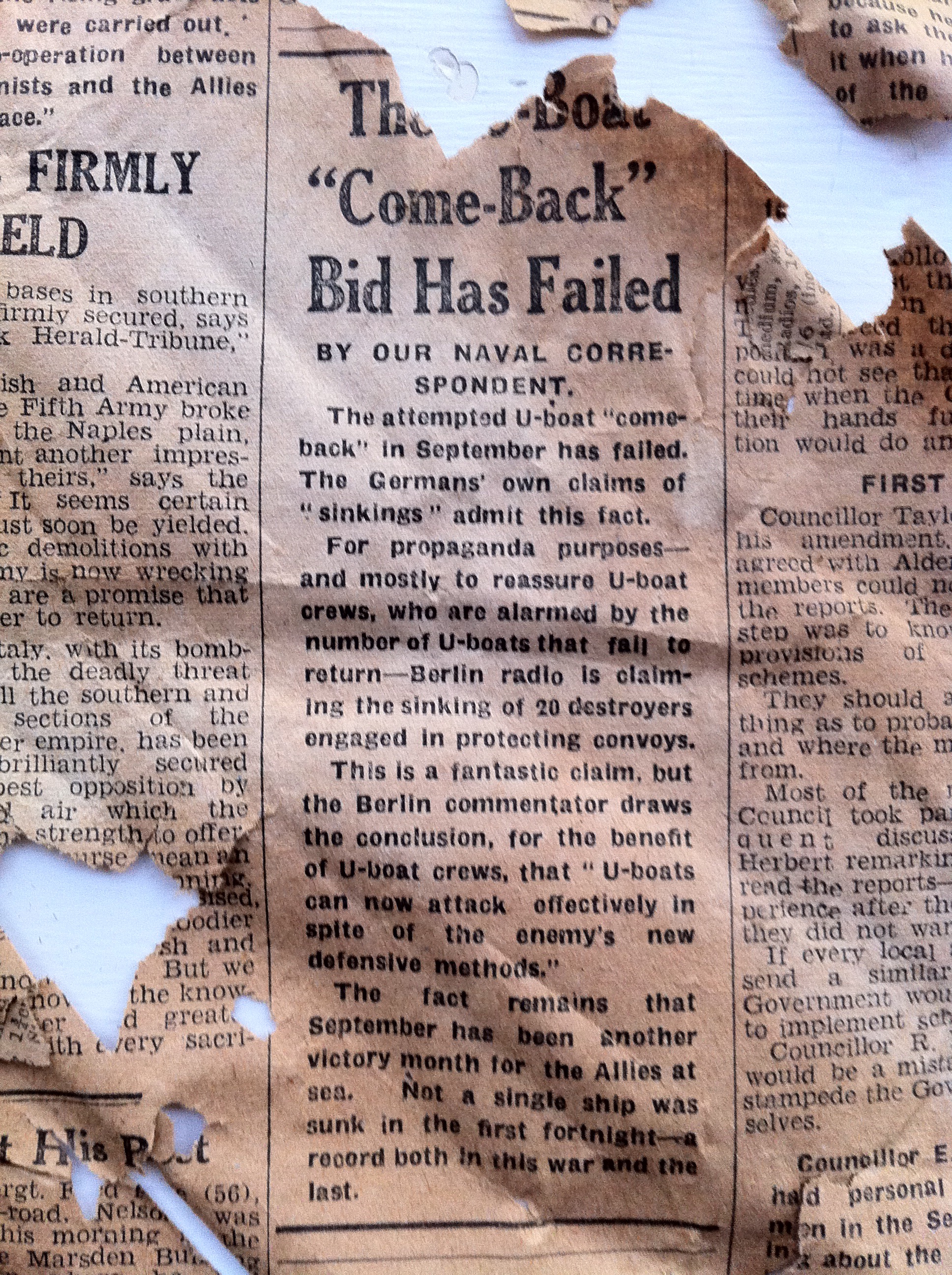
As it happens, the builders had found an old, crumpled newspaper stuffed into the gap between the window and the wall our bedroom. When they first found it, it reminded me of a dead bird.

On the afternoon of Christmas Eve I decided to have a go at ‘uncrumpling’ it using our steam iron. It turned out to be the Lancashire Post from 30th September 1943. The paper was very fragile – I suspect they didn’t use the best quality newspaper during the war years – and I became absorbed in the task of slowly but surely flattening the paper one careful centimetre at a time. I wasn’t even aware that the radio was burbling quietly away on the other side of the room.

As each piece revealed its flattened secrets, I read about the Fifth Army’s losses in North Africa, the Russian advances along the Dneiper, a successful bombing raid over Germany (only eight missing in action). I also read about a local woman fined for fiddling ration books, and a Polish aircraft man convicted of drunk driving.

6B36571F-B19A-4FAF-9A7A-0D972EE9726C

There was also a small item about how the German U-boats had failed to sink a single ship in the previous month. 70 years later, on Christmas Eve, the newspapers and television were full of the news about the Royal pardon given to Alan Turing, the man who had ‘cracked’ the German Enigma code used by the U-boats and, by doing so, had in no doubt saved thousands of lives and perhaps helped to end the war. But Turing was gay at a time when it was illegal, and had been found guilty of gross indecency, jailed, chemically castrated, and forbidden to undertake any work linked to national security. He was and should have been hailed as a national hero. Instead, he committed suicide two years later in 1954, and full recognition has only come very recently.

Those U-boat failures, reported on the front page of that 1943 Lancashire Post, were a direct result of the work Turing had undertaken at Bletchley Park.

7D82AF71-CB37-4FD9-91B3-88A0DF5D6033

Absorbed in the task and on this fascinating window on history, I suddenly became aware of a beautiful, solo treble voice filling the room, singing “Once in Royal David’s City….”. It was three o’clock in the afternoon and the start of that wonderful, traditional Christmas Eve ‘Festival of Nine Lessons and Carols’ from King’s College Chapel in Cambridge. And as that pure, high voice soared…..I burst into uncontrollable sobs. A veritable tsunami of grief poured over, into and through me: disturbing and disruptive in its power and intensity.

It took me a while to realise what it was.

When my mother died, I cried no more than a couple of times, and that was around the time when it all happened and usually  in response to an individual’s kindness and sympathy. But nothing like this.

Though, obviously, Jewish and very proud of her traditions, my mother also had a deep love for many things that were quintessentially English. Among them she had a particularly high regard for and interest in the great cathedrals and churches of England. After she passed away I discovered, amidst the thousands of documents she left, a neatly stacked pile of guides to virtually all the English cathedrals and some other churches, all annotated with her distinctive handwriting. I always smile when I see those guides as my father did not approve of my mother’s interest in Christianity, and I know he would not step inside a church. So I have a very clear picture of my mother wandering around inside with her guide, no doubt quizzing whoever she could find about the history of the building and making notes, while my father sat patiently on a nearby bench doing his Times crossword.

Just before three o’clock in the afternoon on Christmas eve, without fail, and though Jews – on the whole – don’t do Christmas, my mother would sit herself in her favourite chair, turn on the radio, quite loudly, and wait until that beautiful, soaring, solo treble voice filled the room, singing the first verse of the carol, followed by the choir and then the congregation. Earlier in the day she would have called me to remind me NOT to call her between 3pm and 5pm.

As that deep pang of grief and my sobbing subsided, and I was able to collect my thoughts, I wondered how that boy’s voice could trigger such intense emotion. I remembered how some of Mark Rothko’s last paintings, those gigantic fields of deep colour, have a similar effect on some individuals, and I recalled that in some therapeutic contexts music and song are used to enable individuals and groups to confront severe trauma.

In my case, that moment triggered an intense ‘remembrance of things past’ and a huge sense of both loss and love. I suspect we all have those triggers, those Proustian ‘Madeleine biscuit’ moments, when something – perhaps completely unexpected – plunges us into the deep well of memory, love and loss.

That afternoon, as I ironed that old newspaper (something my mother would have loved – the newspaper not the ironing!) and listened to that young boy singing those famous words, I probably missed her more than I’ve done at any other time.

Lessons from the Garden

There’s a corner of our garden where I keep a number of pots and containers that have nothing in them except some earth or compost and the occasional weed. It’s a sort of limbo for plants that once bloomed but have now have departed this horticultural coil. Some have been there since we moved into our new home a couple of years ago. Others have been emptied, cleaned, re-potted and moved to another area of the garden.

When out in the garden during the spring, I’d wander over to this somewhat desolate corner to see if, by chance, there might be a sign of some growth that is not a weed (though I always bear in mind that weeds are simply plants in their natural environment!). I’d even water the barren earth, just in case. The particular pot I am thinking about was a relatively small terracotta pot, full of earth, that had shown no sign of life for nearly two years. The only reason I hadn’t repotted it is that it is a bit too small for the plants I have bought or acquired.

I had got to the point where I thought I’d just empty, clean it and repot it and plant something small that would fit. But when I went to pick it up, lo and behold, I saw a tiny shoot that had broken through the surface. I had no idea what it might be, so I left it. As is the way with plants, it grew slowly and eventually began to form leaves. It was then that I was able to identify that it was a begonia….so I left it to carry on.

Now, several weeks later here it is, gracing our garden with beautiful yellow flowers.

And the lesson?

You know that student who you have sort of ‘written off’. They appear to be in educational limbo, they don’t seem engaged, they don’t contribute much, their work is just passable…or not even that. Well, don’t write them off too soon. They may well be, like my begonia, a very late developer with a lot going on under the surface, needing only the right conditions – and a bit a ‘watering’/nurturing to break through to the surface and bloom.

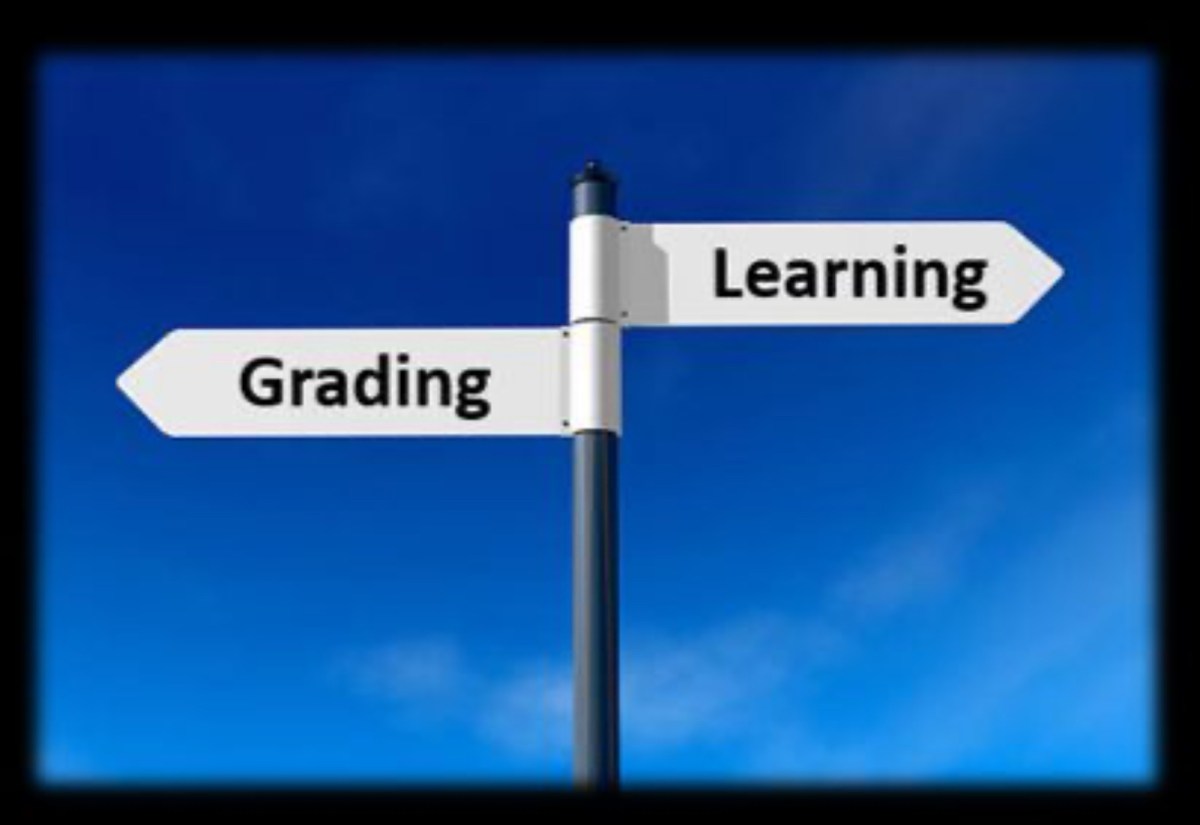
Separate grading from learning!

One of our engrooved or deep-seated beliefs in higher education is that grades are important because they motivate students to do the work. Take them away, and students won’t do anything.
 
But oddly, for a discipline that says it relies on evidence-based research, there is little to no evidence or research that demonstrates that grades make students learn more or work harder. In fact, there is ample evidence that grades actually do the opposite: They hurt academic motivation and inhibit learning.

We’ve known for a long time, well before Covid, that the way we do assessment is damaged and creaking at the seams. Perhaps Covid and now GenerativeAI can finally provide the impetus we need to let go of outdated, obsolete practices that are well past their sell-by date, and embrace those that are fit for purpose to meet the challenges we and our students face.

What we do know is that students  – and we are all students, lifelong learners – work harder, learn more and are much more likely to thrive and achieve when we are intrinsically motivated. When we have some real autonomy, real choices. When we feel we are in control of our learning. It means being given meaningful choices and engaging, authentic tasks to choose from. It means feeling empowered to choose, as students, where to invest our time and energy. It also means feeling encouraged and supported even if that means, receiving feedback that is uncomfortable but honest and that comes from a good place.

Autonomy also means that our own autonomy, our own academic identity has to shift, from the keepers and transmitters of knowledge to facilitators of learning.

Also, as students we like to feel we’re continually growing, improving, developing new skills and understandings. Our own students are no different, so the question for us as teachers and assessors is how best can we focus both our and our students skills, time and energy on helping them build the skills they are motivated to learn?

A sense of relatedness, a sense of genuine belonging is also critical. Somehow we need to find ways of enabling our students to understand they are not just a number, not just cogs in a vast machine but valued as individuals and as part of a larger community… that they matter more than their grades. And they will respond and realise they don’t need the carrot and stick of grades to care about their learning.

So…let’s leave grading to recede in the rear-view mirror, and focus on the road ahead and where that might lead.

‘See me. Feel me. Touch me.’

From virtual to visceral learning

After I wrote a piece on inspiring learning through objects and artefacts, I began to think a bit more about what makes that form of learning so powerful. I was walking the dog (I use it as a form of idea-generation therapy) wondering what might be the opposite or complementary term to ‘virtual learning’. Suddenly, as I walked past the butcher’s shop in the shopping precinct, the word ‘visceral’ fell into my head. Passers-by must have wondered at this figure muttering to himself and repeating the phrase ‘virtual learning, visceral learning’.

I began to like the idea of visceral learning, with its connotations of strong emotions and physical experiences (not to mention unmentionable bodily functions).  I suspect, however, that we won’t be seeing the phrase ‘ visceral learning’ in our institutional mission statements and learning and teaching strategy documents. ‘Immersive’ is much safer, but doesn’t have the visceral heft.

Why visceral?

There is a phenomenon that has been occurring in the last few decades, particular in the arts and popular culture. Essentially it consists of a reaction to a world that, increasingly, is viewed and experienced via gazing at a screen – whether a TV screen or a computer monitor or laptop/tablet/phone screen. Once, audiences used to flock to the theatre to watch the ‘well-made play’. They would sit in the dark, in silence, watching the action on stage. Then TV came along. Similarly  people used to flock to Working Men’s Clubs for a ‘good night out’. Then TV came along. Then computers came along, and now we’ve reached the point where a virtually infinite universe of entertainment and information can be accessed at the click of a mouse or, more recently, by tapping the screen or simply by asking Siri or Alexa or your favourite AI ‘friend’.

But there was a reaction to this sitting in front of a screen; and that reaction was to make performances more visceral. No longer was it sufficient to sit passively and watch. The relationship between the performer, the ‘text’, the audience and the environment became blurred, mutable, transactional. The veritable explosion of site-specific, immersive, interactive performances and performance experiences can be seen, in part, as a reaction to the relative passivity of just watching a screen. Audiences were engaged and involved: physically as well as emotionally. And that pattern can be seen in many fields beyond theatre.

Higher education has, perhaps, been a bit late to the visceral learning party. Perhaps it’s got something to do with the innate distrust of anything that is not focused on the mind and the intellect. If you want to put this to the test, try doing a simple, short physical warm-up exercise with a group of colleagues or students from non-performance based disciplines. The looks and expressions tell you that you might as well be asking them to stick needles in their eyes!

But there’s clearly a shift happening, though currently it tends to occur predominantly amongst the creative, educational  ‘outliers’. But slowly, as in Wenger’s notion of legitimate peripheral participation, as more individuals and groups within that community of practice adopt and adapt the ideas, discourses and – importantly – the new or certainly different practices, the activity moves gradually from the periphery towards the centre of a particular community of practice.

The virtual and the visceral are the ying and yang of learning and teaching. It’s not either/or, but both/and. The more institutions focus on enhancing (and investing) in digital and virtual learning experiences, the more that needs to be complemented by enhancing (and investing in)  visceral learning experiences. No longer should students be required to sit passively in the (lecture) theatre, listening to and watching the action on the stage. They can usually get that via clicking a mouse or tapping  the screen and watching the video of the lecture on YouTube (or via the VLE). Visceral learning goes beyond ‘engaged’ learning. It involves immersing oneself intellectually, emotionally, physically and kinaesthetically in the learning experience. That learning experience needs to be designed skilfully to enable that immersion to occur, and it needs skill and confidence on the part of the teacher, who acts not as a transmitter of knowledge but as a guide, mentor and partner through the visceral learning journey.

Tell me and I forget.

Teach me and I remember.

Involve me and I learn.

(Benjamin Franklin)
Revealing assessment through drawing

When leading workshops on assessment I often start with a ’warm-up’ exercise in which the participants, supplied with sheets of paper and plenty of coloured pens, are asked to draw/make marks on paper about how they feel in relation to assessment: as assessors or being assessed or both. They then share their work with the rest of the group and are given 30 seconds to describe/explain their drawing.

The task not only energises the room at the start of an intense few hours but is also very revealing about attitudes towards and feelings about assessment. It also puts paid to the idea that only some people are creative or can draw. No matter which disciplines are represented by the participants, there is always an interesting, revealing and creative response.

During Covid, the workshops went online and participants were asked to create their drawings then upload them together with their short commentary. These are just a few, published with permission, of the responses to the task.