The full text of the opening ‘provocation’ presented at the Future of Performer Arts Training symposium, Coventry University, UK, 4-5 November 2016. This article first appeared in the Theatre, Dance and Performer Training blog. An adapted version was also presented as a keynote at the Innovations in Performing Arts Education (IPAE17) conference in Hong Kong in June 2017.
Paul Kleiman is Senior Consultant (Higher Education) at Ciel Associates, and Visiting Professor at the School of Media and Performing Arts, Middlesex University and Rose Bruford College of Theatre and Performance.
In the process of thinking about this and putting it together, it appeared increasingly like one of those fiendish jigsaws, in which there are not only loads of pieces, but there are several possibilities. It is not even certain if all the pieces fit together, as some are located in the past, some in the present and some in the future. In the end I gave up trying to weave a compelling linear narrative and accepted the fractured, uncertain nature of what I was confronting….what we are confronting.
So, what I have are just three of the pieces, which I’ll present in the form of three different narratives: two short ones – one from the past and one from the present – and a longer one from the future, in the hope that some connections and sense might be made.
NARRATIVE ONE – THE PAST
It is somewhere around 1990-91. I am sitting around a large table in an upstairs office in The Royal Exchange Theatre in Manchester. The reason I’m there is that I am involved in setting up what was to become the Arden School of Theatre, established in partnership with the Royal Exchange and whose two degree courses – Acting and Technical Theatre – were being validated by Manchester University. Also around the table are three of the Directors of the Royal Exchange, one of whom is an eminent actor, a professor from the university’s drama department, a university administrator, and the person who was to be the Director of the new school. I‘m there as I am helping them to create and write the validation document.
We are discussing the typical things one discusses at these sort of meetings: curriculum design, assessment, quality assurance, resources etc. . It was a bit heavy going, and at one point – I can’t remember what precisely set him off – the eminent actor banged the table and then started thumping his chest wth his right hand: “This is all fucking bollocks!” he shouted, “No one needs a fucking degree to be an actor. It’s all here.” He said, thumping his heart. “It all comes from here!”
And looking back, there’s always been that tension, between what Simon Murray, in the provocation written by him, Mark Evans and Jonathan Pitches, refers to as the ‘spurious binaries’ between art and craft, vocational and academic, theory and practice etc. and, on the whole we’ve managed to navigate our way through those tensions with creativity, rigour and integrity.
NARRATIVE TWO – THE PRESENT
This features Michael – not his real name, but a real person (though there is a degree of irony in that in relation to the tale I’m about to tell) – who is an actor who I know very well.
His backstory is as follows: double first in Classics from an ‘elite’ university followed by a year at a leading London drama school. Parents both theatre people – one’s a former actor turned playwright, the other a former actor turned director and producer. He’s in his mid-thirties and is doing quite well having appeared, in major roles, in several critically acclaimed plays at the National and in the West End. He’s also had some significant roles on television.
Not long ago he received a call from his agent: “Remember that video game you auditioned for about three months ago? Well, they want you.”
Michael has a vague recollection of a casting session, doing some scenes with another actor, feeling it went OK, but kind of knowing he wasn’t right for it, seeing a guy from Eastenders waiting to go in, forgetting about it, moving on to the next thing as he knows you have to learn to do in this business.
Now Michael hasn’t played computer games since the days of Chuckie Egg and Horace Goes Skiing. But he’s intrigued. It’s new, different, and perhaps the future – or at least part of the future, of the acting industry. He knows hardly anything about the project – the level of secrecy is beyond extreme. They won’t tell him the name of the game or even his character. But he’s heard about Motion Capture or MoCap, and the funny suits with lights all over them. He pictures himself crawling around like Andy Serkis playing Gollum in Lord of the Rings. So with no idea of what he’s doing or what he’s let himself in for he finds himself on a plane to Toronto.
On his first day at the studio he’s in the green room-type area. There’s coffee, tea, snacks etc, and a bunch of people wearing black onesies covered with little flourescent balls, their faces have black spots all over them, and they have weird vice like contraptions with cameras attached to their heads. They’re just chatting away, drinking coffee, checking facebook and twitter on their phones like it’s the most normal situation in the world. These are the other actors and soon Michael is suited up and joins them.
Then he’s called to go into THE VOLUME, which is just a big white room with a rig running all the way around. On the rig are a hundred or so cameras, so all those fluorescent dots people are wearing can be captured from all directions. Michael gets ‘measured’ for his ROM – or Range of Motion. He says it’s a bit like an aerobics dance class. They play music and the actors all stand in a line and have to copy a series of movements.
Michael says you get used to all the tech stuff pretty quickly. But when it comes to filming the actual scenes, what is really interesting and so different from being on a film or tv set, is there are no set ups to do. There is no hanging around while 50 lights are rigged, and no turning around to do the scene from another angle. No hair and make up touching you up seconds before action. All that stuff is done in post production. So in the Volume, it’s just you and the other actors playing the scene. It’s all about capturing the performances.
Michael wonders why – with all the extraordinarily sophisticated and powerful technology at their disposal – they go to such trouble to get professional actors in and dress them up in these funny suits. He realises that it’s about breathing life and soul into the computer generated animations. And he finds it thrilling. He’s realises that he’s part of this multi-million dollar project, using the most sophisticated technology, and the filming process is all about the actors.
Sure, most of the money, time and expertise goes into creating the digitally animated world, long after he’s back in London waiting for the phone to ring. But he says that when he was there in The Volume, doing the scenes, it’s like being in a rehearsal room. It’s like being back at drama school. A block of wood becomes a newspaper. A wooden crate becomes the bank of England. It’s fun. It’s playful. It’s magical. And he knows that a few months down the line millions of people around the world are going to see a weird animated version of him doing extraordinary things in the latest title in the one of the biggest game franchises in the world.
I somewhat cheekily asked Michael how much he got paid for that job, and how did it compare to what he was paid, shortly after, for a leading role in a hugely successful but relatively short run of a play in the West End?
He laughed. He said the daily rate was pretty good, certainly much more than he earned per day doing the West End play. But he stressed that the two aren’t really comparable. For example, the budgets for these games are massive – hundreds of millions of dollars. It’s the equivalent of a Bond film or something. And they make huge profits. So when you think of it in those relative terms, the pay’s not actually that great, and the main point is that performers don’t get any residual profits if the game does well – whereas when you do films or tv, you would usually get some kind of residual deal for later profits made from dvd sales, video on demand etc.
I asked him, finally, if he thought the increasing sophistication and power of the technology would eventually make using real actors obsolete? His view, and he said there’d been a lot of discussion about this, was that while the technology would speed up the processs, and enable the creation of increasingly sophisticated humans, it was unlikely that real actors would be replaced due to cost, efficiency, and just plain old ‘essence of humanity’.
NARRATIVE THREE – THE FUTURE
It is the late autumn of 2026. We are in a central European city and we are attending an international conference on arts higher education in Europe. Today’s keynotes, papers, workshops and discussions are focused on the live performing arts.
Over the course of the day certain common themes and patterns emerge. Alongside the passionate talk about the importance and role of drama, dance and music in European education, and the contribution of those disciplines to European culture, there is also a rigorous and pragmatic analysis, understanding and assessment of the sociological, technological, economic, environmental and political realities that confront the live performing arts.
Just after lunch, the speaker from what used to be known as the United Kingdom steps up to the lectern. A widely respected academic and practitioner, with a long and distinguished track record of work and research in the performing arts and education, she starts by giving the ‘long view’ of what’s been happening in the country, or countries formerly known as the UK.
She starts by talking about her own education and her own journey. At her primary and secondary schools in the late 1980s in Wigan – a working-class, mining and textile town in the north west of England that had suffered greatly during the recession of that time – she and her schoolmates had been surrounded by the full panoply of the visual and performing arts. There were artists and composers in residence in schools, arts centres and galleries across the borough. There were resident theatre companies, there were youth orchestras and jazz bands. That’s where and how she –and some of her peers – caught the arts bug and went on from there, journeying into a landscape full of creative opportunities and potential, and actual success.
She goes on to say, with the benefit of hindsight, how that relatively short period seems like a final, burst of creative sunshine before the storm clouds gradually rolled in. She talks about what some might call a ‘Golden Age’ for the live performing arts – between the late 1960s and the millennium. Despite (or perhaps in reaction to) Thatcherism and its neo-liberal legacy, and despite some significant pressures and changes, the performing arts flourished in many and varied ways: big companies and small companies, established companies and new companies; building based companies and touring companies; dance, theatre and music venues in big cities and small towns, presenting popular ‘traditional’ work and popular ‘experimental’ or ‘alternative’ work. There is relatively significant public funding for the arts, particularly during the first half of that period, which, shrinks significantly towards the end of that period.
Over the same period, in education, as she experienced for herself, the importance of the arts from early years education through to higher education went almost without question, and there was an exponential growth in arts activities, in courses and programmes in schools, colleges and higher education. Many of the established, dance, drama and music conservatoires who previously hadn’t seen the point in diluting their high-end professional training by requiring students to write essays and dissertations became higher education institutions –some in their own right, others as part of universities. Again reflecting her own experience, higher education performing arts also sees an exponential growth in research, transnational research groups and projects, publication, conferences, exchange programmes, etc.
But now, she says, its 2026, and the possibly rose-tinted glasses through which she has been gazing at the past are now well and truly discarded, and she begins to describe a performing arts landscape that is very different and far more challenging. Mentioning, almost in passing, the financial crisis of 2008 and its long-lasting repercussions, the election of a Tory government in 2010 and 2015, the Brexit referendum of 2016, and actual Brexit in 2019, she notes that some of the trends and drivers of change that began to emerge towards the end of that ‘Golden’ period had not only accelerated dramatically in the past two decades but they had also wrought some significant changes on the performing arts sector
She talks about a ‘light-bulb’ moment, somewhere around 2015 when she discovered that more people watched a live Royal Shakespeare Company HD-broadcast on one night than attended the theatre in Stratford over the whole year. And she goes to talk about how digitalisation and the internet had also brought the large-scale transmission of performing arts products increasingly under the control of wealthy media companies or broadcasters, who in turn began to be threatened by the transmission of television and films through the Internet, using enhanced broadband.
At the same time the always high proportion of part-time and short-term jobs, and of self-employment and freelancing, had grown even higher, while digital and technological developments had provided greater resources to performing artists, or others, to promote and market their work, thus facilitating the persistence and growth of micro-enterprises across the sector.
She talks about how across Europe, the dependence of the arts, and particularly of the performing arts, on public funds and private sponsorship are very old European traditions, based on a complex web of beliefs about the value of the arts in terms of national prestige and their social benefits. But that had now changed considerably, due to a number of significant economic, cultural and political shifts. Budgetary constraints – mainly as a fall-out from the financial crisis – had certainly played their part, but the most significant factors were, first, the focus on the Creative and Cultural Industries and, in particular, the policy and financial focus on the audiovisual industries as the main drivers of social well-being, economic growth and employment.
She notes that you can see this development in a number of countries, and she recalls the shock and the fuss, a decade earlier, when the Australian government declared that virtually all creative and performing arts courses, apart from a few audiovisual courses, were now ineligible for government subsidies on the basis – according to the then Minister of Education and Training – that only courses that would benefit Australia economically in the 21st century would be supported i.e. STEM or agricultural courses, and that ‘lifestyle’ courses that don’t lead to employment did not represent national economic priorities.
The second factor was the growing belief among politicians and policy-makers that, even without the contribution of the audiovisual sector, the performing arts DID have an important role in employment creation and urban regeneration, BUT ONLY as one part of a multifaceted ‘recreation, culture and sport’ composite.
These two factors had resulted in a situation whereby funds had been only been made available for performing arts activities within wider projects of urban renewal, and for media or science parks in industrial areas around cities. It had led to far greater uncertainty within the performing arts sector, and the increasing development of the role of the performing arts in activities outside their traditional domains.
Now, in 2026, she observes a cultural landscape in which the arts have largely been stripped out of the educational experience of children and young people. She also sees the consequences of that policy on the live performing arts sector which was now being by-passed by a generation of students who did not receive consistent, or in many cases ANY, arts education through primary and secondary education where the focus was on STEM education. She reflects on how that educational neglect had led to a kind of cultural blindspot or illiteracy which, in turn, had led to a severe decline in arts attendance as that generation of millenials now sought other avenues for their entertainment and spending. That generation now had a seemingly endless array of entertainment choices to choose from, and the cost of those choices had been falling as rapidly as their number had exploded. At the bottom of the list for most were expensive live performances of traditional art forms with which they have never seriously engaged.
She reflects on the fact that many of the pessimistic or even ‘doomsday’ scenarios for the live performing arts that the eminent arts producer and impresario Michael Kaiser had predicted in his 2015 book Curtains? (with a question mark) had either already happened or were looming on the horizon. She recalls a sentence from Kaiser’s book that has always stuck in her mind, referring to the theatres, art centres and other performance venues hit by the decline in audiences, or funding, or both: “Many will sit vacant, reminders of a different era, not unlike the Colosseum in Rome and the Parthenon in Athens”.
She is about to comment on the fact that the decline in demand and the consequences of the long-term and persistent lack of encouragement and, indeed, disparagement of the performing arts had impacted significantly on higher education, and that she herself had managed to move from her previous institution before they had actually closed her department. But she stops, realising that her audience – among them colleagues and friends – perhaps needed to hear something positive, something hopeful…and the thought crosses her mind that she herself needs to grasp onto something positive as well.
And two words fall into her head. Improvisation and Creativity.
And she snaps out of her momentary reverie.
“Look” she says, “I know I’ve painted a picture of doom and gloom, and yes, life in the performing arts has become particularly hard…but when was it ever easy.”
She starts talking about an arts ecology and about the way arts education, generational values, social norms, press coverage, public funding (or lack thereof), technology, etc. all fit together, and how a change in one can echo across the others. She goes on to say that, yes, some companies, venues, training schools and university departments had closed, but others were thriving. If you took a close hard look at the ones that were struggling or had gone, they were the ones that had adapted least well to a significantly changed and rapidly changing environment.
She talks about the digital shift, more educated populations, greater competition for leisure time, demographic change including declining and ageing audiences for some art forms. Standing still, even momentarily, is not an option: there is immense pressure to innovate, to adapt, to really understand and develop audiences, to diversify revenue streams.
She goes to talk about the paradigm shift that has occurred. No longer were cultural institutions able to reflect and share the dominant cultural values, no longer were they able to act as mediators between the artist and the audience, as gate-keepers to what the public would and could access or see.
The arts ecology was now, more than ever, multi-dimensional, highly complex, interactive. Technology had transformed the way we create, distribute, access and monetise cultural content. Audiences were no longer passive receivers. They were creators and/or active users of cultural content without needing to pass through intermediaries. Their behaviours and expectations had changed significantly. They were, in a number of ways, empowered. No longer passive spectators, they wanted greater interaction and dialogue in all walks of life.
Those who failed to recognise and understand this paradigm shift struggled, inevitably. They were the ones that had failed to improvise, or improvised too little too late. They were the ones that had tried to stick to the well-trodden path (even though it was leading to the cliff edge), rather than focus their energy and creativity on forging new paths, taking risks, creating new models and ways of working.
Those who had successfully improvised and had devised creative solutions had discovered that, despite the prevailing climate, there were, indeed, audiences and demand for their work. Some had successfully turned the prevailing dysfunctional models on their heads- driven by a mission to create thrilling work alongside financial sustainability, and to offer art to the public – and in a number of cases theatre training – at low or even no cost while paying the artists who created it a living wage.
They did so by enthusing support for their work through great marketing, exploiting the opportunities provided by digital technologies, developing creative and financial partnerships with organizations, institutions and companies (particularly those who liked to be seen as creative innovators); enlisting the generosity of donors, corporations and foundations in support of artist salaries and subsidized ticket prices.
But, she says, we also need to look to the East.
Can you imagine, she says, a government requiring all schools to provide high quality dance, drama and music courses? Can you imagine a government tackling head-on the problem of the arts being ignored in schools and the obsession with exam-oriented teaching and training? Can you imagine a government encouraging well-known artists –from the performing and visual arts – to visit campuses and to join the teaching initiative?
Well, she says, the Chinese did precisely that in 2015.
Five years later they had established a system of arts education encompassing colleges, schools and kindergartens, alongside a heavy investment in increasing the number and enhancing the quality of arts teachers.
The Chinese understood the necessity of cultivating creative human capital in an economy where value is produced through innovation. They had recognised, while the West had managed to forget, that creative science and technology develops only in conjunction with creative art. They had cottoned on to the fact the developed world’s most innovative tech hub cities were also also global leaders in the arts.
Our speaker, reminding herself and the audience that this was conference of arts higher education in Europe, not China, says “OK, let’s take a look at the performing arts landscape we’re in now, and what are we preparing our students for?”
She notes that changing trends in the performing arts rarely manifest themselves with dramatic abruptness. More often than not, they creep up silently, diverting the flow of continuing traditions and practices stealthily but resolutely. As the relentless tidal wave of globalisation, digitalisation and technological innovation has swept across the world, the performing arts have been tossed, turned and, in some cases swept aside, without many even noticing that some of the great rivers of performing traditions and systems had changed course or, at times, had been reined in.
But, continuing the watery metaphor. She says “Yes, waves can drown you and currents can drag you away, but you can also ride the waves and exploit the currents”.
As wave after wave of new technologies have emerged and are still emerging, different ways to creatively interact and collaborate have arisen with them. In this context, play has become a persuasive and powerful tool. The invitation to play can bridge the gap from observation to participation. The key, however, has been ensuring that these playful interactions are not about our relation to technology, but about creating new ways of experiencing culture.
Finally, reflecting on her own journey, and looking at her own institution and her own students, she talks of the many creative, STEAM-driven, cross-discipline conversations with, and projects around, the vast wealth of possibilities presented by emerging technologies; of the fruitful creative collaborations between artists, performers, writers, designers, coders, scientists, technologists, medics, engineers, bioscientists. And what’s been interesting, she says, is that the requests for those creative conversations have come from both directions.
And she ends thus:
Every age has its storytelling form, and everyone likes a good story but, as the wonderful Dario Fo once said: “A theatre, a literature, an artistic expression that does not speak for its own time has no relevance.”
And with that, she closes down her screen.
SOME READING
Creative & Cultural Skills, 2010. The Performing Arts Blueprint, London: Creative & Cultural Skills.
EU Commission, 2012. European Audiences: 2020 and beyond – Conference conclusions, Brussels: European Commission.
Hadley, B., 2015. Improvising a Future in the Performing Arts: The Benefits of Reframing Performing Arts Entrepreneurship Education in Familiar Terms. Liminalities: A Journal of Performance Studies, 11(4).
Kaiser, M. J., 2015. Curtains?: The Future of the Arts in America, Hanover, NH: Brandeis University Press.
Tambling, P., 2015. Freelancing and the future of creative jobs. [Online]
Available at: https://ccskills.org.uk/supporters/blog/freelancing-and-the-future-of-creative-jobs
Tepper, D., 2016. Creative Skills Europe, Trends and skills in the European audiovisual and live performance sectors, Brussels: Creative Skills Europe.
The State Council, 2015, ‘State Council seeks to enhance arts education in China’
[Online] Available at: http://english.gov.cn/policies/latest_releases/2015/09/28/content_281475200223293.htm
Weir, E., 2015, ‘Tepper: Bright Future for Creative Careers’,
[Online] Available at: https://www.mtholyoke.edu/media/tepper-bright-future-creative-careers

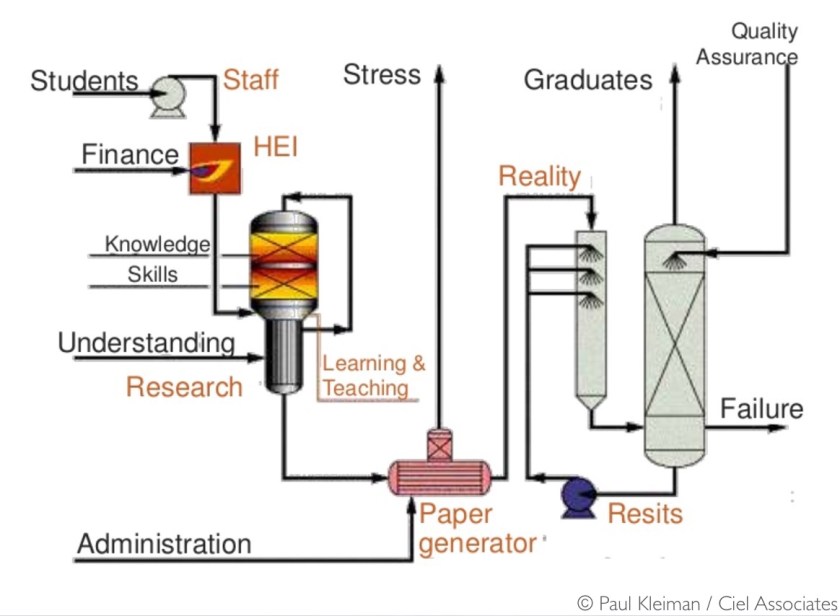
 I know I’m not alone in feeling – increasingly as the years roll by – that all too often the way we assess is at odds with the way our students (and we ourselves) actually learn and experience learning. While I and everyone else round the assessment board table is doing their very best to be professional, to ensure that procedures and regulations are followed, and taking great care to ensure that students are treated fairly and reliably….a bit of my brain is suffering from a form of cognitive dissonance and saying ‘This is nuts!’
 Stumbling with Confidence