A brush, with silence and solitude

I really enjoy painting. Not the sort of thing one might frame and hang on a wall, but the actual walls one might hang them on. The larger the better. And I’m trying to work out why I like it so much.

The rather dark and now somewhat battered walls of our hallway, stairs and upper landing need re-decorating. This time the normally angst-ridden process of choosing a colour was reduced to a simple choice: brilliant white. None of that, “oh, but should it be a ‘cool white’ or a’warm white’ or one with hint of blue/green/yellow/pink?”. Preparation consisted of looking at the walls and deciding that the paint could go straight on, requiring at least two coats. So, with paint, brushes and roller, at the ready, I changed in to my painting clothes (old T-shirt and jeans) and started.

The house is very quiet. My partner is away for the week, so it’s just me, the dog, who is old and sleeps most of the day, and the cat who comes and goes as he pleases. I’m tempted to put on some music, but can’t decide what I want to listen to, so I don’t bother. I turn on the radio instead. Again it doesn’t feel right, so I turn it off.

I am left with silence, except, of course, there’s no such thing. The distant sound of traffic, the odd creaks of an old house, the excited chatter of the kids next door as they arrive home. But gradually, as I start to paint, my face no more than a couple of feet from the wall, I sense everything focusing down to exclude everything except me, the paint tin, the brush and the wall.

One of things I remember particularly from my theatre education and teaching was Stanislavski’s ‘Circle of Concentration’. As an actor you can choose where to draw the circle. You can draw it so closely around yourself that you are aware of nothing except your own mind and body (not that useful for an actor). You can choose to widen it to include the actors on the stage but not the audience. You can choose to include just the (expensive) front rows of the audience or you can choose the include the whole audience. In the case of my painting, the circle is drawn tightly around me, and I immerse myself in the rhythms of the job at hand. Being so close to the wall I notice the small differences in the surface: a hairline crack here, a slight pitting there, a small bubble in the lining paper. The paint is quite thick, and I watch as the rather obvious brushmarks disappear as gravity (I’m supposing) allows the paint to settle in the micro-troughs and render the surface smooth. I have a steady hand and can hold a line, so I don’t use masking tape but I use a narrow brush that I’ve had for many years. I know precisely how this brush works, how much paint to use, how much pressure, in order to achieve a solid, accurate straight line. I’ve tried using another, similar brush, but it’s not the same. I have a relationship with this brush.

And so the hours pass, and the white colour field extends before my eyes. Eventually I stop. I have no idea whether it’s been one hour or five until I look at my watch, which has been on my wrist the whole time, but I haven’t looked at it since I started painting. I’m aware that my body feels tired, and a few muscles are complaining that they haven’t been used in a while. But my mind feels particularly clear and not filled with the usual fog of too many things to do.

There is one of those zen things about the benefits of ‘sitting quietly, doing nothing’. I’d certainly recommend ‘standing quietly, doing painting’.

“It is really a matter of ending this silence and solitude, of breathing and stretching one’s arms again.” ― Mark Rothko

Thinking, Making, Doing, Solving, Dreaming: reflections on completing a PhD thesis on creativity in higher education

Recently, I undertook a PhD viva as external examiner at the university department where I did my own PhD. The viva took place in a room the shelves of which contain copies of every completed PhD. And there it was!

I finally completed it in 2007 at the end of a long four years during which I stopped work completely on researching and writing for over a year due to the long illness and death of my father. I eventually and successfully finished it due, in no small part, to the feeling that I wanted to honour his memory.  I took it off the shelf and as I started to read it, a whole lot of memories and emotions came flooding back, particularly reading the short final section where I reflected on my own learning journey. Here is that reflective section, which I hope may be of some use or interest.


Epilogue

Wanderer, there is no path;
The path forms itself as you walk it.
                                       (Machado)

Amongst the more significant of the research outcomes to emerge from this study of the different ways that a group of university teachers experience creativity in learning and teaching is the complexity and richness in the way academics perceive their experience of creativity in learning and teaching, and their enthusiasm for and interest in it.  The centrality of creativity-as-transformation in relation to learning and teaching, and the importance of creativity in relation to personal and/or professional fulfilment, poses a series of challenges to the current focus on creativity in higher education.  The outcomes suggest that there is much more to the experience of creativity in learning and teaching than simply ‘being creative’. Furthermore, the outcomes indicate that a focus on academics’ experience of creativity separated from their larger experience of being a teacher may encourage over simplification of the phenomenon of creativity, particularly in relation to their underlying intentions when engaged in creative activity.

The significance in these research outcomes is that academics need to be perceived and involved as agents in their own and their students creativity rather than as objects of, or more pertinently, deliverers of a particular ‘creativity agenda’.  The transformational power of creativity poses a clear challenge to organisational systems and institutional frameworks that rely, often necessarily, on compliance and constraint, and it also poses a challenge to approaches to learning, teaching and assessment that promote or pander to strategic or surface approaches learning.

The studies into conceptions of learning and teaching demonstrate that, at its best, learning and teaching is about transformation. This study suggests that whilst for higher education institutions (and even the government) creativity is seen as the means to an essentially more productive and profitable end, for university teachers, creativity is essentially about transformation.

A personal reflection

This study is a product of an abiding interest in creativity, and it is interesting to reflect – at the end of a long and arduous period of research and writing –  on my own categories of stasis, process, and transformation in relation to this study. Though it was always clear that I wanted and intended to undertake a study into conceptions of creativity, it took a lengthy period of thinking, reading and discussion to opt finally for a single methodology approach i.e. phenomenography.

My original intention was to use a mixed methods approach that would utilise phenomenography and activity theory. However, after careful consideration of a whole set of factors including the nature of the study, time and resources, it was clear that utilising a single methodological lens was by far the best option.

The appeal of phenomenography lay both in its utility i.e. the right tool for the job, and its methods. My professional arts practice and a great deal of my pedagogic practice is focused on the construction, deconstruction and reconstruction of narratives.  In the course of understanding – certainly to a much greater extent than I did before – what phenomenography is and how it works, I was attracted to the way in which it creates an holistic relational structure of meaning through the purposeful and rigorous deconstruction and reconstruction of experiential narratives.  The gradual comprehension of what phenomenographic praxis entailed was characterised by a series of surges forward and leaps backward (the retrograde movement often greater than the forward movement), interspersed with periods of stasis that were of varying length.

A significant ‘threshold’ moment was when I was able to make the link between being a phenomenographic researcher and being a designer. A well-designed research study needs to fulfil the principles of what characterises good design generally e.g. it is  innovative, logical, honest, it requires attention to detail, it is focused on enhancing the users’ (in this case the readers’) experience, it is elegant and minimal.  This study certainly aimed to meet those criteria and display those qualities.

The understanding that the outcomes of phenomenographic research are constituted by the researcher in direct relationship with the data led me to undertake all the interviews and the consequent transcription myself. It never occurred to me to do otherwise, though the practicalities of dealing with a much larger sample than that involved in this study may well have induced some pragmatism.  I enjoyed undertaking the interviews though I was always cognisant of the need to achieve and maintain the important but delicate balance between empathy and bracketing.

Though undertaking the task of transcribing the interviews could not be described as particularly enjoyable, there was a great deal of satisfaction derived from listening to the richness and detail of what was said, and ensuring that it was written down as accurately as possible. There was a strong sense, amongst the sheer grind of the transcription process, that what had been said in the interviews and what I was listening to through the headphones was important and valuable – not only to me as the researcher, but also to those speaking the words. That sense of the value of what I had obtained made me determined to ensure that the data was considered, at all stages, with the utmost integrity and rigour.

I had underestimated significantly the time required to undertake the interviews and the transcriptions, which included – as is the case with most if not all participants in the doctoral programme – fitting the work on this study in and around significant work and domestic commitments. However, that underestimation paled into insignificance compared to the time it took to undertake the analysis of the approximately sixty thousand words that constituted the data. Whilst the interview and the transcription processes were relatively straightforward, the process of analysis coincided with my long and difficult journey into understanding phenomenography. As the Machado poem quoted at the front of this study says: the path was unfolding as I was walking it.

There were a number of personal attributes and dispositions that assisted me in the rather daunting quest to seek out the structure of variation across the transcripts, and to undertake the intense iterative process of constituting, re-constituting and distilling the categories of description and the structural and referential aspects of variation. Amongst them was a dogged determination to undertake the task properly allied to a genuine enthusiasm for solving complex puzzles. It may seem a rather trite comparison, but the capacity to sit for an extended amount of time considering, categorising and attempting to piece together the hundreds of pieces of a complex jigsaw was a useful attribute in tackling the analysis stage of this study.

The mock viva proved to be another significant influence on the course of this study. I approached it with serious misgivings and feelings of doubt. But I appreciated greatly that it provided a relatively safe and supportive environment in which to test, in front of my peers on the course, not only the appropriateness of my approach but also the wider knowledge and understanding that I had acquired. The probing questions and constructively critical comments provided me not only with a crucial sense of confidence and encouragement that I was ‘on the right track’, but also provided me with useful insights into the gaps that I needed to fill and the pitfalls I needed to avoid. I must admit to being somewhat surprised not only at the depth and breadth of my own understanding of the subject, but also my ability to articulate that understanding in a relatively coherent fashion.  It also made me reflect, in relation to learning and teaching, on the enormous amount of tacit understanding that individuals acquire, and the importance of creating opportunities for at least some of that understanding to be made explicit.

Finally, to return to the quote from Machado at the beginning of this study, I have certainly walked, occasionally stumbled, and for some considerable time actually stopped – along the path of this study as it has formed itself.  While the path continues in terms of further research, this document represents the end-point of a long, complex and fulfilling stage of that journey, and marks my own thinking, making, doing, solving…..and dreaming.

F-AI-L: forget about assessment?

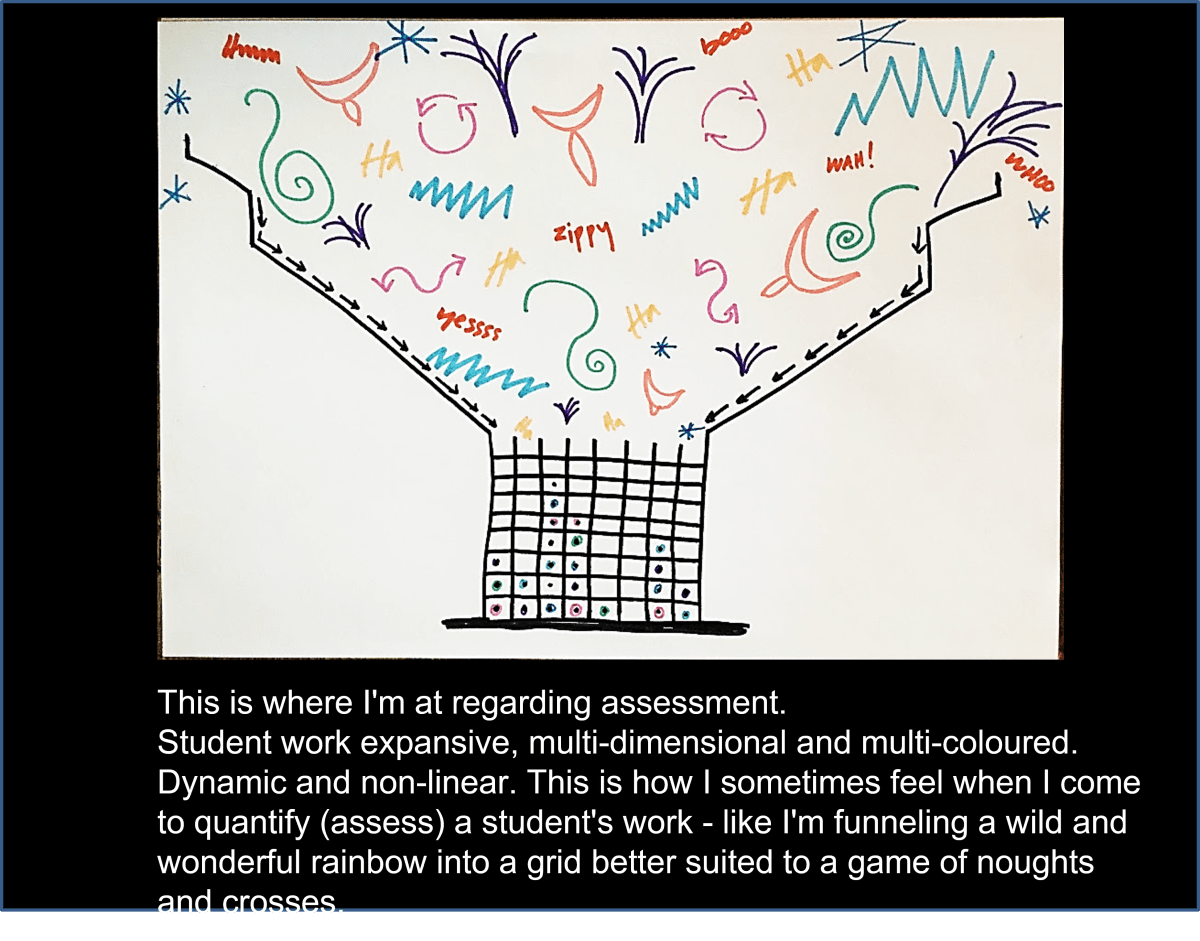
You can’t move these days in Higher Education without reading about how AI has completely compromised most, if not all, the approaches to assessment that require a student to produce an artefact e.g. an essay, a poster, a portfolio, etc.  It would appear that the only way to ensure ‘assessment security’ is to, first, thoroughly body scan and search each student for any devices – external or internal – that might be used to ‘assist’ them to pass the exam and then lock them in a Shielded Room or Faraday Cage under very strict and tight surveillance.

Not exactly an enlightened or constructive educational experience. 

Having focused on assessment for much of my career, I’m beginning to wonder whether we should give up on assessment altogether. But there is one secure form assessment, one that we have practiced for centuries, that goes back to assessment’s Latin root ‘assidere (to sit together or beside)’: the viva. Simply sitting down with a student and asking them or observing them rigorously and systematically in regard to what they know, what they understand, what they have learned, and what they can do.

There are, essentially, two questions that a university has to answer in regard to their graduates: 1) does the student possess sufficient knowledge, understanding and skills in their particular discipline in order to be awarded a qualification? and 2) does the student possess sufficient knowledge, understanding and skills to stand a good chance of successfully navigating their way through an uncertain and complex world? 

Given that many graduates (an old figure in the UK was c. 48% but I suspect it hasn’t changed much) end up working in a field unrelated to their course of study or discipline, the efficacy of the first question is…..questionable (except in the case of professional qualifications e.g. doctors, engineers etc.). As to the second question there’s an assumption they are ready to go out into the ‘real’ world, but that remains an assumption in many cases. 

So…..what if we scrap assessment as we know it?

One thing we do know about assessment is that the inter-rater reliability of a group of experts observing, discussing and assessing a student’s work tends to be higher than when those same experts assess against a set of criteria or rubrics.   

I’m suggesting we scrap the inordinate amount of time and energy spent on marking and grading assessments that are now insecure and unsafe and replace them with regular ‘assessment tutorials or mentoring’ with at least two members of staff. 

In order to do that properly those tutorials must be built into the teaching/contact hours. Teaching is no longer about ‘delivery’ i. e. a teacher-centred and content-oriented paradigm, and shifts to a student-centred, learning-oriented paradigm in which assessment is about sitting down with a student and discovering the answers to those two  questions. 


About me:

I am an independent higher education consultant and co-founder of the educational consultancy Ciel Associates specialising in organisational and transformational change and enhancing learning, teaching and assessment. I have over thirty years experience in a wide range of higher education providers both as a consultant and, before that, in a number of management, leadership and strategic roles. My work is informed by my belief in the transformational power of education and a commitment to enabling institutions to create meaningful and sustainable change. Contact me at Ciel Associates .

Adventures in HE: time for a Skunk Works?

A few years ago, a UK university established a new initiative with funding from central government. The initiative was one of about 70 such initiatives across the HE sector which were established in the hope that, within the five years of the funding, the universities involved would have taken risks and pioneered innovative learning approaches that could be adopted and/or adapted across the sector. 

The university in question established a project with the aim of developing  more practice-based arts provision within the university, establishing more links between the university and external artists and arts organisations, and to increase the links between the subject areas within the creative  and performing arts programmes within the university. The project rapidly established a reputation within the university for taking risks and for hav­ing a different way of looking at things. It was also known for having a different way of talk­ing about things and even a different way of naming things, for example, modules. A critical factor in the project’s ability to forge an innovative path was that its director had been brought in from outside academia, and was relatively and refreshingly unencumbered by things like history and precedence and the engrooved customs, practices and discourses of the institution.

The director had created a Skunk Works.

Skunk Works are, typically, small and loosely structured groups of people who research and develop a project for the sake of innovation. There are several important and essential features of a Skunk Works: one is that it operates independently of the normal research and development operations of the company or organisation; another is that, in order to achieve unusual results, the people working on the project work in ways that are outside the normal ways of working. 

One of the major projects initiated by the director was the development of a pilot MA in interdisciplinary arts practice. The aims of the course were to explore and extend the boundaries of various arts disciplines, and all aspects of the course were designed to be innovative and radical – the curriculum, the delivery, and the assessment. As with all courses, the proposal had to go through the university’s validation process and there were intense discussions about what might or might not be acceptable, especially given the relatively traditional academic culture of the university. The director stuck to her guns and, much to the surprise and, indeed, chagrin of some colleagues, the university validated a course that included modules called ‘Adventures in Interdisciplinarity’ and ‘Further Adventures in Interdisciplinarity’ in which the course participants– a mixture of recent graduates and mature, part-time students– gathered on a Friday and worked intensively through the weekend on various experimental projects and exploratory assignments with artists, directors, film-makers and composers. 

These ‘Adventures’ were designed to provide unusual, typically hazardous (creatively, intellectually, etc.), experiences or activities.  Calling the modules ‘Adventures’ was a very deliberate move and was highly resonant of Ronald Barnett’s call to educators to ‘hang onto a language of delight, wonder, care, excitement, fun, engagement and love– the language in which a student is caught and even entranced’ (Barnett, 2008).

At a time of particularly rapid change with a host of serious challenges facing higher education, perhaps establishing a Skunk Works and investing in the space to breathe, to invent, to imagine, to innovate, and to create something that is different, exciting, and genuinely transformational might be a very good and beneficial move.


Barnett, R. 2008. A will to learn. London: Open University Press.

Image created by AI

About me:

I am an independent higher education consultant and co-founder of the educational consultancy Ciel Associates specialising in organisational and transformational change and enhancing learning, teaching and assessment. I have over thirty years experience in a wide range of higher education providers both as a consultant and, before that, in a number of management, leadership and strategic roles. My work is informed by my belief in the transformational power of education and a commitment to enabling institutions to create meaningful and sustainable change. Contact me at Ciel Associates .

Assessment: paradigm shift required?

There has been a slew of recent journal articles, blogs, podcasts etc.  on the challenges posed by Generative AI in higher education and, particularly, the threat GenAI poses to assessment integrity and security along with  possible approaches to mitigate the threat. 

The picture that emerges is one in which none (perhaps bar one: the viva?) of the traditional forms of assessment are secure – were they ever? It seems clear that not only does a new assessment paradigm need to emerge but also a new paradigm for learning and teaching. As Gramsci wrote in the 1930s: ‘The old is dying and the new is yet to born: in the interregnum, all kinds of morbid symptoms appear’.

The challenge we face in regard to somehow ensuring or at least maximising assessment integrity and security in the face of GenAI is that, essentially, assessment – in the age of mass higher education – has become an economic and logistical issue, not a pedagogical one. An industrialised process of mass production that relies on the production-line workers (lecturers) doing much of the quality control i.e. assessment and marking, in their spare time in order to meet the production deadlines

What has largely disappeared from the way we assess students is the idea of assessment, inherent in its Latin root ’assidere’ (to sit together or sit beside), as a dialogic process. What hasn’t disappeared, though somewhat diminished, is the dominance of the teacher-centred, curriculum-focused paradigm rather than a student-centred, learning-focused paradigm. 

In a recent and worth reading GenAI and assessment-focused journal article by Guy J. Curtis*, he wrote: ‘Students can reasonably expect to have their learning assessed on what they have been taught.’ He’s right but, just as important, students should also expect to be assessed on, or at least have an intensive discussion about, what they have learned. This may well (and should) extend beyond disciplinary specificity as they head towards an increasingly complex and uncertain future in which, whether we like it or not, AI will play an integral role.

So, while we struggle to find ways to make assessment secure without resorting to unacceptable and detrimental levels of surveillance, we might usefully attempt to answer the question: how might we best assess students in ways that reveal what they actually know, what they have learned and what they can do? The pedagogical answer may well be by sitting beside them and questioning them rigorously and systemically. But that begs another question: is higher education willing and able to shift to a new assessment paradigm? 


* Guy J. Curtis article

Image created by AI


About me:

I am an independent higher education consultant and co-founder of the educational consultancy Ciel Associates specialising in organisational and transformational change and enhancing learning, teaching and assessment. I have over thirty years experience in a wide range of higher education providers both as a consultant and, before that, in a number of management, leadership and strategic roles. My work is informed by my belief in the transformational power of education and a commitment to enabling institutions to create meaningful and sustainable change. Contact me at Ciel Associates .