When something(s) need to change…

When a higher education provider calls in a consultant, it’s usually because they want and need some thing or things to change. Usually, at least some people in the institution know precisely what the problem is and what needs to change. But bringing in a consultant can provide validation and confirmation of what needs to done by digging deep into the problems, asking some awkward questions, and providing the hard evidence to support the change event.

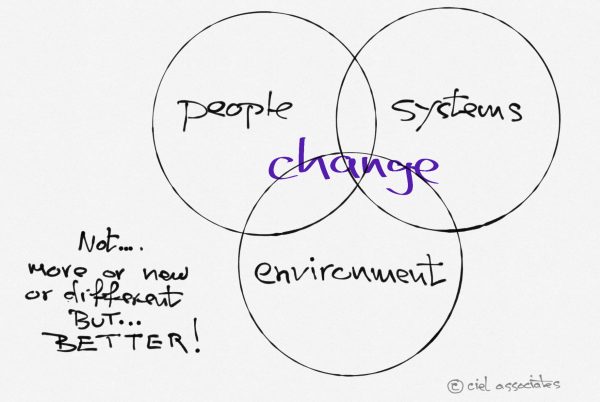
Change, of course, can be challenging, awkward and divisive, and there’s the old cliche about people liking the idea of change as long as they don’t have to change themselves. But change isn’t just about people. For genuine, effective, sustainable change to happen, three things need to be addressed simultaneously: People, Systems and Environment. Changing one or even two of those will lead to whatever change is envisaged either not working as well it could or not at all.

An example:

A university’s STEM departments were scattered around the campus. The university commissioned a prize-winning architect to design a new ‘stand out’ building that would house all the various departments. There would be a beautiful atrium in the centre of the building with a café and colleagues from different departments would gather there and all sorts of wonderful ideas (and possible patents) would emerge from the exchange of ideas.

What actually happened was that while the university clearly changed the environment, nothing was done to address the people and systems involved. Within a very short time the building was re-compartmentalised into separate departments who kept their own coffee machines. The atrium remained a beautiful, empty, silent space.

The PSE framework informs much of our consultancy work. It enables us to explore the potential and practicalities of change through those three ‘lenses’, always asking and seeking ‘What will make this better?’


About me:

I am an independent higher education consultant and co-founder of the educational consultancy Ciel Associates specialising in organisational and transformational change and enhancing learning, teaching and assessment.. My work is informed by my belief in the transformational power of education and a commitment to helping institutions achieve meaningful and sustainable change. Contact me at Ciel Associates .

Beyond the Debatable Hills: is it curtains for the arts in education?

As yet another UK university announces major course closures and redundancies – mainly affecting arts and humanities – it’s worth being reminded that entries for A level arts subjects: dance, design & technology, drama, music among others, have reached the lowest since at least 2011.

Back in 2016 I presented at an arts conference and wrote an associated journal article ‘Predictive Texts’ that took a look into the future of the arts in the UK in 2026 based on the then current trends. I described a cultural landscape in which the arts had largely been stripped out of the educational experience of children and young people. I described the consequences of that policy on the live performing arts sector which was now being by-passed by a generation of students who had not received consistent, or in many cases any, arts education through primary and secondary education where the focus was on STEM education. I reflected on how that educational neglect had led to a kind of cultural blindspot or illiteracy which, in turn, had led to a severe decline in arts attendance as that generation of millenials now sought other avenues for their entertainment and spending.

There have been many dozens of articles written in the last few years voicing concern about state and future of the arts in the UK, particularly in education. Tory policy towards the arts threatened the existence of the entire creative sector, particularly those parts of the sector in which live performance is an integral part of their raison d’etre: live theatre, dance and music. Today, despite the change in government, almost daily there is news of another university cutting its creative and performing arts courses.

The decision to cut arts funding in higher education by the last Tory government signalled not only a drastic diminutions of the arts in education but also, as a consequence of this and other policies, an acceptance that whole sections of the creative sector could be allowed ‘go to the wall’ despite the fact that the sector as whole contributes massively to the GDP. The contrast with the then government’s support of the fishing industry, which played such a huge role in Brexit, is stark. At present fishing contributes around £1.4 billion to the economy (Gross Value Added data from the Office for National Statistics). The creative industries contribute around £124 billion to the economy (2022 figures)

While the election of the Labour Government and the accompanying positive statements about supporting the arts and creativity in education provide some indication of a change for the better (we’ll wait and see on that one), in the meantime a bleak future for the arts beckons. The creative industries are fed via a pipepline of skills and talent that are nurtured in our education system. By reducing or stopping the flow of creative talent along that pipeline ensures that the creative industries, and certainly those parts of the sector that are seen to be less ‘valuable’ in economic terms, wither on the vine. It also ensure that access to the arts and arts training increasingly becomes the preserve of the wealthy and privileged and those who have social, cultural and economic capital.

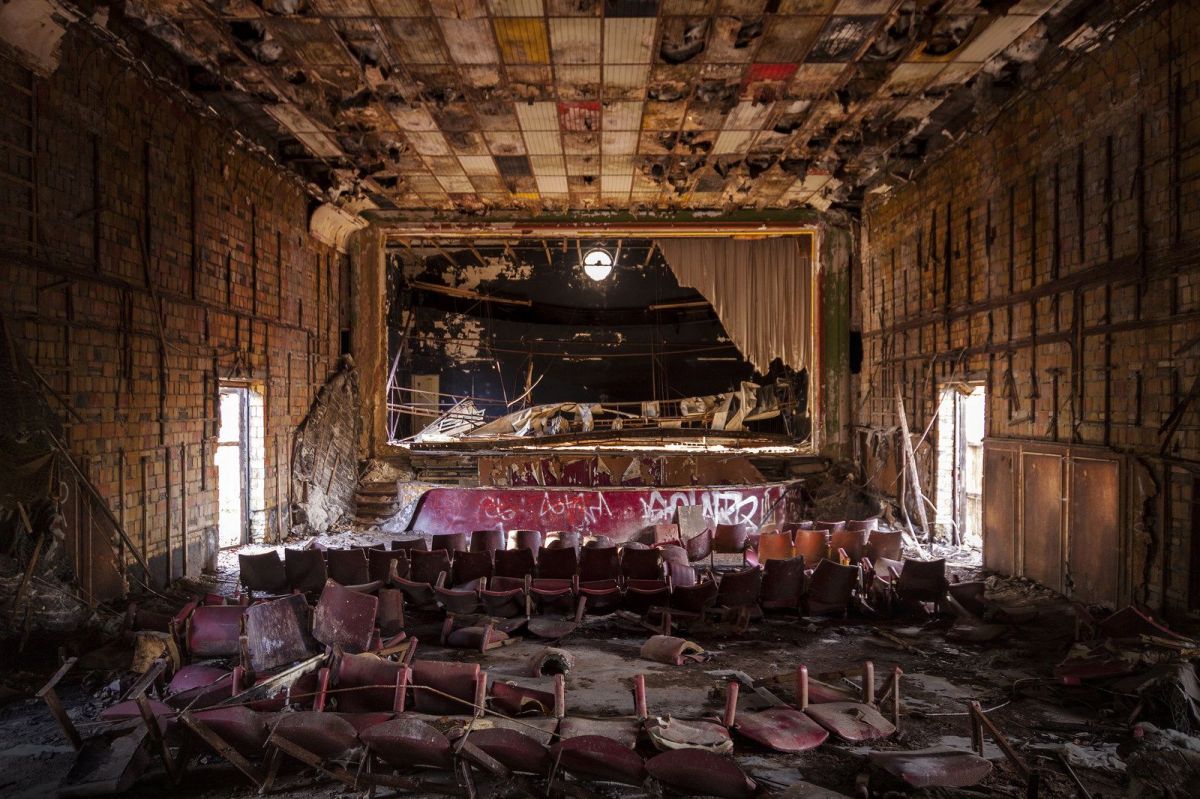
I am reminded of a sentence from the 2015 book by the eminent producer and impresario Michael Kaiser titled ‘Curtains? The Future of the Performing Arts in America’. Examining the trends, Kaiser describes a ‘doomsday scenario’ in which, across America, many theatres, arts centres and other performance venues, hit by the decline in audiences and/or funding, “sit vacant, reminders of a different era, not unlike the Colosseum in Rome and the Parthenon in Athens”. Kaiser was projecting some years into the future, but in the UK the Covid crisis massively accelerated the onset of that doomsday scenario.

Thinking about all this I was reminded of a book I read years ago, which remains one of my favourite books (it’s also on Neil Gaiman’s list of all-time favourites, so I’m in good company). The book is called Lud-in-the-Mist, written in 1926 by Hope Mirrlees. Mirrlees was a classicist, and much of her work dealt with the contested boundaries of Art and Life.

In Lud-in-the-Mist there are two countries. There is the land of Dorimare, a nation of stolid burghers, merchants and artisans. A rather prim and very proper place, where everyone knows their place, where the motto is essentially ‘it’s the economy, stupid’, and where the arts are relegated to activities such as needlework and country dancing: pursuits for the refinement of gentlewomen and gentlemen.

On the border of Dorimare, however, on the other side of the Debatable Hills, lies the land of Faerie, a strange, dark land full of mysteries and wonders…not all of them pleasant. The upright citizens of Dorimare so fear the land that lies beyond those dread hills, that the word ‘Faerie’ is never to be uttered.

Dorimare’s main city of Lud-in-the-Mist lies at the confluence of two rivers: the Dapple and the Dawl. The Dawl is like any other commercial river, but the Dapple happens to flow out of the land of Faerie, and brings with it fairy fruit, that is smuggled into Dorimare.  Eating fairy fruit has a terrible effect on the upright citizens of Lud-in-the-Mist: it causes people to start singing strange songs, to spout poetry, to dance with abandon. In other words, it turns them mad.

The plot revolves around the disappearance of a group of young ladies and the Mayor’s son who have been kidnapped and taken to the land of Faerie, and the attempt of the Mayor, a bumbling, self-important, rather fatuous man to rescue them. (Any resemblance to a real persons is entirely coincidental).  As a consequence of that quest, fundamental changes are wrought – to the Mayor and to Dorimare itself.

In Lud-in-the-Mist, Mirrlees is dealing with the division of the world into Apollonian and Dionysian aspects: the homely and the wild. There is also the long battle between Classicism and Romanticism, and Freud’s theories of the conscious and unconscious mind, and the relationship between terror and beauty.

The actor Mark Rylance, in an interview, said that the arts are essentially ‘mysterious’ which is why they frighten  politicians and policy-makers, because they can’t control them, they can’t measure them.

I imagine the educational curriculum in Dorimare’s schools is very much what like the one demanded by Gradgrind in Dickens’ Hard Times;

“Now, what I want is Facts. Teach these boys and girls nothing but Facts. Facts alone are wanted in life. Plant nothing else, and root out everything else. You can only form the mind of reasoning animals upon Facts: nothing else will ever be of any service to them.“

And if you think that’s rather extreme, consider this – handed to parents at a primary school in London:

‘The new programme of study in English is knowledge-based, this means its focus is on knowing facts rather than developing skills and understanding. It is also characterised by an increased emphasis on the technical aspects of language and less on the creative aspects.”

So, alongside schools dropping all ‘non-core’ subjects i.e. arts subjects and a few others from the school curriculum in order to enable students to catch-up on everything they missed due to Covid, we also had catastrophic cuts to arts subjects in higher education in line with the Tory government’s insistence that all higher education programmes must align with  “economic and societal needs” – which the government believed will only be met by STEM (Science, Technology, Engineering and Maths) programmes and some others such medicine and agriculture. One can only look with envy at the financial support some other countries are putting into supporting their creative and cultural sectors as they recognise the importance and value of those sectors to the well-being of society as a whole.

I was thinking about Lud-in-the-Mist because it seems to me we are increasingly living in a country which is becoming more Dorimare-like by the day, where the arts are increasingly banished to the equivalent of the land of Faerie, where creativity is associated with the creation of goods and wealth, where any hint of an artistic or genuinely creative spirit is dismissed as bad influence, and to be actively discouraged and eliminated.

Across our education system, from primary through to tertiary, there is now a very real danger, evidenced by the course and departmental closures and the significant drop in the take-up of arts subjects, of subjects like art, dance, drama and music disappearing entirely from the curriculum. The clear and present danger for the wider creative arts sector will be the cutting off the pipeline of interest, skills and talent on which the sector relies. We are facing the prospect, in many areas of the country, of the spectre of a cultural wasteland, not unlike Kaiser’s ‘doomsday’ scenario.

A hundred years ago, in Lud-in-the-Mist, Hope Mirrless asked how might we truly embrace the arts in all their wondrous, dangerous, life-affirming glory along with the eccentrics and mavericks?  Or are we fated to banish them, their works and deeds, to that strange, wonderful, forbidden land beyond the Debatable Hills?

The final, celebratory chapter of Lud-in-the-Mist, as the citizens of Dorimare throw open the gates of the city to allow those mysterious, dangerous, life-affirming Faeries to enter, provides the answer.

Plus ça change: a taxonomy of pressures and hard times in higher education


12 years ago I came across and wrote a blog piece about Terran Lane, a tenured associate professor in the US, recently moved from academia to industry.

His move caused consternation amongst his friends and colleagues: “voluntarily giving up tenure is roughly akin to voluntarily giving up a lung”. On his blog – which went viral – he made a list of the “forces that are making it increasingly unpleasant to be an academic in the US right now”. Here’s that list, and it sounds remarkably familiar:

  • the difficulty of making a tangible, positive difference in the world;
  • struggles with workload and life balance;
  • increasing centralisation of power into university administrations and decreasing autonomy for academic staff;
  • a strained funding climate that is trapping academics between dwindling central funding and intensifying university pressure-to-be-funded (generate income);
  • specialisation, narrowness of vision and risk aversion within academic disciplines;
  • poor incentive structures;
  • moves towards mass production and automation of education;
  • salary disparities between the academy and industry;
  • the rise of anti-intellectualism and anti-education sentiment. The creation of that list “turned into not just a dissection of dissatisfactions with the system, but a cry for loss for a beautiful institution that I have loved and outrage at the forces that are eroding it”.

As the list of actual and proposed department closures and redundancies grows longer on a seemingly daily basis,  those who work in higher education in the UK may well nod our head in agreement with most if not all of that list. 

Meanwhile, as the juggernaut of centralised conformity, cost-cutting and bott0m-line accounting rolls inexorably onwards,  on a day-to-day-basis many who work at the ‘chalk-face’ are creating, planning and delivering wonderful, creative, innovative, exciting, relevant learning experiences that defy the forces of ‘command and control’ and the stultifying blanket of conformity.

Also some years ago, before Brexit, at a European conference on the future of arts education, I happened to be standing in the coffee queue next to the German Federal Minister of Education who had just given a keynote address. After an exchange of introductions, and having established I was from the UK, he went on – in a light-hearted way – to list some of our structural problems (transport, health, etc….it was a time, admittedly, when nothing in the UK seemed to be working properly).

He then went on to say that he had a serious question: “For the last 30 years or so, until reunification, our economy was good and many good things both promoted and flowed from that. Yet, culturally and artistically we produced relatively little of world class. Over the same period, in the UK your economy has never been strong, yet you have consistently led the world in music, design, fashion, theatre, etc. My question is what is it that you are doing, or maybe NOT doing in your education system that has allowed you to achieve that?”

I didn’t – standing in that coffee queue – have a coherent, evidence-based answer. But I did say that perhaps it was to do with the fact that we have a long and honourable tradition of non-conformity in the UK combined with a high tolerance of eccentricity.

Is that true…and if so, does it still hold true? Or, in our education systems, have we lost – or are we losing and/or having taken away from us – the very attributes that enable us to lead the field in creative and cultural endeavour and achievement?

* * * * * * *
Terran Lane article in Times Higher Education

We’d never get away with it now!

6 problems and developing creative confidence in students 

LIPA (Liverpool Institute for Performing Arts) welcomed its first students in 1996. In those early days, as a very rare brand new higher education institution, LIPA had many of the typical characteristics of a ‘start-up’: exciting, risk-taking, a bit of a roller-coaster. Looking back at that time, we were certainly operating on the edge of chaos. 

I was Head of Performance Design and had designed and written most of the Performance Design curriculum. One of the things I was really keen on was the idea of ‘de-schooling’: getting the new first year students out of the more creativity inhibiting habits and expectations they had arrived with.

So, during induction week, alongside the usual introductory sessions, the handing out of timetables, module handbooks, etc., we set the students six visual  ‘problems’ that they had to solve before the end of that first semester.

There were some interesting strings attached to that assignment: 

  • the students were on their own, they could not discuss the problems with their fellow students or with any of their tutors
  • their work would not be assessed
  • all their ‘solutions’ would be shown in an exhibition at the end of the semester which would have a proper opening and an invited guest list. 

A number of colleagues, when they heard about this, thought we were mad, confident that the students would never do it as it wasn’t being assessed.

The six problems included the following:

  • Create a self-portrait in any medium. 
  • Create a map of how you get from your bed to the studio in the morning
  • Take three matchboxes and create an object or objects using all the contents and the boxes themselves
  • The Black Square Problem: using six black squares against a white ground illustrate a series of words e.g. chaos, love, kindness, growth etc. 

(To be honest, nearly thirty years on, I can’t remember the other two problems! One, I think,  was something to do with delineating space, and I have no idea what the sixth one was. I was hoping it might come to me as I was writing this).

The day the students came in to set up the exhibition was an extraordinary day. As each student brought in their work, their peers gathered round to see and discuss what was before them. The sense of collegiality and excitement was palpable as was the sense of creativity and imagination at play. 

Some  of those solutions remain clear in my mind to this day. Here are just three: 

J., a German student who had grown up in East Germany before unification, had taken the three matchboxes. She had flattened out the three drawers and stuck them together to make a flat sheet. On the sheet, she had drawn three musical staves (five lines each) using the ends of some burnt matches. Then, using the matches as musical notes, she stuck them along the staves in such a way as to create the opening bars of Beethoven’s ‘Ode to Joy’. The remaining matches were stuck around the sheet to make a frame. Two of the outer matchbox containers were used as labels for the work. But where was the third? It was stuck on the back of the sheet and used to hang the sheet onto a hook on the wall.

(I know I have a photograph of it somewhere!) 

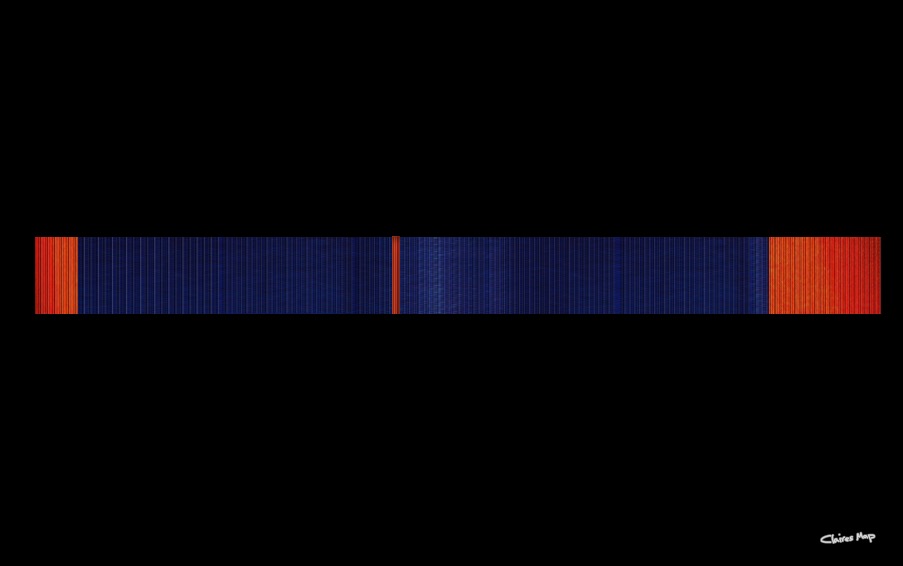
C. had attached a very large, rectangle of black card on the wall. It was in landscape format and across the middle, horizontally, ran a c.4cm strip of paper which was covered in dozens of identical, narrow vertical stripes of red, orange, light blue and dark blue. It looked like a beautiful spectrogram. In the bottom right hand corner was written  ‘C’s map’.  I remember staring at this with a colleague and wondering what did this map represent. Eventually, we called C. over and asked her to explain. It turned out that she lived about 2 miles from LIPA and it was a very cold day when she started making the map. What she had done was to walk from her warm bedroom, through the cold streets to LIPA taking a temperature reading every 20m or so. The different colours represented different temperatures. Red/Orange = warm, Light Blue/Dark Blue=cool/cold. When we asked what the warm strip right in the centre was, C. answered that her measured steps had taken to her to a hot air outlet of a shop.

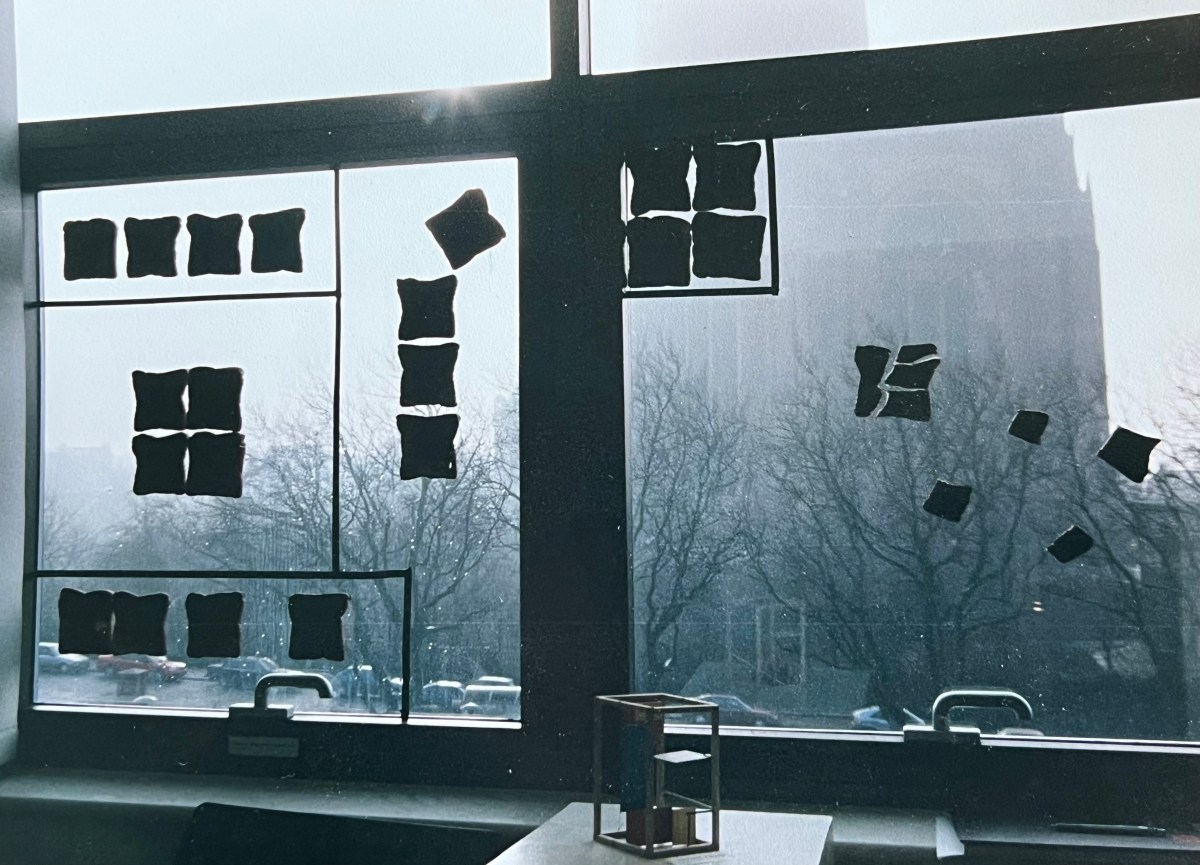
T. had really struggled with the Black Square problem. Just couldn’t get his head around it. Sitting at breakfast a day or so before the exhibition opening, he was pondering the problem to the extent that he forgot he’d put a slice of bread in the toaster. Suddenly out popped a square of blackened toast. It was one of those Eureka moments. T. had found his solution to the black square problem. His solution consisted of illustrating the words using a series of four pieces of square black toast stuck to the windows of the exhibition space. 

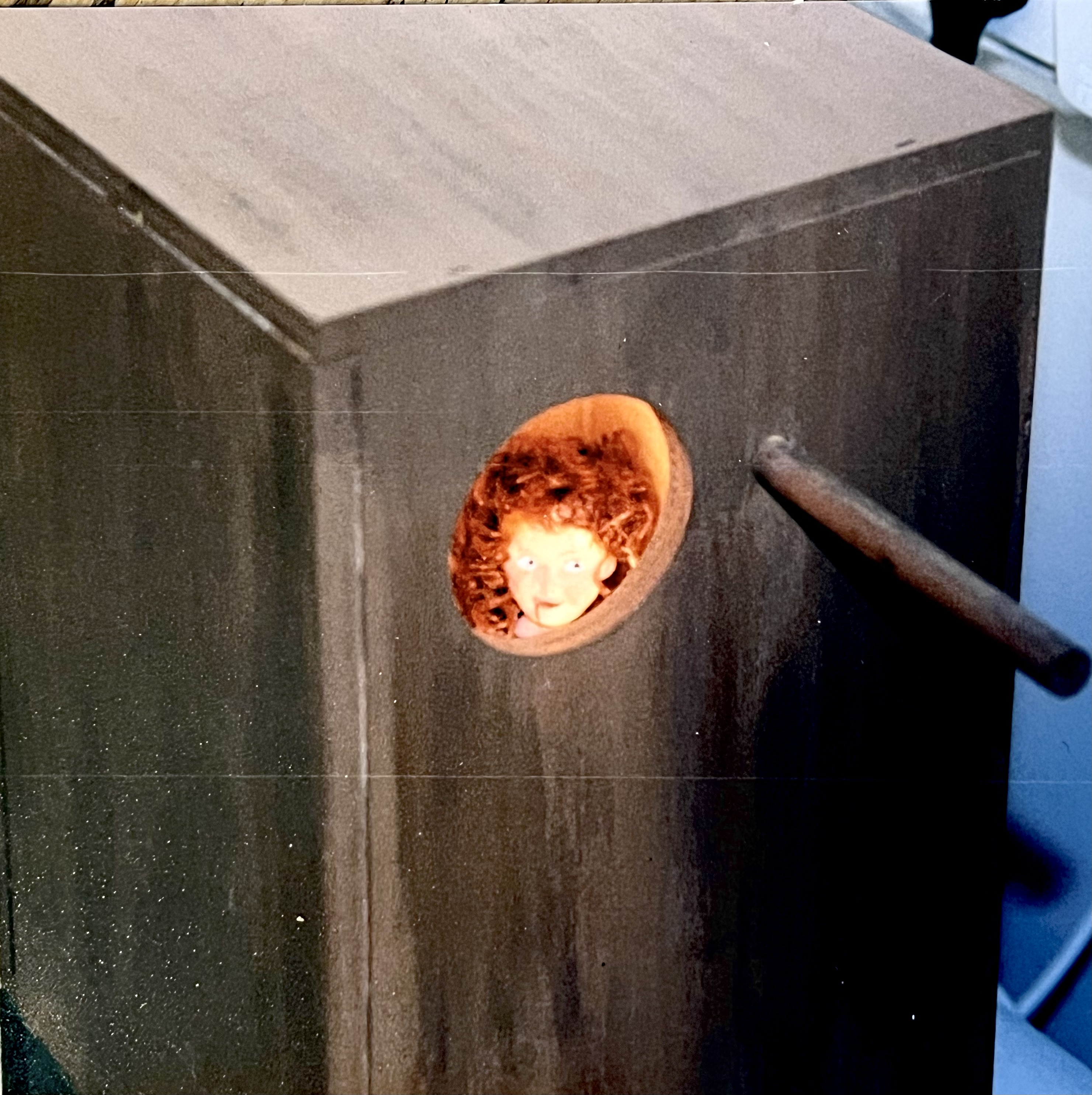
The exhibition opening was a great success. All the students managed to produce a creative solution to each of the problems…some of them truly extraordinary. There were 2D works, 3D works, video, audio, animation. Some made one laugh. Others, particularly some of the self-portraits, were rather disturbing. The strange, bloodied doll in the box which had a peep hole haunts me still! 

Art work. Wooden bok with peep hole. Through the peephole you see a doll sitting in the corner of the box, with a dribble of blood coming from her mouth.

All the art works were presented and lit beautifully. The purpose of the whole enterprise was, of course, nothing to do with the actual problems or the exhibition of work. It was all about confidence, enabling the students to realise that not only did they have some wonderful creative ideas but they could work on their own and create and produce wonder-full work.

The offer of the exhibition was key to getting the students motivated and committed to the project despite there being no assessment. The exhibition made it clear that we valued their ideas and the work they produced. Too often, work into which students have poured their heart and soul is simply handed in or submitted electronically without even a ‘thank you’. I recall one department in another institution where essays and dissertations were simply posted into a box fixed to the wall near the departmental office. 

The six visual problems project demonstrated that if you create interesting assignments and make it clear that you really care about the work students produce, assessment isn’t a given. In recent decades, higher education has developed to the point where the culture is one of ‘if it moves, assess it!’. The solving and exhibiting of the six visual problems proved that need not, necessarily, always be the case.

Could we get away with it now? 

2 Jews, 3 Arabs and 5 cups of tea

More years ago than I care to remember, five men sat around a hissing stove in a campsite outside Sofia in Bulgaria. It was 1969 and Robert and I were two Jewish lads from North London driving from London to Israel via Turkey. We were discussing life, the universe and the future of the Middle East with three Arabs: two Jordanians and a Syrian. Three teachers. Three friends on holiday together.

We had arrived at the campsite quite late in the day, set up our tent and cooked ourselves a meal. Then, as usual, we had a wander around the campsite. We noticed that a number of cars had Arabic number plates. Some of the other campers were walking around the site, and no doubt some must have seen – because it was difficult to avoid – the big sign on our windscreen which said ‘London to Tel Aviv’. To be honest, I thought the sign was a bit of a mistake, especially as it was only two years since the ‘6 Day War’ or ‘June War’ when Israel had defeated the armed forces of Egypt, Jordan and Syria, and had occupied the Sinai, the West Bank and the Golan Heights. But it was Robert’s car, and I wasn’t going to argue.

As darkness fell and we boiled up the kettle for a brew, three figures appeared. One said, in perfect English: “Apologies for disturbing you, but my friends and I saw the sign on your car. Are you really going to Israel?”

“Yes, we are”, Robert said.

“Are you Jewish?”

An awkward moment and an awkward pause. But I had one of those ‘well, in for a penny, in for a pound’ moments, and said “Yes, we are. My name is Paul. This is my friend Robert. We’re making some tea. Please join us…but I’m afraid we only have two cups”.

The first man spoke briefly in Arabic to the other two, who nodded assent, and one of them turned and walked away. Then he turned back to us: “Thank you. We will join you. I am Ibrahim, I am a teacher from Amman in Jordan. These are my friends, they are also teachers.” And pointing in the direction of the man who had walked away: “He has gone to bring some cups”.

When the man returned we all shook hands, introduced ourselves properly, sat around the stove and poured the tea.

At first the conversation was the normal campsite conversation: Where do you live? What do you do? Which football team do you support? (they knew the names of most of the Manchester United players – Best, Charlton, etc.). Then, inevitably, we came to the not insignificant matter that we were about to travel to a country that had recently defeated their countries in war and had occupied parts of their countries.

What struck me then, and has stayed with me all these years, was that there was no obvious bitterness. These were individuals who just wanted a decent life for themselves and their families. Who wanted to teach, and to do good in the world. They did not see us, as Jews, as their enemies; neither did we see them, as Arabs, as our enemies. As we sat and talked, about our lives and our hopes for a peaceful future (and football), there was a strong sense of a shared humanity; that by moving beyond the shackles of politics, religion and history, we were just five individuals, enjoying each other’s company, respecting our differences, sipping tea under the stars.