Telling Tales

I was once helping to run a ‘New to Teaching’ workshop for new/early career lecturers in languages and linguistics.  I was one of several presenters during the day, and I was chatting with one of them – a Head of (a very large) Department –  over the rather basic and disappointing sandwich lunch which the host university’s catering service had deemed suitable for academic consumption.

We talked, inevitably, about the current parlous state of higher education (plus ça change!), and I mentioned that I had done some work and research around complexity and chaos in learning and teaching. At which point his eyes suddenly lit up and he exclaimed: “I know who you are! Must have been at least 10 years ago. You gave a presentation which started with you holding up your taped together memory stick and telling us that it had been through the full hot wash cycle and tumble dryer and, after drying it out, it was STILL WORKING. I always remember that, and I remember your presentation about working at the edge of chaos- a notion which I still use and often rely onto this day. Thank you!”

Now, OK, it’s very nice to know one’s work has had at least some impact, but it did make me wonder about the obvious but frequently overlooked power of image, metaphor and narrative in education.

We live, communicate, interact through stories. We experience the world through stories. We are  storytelling organisms who, individually and socially, lead storied lives.  We  construct and reconstruct our personal and social stories and, in education, learners, teachers, and researchers are storytellers and characters in their own and other’s stories.

The phrase ‘telling tales’ usually has negative associations, but – surely –  great learning and teaching is inextricably bound up with the expert telling of wonderful and genuinely telling tales.

It’s a human need to be told stories. The more we’re governed by idiots and have no control over our destinies, the more we need to tell stories to each other about who we are, why we are, where we come from, and what might be possible.
Alan Rickman

“I thought about the magic that happens when you tell a story right, and everybody who hears it not only loves the story, but they love you a little bit, too, for telling it so well. – Katherine Hannigan

Dripping memory stick image created with GenAI


‘Taking a Line for a Walk’: reflections on interviewing academics about creativity

“You just get this one idea, which might, at first, seem a bit daft. But something just holds you back from thinking it is completely daft. It was the artist Paul Klee who talked about painting being about taking a line for a walk. And that was the thing about it. What it was like….it was like taking an idea for a walk. You know, the more you just did it….it might just work.” (Interview)

It had been a long day. I had spent it interviewing several academics – from new lecturers to emeritus professors, across a range of disciplines – about their conceptions and experiences of creativity in relation to learning and teaching. Even though I was recording it all, it was still hard work maintaining focus and enthusiasm for each of the 45 minute sessions, and ensuring – as one is obliged to do in phenomenographic research – that I had obtained deep and rich responses to my questions.

I always started with the same question: Could you tell me about an occasion that was a creative experience for you in terms of learning and teaching higher education?

All too often that question would be greeted by silence, and what I came to call the ‘rabbit in the headlight’ look: as if why on earth would I think that there might possibly be a connection between creativity and teaching?

But I’d learned, from my training and work in drama, not to be afraid of silence and to avoid the temptation to ‘jump in’ in order to avoid embarrassment. As a drama therapist once told me: “silence IS golden: it usually means they’re thinking”; and sure enough, after a short while, a story would emerge, and I would gently probe the whats, hows and whys of that particular experience.

The last interview of the day was with a vastly experienced educational developer, with a PhD in linguistics, who had taught in China. After the usual hesitant start, he began to tell me how he had developed a successful student-centred, experiential and problem-based learning experience which was the antithesis of the teacher-centred, conformist, ‘micro-teaching’ that was the normal and expected practice. It was he who described the experience with the Paul Klee ‘taking a line for a walk’ quote above.

Thinking back to those interviews, a number of ‘moments’ stand out:

The eminent, soon-to-retire historian bemoaning the conformity and lack of risk-taking in his younger colleagues, and finally – as his last ‘hurrah’ – running a ‘visual history’ course on 18th century England as seen through a number of key objects that he had always wanted to run but never had the nerve… until now when he was leaving. (This was way before Neil McGregor’s renowned BBC series on the objects of the British Museum).

The management school professor in a 5* research rated department who, much to the annoyance of his colleagues, had won a prestigious national prize for his innovative teaching methods. Apparently they couldn’t understand why he was wasting his time on enhancing his learning and teaching expertise when he ought to be enhancing his (and the department’s) research reputation and ranking.

There was the young, early career lecturer, genuinely committed to teaching, tears rolling down her face as she recounted the frustrations of having her creative ideas about teaching rudely quashed by her senior male colleagues: “I feel restricted, I feel frightened….the constant ‘don’t bother about the teaching, just focus on your research’….it makes me so angry, but I don’t dare say anything”.

And there was the language lecturer whose creative ‘Damascene’ moment occurred serendipitously as a result of being very late for a class she was meant to be teaching in parallel with other identical classes. When she finally turned up at the end of the session she found that the group, who normally “sat like puddings” while she presented the set material in the set textbooks, were still there and that “the atmosphere in the room was buzzing…they were talking to each other, they had a problem to solve. So we spent the last couple of minutes talking about how we were going to keep that going now”.

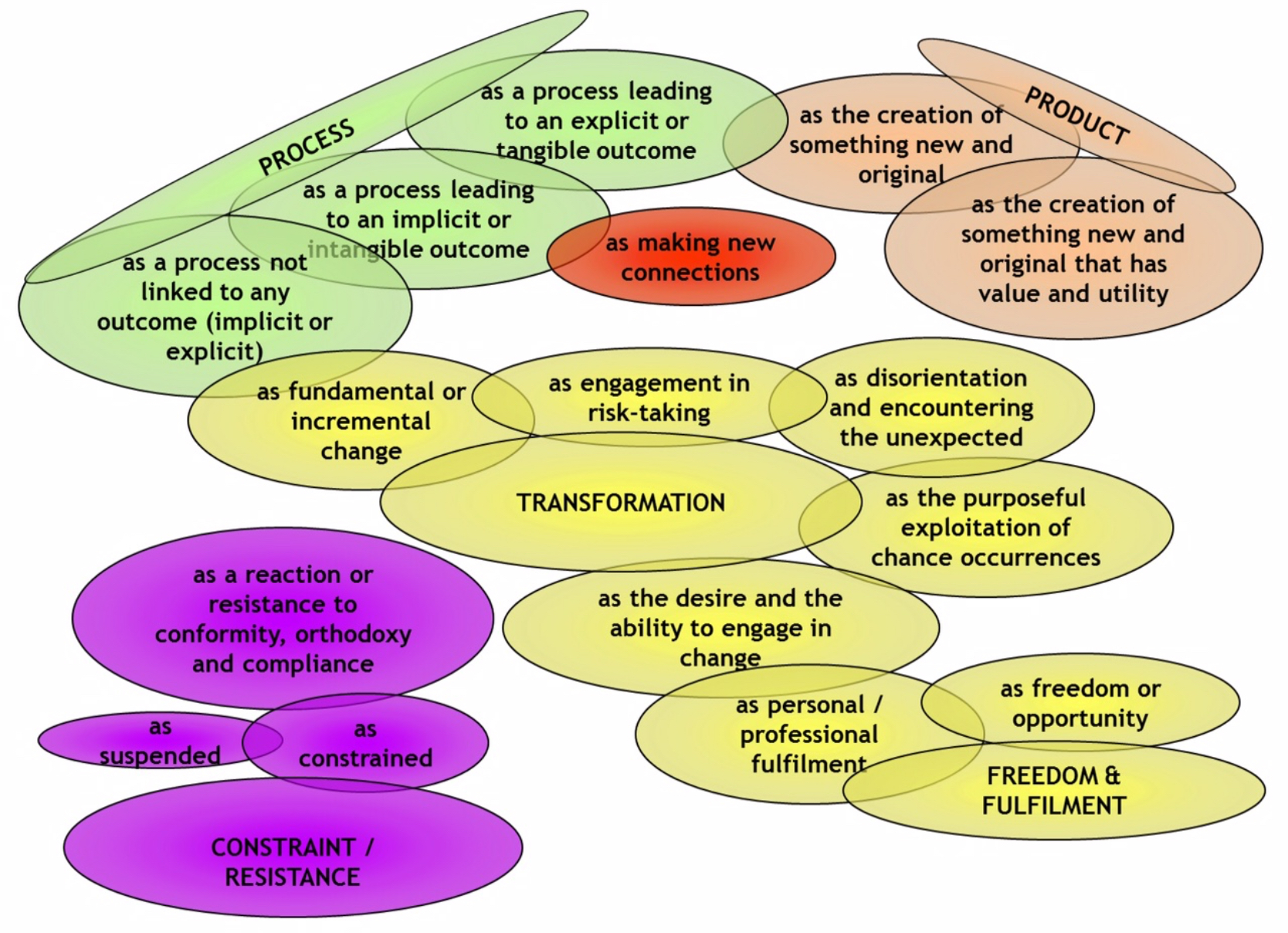
There were many such moments in all the interviews, and after personally transcribing all the interviews (extraordinarily tiring, but so valuable in being able to get ‘inside the source material’), I began to search for patterns of thoughts and behaviour. Slowly but surely, after a long and rigorous iterative process, the many and varied experiences of creativity in higher education began to coalesce around five main conceptual categories. I attempted to capture them in the following map:

Creativity: a conceptual map. (©️ Paul Kleiman)

1. Creativity can be a CONSTRAINT-focused experience, where the constraints and specific limitations tend to encourage rather than discourage it. Creativity occurs despite and/or because of the constraints;

2. Creativity can be a PROCESS-focused experience; that may lead to an explicit or tangible outcome…or may not;

3. Creativity can be a PRODUCT-focused experience where the whole point is to produce something;

4. Creativity can be a TRANSFORMATION-focused experience where the experience frequently transforms those involved in it;

5. Creativity can be a FULFILMENT-focused experience where there is a strong element of personal fulfilment derived from the process/production of a creative work.

As well as the development and identification of these five categories (later to be reduced to three – but that’s another story), a number of significant outcomes and observations sprang from the research. It was clear that university teachers experienced creativity in learning and teaching in complex and rich ways, and certainly the ones I interviewed – once they got going – exhibited great enthusiasm for, and an interest in, creativity.

I was struck, particularly, in response to my exploring the reasons why an individual pursued a particular creative course, by the number of times someone said ‘I stumbled across something’ or something similar. The example of the very late lecturer (above) is a typical example. The frequency and consistency with which the opportunity to exploit the consequences of ‘stumbling upon something’ played a critical part in the various self-narratives of creativity in learning and teaching is clearly important, and it has obvious significance for those interested and engaged in learning and teaching. Firstly it is important to realise that there are several distinct but linked elements in this. One is the ‘stumbling’, and another is the ability or opportunity to exploit it. However, as one of the university teachers interviewed said, people stumble across things all the time but rarely act: “So it’s not just stumbling upon it, it’s finding that the thing has a use”.

Then, beyond finding that whatever it is might have some use, one needs the confidence to be able to engage in an action that exploits – in the best sense of the word – that situation. The notion of confidence constitutes a significant and expanding thematic element through all the five categories. In many of the interviews – and it is one reason why actual face-to-face interviews are so important – as the individual began to explain and explore their own creativity (some said it was really the first time they’d ever really thought about it) – I both heard and observed the growing sense of confidence both vocally and physically: they became animated, they smiled and they laughed.

Confidence clearly plays a critical role in enabling university teaches to engage creatively in their pedagogic practice. However, in the research into conceptions of learning and teaching, little attention seems to be paid to the subject of confidence and other affective aspects of the teacher’s role and identity. A number of researchers comment on this apparent gap in the research literature, and explain it by saying that dealing with the emotional and attitudinal aspects of learning and teaching is rather antithetical to the prevailing analytic/ critical academic discourse.

During the course of those interviews there was a strong sense of people transformed. It is also clear that the centrality of creativity-as-transformation in relation to learning and teaching, and the importance of creativity in relation to personal and/or professional fulfilment, poses a series of challenges. There is much more to the experience of creativity in learning and teaching than simply ‘being creative’. Furthermore, a focus on academics’ experience of creativity separated from their larger experience of being a teacher may encourage over simplification of the phenomenon of creativity, particularly in relation to their underlying intentions when engaged in creative activity.

The transformational power of creativity poses a clear challenge to organisational systems and institutional frameworks that rely, often necessarily, on compliance and constraint, and it also poses a challenge to approaches to learning, teaching and assessment that promote or pander to strategic or surface approaches to learning. Academics need to be perceived and involved as agents in their own and their students’ creativity, rather than as objects of or, more pertinently, deliverers of a particular ‘creativity agenda’.. For higher education institutions (and the government) creativity is seen as the means to an essentially more productive and profitable future. But for university teachers, creativity is essentially about the transformation of their students…and themselves.

Graphic if the weird creativity surrounded by curving black lines

(‘Creativity’ image created by Paul Kleiman with the assistance of AI)

Plus ça change: a taxonomy of pressures and hard times in higher education


12 years ago I came across and wrote a blog piece about Terran Lane, a tenured associate professor in the US, recently moved from academia to industry.

His move caused consternation amongst his friends and colleagues: “voluntarily giving up tenure is roughly akin to voluntarily giving up a lung”. On his blog – which went viral – he made a list of the “forces that are making it increasingly unpleasant to be an academic in the US right now”. Here’s that list, and it sounds remarkably familiar:

  • the difficulty of making a tangible, positive difference in the world;
  • struggles with workload and life balance;
  • increasing centralisation of power into university administrations and decreasing autonomy for academic staff;
  • a strained funding climate that is trapping academics between dwindling central funding and intensifying university pressure-to-be-funded (generate income);
  • specialisation, narrowness of vision and risk aversion within academic disciplines;
  • poor incentive structures;
  • moves towards mass production and automation of education;
  • salary disparities between the academy and industry;
  • the rise of anti-intellectualism and anti-education sentiment. The creation of that list “turned into not just a dissection of dissatisfactions with the system, but a cry for loss for a beautiful institution that I have loved and outrage at the forces that are eroding it”.

As the list of actual and proposed department closures and redundancies grows longer on a seemingly daily basis,  those who work in higher education in the UK may well nod our head in agreement with most if not all of that list. 

Meanwhile, as the juggernaut of centralised conformity, cost-cutting and bott0m-line accounting rolls inexorably onwards,  on a day-to-day-basis many who work at the ‘chalk-face’ are creating, planning and delivering wonderful, creative, innovative, exciting, relevant learning experiences that defy the forces of ‘command and control’ and the stultifying blanket of conformity.

Also some years ago, before Brexit, at a European conference on the future of arts education, I happened to be standing in the coffee queue next to the German Federal Minister of Education who had just given a keynote address. After an exchange of introductions, and having established I was from the UK, he went on – in a light-hearted way – to list some of our structural problems (transport, health, etc….it was a time, admittedly, when nothing in the UK seemed to be working properly).

He then went on to say that he had a serious question: “For the last 30 years or so, until reunification, our economy was good and many good things both promoted and flowed from that. Yet, culturally and artistically we produced relatively little of world class. Over the same period, in the UK your economy has never been strong, yet you have consistently led the world in music, design, fashion, theatre, etc. My question is what is it that you are doing, or maybe NOT doing in your education system that has allowed you to achieve that?”

I didn’t – standing in that coffee queue – have a coherent, evidence-based answer. But I did say that perhaps it was to do with the fact that we have a long and honourable tradition of non-conformity in the UK combined with a high tolerance of eccentricity.

Is that true…and if so, does it still hold true? Or, in our education systems, have we lost – or are we losing and/or having taken away from us – the very attributes that enable us to lead the field in creative and cultural endeavour and achievement?

* * * * * * *
Terran Lane article in Times Higher Education

We’d never get away with it now!

6 problems and developing creative confidence in students 

LIPA (Liverpool Institute for Performing Arts) welcomed its first students in 1996. In those early days, as a very rare brand new higher education institution, LIPA had many of the typical characteristics of a ‘start-up’: exciting, risk-taking, a bit of a roller-coaster. Looking back at that time, we were certainly operating on the edge of chaos. 

I was Head of Performance Design and had designed and written most of the Performance Design curriculum. One of the things I was really keen on was the idea of ‘de-schooling’: getting the new first year students out of the more creativity inhibiting habits and expectations they had arrived with.

So, during induction week, alongside the usual introductory sessions, the handing out of timetables, module handbooks, etc., we set the students six visual  ‘problems’ that they had to solve before the end of that first semester.

There were some interesting strings attached to that assignment: 

  • the students were on their own, they could not discuss the problems with their fellow students or with any of their tutors
  • their work would not be assessed
  • all their ‘solutions’ would be shown in an exhibition at the end of the semester which would have a proper opening and an invited guest list. 

A number of colleagues, when they heard about this, thought we were mad, confident that the students would never do it as it wasn’t being assessed.

The six problems included the following:

  • Create a self-portrait in any medium. 
  • Create a map of how you get from your bed to the studio in the morning
  • Take three matchboxes and create an object or objects using all the contents and the boxes themselves
  • The Black Square Problem: using six black squares against a white ground illustrate a series of words e.g. chaos, love, kindness, growth etc. 

(To be honest, nearly thirty years on, I can’t remember the other two problems! One, I think,  was something to do with delineating space, and I have no idea what the sixth one was. I was hoping it might come to me as I was writing this).

The day the students came in to set up the exhibition was an extraordinary day. As each student brought in their work, their peers gathered round to see and discuss what was before them. The sense of collegiality and excitement was palpable as was the sense of creativity and imagination at play. 

Some  of those solutions remain clear in my mind to this day. Here are just three: 

J., a German student who had grown up in East Germany before unification, had taken the three matchboxes. She had flattened out the three drawers and stuck them together to make a flat sheet. On the sheet, she had drawn three musical staves (five lines each) using the ends of some burnt matches. Then, using the matches as musical notes, she stuck them along the staves in such a way as to create the opening bars of Beethoven’s ‘Ode to Joy’. The remaining matches were stuck around the sheet to make a frame. Two of the outer matchbox containers were used as labels for the work. But where was the third? It was stuck on the back of the sheet and used to hang the sheet onto a hook on the wall.

(I know I have a photograph of it somewhere!) 

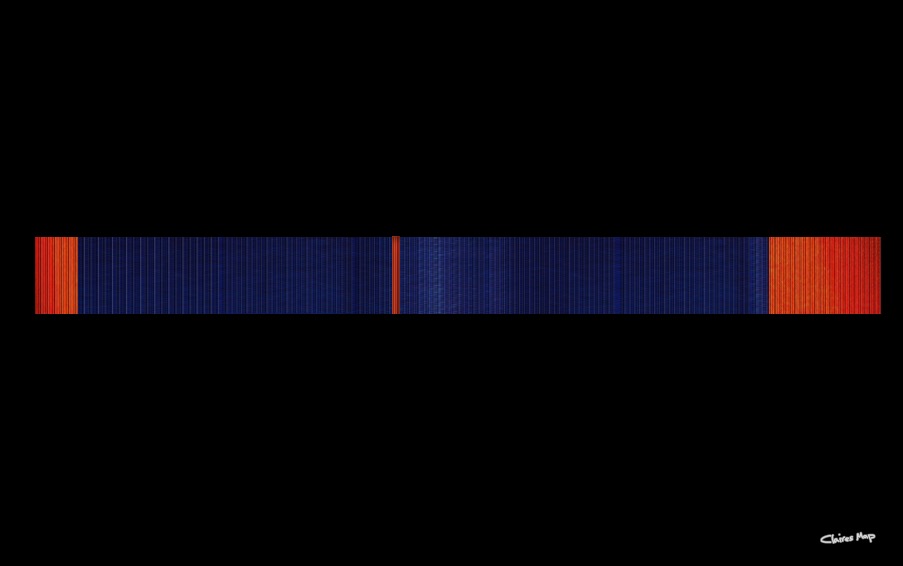
C. had attached a very large, rectangle of black card on the wall. It was in landscape format and across the middle, horizontally, ran a c.4cm strip of paper which was covered in dozens of identical, narrow vertical stripes of red, orange, light blue and dark blue. It looked like a beautiful spectrogram. In the bottom right hand corner was written  ‘C’s map’.  I remember staring at this with a colleague and wondering what did this map represent. Eventually, we called C. over and asked her to explain. It turned out that she lived about 2 miles from LIPA and it was a very cold day when she started making the map. What she had done was to walk from her warm bedroom, through the cold streets to LIPA taking a temperature reading every 20m or so. The different colours represented different temperatures. Red/Orange = warm, Light Blue/Dark Blue=cool/cold. When we asked what the warm strip right in the centre was, C. answered that her measured steps had taken to her to a hot air outlet of a shop.

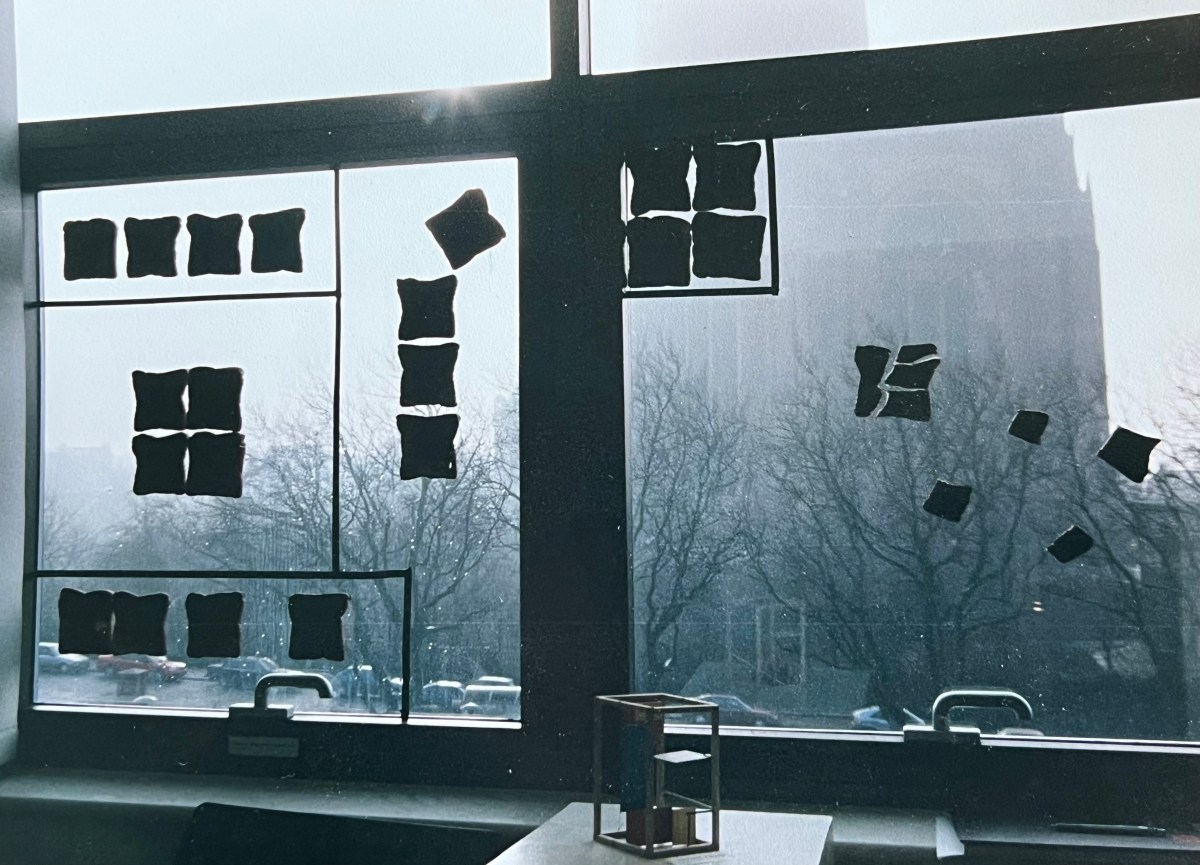
T. had really struggled with the Black Square problem. Just couldn’t get his head around it. Sitting at breakfast a day or so before the exhibition opening, he was pondering the problem to the extent that he forgot he’d put a slice of bread in the toaster. Suddenly out popped a square of blackened toast. It was one of those Eureka moments. T. had found his solution to the black square problem. His solution consisted of illustrating the words using a series of four pieces of square black toast stuck to the windows of the exhibition space. 

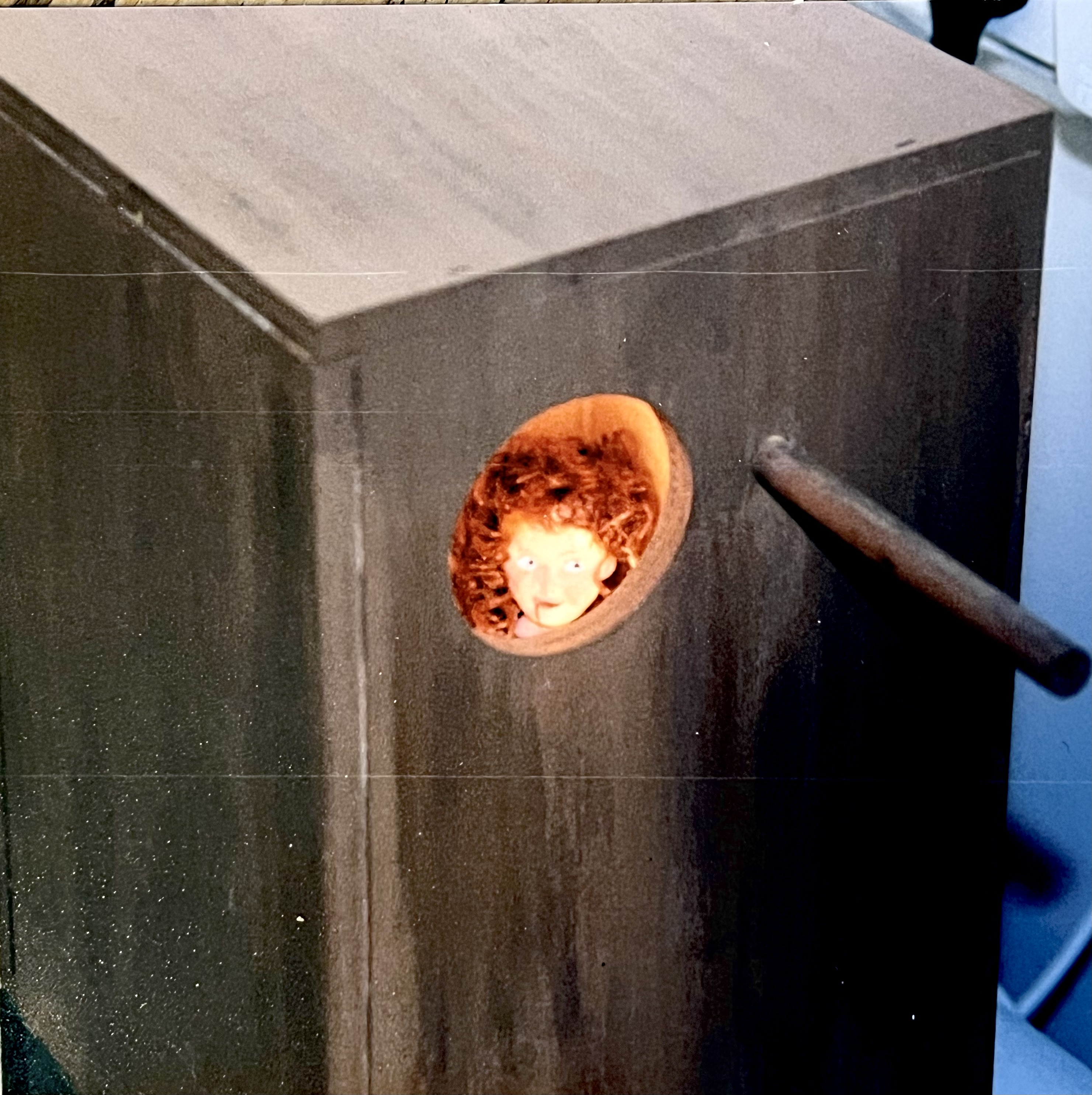
The exhibition opening was a great success. All the students managed to produce a creative solution to each of the problems…some of them truly extraordinary. There were 2D works, 3D works, video, audio, animation. Some made one laugh. Others, particularly some of the self-portraits, were rather disturbing. The strange, bloodied doll in the box which had a peep hole haunts me still! 

Art work. Wooden bok with peep hole. Through the peephole you see a doll sitting in the corner of the box, with a dribble of blood coming from her mouth.

All the art works were presented and lit beautifully. The purpose of the whole enterprise was, of course, nothing to do with the actual problems or the exhibition of work. It was all about confidence, enabling the students to realise that not only did they have some wonderful creative ideas but they could work on their own and create and produce wonder-full work.

The offer of the exhibition was key to getting the students motivated and committed to the project despite there being no assessment. The exhibition made it clear that we valued their ideas and the work they produced. Too often, work into which students have poured their heart and soul is simply handed in or submitted electronically without even a ‘thank you’. I recall one department in another institution where essays and dissertations were simply posted into a box fixed to the wall near the departmental office. 

The six visual problems project demonstrated that if you create interesting assignments and make it clear that you really care about the work students produce, assessment isn’t a given. In recent decades, higher education has developed to the point where the culture is one of ‘if it moves, assess it!’. The solving and exhibiting of the six visual problems proved that need not, necessarily, always be the case.

Could we get away with it now? 

Performing assessment: are you an assessment Cavalier or Roundhead (or Innocent)?

There I am, sitting in my favourite balcony seat in the institute’s auditorium, pen in hand, notebook discreetly balanced on my knee, preparing to watch and assess a performance by final-year performing arts students.

Not only am I audience and critic, but examiner too: I have to assess and assign individual grades to each of those students.

As the show is late going up (do I have to assess that as well?), I have time to consider just some of the variables and imponderables around the assessment of performance. The students may be acting and/or singing and/or dancing and/or playing instruments. The text may be extant or devised. The success of the performance will depend on a team effort – both onstage and offstage – yet, I am required to assess and grade each individual. The visual and acoustic environment may enhance or hinder the perception and reception of the show. The director may have been able to encourage each individual to work to their maximum potential – or they may have destroyed any creativity and enthusiasm.

As the prospect of a list stretching to infinity and beyond looms, I am grateful that the house lights dim and I am eager but nervous about handing out assessment justice to each of the individuals who contributed to the production.

I am comforted by the thought that there is another member of staff (or two) sitting somewhere else in the auditorium also with a notebook and with probably the same thoughts, and there are colleagues in dance, drama and music departments around the country grappling with the same issues.

How do we do it? On what basis? And is it valid or fair or reliable anyway?

My fellow academic assessors and I seem to divide into three main sub-groups:

There are the assessment Roundheads: those fully committed to the assessment world order of modularisation (dividing a programme of study into easily digestible chunks); explicitly stated learning outcomes (making sure the student and the teacher both know what they are aiming towards and what the student is expected to achieve); and criterion-referencing (a set of clearly defined standards against which the student’s work is assessed).

Assessment for the Roundheads, is generally a matter of ensuring that the protocols and criteria are properly set up in the first place, and then following them using one’s professional skills as an educator and practitioner.

Then there are the Cavaliers: those who believe that creativity and artistic endeavour cannot simply (or complicatedly) be reduced to sets of protocols, learning outcomes and assessment criteria. They prefer approaches such as holistic assessment, allowing provision for unexpected outcomes and non-conformist processes, and, in some cases, involving the students in their own assessment and that of their peers.

Lastly, there are the Innocents: often highly experienced and skilled professional practitioners who have recently entered what appears to them to be the overly bureaucratic, esoteric, parallel universe of assessment in higher education.

No longer can their critique of a performance or performer be contained in the cliched and stereotypical “You were wonderful, darling” type of comment. They now have to assess and grade individuals, use assessment protocols, provide detailed formative and summative feedback, and justify their marks to external examiners and assessment boards.

As I sit in the balcony watching the show and attempting to scribble down some notes in the darkness that will be at least partly legible in daylight and, after 15 years of teaching, assessing and chairing various assessment boards, I am certainly not among the innocents. But am I an assessment Cavalier or a Roundhead?

My natural instincts are those of the Cavalier. I know that there is something about good and particularly great work that resists categorisation. It goes by various names such as “the tingle factor” or “the wow moment”. It is that individual or collective feeling that one is experiencing something out of the ordinary (which is surely one of the qualities art aspires to) and that, at the same time, resists description or explanation. Yet, I also know that way subjective madness lies and, in extremis , assessment can consist solely of the preferences and prejudices of individual tutors.

So I put aside the plumed hat and put on the solid helmet of the assessment Roundhead. I immediately feel on safer ground. I have the module handbook, which lays out in precise detail what is expected of the student, what the expected learning outcomes are, what the assessment criteria are, the weighting percentages and the grading criteria. Using the assessment pro forma that has been provided, I can go down the list of criteria statements and, using my knowledge, skills and experience, I can answer questions such as “To what extent does the student demonstrate x, or, y, or z?” with a range of answers from “not at all” to “excellently”.

Turning to the grading criteria, I can then convert my various responses into a number. I can add up all the numbers, apply the weightings (if any) and arrive at a total. I finish by writing some constructively critical comments in the box provided.

This approach satisfies everybody. The students each get a piece of paper with marks and comments that they can share and compare with their peers.

There is also a sense that the tutors are working off the same assessment “script”.

The tutor, under the time pressure of at least dozens if not hundreds of assessments, has got a clear system to work within and to.

The institution can demonstrate that assessment is open and transparent and that there is an assessment paper trail that can be audited by any external body. It also has comprehensive documentary evidence in the case of any appeal.

And the parent – who increasingly has a financial as well as a familial interest – can see that their investment is being taken seriously and is reaping dividends.

So where is the problem?

“Surely,” the Roundheads state with some justification, “this is a far better, fairer, more reliable, more valid and more transparent approach than the old ‘I-feel-a-first-coming-on’ days.”

It is hard, admittedly, to argue against a view that fits so well in an educational world view that always has one eye firmly fixed on Quality Assurance Agency visits, funding council audits, reviews and such like, and that is constantly playing to a gallery in which government perceptions of and policies towards higher education are prominent.

The nagging doubt about all of this centres on those treacherous terms “creativity” and “innovation”. If the teaching of performing arts is about working within rather than extending or working beyond existing forms and boundaries; if it is based around the development and application of craft skills; if it works within and to accepted notions of good practice, then the Roundhead approach is undoubtedly the correct one.

But, if the deserved reputation for creativity and innovation in the arts that this country enjoys is to be maintained, then it might just be that we need some of that creativity and innovation applied to the way we teach and assess those who will become the artistic creators and innovators of the future.

One thing is certain: the collective experience of hundreds of tutors assessing students in performances of different types of dance, drama and music over many years, in many different venues and circumstances, amounts to a vast reservoir of knowledge, experience and skill.

Despite the differences in philosophies, methodologies and practices of assessment, I am always impressed by the immense care, concern and thought of my colleagues around the country, and their willingness to engage in free and open debate.

So, as the applause dies, the house lights come on and I head for the bar before I attempt to decipher my hieroglyphs, I consider that, actually, when it comes to assessment we are certainly worth a 2:1 at least.

(This article first appeared in the Times Higher Education)