Higher Education, Creativity and the German Minister (+Coffee & Pastries)

Some years ago, before Brexit,  I happened to be standing and chatting to the then German Federal Minister for Education. We were in the (long) coffee queue during a break at an ELIA (European League of Institutes of Art) conference, the theme of which was the future of arts higher education in Europe in the light of Bologna, and he had just given a keynote address.

I  thanked him for his keynote, and he asked me my name and where I was from, and what what I did. When I said I was from the UK and worked in higher education performing arts, he smiled and said “Ah, the UK….”

There was a pause.

Then he said, as we shuffled down towards the coffee and pastries: “Let’s put our differences to one side for moment. I have have a serious question for the UK. For the past 40 years or so, your economy has not always been in the best shape – to put it mildly. Yet during that period you managed to lead the world in areas such art, design, fashion, music, theatre,  etc. Over the same period we have had a relatively successful economy but, with a few exceptions, have produced nothing like that sort of consistent, high-level creative output. So, my question is, what are you doing, or perhaps NOT doing, in your education system that enables that sort of creativity to flourish?”

Standing there, eyeing from afar the rapidly diminishing plate of pastries, I did not have a clear, rigorously-argued, well-researched, evidence-based answer to give him. But two thoughts did occur, then I added a third which, on hindsight, perhaps I should have avoided.

I said to him: “I do think it may have something to do with our long tradition of non-conformity, of sticking two fingers up to authority, and also our high tolerance of eccentricity. We like our mavericks and eccentrics……”

I should have stopped there but added “…..neither of which – in my limited experience – you have in Germany”.

At which point we had reached the coffee and the few remaining pastries.

The minister frowned and simply said: “Ah, interesting” and we went our separate ways.

I often think about that conversation as I witness the virulent spread and baleful effects of compliance, conformity and standardisation throughout our systems of learning and teaching. Of course, given our traditions in the UK, many do stick two-fingers in the air and manage to develop and provide wonderful, creative learning experiences. But all too often they occur despite not because of the systems in place, and  they frequently happen in isolation. So,  while eccentricity and creativity still survive and occasionally thrive, we keep quiet about it, hoping that ‘they’ won’t notice the students having a wonderful time and learning a great deal, while ‘they’ obsess about ensuring that the institutional metrics will pass muster, that the quality assurance boxes are appropriately ticked,  that the student ‘customer surveys’ return the ‘correct’ results, that the data to put in the Key Information Set shows shows the institution in the best possible light. It’s worth remembering that KIS also means Keep It Simple!

On Creativity: is ‘might’ the answer…as well as the question?

The eminent, and now sadly departed, educationalist Dorothy Heathcote used to say that the most powerful word in education is the word ‘might’.

Asking a student ‘what MIGHT be the answer?’ rather than ‘what IS the answer?’ opens up the possibilities, the questioning, the pondering, the wondering….the creativity.’

Our handbooks say things like (and I know, because I’ve written them as well) “On the completion of this module/course/program the student WILL be able to demonstrate a, b, c, d…..”We don’t write “On completion of this module/ course/ programme the student may be able to do THIS pretty well, but they also might be able to do THAT even better, and what’s more, they may be able to do stuff we haven’t even though of yet”.

But that sort of language and thinking doesn’t go down too well at the validation board, or with the quality assurance people, or with the policy makers, who require everything to be identified, categorised and pinned down, like a collection of dead butterflies.

How can we/do we – in education – break out of the ever tightening circle of predict and provide, control and compliance?

* * * * *
(Dorothy Heathcote’s obituary in The Guardian)

Zen and the Art of Curriculum Maintenance

Like many, I am fascinated by Japan and Japanese culture. That fascination, in my case, goes back a long way. My father used to do business in Japan and often visited with my mother. We had Japanese art and artefacts in our house and we often hosted Japanese students who came to study here in the UK. I’ve also had the opportunity to visit Japan myself in the course of my work.

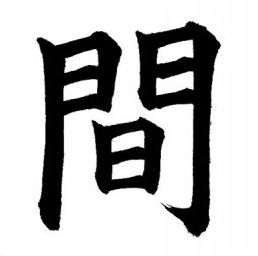
I recently watched James Fox’s series of documentaries about Japanese art and culture and also Monty Don’s programmes about Japanese gardens and garden design.  Both presenters commented on the importance of the Japanese idea of ’Ma’ – often  translated as ‘negative space’ but it is much more than that. One way of understanding ‘ma’ is as the space between tangible things that gives those things meaning. It is not so much empty or negative space, but rather it a space full of energy, potential and promise. The character for “Ma” (間) combines the character for “gate” with the character for “sun” – an image of light beaming through the empty space of a doorway. 

One of Britain’s most influential post war graphic designers, Alan Fletcher, refers to Ma in his introspective book The Art of Looking Sideways

“Space is substance. Cézanne painted and modelled space. Giacometti sculpted by “taking the fat off space”. Mallarmé conceived poems with absences as well as words. Ralph Richardson asserted that acting lay in pauses… Isaac Stern described music as “that little bit between each note – silences which give the form”… The Japanese have a word (ma) for this interval which gives shape to the whole. In the West we have neither word nor term. A serious omission.”

Attic Late Geometric IIa high-necked pitcher, c.735-720 BC Ashmolean Museum, Oxford, UK / bridgemanimages.com

In the western tradition and culture we have nothing like the idea of ‘Ma’. Instead, we dislike a void, and tend to fill it. One of the few things I remember from my student art history days are the large, ancient storage jars called Attic Vases. They are often covered from head to toe in decoration. The reason for that was the belief that the Evil Eye enters through empty space. Perhaps that notion is still hidden deep within our Western psyche? 

Having trained as a designer and with my interest in things Japanese, when I started working in higher education I was immediately struck by the fact of just how busy our curricula and timetables are. It’s as if we are afraid of leaving ‘empty space’. Why? In case students get up to ‘mischief’? 

Rather than filling the curriculum and timetable void, what if we designed them incorporating the idea (and actualité) of ‘Ma’. Designing in the ‘empty/negative’ spaces that help to make sense of the whole, providing the time and space to step back, to think, to reflect, to make, to create.

Reflection: schooldays, sitting quietly and making marks on paper

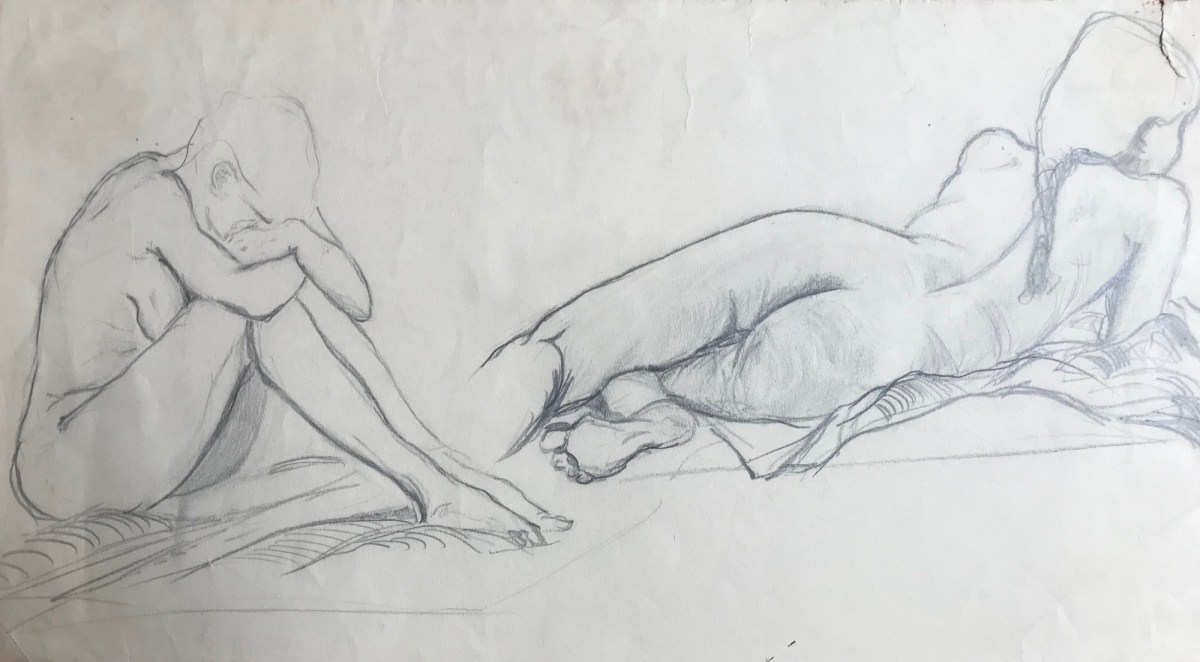
My first attempt at life drawing c. 1968

During a conversation about education with a colleague who is an eminent and well-respected professor of education, he said vehemently ‘I hated school’. Now he and I are probably of a similar generation, but my school experience in the 1960s was rather more positive.

I went to a rather academic boy’s grammar school in London, where corporal punishment had been abolished some years previously. The focus was very much on getting into Oxbridge or at least a ‘decent’ redbrick university. I, however, was interested in becoming an artist.

The art room – run by Mr. Potter – was located at the far end of one wing, up in the roof space. It was, nevertheless, a light and airy space and I enjoyed the many hours spent in there. I wanted to do Art for ‘A’ level and to go to art school. The problem was that the ‘A’ level requirements at that time were stultifyingly restrictive (I don’t think they’ve changed much). One of the requirements was a still-life painting, and I distinctly recall Mr. Potter looking at my somewhat surreal and expressionist rendering and saying, sympathetically, “That’s very interesting, but that will never do”. 

When I asked him why, he explained that the A level required an ultra-realist painting. Any other approach would be deemed a failure. But he then said, encouragingly, that if any of the great masters of modern art, the Cubists, the Expressionists, the Surrealists, the Fauves etc had taken ‘A’ level art, not only would they have failed but there would have been a demand for psychiatric testing!

At this stage I knew that the school and the requirements of the exam board were unable to support me in creating a decent portfolio of work to get into art school.

So I went to see the Headmaster: a kindly, liberal man and a much respected leader and teacher. The school was a rugby playing school (I was actually a very good fly-half at the time) and everything stopped on Wednesday afternoons for sports. Not far from the school, in north London, was the then renowned Camden Institute, which had a wonderful reputation for its adult education art classes led by established artists.  I asked the Headmaster if, instead of running around the rugby field on a Wednesday afternoon, I could attend the Institute’s art classes. He agreed on the proviso that I would occasionally show him the work I was doing.

Walking into and taking part in the life class studio on my first visit was a revelation. I don’t think I’d seen a fully naked woman before except in paintings (we also had male models) but not only did I feel immediately welcome and at home, but the whole experience of sitting quietly at an easel, observing the life model very closely, and making marks on paper was extraordinarily powerful. The only sounds in the room were the slight hiss of the gas fire near the model, the occasional sound of charcoal scraping on paper, and the hushed conversation of the tutor and whoever he was talking to.

Fifty plus years later, I still use that ‘sitting quietly, observing or thinking, and making marks on paper’ in my own work, and in the workshops and seminars I run.

‘Keep on the Grass’: changing the language of education

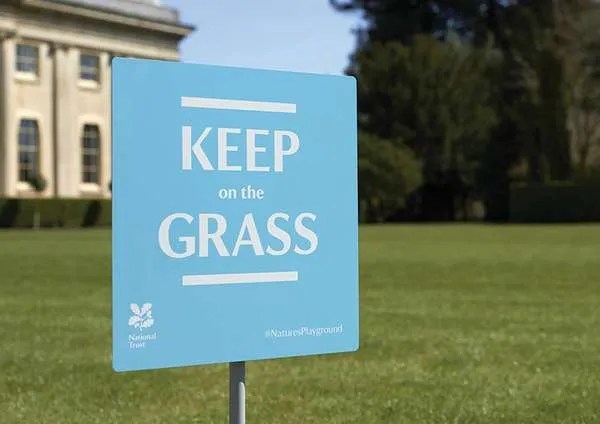
If you visit a National Trust property here in the UK, you will often see signs saying things like ׳Keep off the Grass’, ‘Don’t Touch This’, ‘Don’t Touch That’, ‘Keep to the Path’. It’s all in the negative and proscriptive. But, in a few places, as an experiment they kept the signs but changed the language. Now it’s Dos instead of Don’ts accompanied by some encouraging words.  Rules are there for a reason, but rather than focus only on what people can’t do, try to point them in the direction of what they can do. If you need to impose a restriction zone, for example around a fragile object, then simply explain why and direct visitors to where they can take a closer look at the detail (for example, online). People tend to be more relaxed and understanding when they feel informed and can make a choice.

There was a recent short exchange on Twitter with an HE colleague looking for better word or words than ‘Delivery’ in regard to teaching and learning. I distinctly remembered the late Ken Robinson wondering in regard to the obsession with ‘delivery’: “When did education become a branch of FedEx?”

In my own research into creativity in higher education, when I asked colleagues from across a whole range of disciplines, for the words and phrases they used to describe creativity or being creative in regard to learning and teaching, the top twenty words and phrases contained words that never appear in programme or module specifications or any Teaching, Learning and Assessment strategies.

Words like joy, play, fun, passion, excitement, adventure and let’s admit they sit alongside words like anxiety, stress, disorientation, which are also part of learning.

Learning and studying should involve all of those…..and so should assessment.

So, instead of hitting students as soon as they start with dire warnings about plagiarism and cheating, let’s talk about integrity, trust, responsibility, partnership, collaboration, and so on.

I’d also like to suggest that we stop using the word failure. It’s such a loaded word. Much better, in my own mind and practice, to be able to say to a student: “OK, that didn’t work, and here’s why, but what have you learned from the experience? And design an approach to assessment that rewards the learning instead of penalising the so- called failure.

So, returning to the idea of ‘Keep on the Grass’ and extending the metaphor, perhaps it would be much better for everyone if we start seeing and talking about higher education as less like a machine for learning and more like a garden and words like growth, flourishing, blossoming, ecology and transformation.