“A picture is worth a thousand words” is an old, careworn cliché but it still holds true….to an extent.
What is undoubtedly true is that the human brain processes visual images thousands of times faster than text. A well-chosen, striking image placed in the appropriate context can be very powerful, thought-provoking and, importantly, memorable, linking the image with the content.
Image by Michael Heiss via Openverse
What is also true is that, while PowerPoint rules in higher education, its use is often limited to that of a glorified OHP i.e. the projection of (sometimes lots of) words on a screen. ‘Death by PowerPoint’ is a very real phenomena.
Image by Beate via Openverse
Searching for help
If you search online for a subject such as “How to improve your PowerPoint presentations” you will find dozens, if not hundreds, of ‘How to’ guides. The various recommendations tend to coalesce around a few key recommendations.
Image by gruntzooki via Openverse
These recommendations include:
Don’t simply read out or repeat what is on the screen
Make diagrams and charts interesting but not self-explanatory
Strike a good balance between the verbal, the written and the visual
Keep the number of words or bullet points (or images) on screen to a minimum
Good visuals alongside a clear explanation can help to communicate complex ideas
Turn bullet points into visuals 👇
Eyes image by Alec Couros via Openverse, adapted by Paul Kleiman
Keep It Simple
Somewhere around the middle of the last century someone in the US military coined the phrase “Keep It Simple, Stupid” or KISS for short. The idea behind it is that most things work best if they’re kept simple. Unnecessary complexity gets in the way of purpose and should be avoided. It’s probably no accident that the term has a military provenance as, in that environment, it’s incredibly important to send and process often complex information quickly and without ambiguity.
The KISS principle (or Keep It Short and Simple or Keep it Simple and Straightforward for those who don’t like the ‘stupid’ part) has since been adopted by anyone who needs to relay information – no matter how complex – effectively, efficiently and, above all, memorably.
Image by iNKMan_ via Openverse
Students are visually discerning and visually sophisticated. So it’s important to bear in mind that anything projected onto a screen becomes a visual medium, and the principles of good visual design apply as much to a PowerPoint presentation as to anything else one sees on screen.
These two slides – good design is aesthetic and good design is minimal – from my presentation on the Ten Principles of Good Design are examples, I hope, of keeping it simple as well as conveying some key points which are enhanced by the verbal explication that accompanies the slides.
Slides (c) Paul Kleiman
Where to look
So where can we find images that are guaranteed free-to-use?
There are, thankfully, a number of websites that provide access to millions of images that are free to use, also known as CC0 (Creative Commons Zero). These include: Creative Commons, finda.photo, Freerange, Gratisography, Images of Empowerment, Pexels, Pikwizard, Pixabay, Stocksnap, Unsplash.
Image by ZEISS Microscopy via Openverse
Particularly useful is the image search engine Openverse https://search.openverse.engineering/ It enables you to search through over 600 million free-to-use images most of which simply request that you credit the creator. It also offer you links to other search engines if you still can’t find the right image.
Screen grab image by Paul Kleiman
Time
“I haven’t got the time to search for and insert nice images or to edit my presentations to make them visually interesting”
Everyone is under often immense pressure, and the reluctance to engage in yet another time-consuming activity such as searching for good images to use in presentations is entirely understandable. But if it means that the important and valuable information you want to communicate really ‘sticks’, then it is probably time well spent….and the more you do it, the easier and quicker it gets.
Image by James via Openverse
I would suggest gradually building up your own ‘library’ of images which is located in a folder on your desktop or tablet. You know your subject, so when you come across an image that you think might be useful, stick it in the folder. BUT….(here speaks the voice of experience!) remember to make a note of where/how you found it, who created it and how they want to be credited. That will save you a great deal of time and frustration when you actually use the image.
Image DIY
You can, of course, create your own images! Our homes and surroundings provide an infinite number of photographic possibilities and most mobile phones have excellent cameras and there are many free photo editing apps. The main advice for presentation images tends to focus on close-ups and dramatic or striking images.
This photo was taken on a cycle ride that took me under a pylon. I happened to stop and look straight up and was immediately struck by what I saw. Using simple editing tools I changed it to high contrast black and white.
Image (c) Paul Kleiman
Good visual design and inclusivity
Image by cogdogblog via Openverse
Is creating a visually striking, memorable presentation compatible with the diverse requirement for inclusivity? The answer is a definite ‘Yes’!
A number of those requirements e.g. number of bullet points, font size etc. are about keeping it simple. The technology also provides the ability to read slide captions and descriptions (if you put them in), notes pages can be printed and published beforehand, audio can be recorded over the slides, QR codes can be used to link to the presentation and other material.
Good design takes time and effort. Making good design inclusive should be part of that time and effort.
Arresting images
One of the concerns in regard to using images is about infringing copyright, and it is worth bearing in mind that most images that you come across on the internet (or in books) are copyright protected. None of us and, particularly, our institutions, want to break the law by using copyrighted material we aren’t allowed to reproduce.
Image by deBurca via Openverse
There are, however, the ‘Fair Use’ provisions* that allow copyright works to be used for educational purposes. These include:
Showing copyright works in an educational establishment for educational purposes. However, it only applies if the audience is limited to teachers, students and others directly connected with the activities of the establishment. So, a lecture to students in a lecture theatre is covered by fair use, but a conference presentation in a conference venue isn’t. Whether uploading the presentation to a secure VLE is permittted is a moot point. Uploading to a publicly accessible website is not permitted.
The copying of works in any medium as long as the use is solely to illustrate a point, it is not done for commercial purposes, it is accompanied by a sufficient acknowledgement, and the use is fair dealing. This means minor uses, such as displaying a few lines of poetry on an interactive whiteboard, are permitted, but uses which would undermine sales of teaching materials are not allowed.
While you may use copyrighted images in a perfectly legal way under the ‘Fair Use’ provisions, difficulties can arise if, for example, a student videos or takes photos of your presentation and those copyrighted images and then posts them on social media or in a blog. So it’s far better to play it safe and, wherever possible, use images that you cab be sure are genuinely free-to-use.
So, is a picture worth a thousand words? Here’s a test: if you’ve got as far as here, close your eyes and think about the content of this blog and the various sections. Do the images help you to recall the content?
This is the full transcript (with slides) of my end-of-conference keynote address at the International Assessment in Higher Education (AHE) Conference held in Manchester, UK in June 2023. The keynote video is available here: https://youtu.be/nZbxDv3qqlA3 .
Thank you, for that kind introduction and thank you to the conference for the invitation to speak today. Given the many tremendous presentations and sessions over the past couple of days, there are a lot of very hard acts to follow!
Thinking about this presentation and trying to present something coherent has been like trying to build a house during earthquake. The tectonic plates on which higher education is built are moving dramatically, and is there any safe ground? So, what follows is, I realise, a rather non-linear, almost stream-of-consciousness set of thoughts and ideas about learning, teaching and, particularly assessment.
When I used to Chair an institution’s Exam Board, responsible for progression and awards, I regularly used to experience a sort of cognitive dissonance. Faced with page after page of student ID numbers, names, and a seemingly infinite array of rows and columns filled with numbers, I felt a deep sense of disconnect between what I was looking at and my day-to-day experience of working closely with those same students, discussing their work and their hopes and fears, their successes and disappointments.
Nowadays, when I explore assessment with colleagues I often start a session with finding out how they feel and where they are in regard to assessment, and I ask them to illustrate that by drawing or making marks on paper and then give them no more than 30 seconds to explain what they have drawn. The task not only energises the room at the start of an intense few hours but is also very revealing about attitudes towards and feelings about assessment. It also, puts paid to the “oh, I can’t draw” response. No matter which disciplines are represented by the participants, there is always an interesting, revealing and creative response.
These are just a couple that really stick in my mind and which, in a way, relate to my title and theme.
The individual who drew this said: “This is where I’m at regarding assessment. At its best, the work of my students is expansive! Multi-dimensional and multi-coloured. Dynamic and non-linear. This is how I sometimes feel when I come to quantify (assess) a student’s work – like I’m funnelling a wild and wonderful rainbow into a grid better suited to a game of noughts and crosses.”
And the individual who drew this said:
“This is my big black hole of confusion. It sits at the bottom of all my feelings of assessment. The deepest darkest part is numbers grades. I can write feedback articulating my views, but putting a number to it, seems almost impossible. Objectively, the better students should get a better grade. But what about learning journeys?”
So to begin….If a week is a long time in politics, then a year in higher education is an eternity. When I was invited, shortly after last year‘s conference, to give this keynote address or provocation we were sort of returning to what we might call the post-Covid ‘new normal’ in higher education. The idea that I presented to the conference committee was about how assessment had changed during Covid as we realised that assessment processes, protocols and procedures that had been assumed to be graven in stone, were, in fact, mutable “oh, we can do that!”.
Things changed and changed fast out of necessity. There was a veritable explosion of innovation and creativity in regard to assessment. Digital transformation occurred right across the sector during the pandemic. We learned important lessons about equity, about learning design and about interoperability. We saw success stories and consistently high levels of student attainment. Thankfully we moved away from traditional unseen exams to other forms of assessment that saw many students, particularly those from disadvantaged backgrounds, perform better.
The danger was always going to be, now that we were back in the “new normal“ was that we and our institutions would simply snap back to the old ways of doing things.
Paul Trowler writes about all institutions and organisations having ‘engrooved practices’. Those deeply embedded, social and cultural practices and norms that are so familiar and, to some extent, comfortable , that no one really challenges them. Occasionally, some new exciting innovation that looks like it may well enhance learning, teaching and assessment comes along, and enough people say let’s give a go’ and they give it a go.
The thing about engrooved practices is that they really are deeply embedded, not just in the social and cultural norms of the institution or faculty or department but often also in the minds and psyches of many people within the institution. It’s like they are part of the DNA of the institution, and we know how hard it is to change DNA. So something new, exciting, innovative comes along and some people get really excited about it. “This is the best pedagogic thing since sliced bread.” But unless this new exciting innovative thing becomes not only accepted but embedded within the systems and processes of institution, it remains ephemeral no matter how successful, and it can easily disappear as people snapback to the familiar and comfortable ways of doing things. Or the individual or individuals involved in it move on either within the institution or to another institution.
We have heard about and seen some wonderful, creative, innovative approaches to assessment these past two days….and I’m sure we’ll all leave here full of inspiration and good intentions….but…and it’s a very big BUT ….what happens when we return to our institutions and those pesky engrooved practices and attitudes?
So, that was essentially my starting point for what I was planning to say a year ago, and which I had titled “I am not a number!“; reassessing assessment“.
A year on, I have to say that while the reassessing assessment bit still holds, if I had been asked now to provide a title, it would have been something along the lines of “I am a not a stochastic parrot: reassessing assessment”.
I am, of course referring to last November and the appearance of ChatGPT (or, as an Australian colleague refers to it, ChattieG) and the academic and moral panic that ensued on its public release.
A glance at some headlines gives a flavour of the mood at the time:
ChatGPT is making universities rethink plagiarism!
Chat GPT: a tool for teaching or cheating?
Universities fear cheating epidemic
Chat GPT has universities in emergency mode to shield academic integrity.
EXCLUSIVE: ‘Half of school and college students are already using ChatGPT to cheat’: Experts warn AI tech should strike fear in all academics
I was half expecting to come across a headline that went something like CHATGPT DRIVES A STAKE THROUGH THE HEART OF ACADEMIC INTEGRITY
And we have seen universities reacting in very different ways. Like any crime prevention strategy, the pendulum has been swinging wildly between, at one end, a punitive hang ‘em and flog ‘em type of approach to cheating, at the other end, let’s understand it, let’s acknowledge it, let’s use it genuinely to enhance teaching, learning and assessment.
And if you’re wondering about the ‘Stochastic Parrot’ bit, it comes from the title of an influential and controversial 2021 paper by Emily Bender, Timnit Gebru, Angelina McMillan-Major, and Margaret Mitchell,
A stochastic parrot is an entity “for haphazardly stitching together sequences of linguistic forms … according to probabilistic information about how they combine, but without any reference to meaning.” The paper covered the risks of very large language models, regarding their environmental and financial costs, their inscrutability leading to unknown dangerous biases, the inability of the models to understand the concepts underlying what they learn, and the potential for using them to deceive people. The paper, controversially, resulted in Gebru and Mitchell losing their jobs at Google….but that’s a story for another day. Though the parrot may appear later.
As an aside, a couple of descriptions of ChatGPT or ChattieG, I’ve come across.
This by Prof. Inger Mewburn in her definitely worth reading blog The Thesis Whisperer:
Generally, the best way to use ChattieG is to imagine it as a talented, but easily misled, intern/research assistant who has a sad tendency to be sexist, racist and other kinds of ‘isms’.
And this, by a Senior Lecturer colleague I interviewed recently:
It’s by far the best thing since the internet! The benefits to me and my students are incalculable….and it really levels the playing field for disadvantaged students.
And if you think that generative AI is all about the written word, think again! As we’ve seen, images, artworks, music, posters, powerpoint presentations can all now be produced by Artificial Intelligence…..though I have heard calls for it be called Augmented Intelligence or Assisted Intelligence.
Going back to my original theme, Covid demonstrated conclusively that we can adapt and change our approaches to assessment. The extent to which those changes have been adopted across the board and embedded within institutional systems and protocols is a moot point.
One thing that changed quite dramatically, as we shifted to permanent online, was the relationship with students. There were some very interesting papers and ideas around what was termed “the intimacy of Zoom…or Teams”.
Larry DeBrock and colleagues wrote;
“ that student, who is sitting far enough away in the lecture hall that you can’t quite read her expression amid the proverbial, sea of faces? When you call on her in a live zoom session, she pops up right in front of you, one on one, looking you straight in the eye. There is no backseat in online education. Every student is in the front row.“
There’s a funny thing about front rows. If there’s a choice, no one likes to sit in the front row. Whether it’s a classroom, a lecture theatre or a conference presentation.
When I worked in touring theatre, doing performances in all sorts of venues like community centres and village halls, we used to put out a false front row of seats, knowing that nobody would sit in them. Just as everyone was seated and the show was about to begin the stage crew would remove the front row of chairs – much to people’s shock and amusement -to ensure that we did actually have people sitting in the front row.
But I digress…well, a bit.
The point is, and you may well object to the comparison, the one thing that a performance to an audience in a village hall has in common with teaching, learning and assessment is that it is about relationships, establishing a rapport with others, the very human act of engaging with and communicating with another person or persons.
Those of you familiar with my work will know that I have banged on for years about the word assessment deriving from the Latin ‘Ad Sedere’ – to sit together. Involving students actively in assessment, not just viewing them as objects of assessment, but as agents of and in their ownassessment.
And I’ll be coming back to this later.
But we still hold on to that idea of sitting together at PhD level but have lost it at undergraduate level, due to the massification of higher education and the quasi-industrial/ commercial/ marketised model that has developed as a consequence in which students are regarded as fee-paying customers and given a customer number, (we’re back to “I am not a number!”) but actually are treated more like units to be acquired, processed and produced, with rigorous quality mass testing at every stage of production.
The way we assess and how we assess is all part and parcel of the capitalized, marketized version of higher education that is now so dominant that it’s hard to imagine that there might be an alternative. It is an engrooved model.
It’s a model in which students are both units of production and objects of assessment, replete with individual ID numbers and batch numbers for their particular year group, and it should come as no surprise that students understand – either explicitly or, more likely, implicitly – their role and function inside that model: which is to succeed. And it really should come as no surprise that within a model of higher education predicated on a sort of ‘winner takes all’ version of success that students will be tempted to do whatever it takes to ensure that success. So we enter this eternal game of, on the one side, ever more sophisticated ways of cheating and, on the other side, ever more sophisticated and expensive ways of preventing or spotting the cheats.
Covid severely disrupted that model, but didn’t fundamentally change it. Students could no longer be regarded as a class (pun intended) or units or a set of ID numbers. No longer could we require students to gather together en masse outside and inside examination halls. One of the ironic consequences of lockdown was that it forced us to regard and deal with students as individuals – all sitting in the front row – all with their individual needs, hopes and fears but, at the same time, in regard to assessment trying to meet the requirements of validity, reliability, inclusivity and equity etc.
Then, just as we’re settling back into normal educational service is resumed, we hit another massive interference: this time it’s Generative AI in the shape of ChattieG and its fellow travellers. And now assessment is really in trouble!
I suppose the big question is…is the HE model that currently reigns supreme sustainable?
The famous lines from W.B. Yeats comes to mind:
Things fall apart: the centre cannot hold (from ‘The Second Coming’)
There is also this quote from Antonio Gramsci:
The crisis consists precisely in the fact that the old is dying and the new cannot be born; in this interregnum a great variety of morbid symptoms appear (from ‘Prison Notebooks’ – Notebook 3)
I trained and worked as a designer before stumbling into teaching, and one of the things one learns as a designer – often very painfully – is that there comes a point where it is futile trying to further change, adapt, tinker with an existing design. You’ve got to have to courage to scrap it and start again or, at the very least, undertake a fundamental re-design. Of course, for very understandable reasons, we are really bad at doing either of those things in higher education. Even if we had the will, we rarely, if ever, have the time or resources to engage in such an undertaking.
If, like me, you happen to own a boat – in my case it’s an old narrowboat – that’s it in the photo – you will know that even the best designed vessel, after weeks and months in the water, gathers barnacles and other things around its hull.
Eventually what originally cut through the water and was a pleasure to sail or steer becomes heavy in the water, difficult to steer, a makes slow progress. The same applies to what we do. Even the best designed learning, teaching and assessment strategy gathers ‘barnacles’ over time: a new module here, new content there, new assessment changes everywhere, etc. It gets heavy in the pedagogic waters. Sally Everett, yesterday, talked about wading through treacle.
In the case of a boat , the answer is to take it out of the water, put it into dry dock, scrape off the barnacles, undertake a complete overhaul and, if necessary, refit.
But we can’t do that with our curricula and our learning, teaching and assessment strategies. We don’t have the time or resources between one cohort leaving and the next cohort starting. So often what we do – through programme review – is tinker…..with the result that often we end up not only moving the barnacles around instead of removing them but actually adding more!
So what MIGHT we usefully and positively do in the face very real, clear and present dangers?
I use the word MIGHT deliberately instead of what WILL we do?
A great teacher and mentor I had the privilege of meeting and observing used to say that the most powerful word in education is ‘Might’. If you ask “What is the answer to this problem?” or “What will you do about that?” that implies there is only one correct answer or one possible course of action and a host of incorrect ones. But if you ask “What might be the answer?” or “What might you do?” it opens up the curiosity, the creativity, the possibilities instead of certainties.
We need, somehow, to shift out of our familiar, engrooved discourses and practices and ask how and why students are assessed in the first place. We could also usefully ask why are students motivated to cheat or cut corners?
We actually know why…
High stakes assessment
Assessment overload
The feeling that it’s just another hoop to jump through
Lack of time and space
Lack of intrinsic motivation
Lack of creativity
Lack of inspiration
Lack of meaningfulness – a snapshot in time seemingly unrelated to anything else.
Lack of engagement
Lack of a sense of belonging
Lack of learning!!
You could probably add more.
When I go into institutions to help them solve or resolve a particular issue, I often ask the senior management: “Do you want evolution or revolution?”.
The answer, of course, is usually Evolution, but occasionally, actually very rarely, they bite the bullet and say something along the lines of: ‘We prefer Evolution but if it takes Revolution then we’ll support it’.
I have a fond memory of presenting a proposal for a new, radical approach to the assessment of creative practices to an institution’s senior management team where we proposed moving away from learning outcomes, and the Director of Academic Studies raising his arms in the air and shouting “Hallelujah! Finally!”.
And that’s what we did, and I am pleased, and relieved, to say it works. We have the data and the feedback. But that’s another story. But I wrote a case study which I wanted to title ‘We Don’t Need No Learning Outcomes’ in homage to the famous Pink Floyd song, but the publisher insisted it was changed to ‘We Don’t Need Those Learning Outcomes’ as the original was deemed grammatically incorrect.
What this is all leading to, as you’ve probably guessed, is that I am sure I am not alone in this room in thinking that we are now the stage – in regard to assessment – where REVOLUTION is required. “The centre cannot hold”! We’ve moved beyond adapting, amending, adjusting.
So, in a spirit of revolution, what might we usefully do.
If you look at the various lists of ‘Skills for the 21st century’ you find the same dozen or so attributes appearing in various combinations. These are the skills that students and graduates need to keep up with the lightning-pace of today’s world. Each skill is unique in how it helps students, but they all have one quality in common. They’re essential certainly for today and probably tomorrow.
Here’s one version of them:
Now, let’s for a moment imagine those skills are assessment criteria, and what if we were to assess our own assessments, the things that we require students to do, what if we were to assess them against those criteria? I suspect we’d manage to tick perhaps one or two – including critical thinking. But as for the rest?.
So, here are some thoughts on what we might do:
Create Space. Stop Filling the Void.
Like many, I am fascinated by Japan and Japanese culture. (I did say this was somewhat non-linear!) That fascination, in my case, goes back a long way. I recently watched James Fox’s series of documentaries about Japanese art and culture and also Monty Don’s programmes about Japanese gardens and garden design. Both presenters commented on the importance of the Japanese idea of ’Ma’ – often translated as ‘negative or empty space’ but it is much more than that. One way of understanding ‘ma’ is as the space between tangible things that gives those things meaning. It is not so much empty or negative space, but rather it is a space full of energy, potential and promise. The character for “Ma” (間) combines the character for “gate” 門 with the character for “sun” 日 – an image of light beaming through the empty space of a doorway.
In the western tradition and culture we have nothing like the idea of ‘Ma’. Instead, we dislike a void, and tend to fill it. There’s actually a Latin t erm for it “horror vacui”. One of the few things I remember from my student art history days are the large, ancient storage jars called Attic Vases. They are often covered head to toe in decoration. The reason for that, so we were informed, was the belief that the Evil Eye enters through empty space. Perhaps that notion is still hidden deep within our Western psyche?
What is that proverb? The devil makes work for idle hands.
When I started working in higher education I was immediately struck by the fact of just how busy our curricula, our timetables, our workloads, our assessments are…and it’s got much worse. It’s as if we are afraid of leaving ‘empty space’. Why? In case students and staff get up to ‘mischief’?
Rather than filling the curriculum, timetable and workload voids, what if we designed them incorporating the idea (and actualité) of ‘Ma’. Designing in those spaces that help to make sense of the whole, providing the time and space that allows us and our students to step back, to think, to reflect, to make, to create, to experiment….and perhaps to have those conversations that enable us and our students to get a good and genuine sense of how they are doing, what they might need to do, what they might want to do?
Create a Skunkworks.
Every HE institution, and possibly every faculty, needs a Skunk Works.
How many people here are familiar with the term?
A Skunkworks is essentially a group within an organization given a high degree of autonomy and unhampered by bureaucracy, with the task of working on advanced, experimental projects.
The term goes back to World War Two, Lockheed and America’s need for a new fighter jet as soon as possible, and the group ‘the original Skunkworks’ who managed to get it from drawing board to runway in record time.
So if you’re interested in moving to some of the creative, innovative approaches we’ve heard about these past two days: unessays, collaborative annotation, using ‘ungrading’ approaches to assessment, or designing and implementing genuine authentic assessment, then having an equivalent of an officially sanctioned Skunkworks within your institution or faculty may provide some significant gains and rewards for both students and staff.
Change the Language Around Teaching, Learning and Assessment.
If you visited a National Trust property here in the UK, you would often see signs saying things like Keep off the Grass, Don’t Touch the Plants, Keep to the Path. It was all in the negative and proscriptive. But, as an experiment, they kept the signs but changed the language. Now it’s Dos instead of Don’ts accompanied by some encouraging words. Rules are there for a reason, but rather than focus only on what people can’t do, try to point them in the direction of what they can do. If you need to impose a restriction zone, for example around a fragile object, then simply explain why and direct visitors to where they can take a closer look at the detail (for example, online). People tend to be more relaxed and understanding when they feel informed and can make a choice.
There was a recent short exchange on Twitter with an HE colleague looking for better word or words than ‘Delivery’ in regard to teaching and learning. And I distinctly remember the late Ken Robinson wondering in regard to the obsession with ‘delivery’: “When did education become a branch of FedEx?”
In my own research into creativity in higher education, when I asked colleagues from across a whole range of disciplines, for the words and phrases they used to describe creativity or being creative in regard to learning and teaching, the top twenty words and phrases contained words that never appear in programme or module specifications or Teaching, Learning and Assessment strategies.
Words like joy, play, fun, passion, excitement, adventure and let’s admit they sit alongside anxiety, stress, disorientation which are also part of learning.
Learning and studying should involve all of those…..and so should assessment.
And instead of hitting students as soon as they start with dire warnings about plagiarism and cheating, let’s talk about integrity, trust, responsibility, partnership, collaboration, and so on.
I’d also like to suggest that we stop using the word failure. It’s such a loaded word. Much better, in my own mind and practice, to be able to say to a student: “OK, that didn’t work, and here’s why, but what have you learned from the experience? And design an approach to assessment that rewards the learning instead of penalising the so- called failure.
One of our engrooved or deep-seated beliefs is that grades are important because they motivate students to do the work. Take them away, and students won’t do anything.
But oddly, for a discipline that says it relies on evidence-based research, there is little to no evidence or research that demonstrates that grades make students learn more or work harder. In fact, there is ample evidence that grades actually do the opposite: They hurt academic motivation and inhibit learning.
We’ve known for a long time, well before Covid, that the way we do assessment is damaged and creaking at the seams. Perhaps Covid and now GenerativeAI can finally provide the impetus we need to let go of outdated, obsolete practices that are well past their sell-by date, and embrace those that are fit for purpose to meet the challenges we and our students face
What we do know is that students – and we are all students, lifelong learners – work harder, learn more and are much more likely to thrive and achieve when we are intrinsically motivated. When we have some real autonomy, real choices. When we feel we are in control of our learning. It means being given meaningful choices and engaging, authentic tasks to choose from. It means feeling empowered to choose, as students, where to invest our time and energy. It also means feeling encouraged and supported even if that means, receiving feedback that is uncomfortable but honest and that comes from a good place.
Autonomy also means that our own autonomy, our own academic identity has to shift, from the keepers and transmitters of knowledge to facilitators of learning
Also, as students we like to feel we’re continually growing, improving, developing new skills and understandings. Our own students are no different, so the question for us as teachers and assessors is how best can we focus both our and our students skills, time and energy on helping them build the skills they are motivated to learn?
A sense of relatedness, a sense of genuine belonging is also critical. Somehow we need to find ways of enabling our students to understand they are not just a number, not just cogs in a vast machine but valued as individuals and as part of a larger community… that they matter more than their grades. And they will respond and realise they don’t need the carrot and stick of grades to care about their learning.
So…let’s leave grading to recede in the rear-view mirror, and focus on the road ahead and where that might lead.
For example, there’s a growing body of evidence that pass/fail, scaffolded by clear and coherent explanations, expectations, exemplars etc. shifts the student focus away from grades towards a focus on learning.
For example, move to some of the approaches that have flowed out of the ‘Ungrading’ movement, eliminating or at least greatly minimizing the use grades, focusing instead on providing frequent and detailed feedback to students on their work, in relation to the course learning goals.
For example, move away from atomised learning outcomes and the atomised, tick-box assessment practices that often accompany them towards a much more holistic approach and setting high expectations.
As Chickering and Gamson wrote back in the 1980s,
“Expect more and you will get more. High expectations are important for everyone – for the poorly prepared, for those unwilling to exert themselves, and for the bright and well motivated. Expecting students to perform well becomes a self-fulfilling prophecy when teachers and institutions hold high expectations of themselves and make extra efforts.“
It’s beginning to look like the only way to guarantee -and I use that word very advisedly – some sort of academic integrity involving an encounter with what a student genuinely understands, what they know, what they think and what they can do is, to meet them face-to-face and to interrogate them – in a rigorous but empathetic way.
Many ago, when I was doing some research around assessment, I came across an article in the Harvard Education Review. The article was called “Assessment at a Crossroads: Conversations” (Plus ca change!) and it was a verbatim record of a panel discussion between some of the editors of the Review. It was a really interesting piece, but one comment particularly struck a chord and stuck in my mind. And it’s been a sort of touchstone for me ever since. It was a remark by Walt Haney, who was at that time Professor of Education at the Center for the Study of Testing, Evaluation and Educational Policy in Boston. He said this:
“You’ve got to involve students actively, not just view them as objects of assessment, but as agents of assessment. This can be done in many ways. One is that you ask students systematically what they have learned. It’s a simple idea; it’s rarely done…..You find that students say some remarkable things.”
And students DO say some remarkable things, and not only is it a journey of exploration and discovery for them, it is also a journey of exploration and discovery for us. It’s a dialogic process.
And I imagine some of you sitting there thinking, that’s all very well with cohorts of 20 or 25 students. But what if you’ve got ten times that number. It’s impossible!
It isn’t, as Erik Driessen demonstrated 20 years ago in his work on portfolio-based assessment in Medical Education. That involved 247 students meetings regularly with a mentor, discussing their work, what they’ve learned, what should go in the portfolio and why. Of course, portfolios are not unproblematic, but those very real, person-to-person interactions, transactions and conversations cannot be faked.
So, to wind up….
My partner and I both have theatre backgrounds, and over dinner a couple of nights ago she asked how this keynote was going. I said, as you do, that it was going ok and that, but I needed a really, positive ending before the curtain comes down on the conference. Then, across the lemon ricotta pasta and spinach, she said: “Why don’t you ask Chat GPT?”.
I said “Really?” and I got that ‘I dare you’ look that’s hard to resist.
So I did, and asked Chattie G to provide an inspirational end-of-conference speech for an international conference on assessment in higher education. Full disclosure: what follows is entirely generated by the Stochastic Parrot, unexpurgated.
“As I stand before you today, inspired by the collective brilliance and unwavering dedication of this esteemed gathering, I call upon each of you to embrace an audacious vision for the future of assessment. We find ourselves at a critical juncture, where the very essence of assessment is under siege from numerous threats, both internal and external. But let us not succumb to fear or despair. Instead, let us rise as fearless champions of change and architects of a new era in assessment.
The threats we face are formidable, but they are not insurmountable. The first threat lies within ourselves—the shackles of complacency and conformity that confine us to the stagnant realms of the past. We must break free from these chains and embrace innovation with unyielding determination. Let us dare to dream of an assessment landscape that defies convention, where imagination knows no bounds and boundaries are mere stepping stones to greatness.
But we must also confront the external threats that loom over us. The threat of exclusion, where assessment becomes a gatekeeper, perpetuating inequity and stifling the voices of the marginalized. We must dismantle this fortress of exclusivity and construct a new paradigm that celebrates diversity and inclusivity. Let our assessments be instruments of empowerment, enabling every individual, regardless of their background or circumstances, to unleash their true potential.
Another menacing threat we face is the commodification of assessment—a perilous path where education becomes reduced to a mere transaction, and students are reduced to data points and metrics. We must resist this dehumanizing force and reclaim the true essence of assessment. Let us infuse it with purpose and meaning, recognizing the inherent worth of every learner and valuing their holistic growth and well-being above all else.
Lastly, the encroachment of technological advancements poses both promise and peril. As we navigate this digital frontier, we must wield technology as a powerful ally, not as an all-knowing, all-seeing entity. Let us ensure that technology serves as an enabler, enhancing our capacity to assess with accuracy, efficiency, and integrity. But let us never forget that behind every data point, there lies a human story—a story that must be honored and cherished.
So, my fellow trailblazers of assessment, let us unite in a resounding call to action. Let us challenge the status quo, disrupt the norms, and shape a future where assessment transcends the boundaries of tradition and rises to its full transformative potential. Together, we can forge a future where assessment becomes a catalyst for growth, a beacon of equity, and a testament to the power of human potential.
As we embark on this audacious journey, let us remember that the future is not something that happens to us; it is something we create. It is in our hands to mold and shape, to inspire and empower. So, let our legacy be one of courage, innovation, and unwavering commitment to the cause of assessment.
With hearts afire and minds alight, let us go forth and pioneer a future where assessment becomes the cornerstone of a just and enlightened society. May our resolve be unyielding, our endeavors boundless, and our impact everlasting.
Thank you, and together, let us transcend the boundaries of what assessment can be!”
And now, in my own words: we have a lot to do, colleagues…tremendous challenges….but as these past two days have demonstrated, we have incredible knowledge, skills, understanding, creativity, motivation, commitment to achieve what needs to be done. Thank you.
References
‘Assessment at a Crossroads: Conversations’ (1996). Transcript of panel discussion. Harvard Educational Review, Fall 1996.
Bender, E., Gebru, T., McMillan-Major, A., & Mitchell, M. (2021) “On the Dangers of Stochastic Parrots: Can Language Models Be Too Big?” FAccT ’21, March 3–10, 2021, Virtual Event, Canada https://dl.acm.org/doi/10.1145/3442188.3445922 (accessed July 2023)
Chickering, A. and Gamson, Z. (1987 ‘Seven Principles for Good Practice in Undergraduate Education’. AAHE Bulletin p.3-7.
DeBrock, L., Scagnoli, N., Taghaboni-Dutta, F. (2020) ‘The Human Element in Online Learning’. Inside Higher Education, 17 March 2020.
Gramsci, A. (1930) in Selections from the Prison Notebooks of Antonio Gramsci, ed. and trans. Quintin Hoare and Geoffrey Nowell-Smith (London: Lawrence & Wishart, 1971), 276.
Trowler, P. (2020) Accomplishing Change in Teaching and Learning Regimes: Higher Education and the Practice Sensibility. Oxford University Press
(This is a full transcript of the talk given by Prof. Paul Kleiman at the University of the Arts London’s ‘Reward and Recognition Celebration’ event in the Banqueting Hall at Chelsea College of Art, celebrating the achievements of UAL staff. December 6th 2022)
The event is introduced by Dr. Sérgio Fava, Acting Head of Academic Practice
Good evening everyone.
I’d like to thank UAL for inviting me to speak to you today. It is an honour and a privilege. First of all I’d like to start by congratulating all of you for achieving your various successes whether it’s the PGCert, the Masters degree or Fellowship.
When I was invited to give this address I was asked if I might focus on creativity and assessment as those two topics are not only ‘hot topics’ in higher education but they have been central to my own work and research…and I’ll do my best.
I’ve called this address ‘Stumbling with Confidence: close encounters of the creative kind’. The phrase ‘Stumbling with confidence’ comes from my research into how academics from across a wide range of disciplines across the arts and humanities, social sciences and sciences – how those academics conceptualised creativity in their pedagogic practice.
The research was based on a series of in-depth interviews and I’d start each interview by asking if they could tell me about an experience in regard to teaching their subject that they might regard as a creative experience.
That request was often greeted by what I’d call a sort of rabbit in the headlights stare. You could feel their brain going “Teaching?” “ Creativity?”, frequently accompanied by a long silence.
Now I know silence can be awkward, and there is always a temptation to jump in, to fill the void. There is a Latin term for that: Horor Vacui – fear of empty space. It’s one of the few things I remember from my art history lectures in my student days. We were shown these huge ancient storage jars and vases that were covered head to foot in decoration. One reason for that, so we were told, is the belief that the evil eye enters through empty space. So we fill the void. And when I look at our curricula, our timetables, our workloads that’s what we still do…we fill the void, leaving very little or no space. What are we afraid of?
The Japanese have the concept of ’Ma’ – often translated as ‘negative space’ but it is much more than that. One way of understanding ‘ma’ is as the space between tangible things that gives those things meaning. It is not so much empty or negative space, but rather it a space full of energy, potential and promise.
The great graphic designer, Alan Fletcher, refers to Ma in his book ‘The Art of Looking Sideways’.
“Space is substance. Cézanne painted and modelled space. Giacometti sculpted by “taking the fat off space”. Mallarmé conceived poems with absences as well as words. Ralph Richardson asserted that acting lay in pauses… Isaac Stern described music as “that little bit between each note – silences which give the form”… The Japanese have a word (ma) for this interval which gives shape to the whole. In the West we have neither word nor term. A serious omission.”
Rather than filling the curriculum, timetables and, indeed, our own working week, what if we incorporated ‘Ma’.? Designing in the ‘empty/negative’ spaces that help to make sense of the whole, providing the time and space to step back, to think, to reflect, to create….
But I digress….
Back to silence and the research interviews.…
Many years ago a colleague, who was very interested in Buddhism, taught me that when a question is greeted with silence it usually means people are thinking. Let the silence breathe, embrace it…and an answer will come.
Just as my friend advised, in my interviews, I would wait, let the silence breathe and, sure enough, eventually an answer would come and an often fascinating narrative would emerge.
I would then ask “What made you follow this particular path?” and more often than not the interviewee would say something along the lines of “I stumbled across something and I thought I’d try it”.
What became clear is that though we stumble across stuff constantly the key element is also confidence. Having the confidence to pursue it further, to go ahead, to have a go, to try it out…often in the face of resistance or constraints.
Some of you may be familiar with the now famous Ken Robinson TED-talk (the most watched TED-talk ever!) on the theme of ‘Schools Kill Creativity’. You may agree or disagree with Robinson’s thesis, but there is no doubt in my mind that, certainly, in my own disciplines of the performing and visual arts, many students have managed to keep their creative flame burning despite not because of their school experiences, and many colleagues manage to keep their own creative flame burning despite not because of the systems and environment they work within.
When I was Head of Performance Design at LIPA (the Liverpool Institute for Performing Arts) I often used to refer to the first year as the ‘de-schooling year’. We would set projects and assignments that were designed specifically to encourage creative thinking and to get rid of the expectations and habits acquired through school in order to provide, if nothing else, the confidence to ‘have a go’, ‘to be prepared for things not to work’ (I have an intense dislike for the word ‘failure’). And I designed and implemented an approach to assessment that focussed not on the so-called ‘failure’ but on the learning from that so-called failure. Let’s reward the learning and not penalise the failure.
At LIPA and, I’m sure, here at UAL as well, we attracted some wonderful, highly creative students. Now, if you look at the research into the qualities and attributes of highly creative individuals you find among them:
– High curiosity – High risk taker – Collector of theUnusual – Intellectual playfulness – Lateral thinking and responses – Uninhibited – Radical – Tenacious – Determination to succeed – Intellectual playfulness – Highly self-aware and open to the irrational within themselves – Non-conforming, accepting of chaos, not interested in details – Described as ‘individualistic’ but not afraid of being classified as ‘different’ – Unwilling to accept authoritarian pronouncements
Now, arts-based institutions will have a significant number of students (and staff) who meet some if not all those criteria. We certainly had them at LIPA, and one, in particular, sticks in my mind.
We were in Germany interviewing applicants for the performance design degree course. Amongst those interviewed was a young woman, Eva, and when we saw her portfolio of work and spoke with her she immediately struck me and my co-interviewers as a real ‘creative spark’. It was one of those ‘tingle factor’ moments. It was obvious that she exhibited many of the characteristics that I just listed. We also recognised that if she were to accept the offer of the place that we made, her relationship with the course, the institution and the system would not be unproblematic.
Our assumptions proved entirely correct as Eva challenged, often in a very creative way, the course work and assignments that were set. For example, I would set an assignment based on what I believed to be the best pedagogic principles. Inevitably there would be a knock on my office door.
“Ah, Eva, come in. What can I do for you?”
And Eva would stand there and say something along the lines of:
“This assignment that you have given us…”
Me: “Yes?”
“It is…..(I won’t use the word in polite company but it begins with ‘s’and ends in ‘t’,) I have a better idea.”
And often it was.
And I and my colleagues would be sitting there going “Why didn’t we think of that?”
We were caught in a dilemma. We had in Eva someone who was generally regarded across the institution, which prided itself on its fostering of creativity, innovation, taking risks etc., as one of the most creative students in the building. Yet her refusal to comply with and conform to the regulations and procedures of the university put her at severe risk of failure…of being kicked out.
There was a consensus amongst the course team that we would do all we could to keep Eva on the course, even if it meant bending as far as possible (but not actually breaking) the regulations.
Our reasoning went as follows:
The institution and its courses were designed to attract the most talented and creative students. We taught a subject that placed a high priority on creativity and creative solutions within an institution that declared the same priorities.
As it happens, Ken Robinson was at that time our chief external examiner at LIPA, and in relation to this particular case I remember Ken saying to me that, given our values, if we could not keep someone like Eva on the course, then we had to seriously question ‘what are we doing?’ and ‘why are we doing it?’.
In the end there was a compromise. Eva reluctantly agreed to undertake those parts of the course that were absolutely essential to her staying, and we would endeavour – with the encouragement of Ken Robinson – to ensure that we could fit her work into the assessment system of the validating university.
Eva graduated from LIPA and she is now a very successful artist/designer/performer/creative entrepreneur based in Germany.
We actually had a number of highly creative students that came from Germany and I used to ask them why they came to the UK and to LIPA, and the answer was usually that they could not get what they wanted and needed creatively in Germany.
A couple of years after Eva graduated and I had left LIPA, I was at a conference in Belgium the theme of which was something like ‘the Future of Arts Higher Education in Europe”, and I found myself in the long queue for coffee and pastries standing next to the then German Federal Minister of Education who had just given the keynote address – in English! I thanked him for his keynote and he asked me where I was from.
“I’m from the UK” I said cheerfully.
There was a long pause….and this was several years before Brexit…. “Ah, the UK….an interesting country”.
As we shuffled towards the refreshments he went on to say: “I know I could say a lot about the UK, but I have a serious question to ask about your education system. For several decades your economy has not been in the best shape, and yet as a country you have led the world in many of the creative arts: art and design, music, theatre, dance, architecture, etc.
Over the same period we in Germany have had a very successful economy and yet, with a few notable exceptions, we have had nothing like your creative success. So, what are you doing, or perhaps not doing in your education system that allows that creativity to thrive?”
We were close to the coffee and rapidly disappearing pastries at this point, and I said that I didn’t have an oven-ready, well-researched, evidence-based answer to give him but I did say two things….actually three….but, on reflection, I should have held back from the third one.
First, that we have a long and noble tradition of non-conformity in this country, of sticking two-fingers up to authority and second, sort of related to that, we have a high tolerance of mavericks and eccentrics. I then made the fatal error of going on to say, thirdly, that I thought neither of those were in the German education tradition.
We’d now finally reached the coffee and the few remaining pastrie and he simply said “Ah, that’s very interesting and turned to talk to someone else”.
I often think back to my experiences with Eva, to that conversation with the German Minister and to that series of interviews with colleagues about creativity in teaching when looking at higher education now. And I do wonder whether creativity and creative success often thrives despite not because of the way higher education works. Certainly, in my own research, the notion of creativity in the face of resistance and constraints was a major theme.
In the course of my work with universities I’ve come across numerous wonderful, creative, innovative approaches to teaching and learning. All too often, however, they tend to exist in isolation driven by a particular individual who, in the nicest possible way, has decided not to do what is required or expected of them in the cause of ensuring their students have the best possible learning experiences.
When I first joined Lancaster University I went along to one of its annual internal learning and teaching festival – I think they called it. A lecturer in the department of religious studies talked about having been asked to create a new course on an aspect of Early Christianity that he wasn’t that familiar with. As an excellent academic and committed teacher, he spent the summer researching, writing and preparing his ten lectures and seminars that the course documents required.
Now, there were a number of mature students on the course and after his second or third lecture he was in a local pub and one of those mature students was working behind the bar. As he ordered his drink he asked her, as you would, “How’s it going?” And she said something like “oh it’s fine, though we know you’re just keeping ahead of us”.
He went home totally deflated, and it crossed his mind to throw the masses of research and all his lecture notes in the bin. But he didn’t. Instead he copied a lot of the research and put it into three folders and went back into the next session and divided the students into three groups and gave each group a folder containing masses of research material.
He told them to get their heads around the source material and to produce something in response….and that was completely open. He said that during class time he would be in his office and available to talk about and discuss any aspect of the work.
In the end, one group produced a short play, another group a video, and the third group produced a mini exhibition with posters and artefacts. The lecturer was absolutely delighted at the three responses but was also extremely worried, as the one thing that hadn’t changed and that couldn’t be avoided was the traditional three hour sit down exam the students were required to sit.
As it turned out, he needn’t have worried. Not only did they all pass with flying colours, but the knowledge and understanding they had acquired really stuck. Genuinely deep learning.
What he had done, following his pedagogic instincts, was to engage in what could be terms variously as Problem Based Learning, The Flipped Classroom, Student-centred learning.
He also realised, when it came to assessment, that the sit-down exam, although they all passed, was an inappropriate assessment tool to assess the creative practices and work the students had produced, and he changed it the following year to a viva…which leads me on to assessment.
The word Assessment can be traced back to the Latin ad sedere which means to sit together, to sit beside each other. For a number of reasons, students numbers being amongst them, we’ve lost – particularly at undergraduate level – that sense of assessment being a sitting together, sitting beside each other a dialogic exchange.
When I first started researching and developing innovative approaches to assessment, particularly around the assessment of creative practices. I came across a quote in an article in the Harvard Educational Review. The article in question was a verbatim account of a discussion between several leading academics, all of whom were on the editorial board of the review. The article was called Assessment at the Crossroads: a conversation…and amongst a great deal of fascinating and useful comments, one stood out for me, and it has been a touchstone for much of my work ever since. It was a comment by Walt Haney, then Professor of Education at the Center for the Study of Testing, Evaluation and Educational Policy in Boston. He said:
“You’ve got to involve students actively, not just view them as objects of assessment but as agents of and in their own assessment. This can be done in many ways. One is that you ask students systematically what they have learnt. It’s a simple idea, rarely done. You find that students say some remarkable things”.
Those notions of ‘sitting down together’ and ensuring students are not just objects of our assessment but agent in their own assessment informed the development of a negotiated approach to assessment that I developed and implemented at LIPA and which has been adopted and adapted in several institutions. I understand it played a small part in the development of the approach to assessment that you now use here at UAL.
The work on assessment I have been engaged with has involved, perhaps controversially, a move away from the often fuzzy, threshold statements of learning outcomes and towards setting very clear and concise high expectations.
It also involved creating five or six assessment lenses or assessment fields through which all work….and I mean ALL work….is assessed. And an essential feature is that those fields or lenses could be weighted and negotiated depending on the nature of the assignment and what was expected…or perhaps unexpected, at the end.
I haven’t got time to go into details but if you’re interested, and at the risk of immodesty of you Google my name and either negotiated assessment or a case study called We Don’t Need Those Learning Outcomes there’s more there. Those familiar with the Pink Floyd reference will appreciate that the powers that be wouldn’t let me submit a paper titled: We Don’t Need No Learning Outcomes on the basis that it was ungrammatical!
So, to try and tie all these various strands together.
Even before the pandemic struck I used to talk about the fact that the tectonic plates that underpin higher education are moving dramatically, and the whole system is being shaken down its foundations. The pandemic served to accelerate many of the trends that were already happening, particularly in regard to learning, teaching and assessment. Amidst the panic and the often extreme pressures we saw a veritable explosion of creativity and innovation. Things changed, and changed fast because there was no alternative. Systems, procedures and processes that were seemingly graven in stone suddenly became flexible and malleable. “Oh, we CAN do that!”
Colleagues across the country (and internationally) were thinking seriously about and implementing authentic assessment with the work of individuals like Sally Brown and Kay Sambell inspiring a lot of colleagues. There was, and still is a growing conversation around the idea of ungrading and the work, among others, of Jesse Stommel in the US and Martin Compton here in the UK. If you haven’t come across ungrading before do look it up.
The technological and digital tools that were available were gathered in a creative embrace by staff and students. In my own little patch as an external examiner I saw some truly wonderful and inspiring work not only done by students, but also done by colleagues on behalf of students.
Yes, it was often difficult, painful, exhausting, stressful ….but creativity is often like that. It often thrives in difficult circumstances.
We now have least six different ways students may engage in learning. My colleague Sue Beckingham usefully describes them as in-person, fully distant, hybrid (some classes in-person, some online), hyflex (students choose the mode), blended (in-person with a blend of activities) + self-directed.
The danger is, now we are in the ‘new normality’, that our institutions and we ourselves, simply snap back to what was familiar. It took a pandemic to show us what was actually possible, that change was actually possible.
But this is not change just for change’s sake. And it’s not about novelty or doing something different. It’s about harnessing our creativity to make something better.
The great designer Jony Ive at Apple, talking about design, said “Making something new or different is relatively easy. To make something that is genuinely better is really hard”.
I’d add to that, in regards to higher education, that we are often our own worst enemies when it comes to making creative interventions to enhance learning and teaching. It’s all too easy to falter or just stop in the face of actual or perceived constraints.
But it needn’t be that way.
I was involved, as a consultant, in the development of an MA in interdisciplinary arts at a Russell Group university. It was an exciting, novel and I suppose risky venture for that particular institution. But they had been given lots of money to do it. interestingly, they appointed a creative practitioner as programme director, and I and some others, with experience of higher education, were there to advise and support.
The director had some wonderful creative ideas and vision for the programme which we had to ensure got through the university’s rigorous validation process. The program director and I had some heated exchanges about things like what call module titles. I would be saying things like “I absolutely agree with your vision, ideas and thinking but if you want to get this passed by the validation board you need to call it this and not that.
Anyway, a few months later the program director rang me to say that the program had got through validation.
I, of course, congratulated her, but then asked, after all our discussions: “what did you call the first module? “
She said that she had decided to stick to her guns and the first module was called ‘Adventures in Interdisciplinary Arts’.
I said that was fantastic and then asked what did you call the second module?
She said “‘Further Adventures’, of course”.
And I said “you’ve got that through validation at that university? amazing?”
She said “ yes. All those fuddy-duddy professors sitting round the table seem to love it I was saying things like they would love to do a course like this”
The program was indeed a series of adventures. The students were mature students with jobs and families and care responsibilities. So they would meet on a Friday afternoon, and work intensively right through the weekend with artists musicians filmmakers writers choreographers etc. and produce something on Sunday evening or they might work on the same adventure over a couple of weekends.
Getting that program of adventures through validation was a lightbulb moment for me. I realised that I’d been in the high education game for too long and was too easily, too readily self-censoring myself. I’d become institutionalised!
And I suppose that’s the message I’d like to leave you with.
Not being institutionalised (!) but being prepared take the risk, to have a go, to try something you believe will make things genuinely better.
Actually it’s not a message….that relatively easy. It’s a question.
And on the matter of asking questions, the great drama educationalist Dorothy Heathcote used to say that the most powerful word in education is the word ‘might’. If you ask ‘What is the answer to this question?’ or ‘What will you do?’, it suggests that there is one correct answer or a definite course of action. But if you ask “What might be the answer to this question?” or “What might you do?”… You open up the space, the possibilities, the curiosity, the creativity
So I’ll frame my question in those terms:
Not ‘how will you’ but ‘how might you’ harness your undoubted creativity, confidence and passion for learning and teaching to make things better?
And that might, indeed, involve a great deal of Stumbling with Confidence.
After the UK government promised financial support to other sectors of the economy, and after intense pressure on the Culture Secretary Oliver “I won’t let you down” Dowden, the arts eventually received £1.5bn.
Despite the support, which looks like it is being targeted only at building-based companies, here is a growing feeling that the government is quite prepared to let whole sections of the creative sector ‘go to the wall’ despite the fact that the sector as whole contributes massively to the GDP. More disturbingly, it is not necessarily the whole of the creative sector, which now includes the important and profitable video and computer games industry, but those parts of the sector that are seen to be less ‘valuable’ in economic terms and which, coincidentally, voted in large part against Brexit and against the Tories at the last election. Boris Johnson and his chief adviser Dominic Cummings have a well-deserved (and well-evidenced) reputation for valuing loyalty to Brexit above all other considerations.
The future for the live arts looks very bleak indeed, and I’m reminded of a sentence from a 2015 book by the eminent producer and impresario Michael Kaiser titled ‘Curtains? The Future of the Performing Arts in America’. Examining all the current but pre-Covid trends, Kaiser describes a ‘doomsday scenario’ in which, across America, many theatres, arts centres and other performance venues, hit by the decline in audiences and/or funding, “sit vacant, reminders of a different era, not unlike the Colosseum in Rome and the Parthenon in Athens”. Kaiser was projecting some years into the future, but in the UK the Covid crisis has massively accelerated the onset of that doomsday scenario.
Thinking about all this I was reminded of a book I read years ago, which remains one of my favourite books (it’s also on Neil Gaiman’s list of all-time favourites, so I’m in good company). The book is called Lud-in-the-Mist, written in 1926 by Hope Mirrlees. Mirrlees was a classicist, and much of her work dealt with the contested boundaries of Art and Life.
In Lud-in-the-Mist there are two countries. There is the land of Dorimare, a nation of stolid burghers, merchants and artisans. A rather prim and very proper place, where everyone knows their place, where the motto is essentially ‘it’s the economy, stupid’, and where the arts are relegated to activities such as needlework and country dancing: pursuits for the refinement of gentlewomen and gentlemen.
On the border of Dorimare, however, on the other side of the Debatable Hills, lies the land of Faerie, a strange, dark land full of mysteries and wonders…not all of them pleasant. The upright citizens of Dorimare so fear the land that lies beyond those dread hills, that the word ‘Faerie’ is never to be uttered.
Dorimare’s main city of Lud-in-the-Mist lies at the confluence of two rivers: the Dapple and the Dawl. The Dawl is like any other commercial river, but the Dapple happens to flow out of the land of Faerie, and brings with it fairy fruit, that is smuggled into Dorimare. Eating fairy fruit has a terrible effect on the upright citizens of Lud-in-the-Mist: it causes people to start singing strange songs, to spout poetry, to dance with abandon. In other words, it turns them mad.
The plot revolves around the disappearance of a group of young ladies and the Mayor’s son who have been kidnapped and taken to the land of Faerie, and the attempt of the Mayor, a bumbling, self-important, rather fatuous man to rescue them. (Any resemblance to a real persons is entirely coincidental). As a consequence of that quest, fundamental changes are wrought – to the Mayor and to Dorimare itself.
In Lud-in-the-Mist, Mirrlees is dealing with the division of the world into Apollonian and Dionysian aspects: the homely and the wild. There is also the long battle between Classicism and Romanticism, and Freud’s theories of the conscious and unconscious mind, and the relationship between terror and beauty.
The actor Mark Rylance, in an interview, said that the arts are essentially ‘mysterious’ which is why they frighten politicians and policy-makers, because they can’t control them, they can’t measure them.
I imagine the educational curriculum in Dorimare’s schools is very much what like the one demanded by Gradgrind in Dickens’ Hard Times;
“Now, what I want is Facts. Teach these boys and girls nothing but Facts. Facts alone are wanted in life. Plant nothing else, and root out everything else. You can only form the mind of reasoning animals upon Facts: nothing else will ever be of any service to them.“
And if you think that’s rather extreme, consider this – handed to parents at a primary school in London in 2015:
‘The new programme of study in English is knowledge-based, this means its focus is on knowing facts rather than developing skills and understanding. It is also characterised by an increased emphasis on the technical aspects of language and less on the creative aspects.”
I was once asked, by the then German Federal Minister of Education as it happens, as we stood together in the queue for coffee at a conference on the future of Arts Higher Education in Europe, what it was that had made the UK such a world leader in art, design, fashion, music , theatre, etc? He was comparing the UK with his own country and the fact that, with a few notable exceptions, Germany – with a relatively successful economy compared to the UK – had demonstrated nothing like that level of consistent creative output over the years.
I didn’t have a rigorously researched, evidence-based answer to give him, but I did say that I thought it had something to do with our long history and tradition of non-conformity, of sticking two fingers up to authority, and our high and genuine tolerance of mavericks and eccentrics. Neither of which, I suggested humbly, were common attributes in his own country.
The Minister said ‘Ah, that’s very interesting’…and moved on.
I was thinking about Lud-in-the-Mist because it seems to me we are increasingly living in a country which is becoming more Dorimare-like by the day, where the arts are increasingly banished to the equivalent of the land of Faerie, where creativity is associated with the creation of goods and wealth, where any hint of an artistic or genuinely creative spirit is dismissed as bad influence, and to be actively discouraged and eliminated.
In our education system there is now a very real danger, evidenced by the significant drop in the take-up of arts subjects, of subjects like art, dance, drama and music disappearing entirely from the formal curriculum (to be replaced by an ‘After School Club’?). That already was a flashing danger signal for the wider creative arts sector, cutting off the pipeline of interest, skills and talent on which the sector relies. Now we are faced with the spectre of a cultural wasteland, not unlike Kaiser’s ‘doomsday’ scenario.
A hundred years ago, in Lud-in-the-Mist, Hope Mirrless asked how might we truly embrace the arts in all their wondrous, dangerous, life-affirming glory along with the eccentrics and mavericks? Or are we fated to banish them, their works and deeds, to that strange, wonderful, forbidden land beyond the Debatable Hills?
The final, celebratory chapter of Lud-in-the-Mist, as the citizens of Dorimare throw open the gates of the city to allow those mysterious, dangerous, life-affirming Faeries to enter, provides the answer.
We live in a time of chaos, as rich in the potential for disaster as for new possibilities.
Margaret Wheatley
It is perhaps an understatement to say that, in regard to higher education, we are living in interesting times. This piece is written (in June 2020) during a period of particularly momentous upheavals. We face a series of national and international crises. The impacts of these various crises, and the effects of the various actions taken to deal with them, are felt everywhere, and higher education systems are not immune. The shapes and forms of higher education are being severely shaken and stirred as the tectonic plates upon which they have been built shift dramatically beneath them.
In the UK, the challenges for higher education have been exacerbated by the paradigm shift from the long-standing acceptance of higher education as a public good, largely financed by public funds to regarding it as a lightly regulated market in which consumer demand, in the form of student choice, is sovereign in determining what is offered by service providers (i.e. universities).
So, what might we do, in higher education, to negotiate our way through what many find to be an unfamiliar, discomforting, increasingly complex landscape?
The use of the word ‘might’ in the question above is intentional. The eminent drama teacher and educationalist Dorothy Heathcote used to say that the most important word in education is the word ‘might’. Demand of a child ‘What is the answer to this question or problem?’ and it closes down the possibilities. But ask ‘What might be the answer?’ and it opens up those possibilities, and encourages curiosity, creativity and creative approaches to problem-solving.
One of the things we might usefully do, and which those who make and decide educational policy are frequently criticised for signally failing to do, is to strive to understand the complex and often chaotic nature of what confronts us. Managing complexity and the complex adaptive systems that are our higher education institutions, is now the greatest challenge for institutional leaders, and there are three factors that might provide them with the best opportunity to capitalise on that complexity: creativity, operational dexterity and reinventing the relationship with their students.
Complex adaptive systems are like eco-systems: they are constantly changing and evolving, and their complexity means that the ability of human agents to control them in any meaningful, purposeful way is virtually non-existent. Such systems are adaptive in that they are self-evolving, agile and, importantly, inherently unpredictable. Crucially they rely on disequilibrium and feedback in order to develop and grow. To stay viable, they need to keep themselves off-balance, maintaining themselves in a state of non-equilibrium. A successful complex adaptive system frequently creates or deliberately seeks out feedback and information in the form of perturbances or disturbances that might threaten its stability and knock it off balance, thus producing the disequilibrium that is necessary for growth.
Such systems tend to ‘self-organise’ around changes, and small changes can have big impacts: the well-known ‘butterfly effect’. So, in a time of crisis, when, with the best possible motives of course, we start changing the ways we operate, we may have little or no idea of the possible consequences.
The diagram below illustrates the ‘complexity continuum’ between stasis and chaos. Based on the work of Ralph Stacey and Paul Tosey it illustrates how a system’s search for, or need for, equilibrium in the form of certainty and agreement produces stasis. It also shows how the further one travels away from certainty and agreement, the nearer one approaches a state of chaos. Right at the ‘edge of chaos’ is the point at which a system is poised just before it moves into an actual chaotic state. It is where the components of a system are in a state of flux, never quite locking into place but, at the same time, never quite dissolving into turbulence.
It is there, right on the edge of chaos, where creativity is most potent. It is also an area where levels of energy and emotion are high, where risk-taking, excitement and exhaustion co-exist in a ferment of activity. It is characterised by encounters with uncertainty, anxiety, doubt, chance, error and ‘muddling through’. There is great potential for novel forms of relationships emerging, but there is also the possibility of disintegration.
The problem, for higher education systems (as in many other systems), is that there is a constant ‘gravitational pull’ towards certainty and agreement: towards stasis. That pull exists at all levels, from the macro level of educational policy to the micro level of module learning outcomes, and it requires and takes up a lot energy to resist it. Higher education institutions are also characterised by organised or ‘engrooved’ sets of social and cultural practices. These are long-established, often tacit, patterns of behaviour that are difficult to change and which often act as barriers to operational dexterity as changes often falter and practices ‘snap back’ to old models.
So in what, for many higher education institutions, is a time of existential crisis, survival depends on creativity and the need for individuals and groups who are able to adapt and operate successfully in a highly complex and rapidly changing environments. Those higher education institutions that are tied to models and paradigms of learning and teaching (and the systems that support them) that are designed for a far less complex, more stable, predictable world will, inevitably, struggle.
Fortunately, higher education is full of intelligent, creative people who understand all too well – through their own day-to-day experiences – that learning and teaching is complex and, sometimes, chaotic, and that the systems and processes that we create around that experience, or have created for us, are not always best suited to dealing with that complexity. It is also clear that the professional act of teaching with the still significant but also significantly decreasing autonomy attached to this role, provides fertile conditions for people to be creative in order to confront those complexities and to really enhance students’ learning.
Changes in higher education rarely manifest themselves with dramatic abruptness. More often than not, they creep up silently, diverting the flow of continuing traditions and practices stealthily but resolutely. The coronavirus crisis has fundamentally changed that ‘slow evolution’. It has swept as a tidal wave across and through our educational systems. But there is another wave sweeping through and across our systems: a relentless wave of digitisation and technological innovation, and it is vital to remember that while waves can drown you and currents can drag you away, you can also ride the waves and exploit the currents.
As wave after wave of new technologies have emerged and are still emerging, different ways to creatively interact and collaborate have arisen with them. In this context, play has become a persuasive and powerful tool. The invitation to play can bridge the gap from observation to participation. There is now extraordinary potential for cross-discipline conversations and projects around the vast wealth of possibilities presented by existing and emerging technologies. We will need to draw on our ability to tell stories, to create visually compelling messages and designs, to come up with new ways to organise and synthesise information. The key, however, is to ensure that these playful interactions are not about our relation to technology, but about creating new ways of experiencing education.


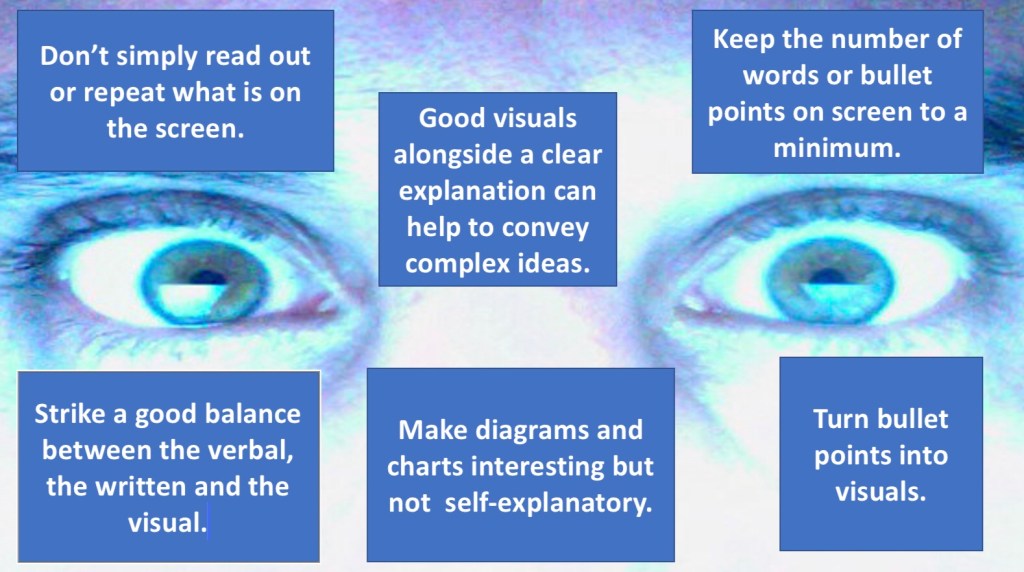
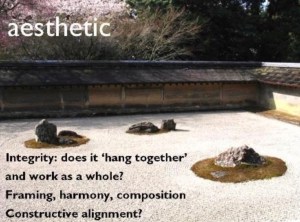
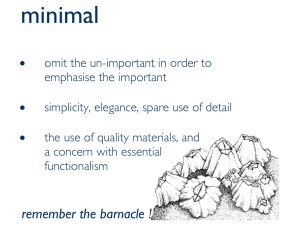


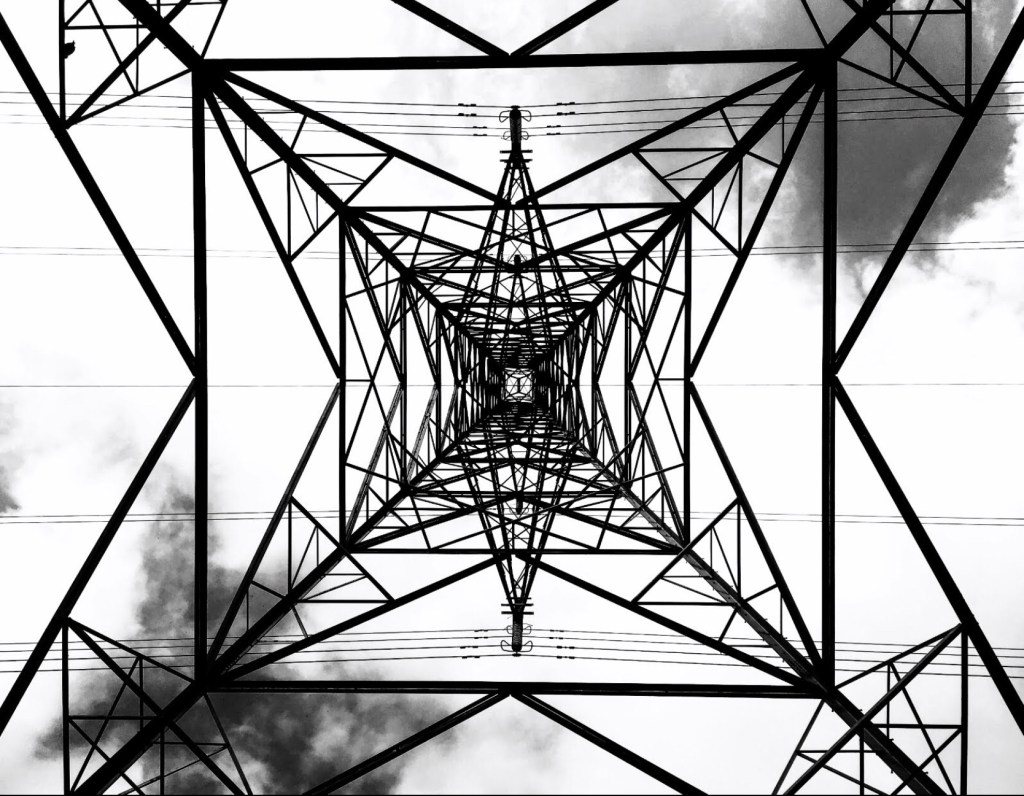

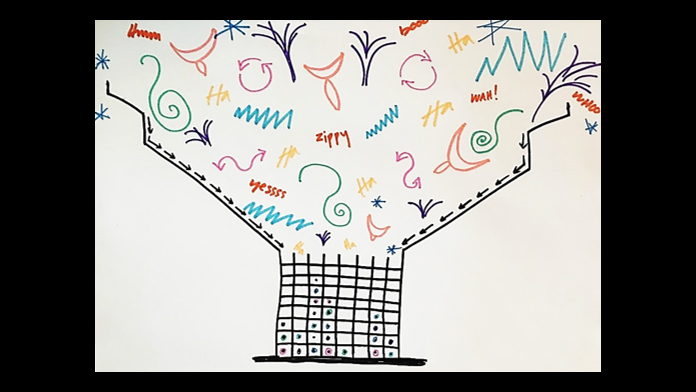
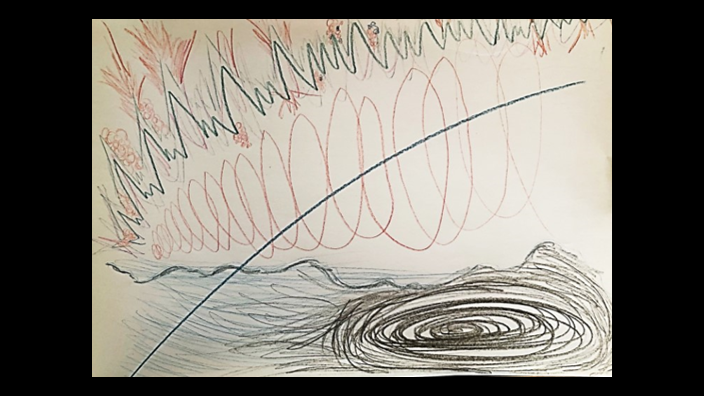
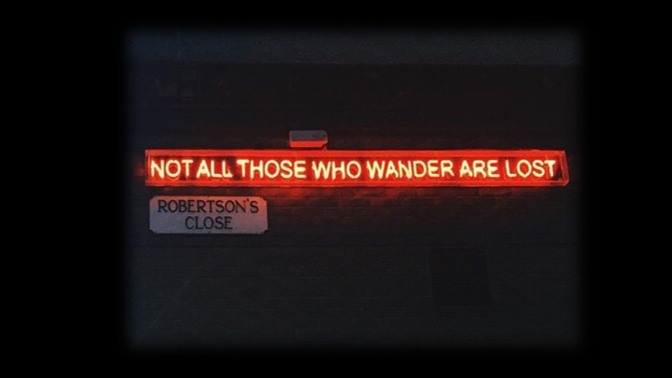
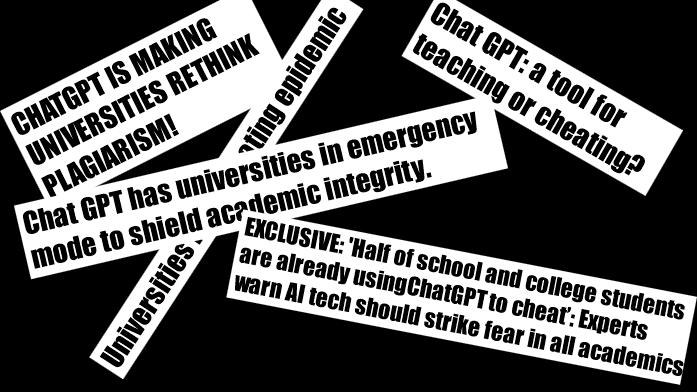
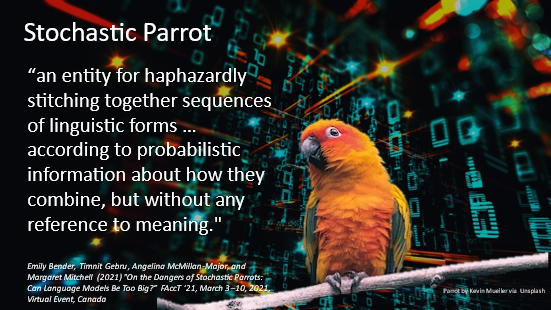
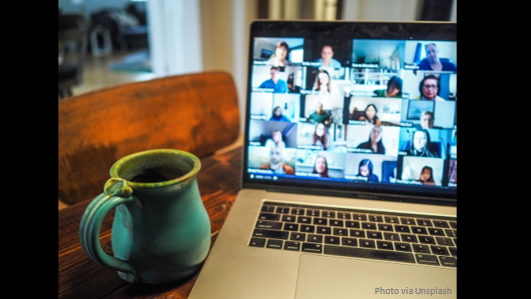
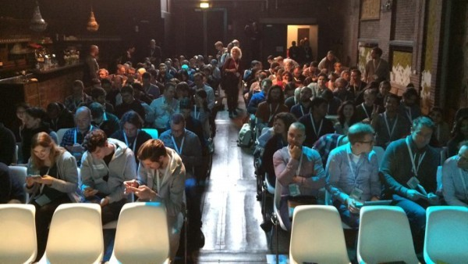

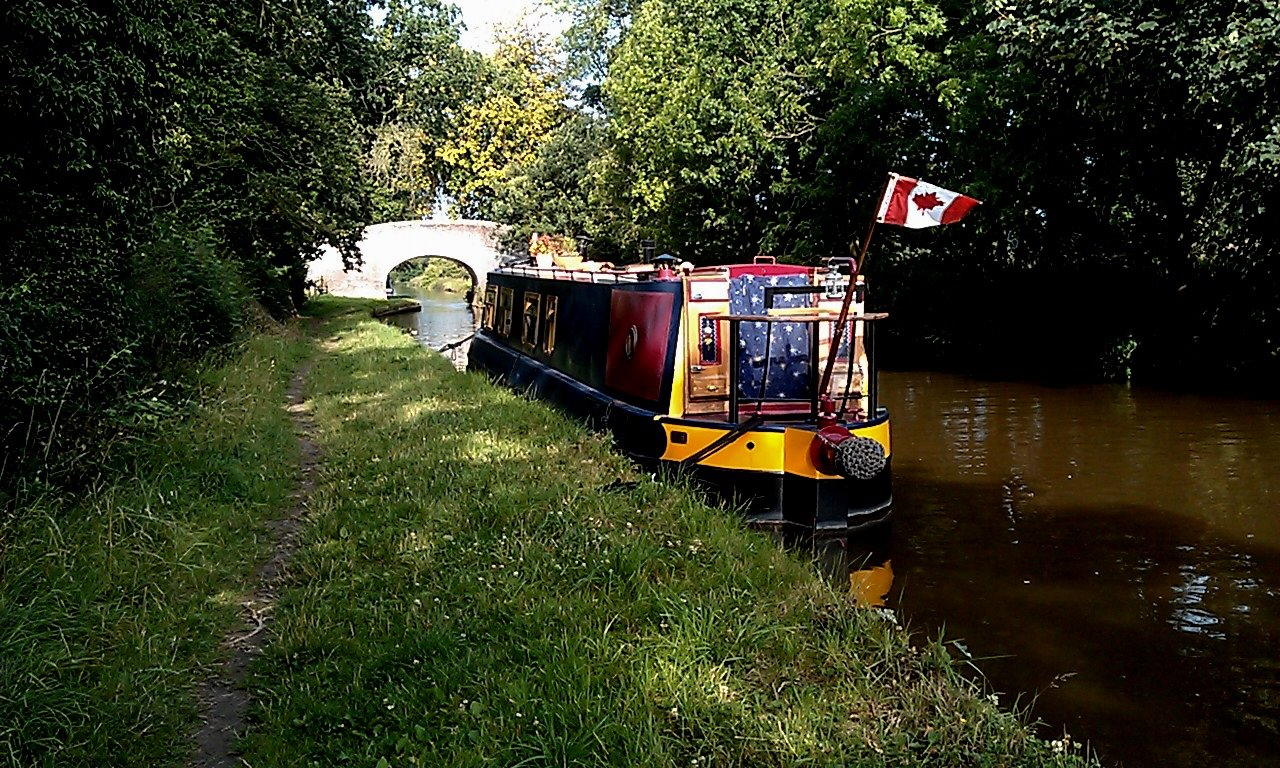

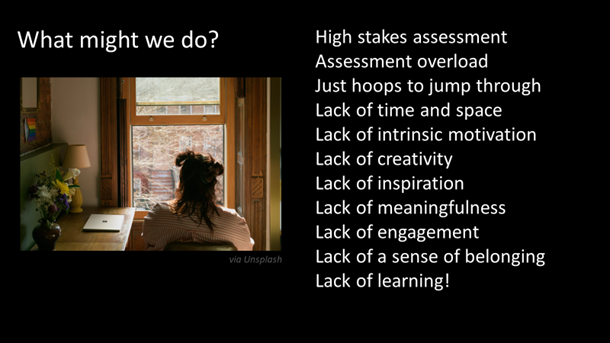
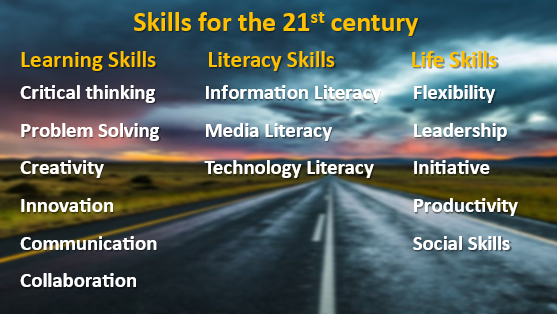
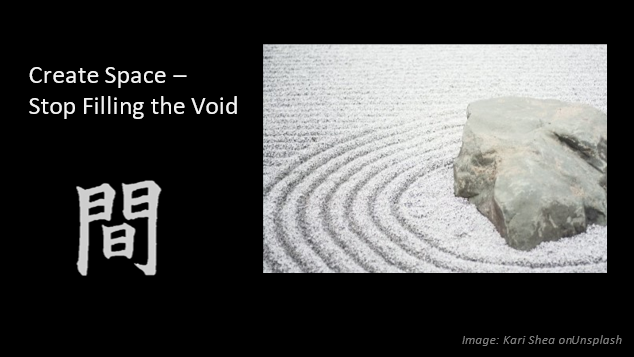

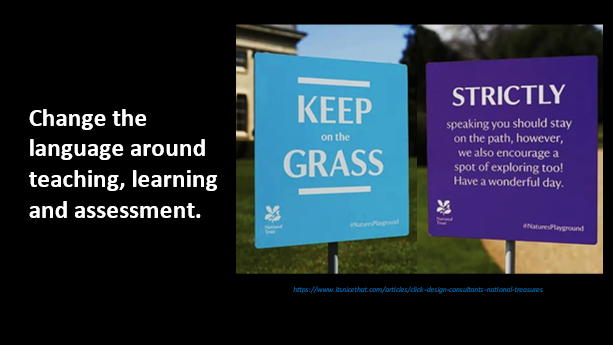


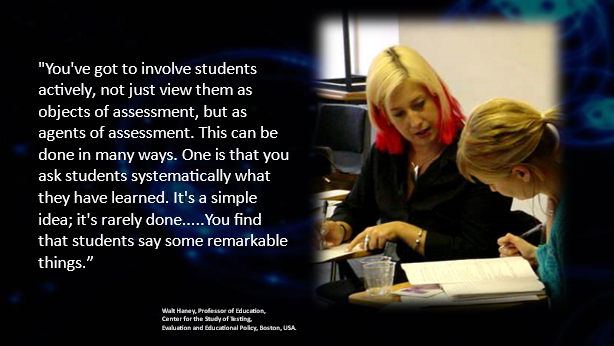
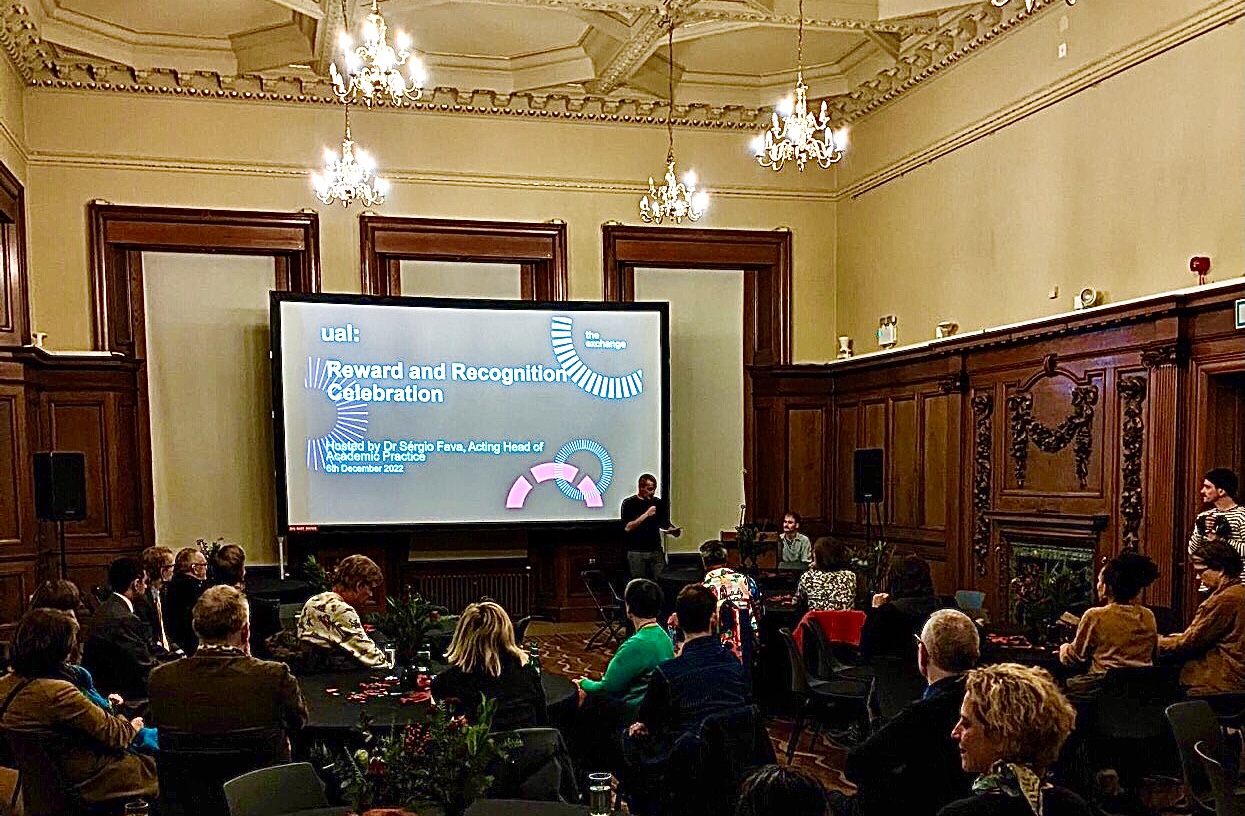
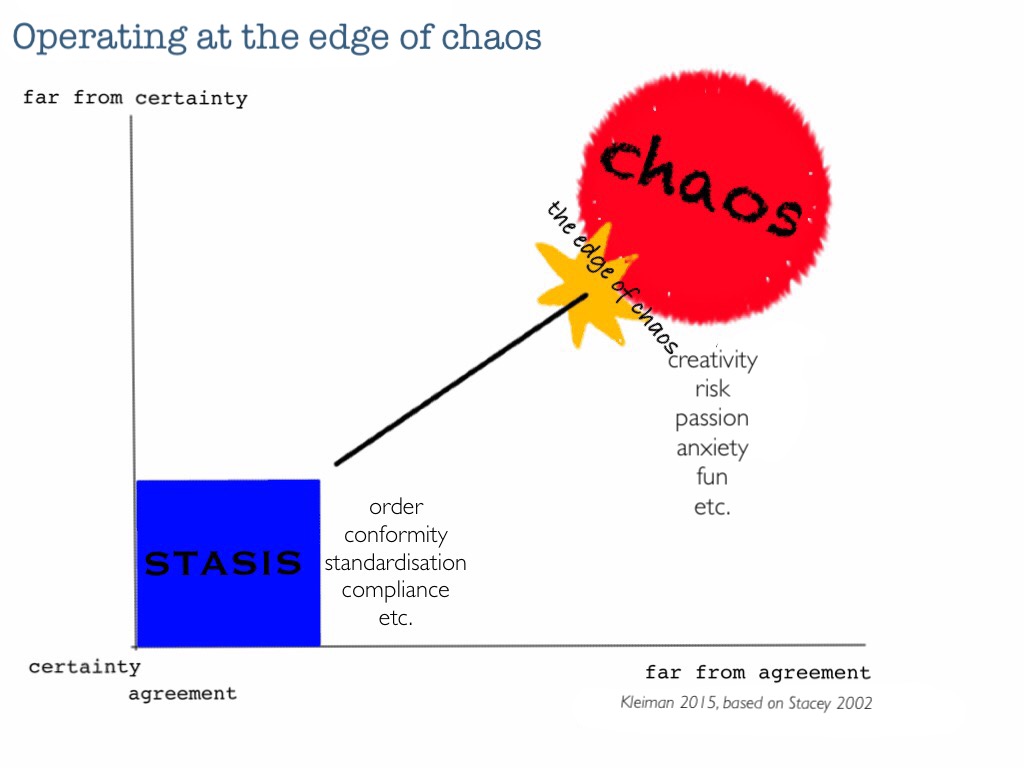
 Stumbling with Confidence