
On history and all that (Part 1): my deal with history

There’s been much sound and fury recently about the teaching of history in schools, prompted by the pronouncements and interventions of Michael Gove, the Secretary of State for Education.

Like many I really love and am fascinated by history. But, though I am an educationalist, I’m not an historian or history teacher (nor for that matter is Michael Gove) so I won’t comment on what should be in or out of the history curriculum – I’ll leave that to the experts to argue about. This is more about my own personal history of my journey into history.

I really didn’t get history when I was at school, though I did it for A-level. I loved art and english, couldn’t do music because it clashed with art, and history was the least worst option. In fact my attendance and achievement was such that Mr. Davis, the history teacher, who took great pride in the success of his students and in his teaching of the history of 19th century Europe and America, suggested strongly that it might be for the best if he did not enter me for the exam.

With pride suitably hurt, I decided to make a deal with Mr. Davis. In exchange for allowing me to take the exam, I would revise hard and ensure that I at least passed. He, somewhat reluctantly, agreed, and we shook hands on it.

As I lived in London, the next day I travelled to the centre of the city and headed for Foyles, the famous bookshop. There I purchased the past seven years of A-level history papers.

On my arrival back home, I cleared a space on my bedroom floor, laid out the A-level papers, and started to make a chart of the questions. By the time I’d finished I’d worked out that there was always a question on Bismark and German unification, always a question on Garibaldi and Italian unification, invariably a question on an aspect of the American War of Independence, the Corn Laws and so on.

I then went out and bought several of those ‘help with your revision’ books (the internet wasn’t an available option in those days) that covered the various topics I had identified as ‘favourites’. I read them carefully and made copious notes.

On the day of the History A-level examination, I sat down in the school hall along with c. 50 other boys (it was an all-boys grammar school) and at the words ‘You may start’ I turned over the paper and opened it. There were seven questions, and I’d got six direct ‘hits’…and I could just about waffle through the seventh.

When I went to school some weeks later to pick up my results, my path crossed with that of Mr. Davis. He stopped, smiled a bit weakly, and said: “It seems I underestimated you, Kleiman. The powers that be have seen fit to award you a ‘B’. Erm..congratulations!” With that he shook my hand, shook his head, and walked off.

(to be continued…)
The Elixir of Wonder

Yesterday I spent the morning discussing future strategies and scenarios in higher education. What struck me was that over the course of three hours the words education, teaching, and learning were never used.

In the evening I was a guest at the opening night of the Royal Northern College of Music’s production of Donizetti’s opera ‘The Elixir of Love’ to be sung in Italian and featuring – in the cast and orchestra – students from right across the undergraduate and post-graduate provision.

I have to admit that opera generally – and particularly early 19th century Italian comic opera – does not feature on my list of favourite ‘must see’ genres. In fact it’s probably well along the ‘must avoid’ end of the continuum. However, I’d been invited by colleagues I like and respect, and there was a pre-show dinner at the RNCM’s excellent restaurant.

There was a full house, so the building was humming. There’s something great about that pre-show foyer buzz as people arrive, meet, greet, drink, chat, etc. As Richard Schechner pointed out many years ago, the trouble with too many shows is that what happens in the foyer, bars and social spaces before, at the interval, and after a show is all too frequently the most interesting phenomena of the evening.

We took our seats as the orchestra tuned up. Again there’s that wonderful expectancy as the various instruments tune in to that plaintive A on the oboe.

Then it was curtain up and straight into what, from the start to the finish, was a hugely enjoyable, visually seductive and witty, brilliantly performed and played production. 24 hours later, as I write this, I am still smiling because of it.

However this is not a review of the production. But rather, thinking back to my rather dry and ‘education-free’ meeting – about higher education – in the morning, a reflection on how our much disparaged and ‘useless’ disciplines of dance, drama and music in education (all present in this production) provide opportunities for students and also staff to engage in the creation of truly wonderful work. This is something that too many of those who are in control of our education systems, with their obsessions with protocols and standardisation and compliance and conformity and league tables and graduate employability and sustainability and an infinite host of other -isations and -ilities, just don’t get!

I’ve written before how our obsession with the somewhat triumphalist notion of ‘excellence’ has blinded us to that which is so obvious about genuine, transformative education: it’s not excellence we should be pursuing…it is wonder-full education.

The RNCM show provided that Elixir of Wonder.

Musings on a ‘monsterous’ conference call

Something more near
Though deeper within darkness
Is entering the loneliness. . .

(Ted Hughes, “The Thought-Fox”)


In the wake of the recent announcement and call for contributions for the HEA’s Arts & Humanities ‘Heroes and Monsters” conference, there have been a number of posts and blogs on various sites wrestling with what the call is actually about!One that caught my eye was by Susan Deacy.

Dr. Deacy writes “The particulars make clear that the event is looking for ways to challenge current ways of learning and teaching to ‘make strange’ academic practice and challenge what is taken for granted by its practitioners. On the conference’s definition, monsters dwell in realms just beyond our own; they can come into our world to ‘unnerve’ us and ‘innervate’ us, and thus a ‘monstrous pedagogy’ can ‘disrupt habits’ and ‘articulate…different ways of being’. But who are ‘we’?”

There is a strong implication in the conference description, that ‘we’ are the ones who are disrupted and unnerved. But ‘we’ are, or can be, or may wish to be also the monsters and/or heroes (heroic monsters? monstrous heroes?). The teacher as Theseus and/or the Minotaur?

What has struck me in recent weeks (and, before I proceed further, I need to declare my interest as a member of the HEA’s Arts and Humanities team) is that I have newly encountered and had conversations about not just our own ‘Heroes & Monsters’ conference, but also the influence of Punk and the punk aesthetic in learning and teaching (did you know there’s an active group of scholars called Punkademics?); the establishment of a university Centre for Gothic Studies; and a course entitled Vampire Studies.

I do wonder, as the significant pressures of standardisation, marketisation, consumerisation, etc. in higher education bear increasingly down on us (then again, who are ‘we’?), whether this is a form of resistance.

But we don’t resist change, per se. We resist loss, and we replace that loss not with the known, the common, the understood, the accepted. We replace it with ‘the other’ or, better, ‘an other’: one that has genuine meaning in an environment in which so many things have become de-referentialised, that strikes a chord, that ‘chimes with the times’.

It is also no accident that the ‘Heroes and Monsters’ conference call connects directly with the allure and fascination of the myth and the quest. As I’ve got a book chapter to write on key aspects of teaching and learning in dance, drama and music, I’ll end (I may return, hauntingly) as I began, with Ted Hughes, and this in his essay ‘Myth and Education’:

“The myths for [Plato] were not very different from what they are for us, imaginative exercises about life in a world full of supernatural figures and miracles that never happened, never could happen. Yet these, he suggested, were the ideal grounding for the future wise and realistic citizen. We can imagine what would happen if we proposed now that all education in England up to the school age of 11 be abolished and there be put in its place a huge system of storytelling.

If we think of that we can see how far the wisdom in our educational system differs from what Plato would have called wisdom. Our school syllabus of course is one outcome of 300 years of rational enlightenment, which had begun by questioning superstitions and ended by prohibiting imagination itself as a reliable mental faculty, branding it more or less as a criminal in the scientific society. And what this has ended in is a completely passive attitude of apathy in face of material facts. The scientific attitude, which is the crystallisation of the rational attitude, has to be passive in the face of the facts if it is to record the facts accurately.

Such is the prestige of the scientific style of mind that this passivity in the face of the facts, this detached, inwardly inured objectivity, has become the prevailing mental attitude of our time. It is taught in schools as an ideal.

The result is something resembling mental paralysis”.

Forget Excellence…we need wonder!

Paul Kleiman

(First published in the Higher Education Academy’s EXCHANGE MAGAZINE, Issue 7, 2008)

Excellence! Everyone is writing, talking, researching, obsessing about it. But what is it?

Some years ago PALATINE, the Subject Centre for Dance, Drama and Music, undertook an enquiry into the use of the full range of marks in assessing the performing arts in higher education. As well as provoking the centre’s biggest and most heated electronic postbag, a number of respondents described the distinct discomfort they experienced when considering the assessment of work at the very top of the range. One memorably wrote: “I feel the increasingly heavy pull of gravity on my pen as I get to 75%.”

The response supported research that found that the extremities of the percentage scale are perceived as insecure territory for the assessors of qualitative subject matter. There is a strong sense, in the arts and humanities, that nothing can be that good or, for that matter, that bad, and the research revealed that most marking in the arts and humanities ranged between c. 35% to 75% which, in the eccentric and esoteric honours grading system we use in the UK, still manages to cover everything from a Fail to a First!

Undoubtedly one of the assessment challenges we have set for ourselves in performing arts disciplines is requiring students to demonstrate achievement in a wide range of practical, scholarly and creative modes. High achievement in one is rarely sustained across the breadth of an assessment régime in our disciplines, and we have to work to ensure that ‘excellent’ achievement is reflected in the aggregated marks at module and degree level. This is a pedagogic challenge which is not shared by other, more traditional arts and humanities subjects.

So what does excellence mean in this context?

Going by the result of the debate on excellence at an academic conference, there is a clear majority who feel that the term has lost credibility and value. When all institutions are either ‘excellent’ or, at the very least, ‘striving for excellence’ then we are witnessing a lot of sound (but hopefully not fury) signifying nothing. Excellence has become ‘de-referentialised’. Turning to the dictionary provides little assistance. In the Concise Oxford ‘to excel’ is defined as to surpass or to be pre-eminent (i.e. to be better than the majority), whereas ‘excellence’ is defined as ‘very good’.

Whatever meaning ‘excellence’ once had has become lost in a blizzard of hyperbole. The fate of excellence follows in the tradition of other terms such as ‘community’ and, more recently, ‘creativity’, whose meaning has become devalued and decontextualised through over- and inappropriate use.

In the arts, the term excellence is rarely if ever used as a descriptor except – and this may be relevant in considering educational achievement – in relation to the application or demonstration of skill or craft. Academics, students and arts practitioners tend to avoid the ‘E’ word. The theatrical cliché has never been: “You were excellent, darling”. ‘Wonderful’ is truly a much better word than ‘excellent’ to describe high artistic achievement. Rather than excellent’s rather hard-edged, triumphalist implication of being better than others, ‘wonderful’, i.e. full of wonder, has a sense of the remarkable, the extraordinary, the truly successful that is the mark of the highest quality work.

Excellence, it must be said, is much favoured by arts politicians and bureaucrats who use it both aspirationally and as a justification for funding. Excellence attracts rewards and prizes. But the use of the term has more to do with product branding (as it has in higher education) than with a real concern with the subtle complexities of quality and value.

Here is a typical example: one of our leading UK arts funding bodies, in its mission statement, states: “We believe the arts to be the foundation of a confident and cultured society. They challenge and inspire us. They bring beauty, excitement and happiness into our lives. They help us to express our identity as individuals, as communities and as a nation”.

Wonderful! But then they go and ruin it by reverting to corporate-speak and saying they are going to “serve the people … by fostering arts of excellence through funding, development, research and advocacy”. An external examiner I knew, having seen what was – by general consensus – a remarkable, successful, extraordinary, inspiring … yes, wonderful piece of final-year practical work was dismayed to find that the two internal examiners, who also thought the work was remarkable, successful etc had agreed a mark of 75%. He asked them to start at 100%, and argue persuasively for marks to be deducted. With the assessment criteria in their hands they struggled to get below 95%. To describe that work as merely ‘excellent’ would have been insufficient. It was beyond excellence.

That is perhaps what we should be striving for and, in doing so, we need to look beyond our obsession with trying to define, achieve, assess and reward excellence.

As the old saying goes: education is, or ought to be, a wonderful thing.

Straight to the Core: Gove, the Arts and the Core Curriculum

Nelson Mandela said that “Education is the most powerful weapon which you can use to change the world”, which is why politicians can’t help but meddle.

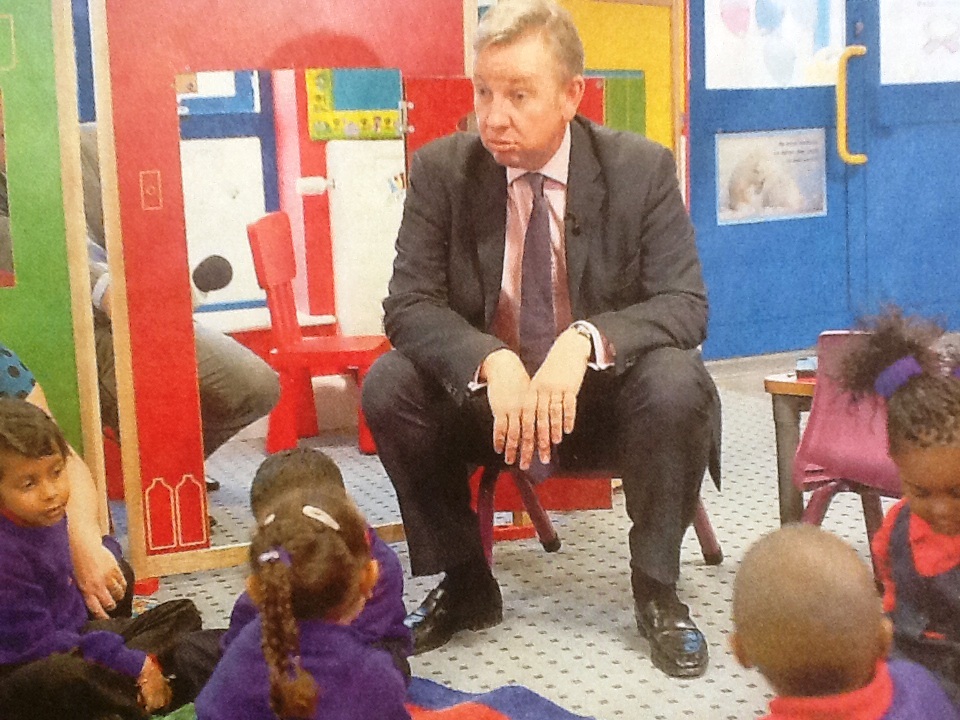
Here in the UK, with a long and – with a few notable exceptions – inglorious history of political meddling in the education of our children and young people, we currently have an über-meddler in the shape of Michael Gove (pictured), the Secretary of State for Education.

Mr. Gove is convinced, with the passion of the true zealot, that our education system is broken and that it needs a complete overhaul. He is particularly obsessed with the need for a ‘core curriculum’ which essentially takes us back to the 3R’s with some science and technology attached. I have nothing personal against young people being able to read, write and count. Actually I think it’s quite important. I think science and technology are important. But I do object strongly when – in order to achieve his ambition – Mr Gove decides that the arts are an irrelevancy when it comes to the content of his ‘core curriculum’.

Mr. Gove is an intelligent man. After all he was a leading journalist on The Times, and therefore ought to be used to ensuring that he quotes his sources accurately. Well, he keeps going on about how his ideas for this arts-free ‘core curriculum’ are informed by his admiration for the Massachusetts Common Core of Learning. As well he might be. The education system in Massachusetts is at the top of the US educational league tables.

Now, I don’t know if Mr. Gove has actually read the Massachusetts Common Core of Learning, or whether – returning to his journalistic habits – he is studiously ignoring the inconvenient truth. But there, in the Massachusetts Common Core of Learning, in stark black and white, is the following:

“All students should:
Acquire, Integrate and Apply Essential Knowledge (in)
– Literature and Language
– Mathematics, Science and Technology
– Social studies, History and Geography
– Visual and Performing Arts
– Health

Under ‘Visual and Performing Arts’ there is:
– Know and understand the nature of the creative process, the characteristics of visual art, music, dance and theatre, and their importance in shaping and reflecting historical and cultural heritage.
– Analyze and make informed judgments regarding the arts.
– Develop skills and participate in the arts for personal growth and enjoyment.

Under Literature and Language:
– Read a rich variety of literary works including fiction, poetry, drama and nonfiction from different time periods and cultures, relating them to human aspirations and life experiences.
– Analyze implications of literary works, and communicate them through speaking, writing, artistic and other means of expression.

All students should:
Use Mathematics, the Arts, Computers and Other Technologies Effectively
– Apply mathematical skills to interpret information and solve problems.
Use the arts to explore and express ideas, feelings and beliefs.
– Use computers and other technologies to obtain, organize and communicate information and to solve problems.
– Develop and present conclusions through speaking, writing, artistic and other means of expression.

In 2006, UNESCO declared: “International declarations and conventions aim at securing for every child and adult the right to education and to opportunities that will ensure full and harmonious development and participation in cultural and artistic life. The basic rationale for making Arts Education an important and, indeed, compulsory part of the educational programme in any country emerges from these rights. Culture and the arts are essential components of a comprehensive education leading to the full development of the individual. Therefore, Arts Education is a universal human right, for all learners” (The Road Map for Arts Education,p3)

Please note the “essential components of a comprehensive education”. Perhaps Mr. Gove’s dislike of arts education derives from his antipathy to the word ‘comprehensive’?