”It’s cheating Jim, but not as we know it”: the problematic arts of plagiarism

Recently, while the academic world attempts to negotiate its path through the minefield posed by Generative AI, I was looking at some university policies about academic integrity and stumbled across these two statements:

There are few intellectual offences more serious than plagiarism in academic and professional contexts.

To submit a paper or comparable assignment that is not truly the product of your own mind and skill is to commit plagiarism.  To put it bluntly, plagiarism is the act of stealing the ideas and/or expression of another and representing them as your own.  It is a form of cheating and a kind of scholastic and professional dishonesty which can incur severe penalties.  It is important, therefore, that you understand what constitutes plagiarism, so that you will not unwittingly jeopardize your college career.

Reading those dire warnings about academic misconduct took me back to the now seemingly far off days when we obsessed about plagiarism and you couldn’t move for workshops and seminars on topics such as ‘Designing Out Plagiarism From Assessment‘. But it also reminded me that for anyone with an arts background or a knowledge of art, literature or music history, the idea of plagiarism as a black and white issue is an absurd idea. There’s a lot of grey.

Consider this famous engraving of ‘The Judgment of Paris’ by Raphael, created circa 1510-20, and pay particular attention to the group of three figures on the lower right. Do they remind you of anything?
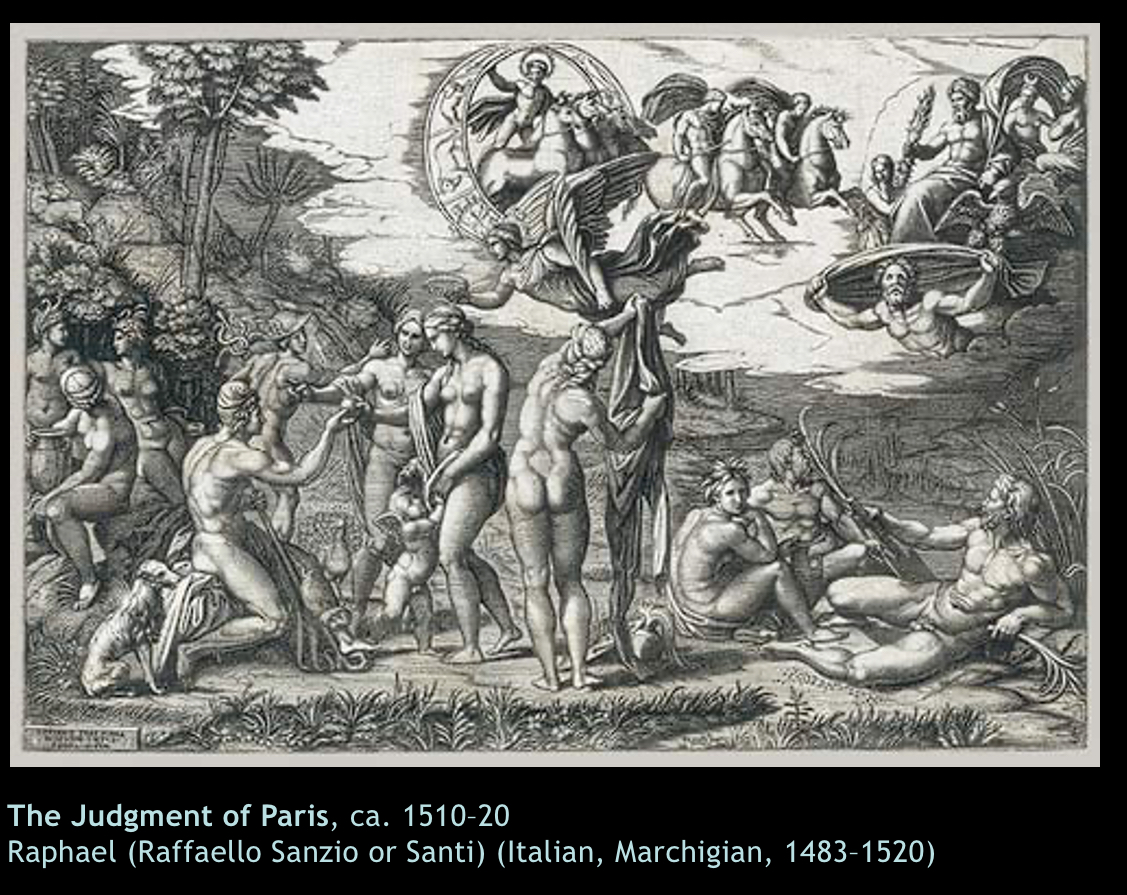
Let’s now skip over the engravings made soon after by Raimondo (left) and Marco Dente da Ravenna (right)….

….and consider this famous painting from the 19th century.

As Manet’s figures are clearly based on the three figures in those engravings is the painting ‘truly the product of his mind and skill’?

But the chain of ‘borrowing’ continues. Picasso sees the Manet painting and creates this, at least acknowledging his immediate source (or at least the Musee Picasso is acknowledging the source)

Then, in 1981, this album cover appears:
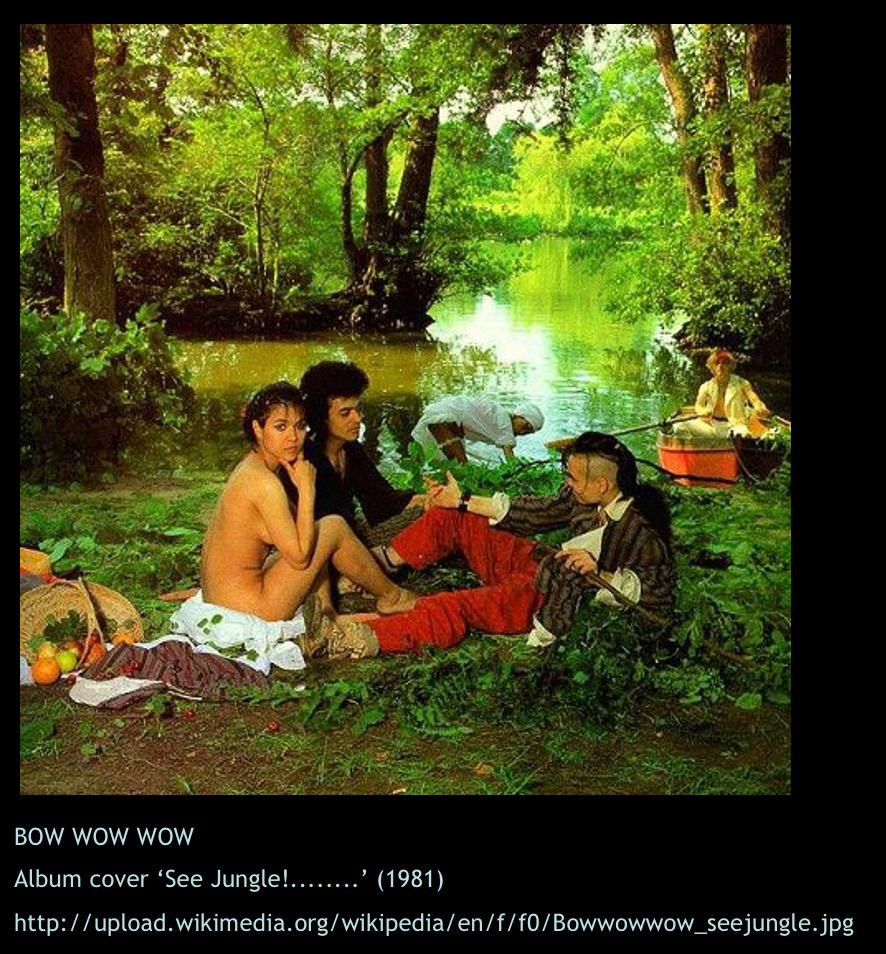
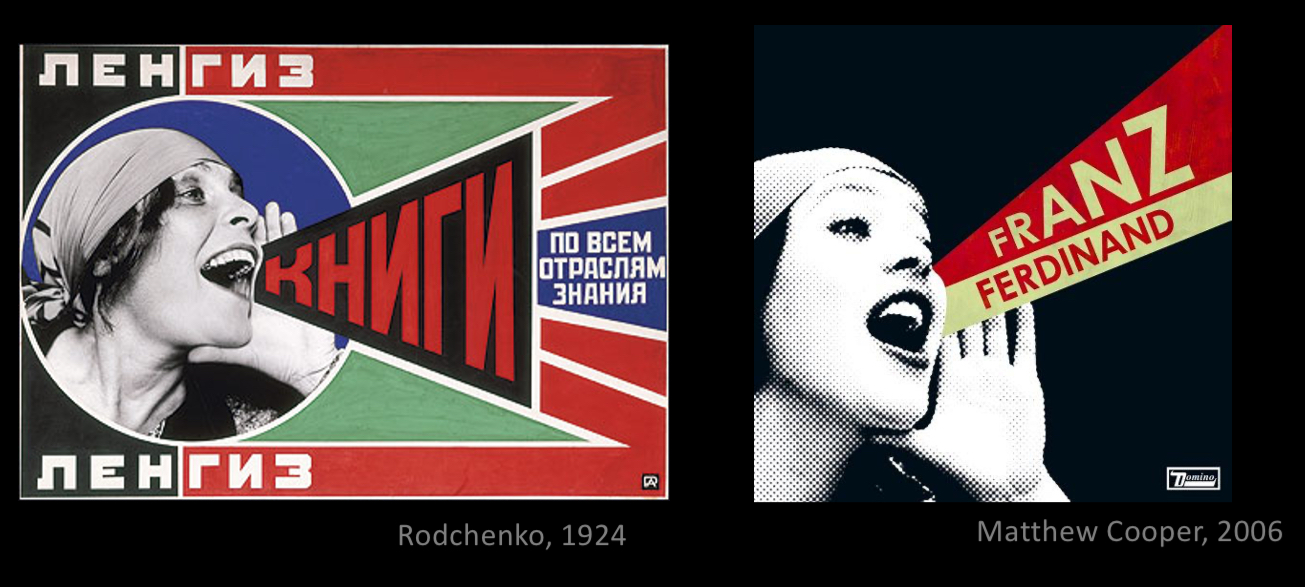
Or consider these album covers and that university statement about there being ‘few intellectual offences more serious than plagiarism in academic and professional contexts.’
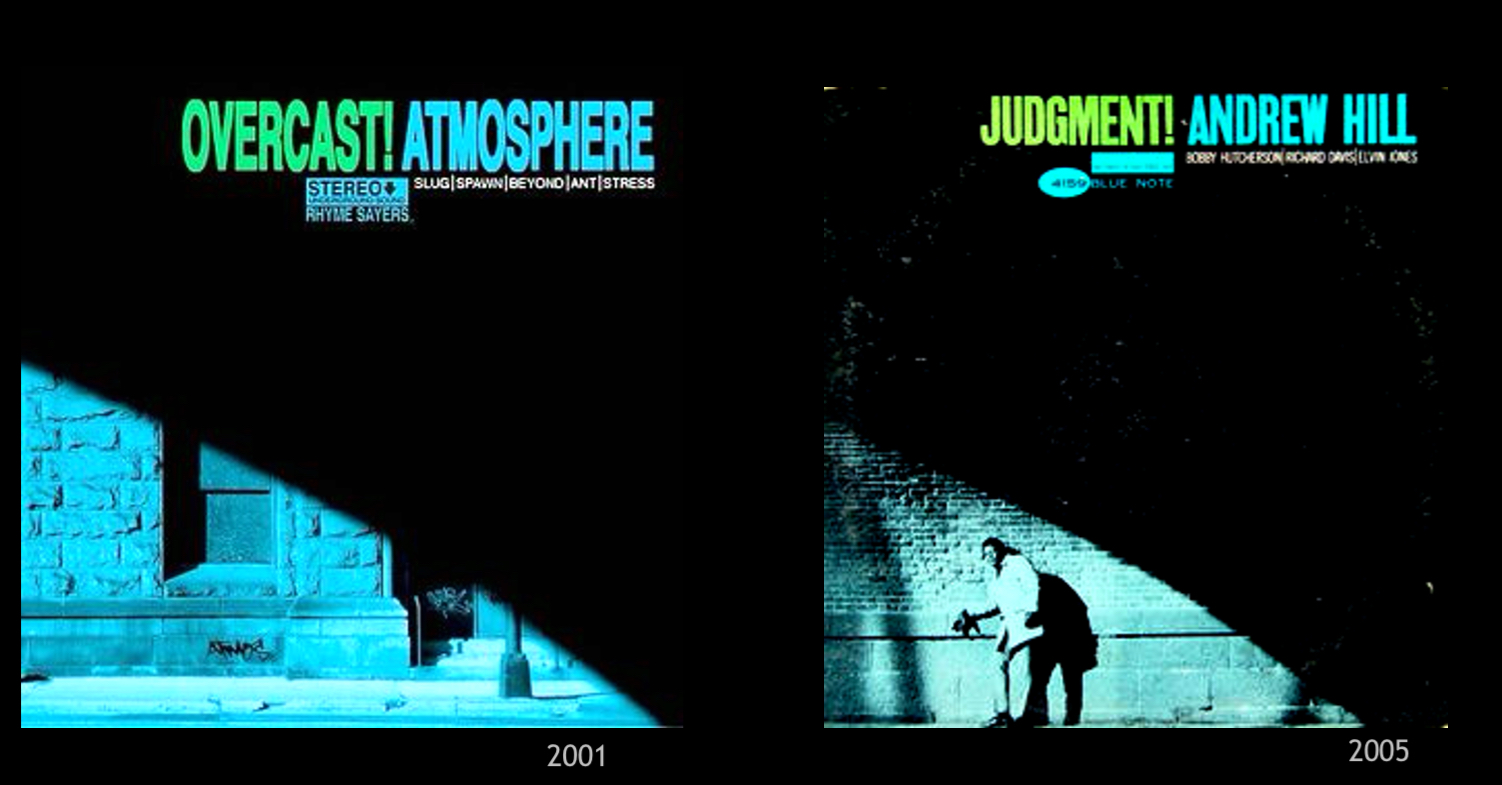
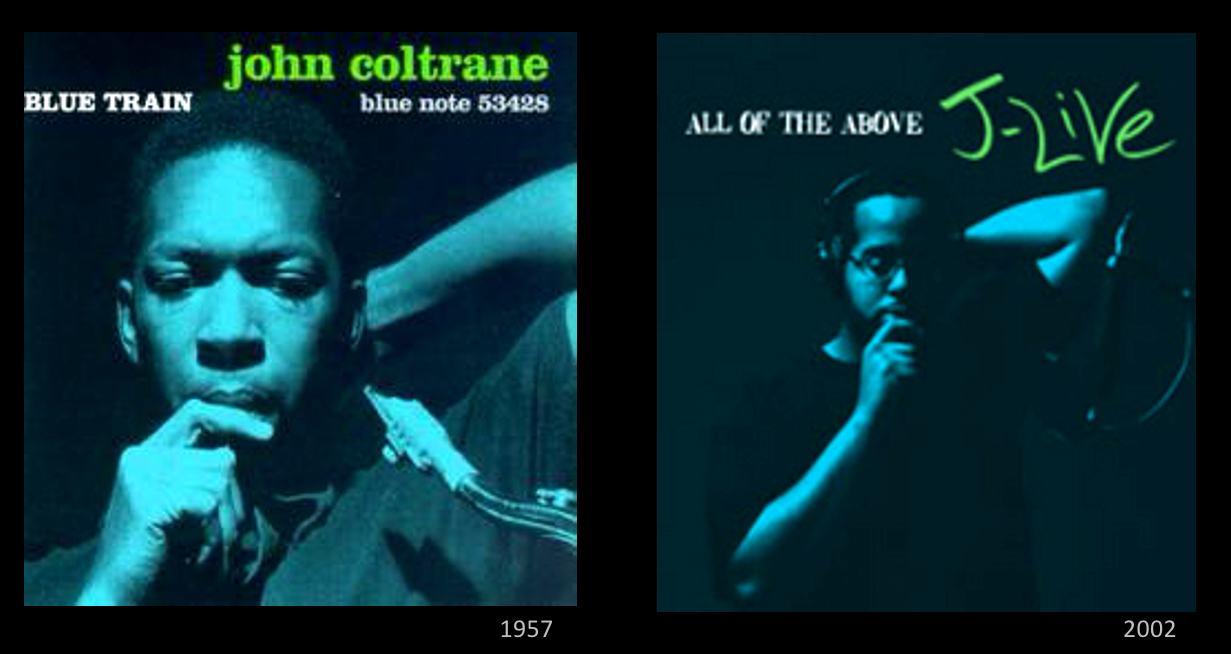
It seems clear, particularly in regard to art works, that a conception of the creative process that imagines that new works are original and autonomous may often be at odds with actual acts of creation that in many instances involve copying, directly referencing, adapting and other uses of existing works.

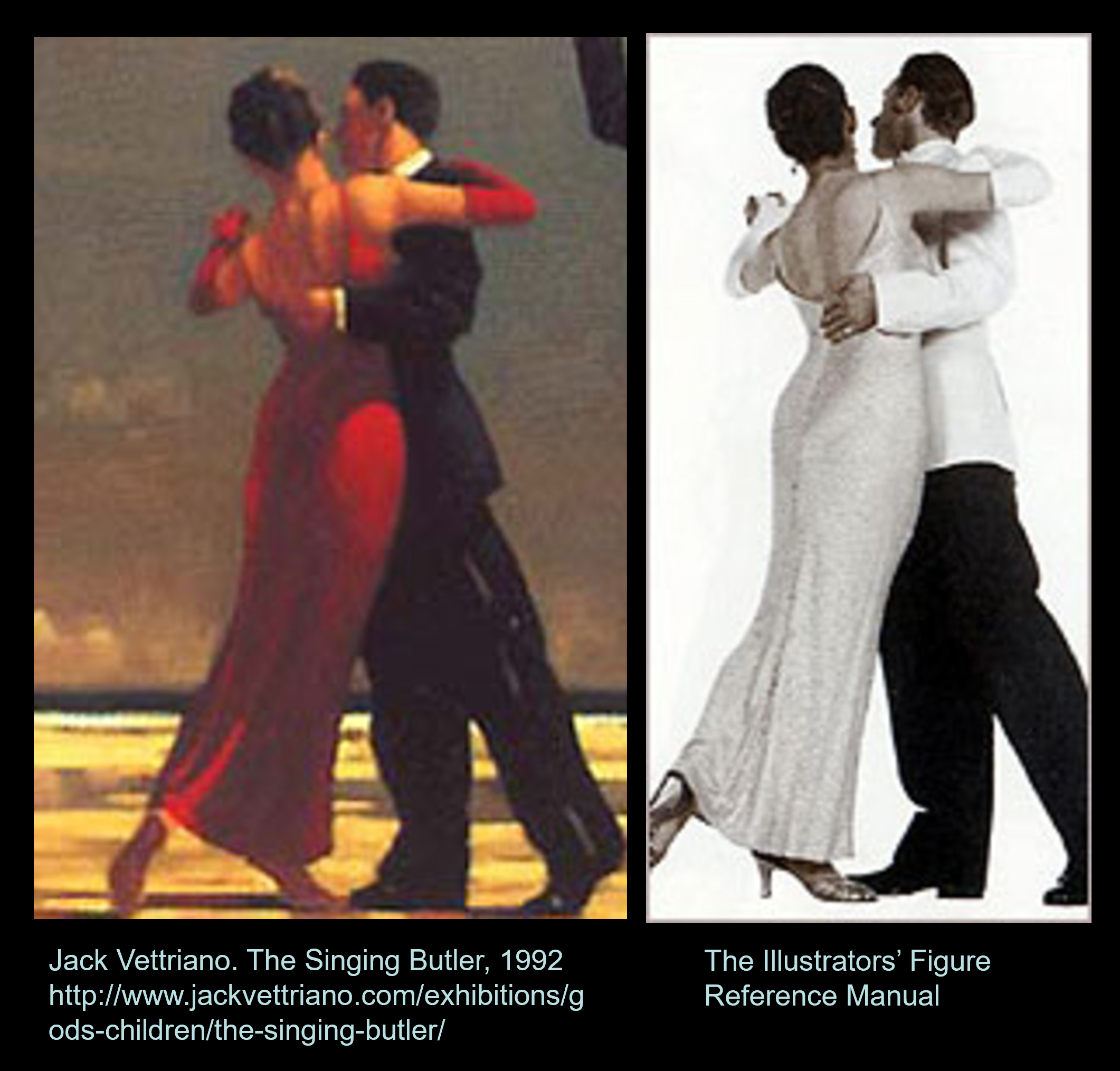
While some artists e.g. Manet and Picasso are lauded for their appropriation of previous art, the popular artist Jack Vettriano, who died recently, was frequently dismissed by the art establishment for being derivative and unoriginal (as well as popular!). The often quoted example is that the two dancing figures in his most famous work ‘The Singing Butler’ (section below) – the most popular art print in the UK – were virtually direct copies of the dancing figures from The Illustrator’s Figure Reference Manual.

In a number of disciplines and fields of study terms such influence, intertextuality, formulaic cultural production, appropriation and borrowing are important parts of the disciplinary discourse. In art and literary criticism, terms such as intertextuality, allusion, quotation, and influence are used, In musicology terms used to discuss relationships between musical texts include borrowing, self-borrowing, transformative imitation, quotation, allusion, homage, modeling, emulation, recomposition, influence, paraphrase, and indebtedness. Brahms, for example, openly admitted the strong influence of Beethoven. His First Symphony is sometimes referred to as ‘Beethoven’s Tenth’ and Brahms famously stated, “You have no idea how it feels to hear his footsteps constantly behind you.” In the context of plagiarism in popular music, the work of the forensic musicologist Joe Bennett is worth reading and listening to. One of the problems with identifying plagiarism is that, if and when it comes to court and as Bennett also makes clear in his work and research, what sounds superficially similar – certainly on first hearing – to a jury of ‘ordinary people’ is actually far more complex. Certain combinations of notes and chords are so ubiquitous across the musical landscape that they have become ‘commonplace’ items and are, in fact, common property.

As examples accumulate it becomes apparent, as Jonathan Lethem wrote in The Ecstasy of Plagiarism (2007) ‘that appropriation, mimicry, quotation, allusion, and sublimated collaboration consist of a kind of sine qua non of the creative act, cutting across all forms and genres in the realm of cultural production.’

The final example, returning to the two images at the start, is the cautionary tale of a book cover from 1974 and a very large painting that was a Turner Prize finalist in 2000. The full story of the plagiarism furore it caused and the law suit that followed can be read here https://artquest.org.uk/artlaw-article/originality/ , but here are the bare bones.

In 1974, Robert Heinlein’s book ‘Double Star’ was published with a cover created by the sci-fi artist Anthony Roberts. In 2000, the artist Glenn Brown’s large painting ‘The Love of Shepherds’ was chosen as a finalist in that year’s Turner Prize. Brown frequently uses the work of other artists in developing his large-scale work and is known for the use of art historical references in his paintings (as did Manet and Picasso). Starting with reproductions from the works of other artists, his biography states that he “transforms the appropriated image by changing its colour, position and size”.

Anthony Roberts was alerted to the similarity with his own painting for the book cover after a visitor to the Turner Prize exhibition noticed the similarity and the story hit the headlines. Roberts sued Brown and eventually the case was settled out of court. The painting is now titled ‘The Love of Shepherds’ (after ‘Doublestar’ by Anthony Roberts).


When a university states that students must “understand what constitutes plagiarism, so that you will not unwittingly jeopardize your college career” perhaps they should clarify precisely what they mean. If they are referrring to plagiarism in a purely academic context i.e. writing essay, dissertations etc. then what is and is not plagiarism is, or should be clear. But beyond that, particularly in the areas of creative practices, we enter the ‘Grey Zone’, and we should be ensuring that understanding plagiarism also means enabkling students successfully and effectively to understand, appreciate and negotiate their way through that grey zone.

Telling Tales

I was once helping to run a ‘New to Teaching’ workshop for new/early career lecturers in languages and linguistics.  I was one of several presenters during the day, and I was chatting with one of them – a Head of (a very large) Department –  over the rather basic and disappointing sandwich lunch which the host university’s catering service had deemed suitable for academic consumption.

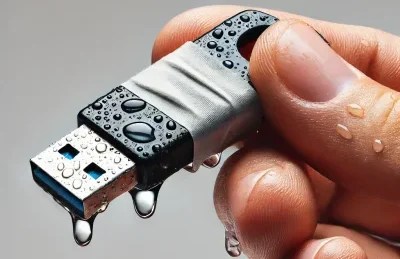
We talked, inevitably, about the current parlous state of higher education (plus ça change!), and I mentioned that I had done some work and research around complexity and chaos in learning and teaching. At which point his eyes suddenly lit up and he exclaimed: “I know who you are! Must have been at least 10 years ago. You gave a presentation which started with you holding up your taped together memory stick and telling us that it had been through the full hot wash cycle and tumble dryer and, after drying it out, it was STILL WORKING. I always remember that, and I remember your presentation about working at the edge of chaos- a notion which I still use and often rely onto this day. Thank you!”

Now, OK, it’s very nice to know one’s work has had at least some impact, but it did make me wonder about the obvious but frequently overlooked power of image, metaphor and narrative in education.

We live, communicate, interact through stories. We experience the world through stories. We are  storytelling organisms who, individually and socially, lead storied lives.  We  construct and reconstruct our personal and social stories and, in education, learners, teachers, and researchers are storytellers and characters in their own and other’s stories.

The phrase ‘telling tales’ usually has negative associations, but – surely –  great learning and teaching is inextricably bound up with the expert telling of wonderful and genuinely telling tales.

It’s a human need to be told stories. The more we’re governed by idiots and have no control over our destinies, the more we need to tell stories to each other about who we are, why we are, where we come from, and what might be possible.
Alan Rickman

“I thought about the magic that happens when you tell a story right, and everybody who hears it not only loves the story, but they love you a little bit, too, for telling it so well. – Katherine Hannigan

Dripping memory stick image created with GenAI


‘Taking a Line for a Walk’: reflections on interviewing academics about creativity

“You just get this one idea, which might, at first, seem a bit daft. But something just holds you back from thinking it is completely daft. It was the artist Paul Klee who talked about painting being about taking a line for a walk. And that was the thing about it. What it was like….it was like taking an idea for a walk. You know, the more you just did it….it might just work.” (Interview)

It had been a long day. I had spent it interviewing several academics – from new lecturers to emeritus professors, across a range of disciplines – about their conceptions and experiences of creativity in relation to learning and teaching. Even though I was recording it all, it was still hard work maintaining focus and enthusiasm for each of the 45 minute sessions, and ensuring – as one is obliged to do in phenomenographic research – that I had obtained deep and rich responses to my questions.

I always started with the same question: Could you tell me about an occasion that was a creative experience for you in terms of learning and teaching higher education?

All too often that question would be greeted by silence, and what I came to call the ‘rabbit in the headlight’ look: as if why on earth would I think that there might possibly be a connection between creativity and teaching?

But I’d learned, from my training and work in drama, not to be afraid of silence and to avoid the temptation to ‘jump in’ in order to avoid embarrassment. As a drama therapist once told me: “silence IS golden: it usually means they’re thinking”; and sure enough, after a short while, a story would emerge, and I would gently probe the whats, hows and whys of that particular experience.

The last interview of the day was with a vastly experienced educational developer, with a PhD in linguistics, who had taught in China. After the usual hesitant start, he began to tell me how he had developed a successful student-centred, experiential and problem-based learning experience which was the antithesis of the teacher-centred, conformist, ‘micro-teaching’ that was the normal and expected practice. It was he who described the experience with the Paul Klee ‘taking a line for a walk’ quote above.

Thinking back to those interviews, a number of ‘moments’ stand out:

The eminent, soon-to-retire historian bemoaning the conformity and lack of risk-taking in his younger colleagues, and finally – as his last ‘hurrah’ – running a ‘visual history’ course on 18th century England as seen through a number of key objects that he had always wanted to run but never had the nerve… until now when he was leaving. (This was way before Neil McGregor’s renowned BBC series on the objects of the British Museum).

The management school professor in a 5* research rated department who, much to the annoyance of his colleagues, had won a prestigious national prize for his innovative teaching methods. Apparently they couldn’t understand why he was wasting his time on enhancing his learning and teaching expertise when he ought to be enhancing his (and the department’s) research reputation and ranking.

There was the young, early career lecturer, genuinely committed to teaching, tears rolling down her face as she recounted the frustrations of having her creative ideas about teaching rudely quashed by her senior male colleagues: “I feel restricted, I feel frightened….the constant ‘don’t bother about the teaching, just focus on your research’….it makes me so angry, but I don’t dare say anything”.

And there was the language lecturer whose creative ‘Damascene’ moment occurred serendipitously as a result of being very late for a class she was meant to be teaching in parallel with other identical classes. When she finally turned up at the end of the session she found that the group, who normally “sat like puddings” while she presented the set material in the set textbooks, were still there and that “the atmosphere in the room was buzzing…they were talking to each other, they had a problem to solve. So we spent the last couple of minutes talking about how we were going to keep that going now”.

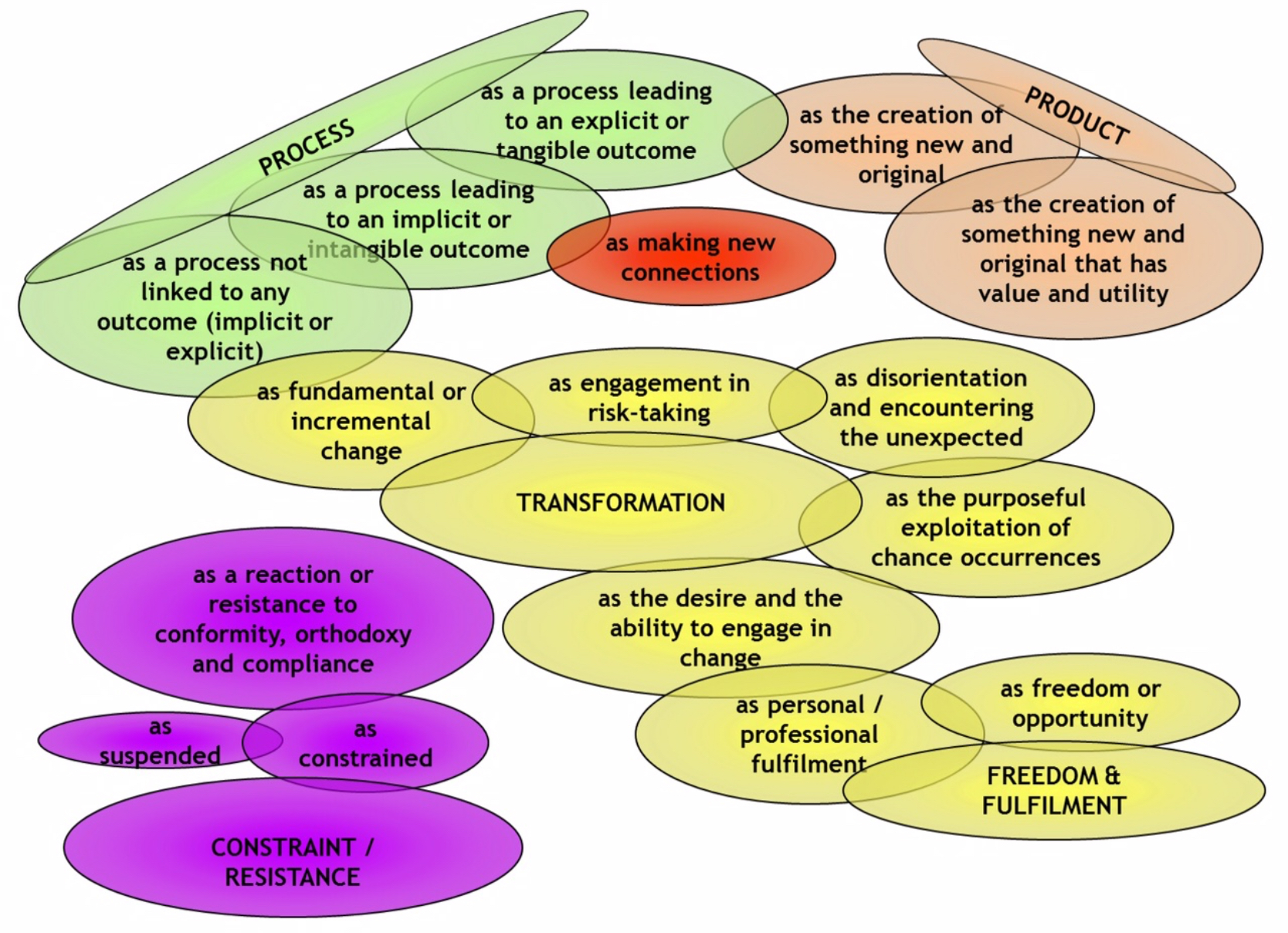
There were many such moments in all the interviews, and after personally transcribing all the interviews (extraordinarily tiring, but so valuable in being able to get ‘inside the source material’), I began to search for patterns of thoughts and behaviour. Slowly but surely, after a long and rigorous iterative process, the many and varied experiences of creativity in higher education began to coalesce around five main conceptual categories. I attempted to capture them in the following map:

Creativity: a conceptual map. (©️ Paul Kleiman)

1. Creativity can be a CONSTRAINT-focused experience, where the constraints and specific limitations tend to encourage rather than discourage it. Creativity occurs despite and/or because of the constraints;

2. Creativity can be a PROCESS-focused experience; that may lead to an explicit or tangible outcome…or may not;

3. Creativity can be a PRODUCT-focused experience where the whole point is to produce something;

4. Creativity can be a TRANSFORMATION-focused experience where the experience frequently transforms those involved in it;

5. Creativity can be a FULFILMENT-focused experience where there is a strong element of personal fulfilment derived from the process/production of a creative work.

As well as the development and identification of these five categories (later to be reduced to three – but that’s another story), a number of significant outcomes and observations sprang from the research. It was clear that university teachers experienced creativity in learning and teaching in complex and rich ways, and certainly the ones I interviewed – once they got going – exhibited great enthusiasm for, and an interest in, creativity.

I was struck, particularly, in response to my exploring the reasons why an individual pursued a particular creative course, by the number of times someone said ‘I stumbled across something’ or something similar. The example of the very late lecturer (above) is a typical example. The frequency and consistency with which the opportunity to exploit the consequences of ‘stumbling upon something’ played a critical part in the various self-narratives of creativity in learning and teaching is clearly important, and it has obvious significance for those interested and engaged in learning and teaching. Firstly it is important to realise that there are several distinct but linked elements in this. One is the ‘stumbling’, and another is the ability or opportunity to exploit it. However, as one of the university teachers interviewed said, people stumble across things all the time but rarely act: “So it’s not just stumbling upon it, it’s finding that the thing has a use”.

Then, beyond finding that whatever it is might have some use, one needs the confidence to be able to engage in an action that exploits – in the best sense of the word – that situation. The notion of confidence constitutes a significant and expanding thematic element through all the five categories. In many of the interviews – and it is one reason why actual face-to-face interviews are so important – as the individual began to explain and explore their own creativity (some said it was really the first time they’d ever really thought about it) – I both heard and observed the growing sense of confidence both vocally and physically: they became animated, they smiled and they laughed.

Confidence clearly plays a critical role in enabling university teaches to engage creatively in their pedagogic practice. However, in the research into conceptions of learning and teaching, little attention seems to be paid to the subject of confidence and other affective aspects of the teacher’s role and identity. A number of researchers comment on this apparent gap in the research literature, and explain it by saying that dealing with the emotional and attitudinal aspects of learning and teaching is rather antithetical to the prevailing analytic/ critical academic discourse.

During the course of those interviews there was a strong sense of people transformed. It is also clear that the centrality of creativity-as-transformation in relation to learning and teaching, and the importance of creativity in relation to personal and/or professional fulfilment, poses a series of challenges. There is much more to the experience of creativity in learning and teaching than simply ‘being creative’. Furthermore, a focus on academics’ experience of creativity separated from their larger experience of being a teacher may encourage over simplification of the phenomenon of creativity, particularly in relation to their underlying intentions when engaged in creative activity.

The transformational power of creativity poses a clear challenge to organisational systems and institutional frameworks that rely, often necessarily, on compliance and constraint, and it also poses a challenge to approaches to learning, teaching and assessment that promote or pander to strategic or surface approaches to learning. Academics need to be perceived and involved as agents in their own and their students’ creativity, rather than as objects of or, more pertinently, deliverers of a particular ‘creativity agenda’.. For higher education institutions (and the government) creativity is seen as the means to an essentially more productive and profitable future. But for university teachers, creativity is essentially about the transformation of their students…and themselves.

Graphic if the weird creativity surrounded by curving black lines

(‘Creativity’ image created by Paul Kleiman with the assistance of AI)

When something(s) need to change…

When a higher education provider calls in a consultant, it’s usually because they want and need some thing or things to change. Usually, at least some people in the institution know precisely what the problem is and what needs to change. But bringing in a consultant can provide validation and confirmation of what needs to done by digging deep into the problems, asking some awkward questions, and providing the hard evidence to support the change event.

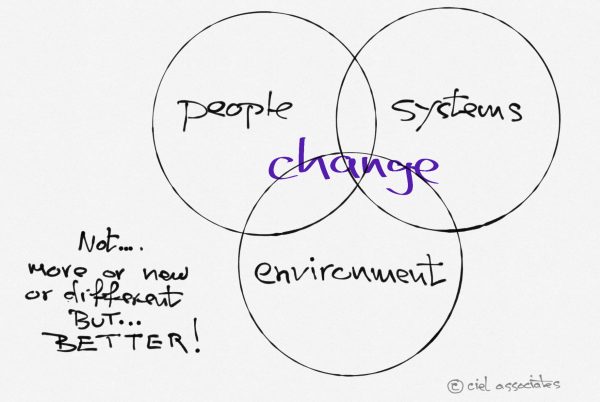
Change, of course, can be challenging, awkward and divisive, and there’s the old cliche about people liking the idea of change as long as they don’t have to change themselves. But change isn’t just about people. For genuine, effective, sustainable change to happen, three things need to be addressed simultaneously: People, Systems and Environment. Changing one or even two of those will lead to whatever change is envisaged either not working as well it could or not at all.

An example:

A university’s STEM departments were scattered around the campus. The university commissioned a prize-winning architect to design a new ‘stand out’ building that would house all the various departments. There would be a beautiful atrium in the centre of the building with a café and colleagues from different departments would gather there and all sorts of wonderful ideas (and possible patents) would emerge from the exchange of ideas.

What actually happened was that while the university clearly changed the environment, nothing was done to address the people and systems involved. Within a very short time the building was re-compartmentalised into separate departments who kept their own coffee machines. The atrium remained a beautiful, empty, silent space.

The PSE framework informs much of our consultancy work. It enables us to explore the potential and practicalities of change through those three ‘lenses’, always asking and seeking ‘What will make this better?’


About me:

I am an independent higher education consultant and co-founder of the educational consultancy Ciel Associates specialising in organisational and transformational change and enhancing learning, teaching and assessment.. My work is informed by my belief in the transformational power of education and a commitment to helping institutions achieve meaningful and sustainable change. Contact me at Ciel Associates .

Beyond the Debatable Hills: is it curtains for the arts in education?

As yet another UK university announces major course closures and redundancies – mainly affecting arts and humanities – it’s worth being reminded that entries for A level arts subjects: dance, design & technology, drama, music among others, have reached the lowest since at least 2011.

Back in 2016 I presented at an arts conference and wrote an associated journal article ‘Predictive Texts’ that took a look into the future of the arts in the UK in 2026 based on the then current trends. I described a cultural landscape in which the arts had largely been stripped out of the educational experience of children and young people. I described the consequences of that policy on the live performing arts sector which was now being by-passed by a generation of students who had not received consistent, or in many cases any, arts education through primary and secondary education where the focus was on STEM education. I reflected on how that educational neglect had led to a kind of cultural blindspot or illiteracy which, in turn, had led to a severe decline in arts attendance as that generation of millenials now sought other avenues for their entertainment and spending.

There have been many dozens of articles written in the last few years voicing concern about state and future of the arts in the UK, particularly in education. Tory policy towards the arts threatened the existence of the entire creative sector, particularly those parts of the sector in which live performance is an integral part of their raison d’etre: live theatre, dance and music. Today, despite the change in government, almost daily there is news of another university cutting its creative and performing arts courses.

The decision to cut arts funding in higher education by the last Tory government signalled not only a drastic diminutions of the arts in education but also, as a consequence of this and other policies, an acceptance that whole sections of the creative sector could be allowed ‘go to the wall’ despite the fact that the sector as whole contributes massively to the GDP. The contrast with the then government’s support of the fishing industry, which played such a huge role in Brexit, is stark. At present fishing contributes around £1.4 billion to the economy (Gross Value Added data from the Office for National Statistics). The creative industries contribute around £124 billion to the economy (2022 figures)

While the election of the Labour Government and the accompanying positive statements about supporting the arts and creativity in education provide some indication of a change for the better (we’ll wait and see on that one), in the meantime a bleak future for the arts beckons. The creative industries are fed via a pipepline of skills and talent that are nurtured in our education system. By reducing or stopping the flow of creative talent along that pipeline ensures that the creative industries, and certainly those parts of the sector that are seen to be less ‘valuable’ in economic terms, wither on the vine. It also ensure that access to the arts and arts training increasingly becomes the preserve of the wealthy and privileged and those who have social, cultural and economic capital.

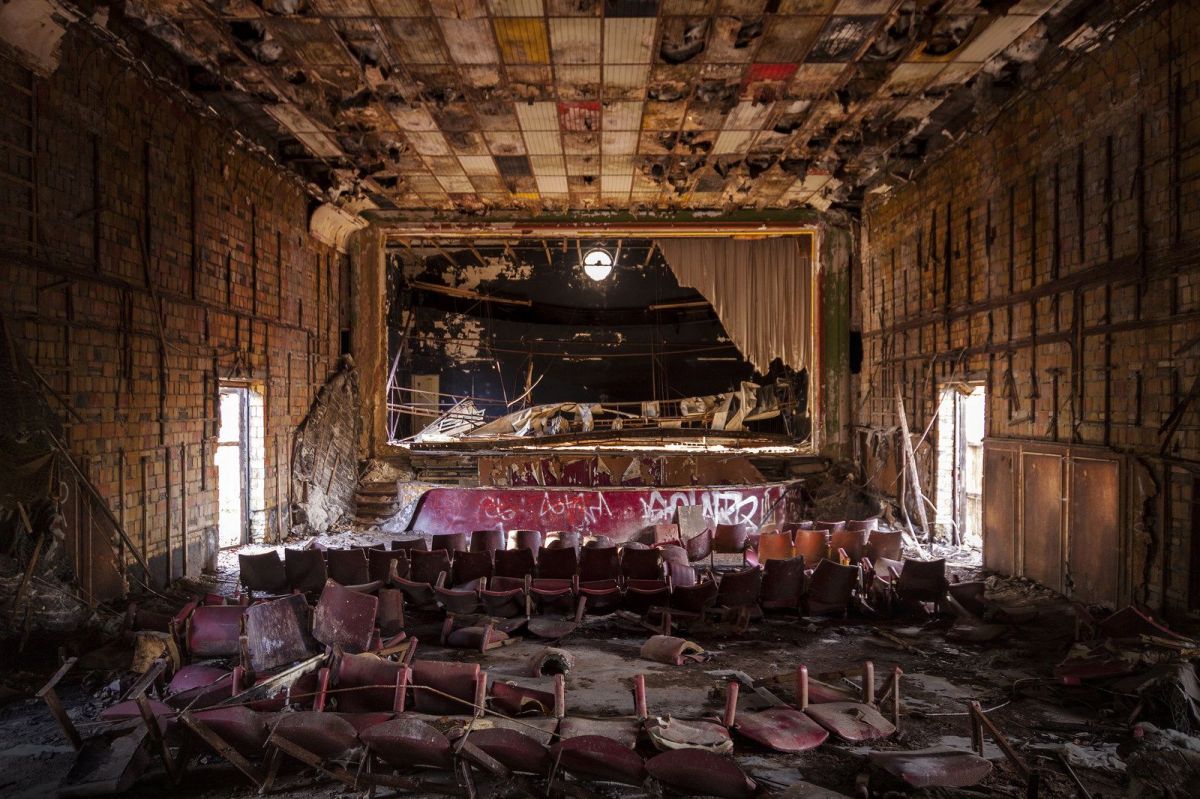
I am reminded of a sentence from the 2015 book by the eminent producer and impresario Michael Kaiser titled ‘Curtains? The Future of the Performing Arts in America’. Examining the trends, Kaiser describes a ‘doomsday scenario’ in which, across America, many theatres, arts centres and other performance venues, hit by the decline in audiences and/or funding, “sit vacant, reminders of a different era, not unlike the Colosseum in Rome and the Parthenon in Athens”. Kaiser was projecting some years into the future, but in the UK the Covid crisis massively accelerated the onset of that doomsday scenario.

Thinking about all this I was reminded of a book I read years ago, which remains one of my favourite books (it’s also on Neil Gaiman’s list of all-time favourites, so I’m in good company). The book is called Lud-in-the-Mist, written in 1926 by Hope Mirrlees. Mirrlees was a classicist, and much of her work dealt with the contested boundaries of Art and Life.

In Lud-in-the-Mist there are two countries. There is the land of Dorimare, a nation of stolid burghers, merchants and artisans. A rather prim and very proper place, where everyone knows their place, where the motto is essentially ‘it’s the economy, stupid’, and where the arts are relegated to activities such as needlework and country dancing: pursuits for the refinement of gentlewomen and gentlemen.

On the border of Dorimare, however, on the other side of the Debatable Hills, lies the land of Faerie, a strange, dark land full of mysteries and wonders…not all of them pleasant. The upright citizens of Dorimare so fear the land that lies beyond those dread hills, that the word ‘Faerie’ is never to be uttered.

Dorimare’s main city of Lud-in-the-Mist lies at the confluence of two rivers: the Dapple and the Dawl. The Dawl is like any other commercial river, but the Dapple happens to flow out of the land of Faerie, and brings with it fairy fruit, that is smuggled into Dorimare.  Eating fairy fruit has a terrible effect on the upright citizens of Lud-in-the-Mist: it causes people to start singing strange songs, to spout poetry, to dance with abandon. In other words, it turns them mad.

The plot revolves around the disappearance of a group of young ladies and the Mayor’s son who have been kidnapped and taken to the land of Faerie, and the attempt of the Mayor, a bumbling, self-important, rather fatuous man to rescue them. (Any resemblance to a real persons is entirely coincidental).  As a consequence of that quest, fundamental changes are wrought – to the Mayor and to Dorimare itself.

In Lud-in-the-Mist, Mirrlees is dealing with the division of the world into Apollonian and Dionysian aspects: the homely and the wild. There is also the long battle between Classicism and Romanticism, and Freud’s theories of the conscious and unconscious mind, and the relationship between terror and beauty.

The actor Mark Rylance, in an interview, said that the arts are essentially ‘mysterious’ which is why they frighten  politicians and policy-makers, because they can’t control them, they can’t measure them.

I imagine the educational curriculum in Dorimare’s schools is very much what like the one demanded by Gradgrind in Dickens’ Hard Times;

“Now, what I want is Facts. Teach these boys and girls nothing but Facts. Facts alone are wanted in life. Plant nothing else, and root out everything else. You can only form the mind of reasoning animals upon Facts: nothing else will ever be of any service to them.“

And if you think that’s rather extreme, consider this – handed to parents at a primary school in London:

‘The new programme of study in English is knowledge-based, this means its focus is on knowing facts rather than developing skills and understanding. It is also characterised by an increased emphasis on the technical aspects of language and less on the creative aspects.”

So, alongside schools dropping all ‘non-core’ subjects i.e. arts subjects and a few others from the school curriculum in order to enable students to catch-up on everything they missed due to Covid, we also had catastrophic cuts to arts subjects in higher education in line with the Tory government’s insistence that all higher education programmes must align with  “economic and societal needs” – which the government believed will only be met by STEM (Science, Technology, Engineering and Maths) programmes and some others such medicine and agriculture. One can only look with envy at the financial support some other countries are putting into supporting their creative and cultural sectors as they recognise the importance and value of those sectors to the well-being of society as a whole.

I was thinking about Lud-in-the-Mist because it seems to me we are increasingly living in a country which is becoming more Dorimare-like by the day, where the arts are increasingly banished to the equivalent of the land of Faerie, where creativity is associated with the creation of goods and wealth, where any hint of an artistic or genuinely creative spirit is dismissed as bad influence, and to be actively discouraged and eliminated.

Across our education system, from primary through to tertiary, there is now a very real danger, evidenced by the course and departmental closures and the significant drop in the take-up of arts subjects, of subjects like art, dance, drama and music disappearing entirely from the curriculum. The clear and present danger for the wider creative arts sector will be the cutting off the pipeline of interest, skills and talent on which the sector relies. We are facing the prospect, in many areas of the country, of the spectre of a cultural wasteland, not unlike Kaiser’s ‘doomsday’ scenario.

A hundred years ago, in Lud-in-the-Mist, Hope Mirrless asked how might we truly embrace the arts in all their wondrous, dangerous, life-affirming glory along with the eccentrics and mavericks?  Or are we fated to banish them, their works and deeds, to that strange, wonderful, forbidden land beyond the Debatable Hills?

The final, celebratory chapter of Lud-in-the-Mist, as the citizens of Dorimare throw open the gates of the city to allow those mysterious, dangerous, life-affirming Faeries to enter, provides the answer.