Is it curtains for the arts, banished beyond the Debatable Hills?

Guildhall_Theatre-closed

After the UK government promised financial support to other sectors of the economy, and after intense pressure on the Culture Secretary Oliver “I won’t let you down” Dowden, the arts eventually received £1.5bn.

Despite the support, which looks like it is being targeted only at building-based companies, here is a growing feeling that the government is quite prepared to let whole sections of the creative sector ‘go to the wall’ despite the fact that the sector as whole contributes massively to the GDP. More disturbingly, it is not necessarily the whole of the creative sector, which now includes the important and profitable video and computer games industry, but those parts of the sector that are seen to be less ‘valuable’ in economic terms and which, coincidentally, voted in large part against Brexit and against the Tories at the last election. Boris Johnson and his chief adviser Dominic Cummings have a well-deserved (and well-evidenced) reputation for valuing loyalty to Brexit above all other considerations.

The future for the live arts looks very bleak indeed, and I’m reminded of a sentence from a 2015 book by the eminent producer and impresario Michael Kaiser titled ‘Curtains? The Future of the Performing Arts in America’. Examining all the current but pre-Covid trends, Kaiser describes a ‘doomsday scenario’ in which, across America, many theatres, arts centres and other performance venues, hit by the decline in audiences and/or funding, “sit vacant, reminders of a different era, not unlike the Colosseum in Rome and the Parthenon in Athens”. Kaiser was projecting some years into the future, but in the UK the Covid crisis has massively accelerated the onset of that doomsday scenario.    

Thinking about all this I was reminded of a book I read years ago, which remains one of my favourite books (it’s also on Neil Gaiman’s list of all-time favourites, so I’m in good company). The book is called Lud-in-the-Mist, written in 1926 by Hope Mirrlees. Mirrlees was a classicist, and much of her work dealt with the contested boundaries of Art and Life.

In Lud-in-the-Mist there are two countries. There is the land of Dorimare, a nation of stolid burghers, merchants and artisans. A rather prim and very proper place, where everyone knows their place, where the motto is essentially ‘it’s the economy, stupid’, and where the arts are relegated to activities such as needlework and country dancing: pursuits for the refinement of gentlewomen and gentlemen.

On the border of Dorimare, however, on the other side of the Debatable Hills, lies the land of Faerie, a strange, dark land full of mysteries and wonders…not all of them pleasant. The upright citizens of Dorimare so fear the land that lies beyond those dread hills, that the word ‘Faerie’ is never to be uttered.

Dorimare’s main city of Lud-in-the-Mist lies at the confluence of two rivers: the Dapple and the Dawl. The Dawl is like any other commercial river, but the Dapple happens to flow out of the land of Faerie, and brings with it fairy fruit, that is smuggled into Dorimare.  Eating fairy fruit has a terrible effect on the upright citizens of Lud-in-the-Mist: it causes people to start singing strange songs, to spout poetry, to dance with abandon. In other words, it turns them mad.

The plot revolves around the disappearance of a group of young ladies and the Mayor’s son who have been kidnapped and taken to the land of Faerie, and the attempt of the Mayor, a bumbling, self-important, rather fatuous man to rescue them. (Any resemblance to a real persons is entirely coincidental).  As a consequence of that quest, fundamental changes are wrought – to the Mayor and to Dorimare itself.

In Lud-in-the-Mist, Mirrlees is dealing with the division of the world into Apollonian and Dionysian aspects: the homely and the wild. There is also the long battle between Classicism and Romanticism, and Freud’s theories of the conscious and unconscious mind, and the relationship between terror and beauty.

The actor Mark Rylance, in an interview, said that the arts are essentially ‘mysterious’ which is why they frighten  politicians and policy-makers, because they can’t control them, they can’t measure them.

I imagine the educational curriculum in Dorimare’s schools is very much what like the one demanded by Gradgrind in Dickens’ Hard Times;

“Now, what I want is Facts. Teach these boys and girls nothing but Facts. Facts alone are wanted in life. Plant nothing else, and root out everything else. You can only form the mind of reasoning animals upon Facts: nothing else will ever be of any service to them.“

And if you think that’s rather extreme, consider this – handed to parents at a primary school in London in 2015:

‘The new programme of study in English is knowledge-based, this means its focus is on knowing facts rather than developing skills and understanding. It is also characterised by an increased emphasis on the technical aspects of language and less on the creative aspects.”

I was once asked, by the then German Federal Minister of Education as it happens, as we stood together in the queue for coffee at a conference on the future of Arts Higher Education in Europe, what it was that had made the UK such a world leader in art, design, fashion, music , theatre, etc?  He was comparing the UK  with his own country and the fact that, with a few notable exceptions, Germany – with a relatively successful economy compared to the UK –  had demonstrated nothing like that level of consistent creative output over the years.

I didn’t have a rigorously researched, evidence-based answer to give him, but I did say that I thought it had something to do with our long history and tradition of non-conformity, of sticking two fingers up to authority, and our high and genuine tolerance of mavericks and eccentrics. Neither of which, I suggested humbly, were common attributes in his own country.

The Minister said ‘Ah, that’s very interesting’…and moved on.

I was thinking about Lud-in-the-Mist because it seems to me we are increasingly living in a country which is becoming more Dorimare-like by the day, where the arts are increasingly banished to the equivalent of the land of Faerie, where creativity is associated with the creation of goods and wealth, where any hint of an artistic or genuinely creative spirit is dismissed as bad influence, and to be actively discouraged and eliminated.

In our education system there is now a very real danger, evidenced by the significant drop in the take-up of arts subjects, of subjects like art, dance, drama and music disappearing entirely from the formal curriculum (to be replaced by an ‘After School Club’?). That already was a flashing danger signal for the wider creative arts sector, cutting off the pipeline of interest, skills and talent on which the sector relies.  Now we are faced with the spectre of a cultural wasteland, not unlike Kaiser’s ‘doomsday’ scenario.

A hundred years ago, in Lud-in-the-Mist, Hope Mirrless asked how might we truly embrace the arts in all their wondrous, dangerous, life-affirming glory along with the eccentrics and mavericks?  Or are we fated to banish them, their works and deeds, to that strange, wonderful, forbidden land beyond the Debatable Hills?

The final, celebratory chapter of Lud-in-the-Mist, as the citizens of Dorimare throw open the gates of the city to allow those mysterious, dangerous, life-affirming Faeries to enter,  provides the answer.
Learning at the Edge of Covid Chaos

We live in a time of chaos, as rich in the potential for disaster as for new possibilities.

Margaret Wheatley

It is perhaps an understatement to say that, in regard to higher education, we are living in interesting times. This piece is written (in June 2020) during a period of particularly momentous upheavals. We face a series of national and international crises. The impacts of these various crises, and the effects of the various actions taken to deal with them, are felt everywhere, and higher education systems are not immune. The shapes and forms of higher education are being severely shaken and stirred as the tectonic plates upon which they have been built shift dramatically beneath them.

In the UK, the challenges for higher education have been exacerbated by the paradigm shift from the long-standing acceptance of higher education as a public good, largely financed by public funds to regarding it as a lightly regulated market in which consumer demand, in the form of student choice, is sovereign in determining what is offered by service providers (i.e. universities).

So, what might we do, in higher education, to negotiate our way through what many find to be an unfamiliar, discomforting, increasingly complex landscape?

The use of the word ‘might’ in the question above is intentional. The eminent drama teacher and educationalist Dorothy Heathcote used to say that the most important word in education is the word ‘might’. Demand of a child ‘What is the answer to this question or problem?’ and it closes down the possibilities. But ask ‘What might be the answer?’ and it opens up those possibilities, and encourages curiosity, creativity and creative approaches to problem-solving.

One of the things we might usefully do, and which those who make and decide educational policy are frequently criticised for signally failing to do, is to strive to understand the complex and often chaotic nature of what confronts us. Managing complexity and the complex adaptive systems that are our higher education institutions, is now the greatest challenge for institutional leaders, and there are three factors that might provide them with the best opportunity to capitalise on that complexity: creativity, operational dexterity and reinventing the relationship with their students.  

Complex adaptive systems are like eco-systems: they are constantly changing and evolving, and their complexity means that the ability of human agents to control them in any meaningful, purposeful way is virtually non-existent. Such systems are adaptive in that they are self-evolving, agile and, importantly, inherently unpredictable. Crucially they rely on disequilibrium and feedback in order to develop and grow. To stay viable, they need to keep themselves off-balance, maintaining themselves in a state of non-equilibrium. A successful complex adaptive system frequently creates or deliberately seeks out feedback and information in the form of perturbances or disturbances that might threaten its stability and knock it off balance, thus producing the disequilibrium that is necessary for growth.

Such systems tend to ‘self-organise’ around changes, and small changes can have big impacts: the well-known ‘butterfly effect’. So, in a time of crisis, when, with the best possible motives of course, we start changing the ways we operate, we may have little or no idea of the possible consequences.

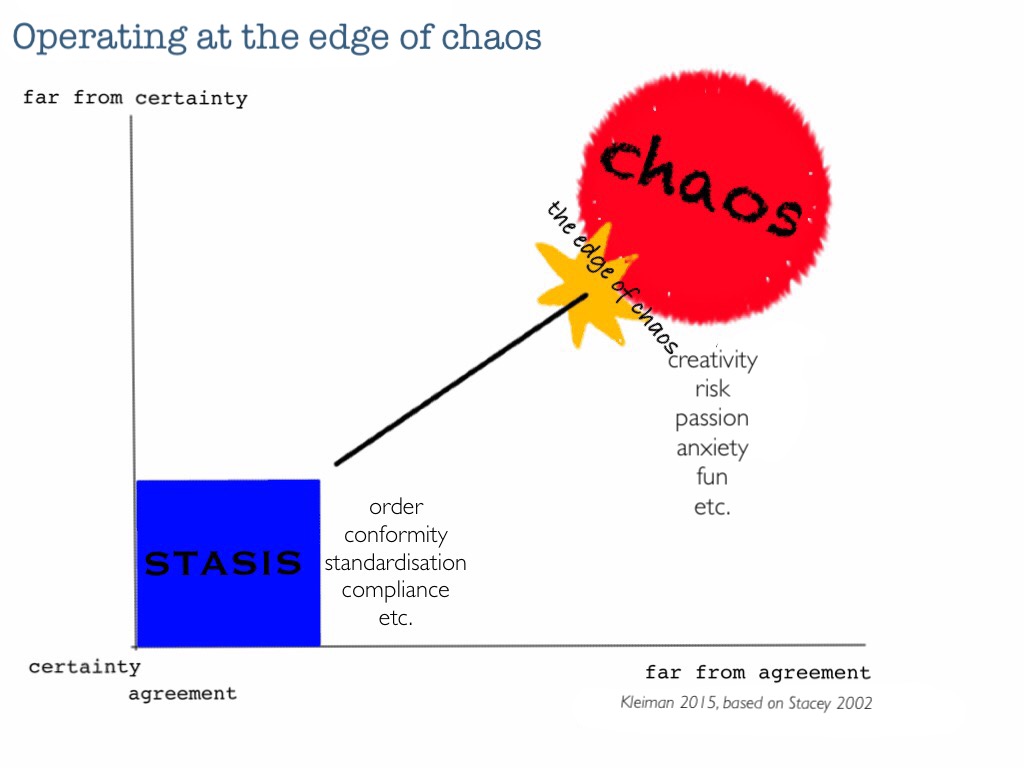
The diagram below illustrates the ‘complexity continuum’ between stasis and chaos. Based on the work of Ralph Stacey and Paul Tosey it illustrates how a system’s search for, or need for, equilibrium in the form of certainty and agreement produces stasis. It also shows how the further one travels away from certainty and agreement, the nearer one approaches a state of chaos. Right at the ‘edge of chaos’ is the point at which a system is poised just before it moves into an actual chaotic state. It is where the components of a system are in a state of flux, never quite locking into place but, at the same time, never quite dissolving into turbulence.

It is there, right on the edge of chaos, where creativity is most potent. It is also an area where levels of energy and emotion are high, where risk-taking, excitement and exhaustion co-exist in a ferment of activity. It is characterised by encounters with uncertainty, anxiety, doubt, chance, error and ‘muddling through’. There is great potential for novel forms of relationships emerging, but there is also the possibility of disintegration.

The problem, for higher education systems (as in many other systems), is that there is a constant ‘gravitational pull’ towards certainty and agreement: towards stasis. That pull exists at all levels, from the macro level of educational policy to the micro level of module learning outcomes, and it requires and takes up a lot energy to resist it. Higher education institutions are also characterised by organised or ‘engrooved’ sets of social and cultural practices. These are long-established, often tacit, patterns of behaviour that are difficult to change and which often act as barriers to operational dexterity as changes often falter and practices ‘snap back’ to old models.

So in what, for many higher education institutions, is a time of existential crisis, survival depends on creativity and the need for individuals and groups who are able to adapt and operate successfully in a highly complex and rapidly changing environments. Those higher education institutions that are tied to models and paradigms of learning and teaching (and the systems that support them) that are designed for a far less complex, more stable, predictable world will, inevitably, struggle.

Fortunately, higher education is full of intelligent, creative people who understand all too well – through their own day-to-day experiences – that learning and teaching is complex and, sometimes, chaotic, and that the systems and processes that we create around that experience, or have created for us, are not always best suited to dealing with that complexity. It is also clear that the professional act of teaching with the still significant but also significantly decreasing autonomy attached to this role, provides fertile conditions for people to be creative in order to confront those complexities and to really enhance students’ learning.

Changes in higher education rarely manifest themselves with dramatic abruptness. More often than not, they creep up silently, diverting the flow of continuing traditions and practices stealthily but resolutely. The coronavirus crisis has fundamentally changed that ‘slow evolution’. It has swept as a tidal wave across and through our educational systems.  But there is another wave sweeping through and across our systems: a relentless wave of digitisation and technological innovation, and it is vital to remember that while waves can drown you and currents can drag you away, you can also ride the waves and exploit the currents.

As wave after wave of new technologies have emerged and are still emerging, different ways to creatively interact and collaborate have arisen with them. In this context, play has become a persuasive and powerful tool. The invitation to play can bridge the gap from observation to participation. There is now extraordinary potential for cross-discipline conversations and projects around the vast wealth of possibilities presented by existing and emerging technologies. We will need to draw on our ability to tell stories, to create visually compelling messages and designs, to come up with new ways to organise and synthesise information. The key, however, is to ensure that these playful interactions are not about our relation to technology, but about creating new ways of experiencing education.

Beyond Teaching Excellence

(On not filling and measuring the pail, but lighting the fire)

[This is the transcript of a ‘provocation’ I presented at the joint conference of the three subject associations for dance (DanceHE), drama (SCUDD) and music (NAMHE) as part of a debate about the Teaching Excellence Framework (TEF),  University of Huddersfield, 7th April 2017]

So…..
We didn’t vote for it. It’s far more complicated than those who envisaged it thought it might be. There are serious doubts about whether it’s going to achieve what it set out to do. But it’s here, it’s happening, and we’re told we’ve got to make the best of it.

And that’s just the TEF.

So what are the “known knowns”, which in some cases turn out to be “unknowns” anyway.

Take ‘excellence’ for example. In the original government Green Paper, there’s a very helpful section headed:

What do we mean by excellence?

(At this point you have to imagine a scene from Yes Minister, in which Sir Humphrey, in his inimitable way, explains ‘excellence’ to a rather bewildered Jim Hacker)

Humphrey: Well, Minister…..

“There is no one broadly accepted definition of “teaching excellence”. In practice it has many interpretations and there are likely to be different ways of measuring it. The Government does not intend to stifle innovation in the sector or restrict institutions’ freedom to choose what is in the best interests of their students. But we do think there is a need to provide greater clarity about what we are looking for and how we intend to measure it in relation to the TEF. Our thinking has been informed by the following principles:

  • excellence must incorporate and reflect the diversity of the sector, disciplines and missions – not all students will achieve their best within the same model of teaching;
  • excellence is the sum of many factors – focussing on metrics gives an overview, but not the whole picture;
  • perceptions of excellence vary between students, institutions and employers;
  • excellence is not something achieved easily or without focus, time, challenge and change.”

Hacker: Really? Is that it?
Humphrey: Yes, Minister.

So that’s much clearer isn’t it? The Government clearly believes that excellent teaching can occur in many different forms, in a wide variety of institutions, and it is not the intention of the TEF to constrain or prescribe the form that excellence must take. What we should expect though, is that excellent teaching, whatever its form, delivers excellent outcomes.

Well, for a start, the TEF has criteria, and metrics, so the notion and form of excellence in regard to the TEF is already proscribed or constrained. In fact, what will – and no doubt is happening – is that institutions are aligning their priorities precisely to those criteria – which, as almost everyone admits – are in any case based on the proxy ‘outcomes’ of NSS scores, retention and most importantly graduate salaries which are high enough to pay back all the money the government has lost in its ill-advised restructuring of HE finance.

What about some “known unknowns”?

What we do know is that the TEF puts the so-called ‘elite’ institutions, whose excellence is hitherto self-evident and uncontested, under some pressure. It’s been noticeable that while there has been a great deal of loud and insistent criticism of the NSS metrics from that quarter, there has been far less directed at the stats on employment and earnings. Surely that has nothing to do with the fact that, in regard to employment and earnings, Russell Group graduates do rather well…..but the evidence shows that has more to do with the social, educational and cultural capital of Russell Group students than the quality of the teaching

So, while we know that it’s hard to fall once you’ve been at the top for a long time, the “unknown” is how the politics of this will play out in practice when our much vaunted and excellent ‘elite’ institutions don’t appear at the top of whatever league table appears for Teaching Excellence. Paul Blackmore, at Kings, argues that long-held prestige – primarily based on research outcomes – will probably still trump the TEF outcomes in the short-term.

Some years ago, way before TEF even glimmered on the horizon, I was asked to contribute to a special ‘On Excellence’ issue of the HEA’s ‘Exchange’ magazine. I was writing at a time when I’d just been at a large academic conference where there had been a major debate about excellence in higher education.

Even back then there was a clear majority who felt that the term has lost credibility and value. When all institutions are either ‘excellent’ or, at the very least, ‘striving for excellence’ then we are witnessing a lot of sound (but hopefully not fury) signifying nothing. Excellence, in the memorable term coined by Bill Readings’ has become ‘de-referentialised’.

Readings’ extraordinarily prescient book – The University in Ruins – appeared 21 years ago. He described the university, forced to abandon its historical raison d’etre as a bastion of knowledge and culture, now enmeshed in corporatist, consumerist ideology, and obsessed by the ubiquitous, but empty, quest for excellence. Everywhere one looks, one sees mission statements and vision statements aspiring to excellence. There are no modifiers to the word, and thus the excellence can seem empty. It is unspecific. Excellence in teaching, excellence in research, and not forgetting excellence in parking (I kid you not). Everybody’s striving for excellence, because who wants to strive for just being ‘pretty good’.

The “excellence in parking” demonstrate the vacuity of the term. It was actually awarded to a university’s Parking Services for their success in restricting vehicle access to the university, and significantly reducing the number of parking spaces. Excellence could just as well have meant making people’s lives easier by increasing the number of parking spaces available. The issue here is not the merits of either option but the fact that excellence can function equally well as an evaluative criterion on either side of the issue of what constitutes “excellence in parking”, because excellence has no content to call its own.

So beyond the dodgy but unavoidable metrics, and the slipperiness of the notion of excellence, how do we demonstrate our ‘excellence’?

Well, there is of course the Provider Submission to supply a richer, deeper more meaningful narrative. Well having seen a few, there’s a clear M.O. (as the police say at a crime scene):

  • Use the word excellence or excellent a lot, particular if you can quote a reputable source e.g. QAA or External Examiner or provide some evidence where you can.
  • Write things like….
  • “We recognise and reward excellent teaching.”
  • “Team teaching and team meetings all support teaching excellence”
  • “Our eternal examiner comments that students’ standards of analysis are at times excellent”
  • “Our accrediting body commented on our ‘Excellent interaction with industry bodies and exemplary experiential learning practices’”

So we do what we’ve always done which is to play the game, and play it as well, or as excellently, as we can.

But…thinking back to that article on excellence I wrote for the HEA: my starting point for the article was the thought that we tend to avoid the ‘E’ word when it comes to talking about our art and performance practices. I know it’s a cliché, but when we greet the performers after a great show, we rarely, if ever, say “That was excellent”.

We say “That was wonderful” (the ‘darling’ is an optional extra), and I do think ‘wonderful’ is truly a much better word than ‘excellent’. Rather than ‘excellent’s’ rather hard-edged, triumphalist implication of being better than others, ‘wonderful’, i.e. full of wonder, has a sense of the remarkable, the extraordinary, the inspirational, the truly successful that is the mark of the highest quality work.

There is that famous quote ‘education is not the filling of a pail, but the lighting of a fire‘ (which is often misattributed to W.B.Yeats). That ‘lighting of the fire’ is what  I know we truly strive for,  and that we need to look beyond our obsession with trying to define, achieve, assess and reward excellence. What the TEF forces us to do is to focus on the filling of the pail, and then tick off when it is full, when we should be focusing on the fire.

© Paul Kleiman 2017

If you enjoyed this, you might also enjoy The Emperor’s Folderol or Tales of the TEF: https://stumblingwithconfidence.wordpress.com/2015/11/12/the-emperors-folderol-or-tales-of-the-tef/


Assessment at the Edge 2: Clash of the Paradigms

(or Rumble in the Epistemological Jungle) 


clashoftheparadigms

We operate, on the whole, within education systems that are based on a traditional linear, positivist, computational paradigm that has been the dominant scientific paradigm since Newton et al back in the 17th century. It is a paradigm in which education is perceived as a form of industrial or mechanised process.

It is, essentially, a closed system, which is the sum of its parts (learners, teachers, curriculum, content, delivery, technology, etc.). By controlling these parts, we can regulate the performance of the whole system. Educational systems design is the process of regulating these closed systems. It is a system in which human behaviour and performance are assumed to be predictable within known circumstances, and in which knowledge is assumed to be an external, quantifiable object that can be transmitted to and acquired by learners. This enables patterns of behaviour to be analysed and used to make judgements about how learners are thinking or what they have learned.

It is a system in which a ‘line of determination’ is assumed between cause and effect: for example – teaching predictably causes learning. These assumptions over-simplify the world and tend to reduce human learning, performance and achievement to a repertoire of manipulable behaviours. But learning is far more complex and much less certain than these assumptions infer.

In one corner we have the dominant Positivist or Quantitative Paradigm which is based on the epistemological belief that all true knowledge is ‘scientific’ knowledge. In this paradigm there is a single objective reality ‘out there’ that is orderly, predictable, and can be studied, captured and understood by amassing data and triangulating it (I shall return to the triangle).

The overarching aim is to achieve explanation and control, which is possible because knowledge is objective, measurable, value-free and a quantifiable object that is transmitted by the ‘teacher as expert’ to, and acquired by, learners. Rigour is achieved via the ‘holy trinity’ of validity, reliability and generalisability.

In the other corner we have the Interpretive or Qualitative Paradigm in which subjectivity is inherent and should be acknowledged because complete or pure objectivity is impossible and should never be claimed. For those in this corner ‘truth’ is a matter of consensus amongst informed and sophisticated constructors, not of correspondence with an objective reality. Furthermore, because all measurement is fallible, there is great emphasis on multiple measures and observations in order to able to claim authenticity, and for that authenticity to be recognised.

Those who operate within this paradigm understand that there are multiple realities and that knowledge is subjective, contextualised and value-dependent. They aim for understanding in order to enhance learning, they are openly self-questioning and self-critical, and they welcome scrutiny and debate. Importantly, they view students as co-constructors of their learning, and perceive themselves to be partners and participants in learning as well as guides and mentors. (That position, by the way, does not prevent them from also being experts!).

In order to find a way to deal with all of this epistemological complexity in relation to how we approach assessment, I’m suggesting that one way – and of course there are and will be others – is to approach assessment as a form a qualitative research instead of a quasi-scientific investigation. If we choose to follow the interpretive paradigm in relation to assessment then we need adjust our thinking and our language. Essentially we need to do a form of ‘Find and Replace’.

We need to replace :

  • Validity with Credibility, Coherence, Consistency, Trustworthiness, Authenticity
  • Certainty with Relativity
  • Generalised Explanation with Local Understanding
  • Source Data with Empirical Materials
  • “Is it true?” with “Does it work?”
  • Single Point Perspective with Multiple Perspectives
  • the Triangle with the Crystal

To be continued……

Next instalment coming soon:  Assessment at the Edge 3: Triangles and Crystals

Back to Assessment at the Edge 1

Assessment at the Edge 1: Faultlines

img_4881I know I’m not alone in feeling – increasingly as the years roll by – that all too often the way we assess is at odds with the way our students (and we ourselves) actually learn and experience learning. While I and everyone else round the assessment board table is doing their very best to be professional, to ensure that procedures and regulations are followed, and taking great care to ensure that students are treated fairly and reliably….a bit of my brain is suffering from a form of cognitive dissonance and saying ‘This is nuts!’

There used to be a one of those car stickers that went something like ‘Do Not Adjust Your Mind…There Is A Fault With Reality’. And that’s how it feels. There seems to be a serious disjunction or faultline  between what appears on the hundreds of assessment print outs – actual or virtual – and the actual day-to-day experience of learning and teaching, of creating work, of pursuing ideas, of encouraging and enabling students to really stretch themselves, to try out new things, to fail gloriously, to boldly go.

As teachers we need to – and are required to – ascertain, with as much validity, reliability and fairness as possible, what our students know and understand. For most of us, learning, teaching and assessment is a form of journey along the highways and byways of a particular subject. We, the guided and the guides, explore the landscape of the discipline. Our role as guides, more often than not, is to enable those we guide to understand the meaning and significance of what is seen, what is heard, what is felt, what is experienced.

Occasionally, because as guides we take our work seriously, and there are matters of accountability and responsibility that need to be attended to, we stop and check to see how much those who have entrusted their education to us know and understand, and what they can do.

In order to assess our students we stop acting as guides and essentially become researchers or purposeful explorers. We set out to discover what they know and understand, and what skills they possess. We ask them, demand of them, to demonstrate their knowledge, understanding and skills. We assess them, evaluate them, judge them, measure them against a set of standards or criteria.

If it’s a relatively simple matter of fact or basic competence then it is relatively straightforward to test it. The student either knows who, or what, or when or how…or they don’t. But the landscapes we explore in education are highly complex, intricate, shifting, multi-layered, multi-faceted. Simple straightforward answers and simple straightforward questions are hard to come by. The terrain does not reveal itself easily. Nor should it. In such a landscape meaningful assessment is also highly complex, intricate, shifting, multi-layered and multi-faceted.

If we consider the types of assessment that dot the landscape, we can see a veritable bio-diversity of assessment. But this diversity is also a challenge, and it is worth noting just how many of these types of assessment result in assessment ‘data’ that is qualitative rather than quantative in nature.

But there is may be a problem with this: the more assessment involves qualitative information, the more subjectivity is involved. Now this would be mitigated and we would have improved reliability if we had strict or stricter assessment criteria and also more structured and proscribed content. But, and this is a big ‘but’, if we had those it would obliterate the essence of qualitative assessment in terms of flexibility, personal orientation and authenticity. Which brings us, eventually, to the question of assessment paradigms and to the Clash of the Paradigms.

Next instalment:  Assessment at the Edge 2: Clash of the Paradigms