More years ago than I care to remember, five men sat around a hissing stove in a campsite outside Sofia in Bulgaria. It was 1969 and Robert and I were two Jewish lads from North London driving from London to Israel via Turkey. We were discussing life, the universe and the future of the Middle East with three Arabs: two Jordanians and a Syrian. Three teachers. Three friends on holiday together.
We had arrived at the campsite quite late in the day, set up our tent and cooked ourselves a meal. Then, as usual, we had a wander around the campsite. We noticed that a number of cars had Arabic number plates. Some of the other campers were walking around the site, and no doubt some must have seen – because it was difficult to avoid – the big sign on our windscreen which said ‘London to Tel Aviv’. To be honest, I thought the sign was a bit of a mistake, especially as it was only two years since the ‘6 Day War’ or ‘June War’ when Israel had defeated the armed forces of Egypt, Jordan and Syria, and had occupied the Sinai, the West Bank and the Golan Heights. But it was Robert’s car, and I wasn’t going to argue.
As darkness fell and we boiled up the kettle for a brew, three figures appeared. One said, in perfect English: “Apologies for disturbing you, but my friends and I saw the sign on your car. Are you really going to Israel?”
“Yes, we are”, Robert said.
“Are you Jewish?”
An awkward moment and an awkward pause. But I had one of those ‘well, in for a penny, in for a pound’ moments, and said “Yes, we are. My name is Paul. This is my friend Robert. We’re making some tea. Please join us…but I’m afraid we only have two cups”.
The first man spoke briefly in Arabic to the other two, who nodded assent, and one of them turned and walked away. Then he turned back to us: “Thank you. We will join you. I am Ibrahim, I am a teacher from Amman in Jordan. These are my friends, they are also teachers.” And pointing in the direction of the man who had walked away: “He has gone to bring some cups”.
When the man returned we all shook hands, introduced ourselves properly, sat around the stove and poured the tea.
At first the conversation was the normal campsite conversation: Where do you live? What do you do? Which football team do you support? (they knew the names of most of the Manchester United players – Best, Charlton, etc.). Then, inevitably, we came to the not insignificant matter that we were about to travel to a country that had recently defeated their countries in war and had occupied parts of their countries.
What struck me then, and has stayed with me all these years, was that there was no obvious bitterness. These were individuals who just wanted a decent life for themselves and their families. Who wanted to teach, and to do good in the world. They did not see us, as Jews, as their enemies; neither did we see them, as Arabs, as our enemies. As we sat and talked, about our lives and our hopes for a peaceful future (and football), there was a strong sense of a shared humanity; that by moving beyond the shackles of politics, religion and history, we were just five individuals, enjoying each other’s company, respecting our differences, sipping tea under the stars.
The morning after the announcement of Trump’s victory, I, like many though by no means all, sat rather despondently at my kitchen table listening to the endless post-mortems.
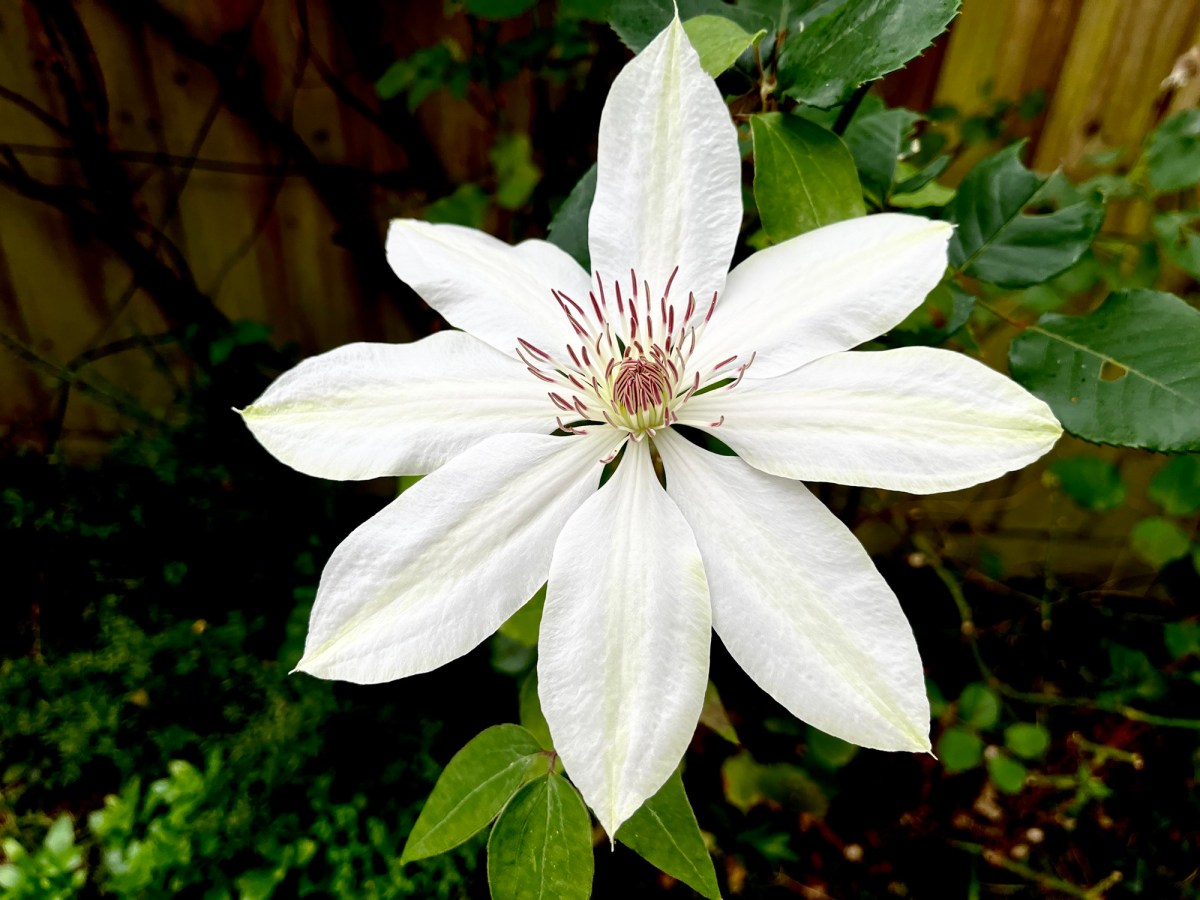
I glanced out of the window and something caught my eye. There, in the grey morning light and among the plants that had long ago bloomed and were now preparing for winter, was this glowing, lone white clematis. It certainly wasn’t there a couple of days before.
I went out into the garden and sat looking at it for a while. I took it as reminder that there is still much beauty in the world and that, what with all the horrors and tragedies happening on our planet, we need, sometimes and for our own well-being, to just ‘press pause’ and stop to appreciate the small, often wondrous things that help to quiet our troubled souls.
How well do we really know the life stories of our parents?
Obviously most of us will know some details of their lives before they were our parents: place of birth, schooling, career etc., and as children – and we will always be their children – we will, of course, know much of the middle and latter parts of their stories. There will also, usually, be some documentary record of their lives: photos, letters, various official documents, kept – perhaps – in a drawer, box or folder. But how often do we have access to the detailed narratives and minutiae of their entire lives?
My mother, Shirley, passed away peacefully, with her three sons and daughters-in-law by her bedside, in November 2012. She was buried the next day, according to Jewish custom, next to her beloved husband Alfred who had passed away in January 2006 after a long illness. She was a remarkable woman, much loved and admired, as testified by the hundreds of people who attended her funeral and who visited the family during the shiva (the seven days of official mourning). But I, along with my two brothers and our respective wives, only discovered quite how remarkable she was when we tackled the Herculean task of clearing her apartment.
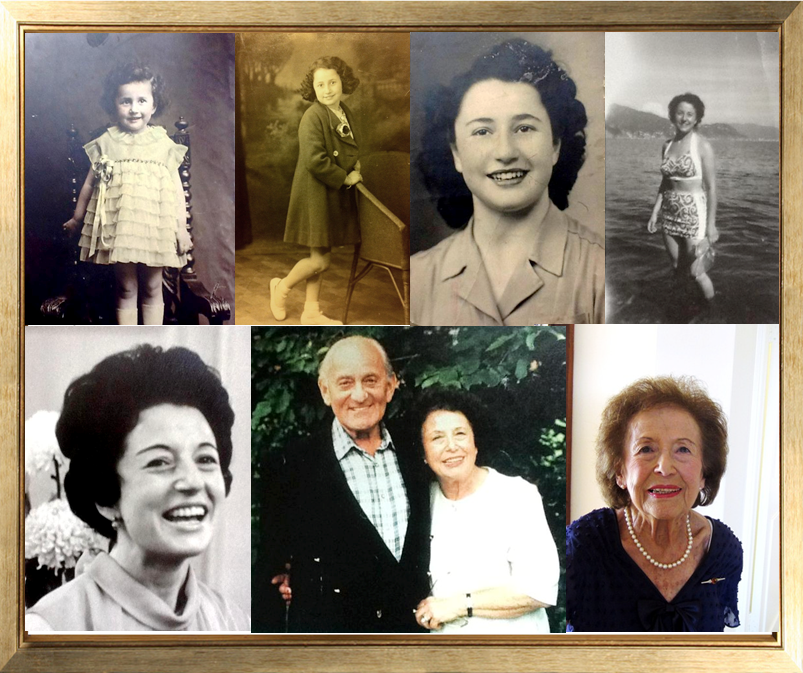
Photos of Shirley (and Alfred) 1929 to 2012 (2 weeks before she died)
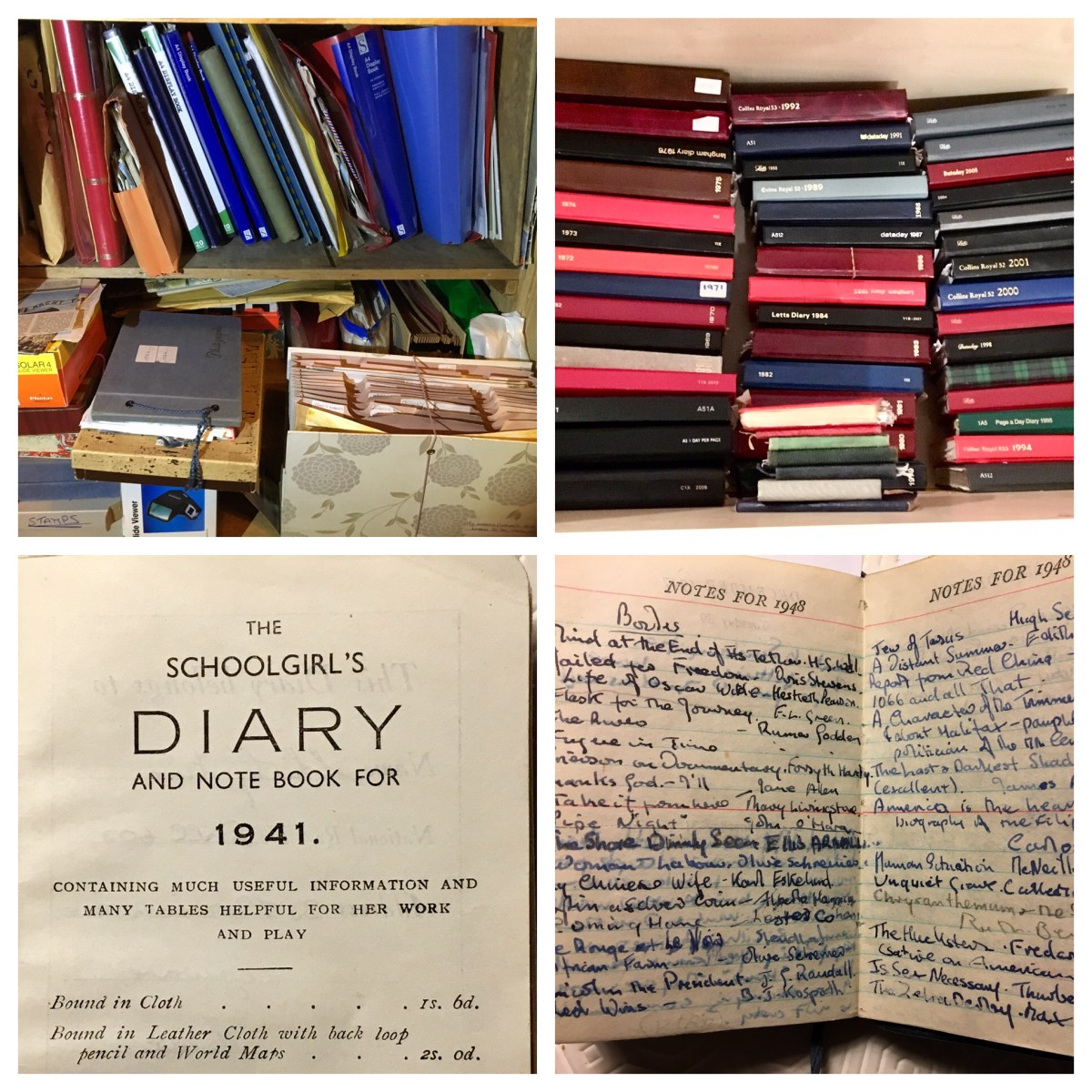
We always knew she kept a diary, and that no day was complete without her making a diary entry before she went to bed, always after midnight. We could always phone her to ask when a particular childhood or family event occurred. She would inevitably return the call giving chapter and verse on the event in question. She also wrote notes to herself, normally in the form of a ‘to do’ list, usually on small pieces of paper held together with a paper clip, and would fret if she mislaid them.
My mother liked to have things ‘so so’, and disliked causing upset, and so although her death was unexpected, she had already ensured that there were lists and instructions to cover any and all eventualities.
I ought to add at this point, as the above makes her sound like some sort of obsessive-compulsive, that she wasn’t at all – or certainly not obviously. She was delightful company; always elegant, gracious, a wonderful host, full of intelligent conversation whether discussing the latest book she’d read or play she’d seen. She even suffered fools with regal politeness…at least until they had left her presence. But when she was alone, and when my father was alive that would usually mean late at night after he had gone to bed, or in the years after he had passed away, she became what might have been her true vocation if her life had taken another direction: a highly skilled and dedicated archivist.
What we didn’t know, and what we discovered when we started clearing the apartment, was that alongside the carefully stored schoolgirl diaries that she started in 1941 when she was 15 years old and the page-a-day diaries that she started in the 1950s, she had recorded, labelled, catalogued and archived what appeared to be the documentation of her entire life: letters, postcards, photographs and slides, study notes, maps and guides, newspaper clippings, certificates, theatre and concert programmes.
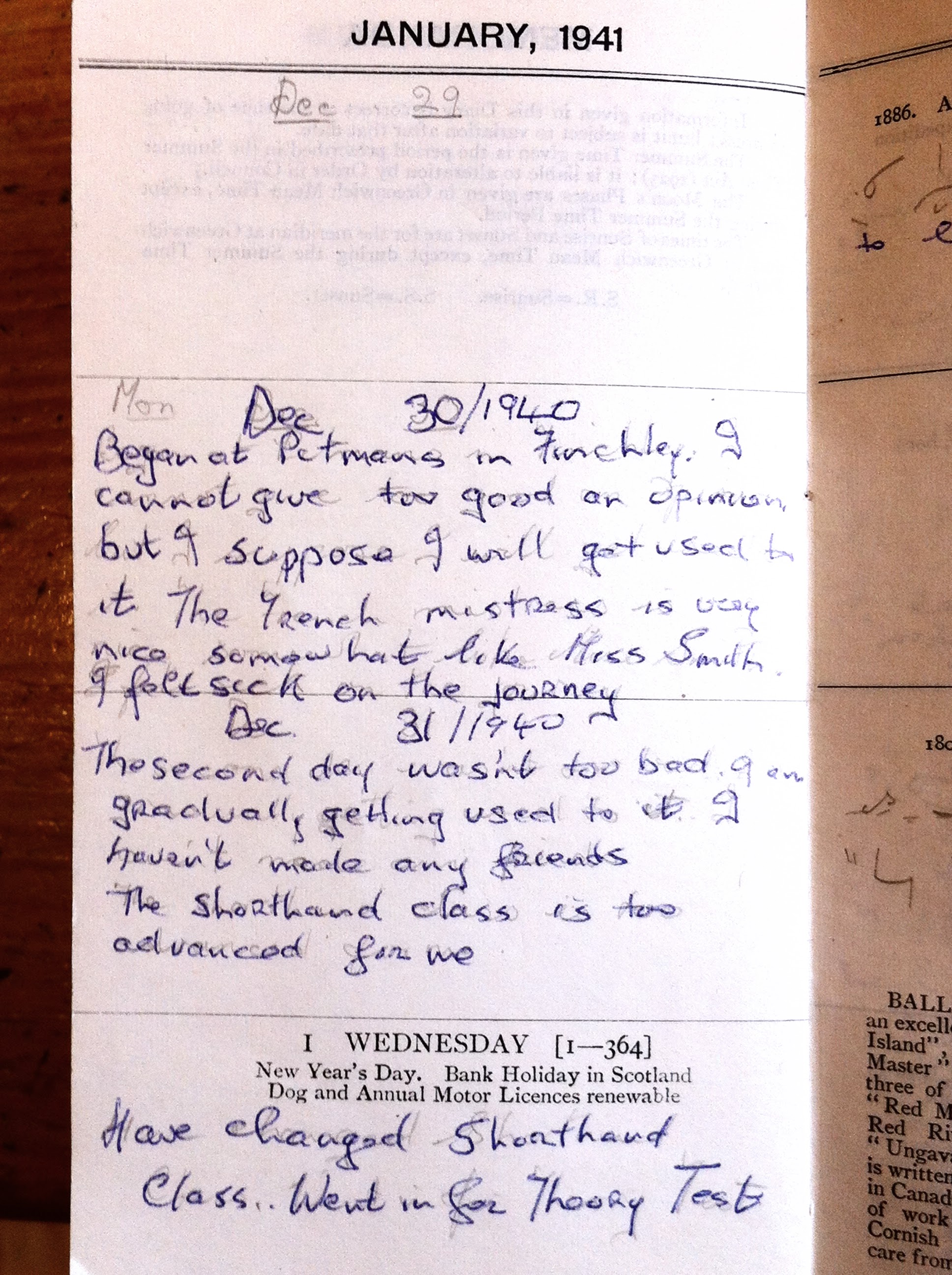
First page of the first diary, January 1941. Shirley was 15 years old.
Some of it was contained in two huge files each labelled ‘My Life’, each of which contained hundreds of documents. There were also dozens of files and folders with labels such as ‘Holidays’, ‘Trip to Far East’, ‘Film Work’ (she worked in the British film industry in the 1940s), ‘Family Documents’ (some of which went back to Russia in the late 19th century). There was one file that was labelled ‘Rememberings’ which really caught my eye. I opened it to find a series of typed pages that were almost a stream of consciousness about my mother’s early life. The first one ‘Deptford High Street’ https://bit.ly/RememberingDeptford recalled in as much detail as she could remember when in her 80s, growing up on Deptford High Street in south-east London and describing the people and the shops, cinema, goods yard etc. as she walked to school. Another was a much earlier ‘Remembering’ from when she had asked her own mother to describe the family’s origins in Russia and their early life in England in the early 1900s.
Virtually every personal letter my mother had ever received or written (she always made carbon copies until the advent of computers, when she’d simply print it out twice) had been carefully sorted into either years or particular individuals or topics. Each bundle was held together by an elastic band, and on the top of each bundle, held in place by the elastic band, was a small piece of paper which had the contents of the bundle written on it in her distinctive handwriting e.g. ‘letters to/ from Alfred in Hong Kong’ or simply ‘Letters 1983’. There were also small bundles of papers, usually small and clipped together, of what she called her ‘journals’. Whenever she travelled anywhere, she would not take her actual diary with her. Instead she would write her thoughts and observations on any piece of paper she could find, clip them all together, and then bring them home to be transferred into the diary or kept together in a file somewhere.
When we started dipping into the odd diary or two, there were frequent references to ‘see my commonplace book’. It was a term we were all unfamiliar with, so naturally I googled it. According to what seemed a perfectly sensible article in Wikipedia: “Commonplace books (or commonplaces) were a way to compile knowledge, usually by writing information into books. They became significant in Early Modern Europe…Such books were essentially scrapbooks filled with items of every kind: medical recipes, quotes, letters, poems, tables of weights and measures, proverbs, prayers, legal formulas. Commonplaces were used by readers, writers, students, and scholars as an aid for remembering useful concepts or facts they had learned. Each commonplace book was unique to its creator’s particular interests… the value of such collections is the insights they offer into the tastes, interests, personalities and concerns of their individual compilers. From the standpoint of the psychology of authorship, it is noteworthy that keeping notebooks is in itself a kind of tradition among litterateurs….Some modern writers see blogs as an analogy to commonplace books.”
We eventually found my mother’s commonplace books, and they were almost exactly as described in the Wikipedia article. Whenever she had read, seen or heard something of interest, whether it was in a book or newspaper, on the radio or television (usually BBC Radio 3 or 4, she was not a great fan of television unless it was a factual programme), or at the cinema or theatre, she would write it down or cut it out and place it in one of her commonplace books.
The amount of material we had uncovered was extraordinary, both the sheer amount of it and the quality of contents: my mother wrote beautifully, often with great style and wit, and in great detail.
When we told people about it they all said “what are you going to do with it all?”. There were one or two who said we should just throw it all away. But I don’t think they had any sense (how could they?) of what we had in front of us. The more I read, the more I became determined to ‘do something’. The final piece or decider of the ‘what to do with it all?’ question fell – literally – into my hands some weeks after we had started clearing the apartment. I was in the room known as the ‘office’. It was the room in which my parents had worked for nearly 30 years, mainly in their role as editors of their local synagogue magazine which was a large, serious, glossy bi-annual publication. Before he retired, my father also ran his textile merchant business from there, and the shelves were full of files and all the paraphernalia of a working office.
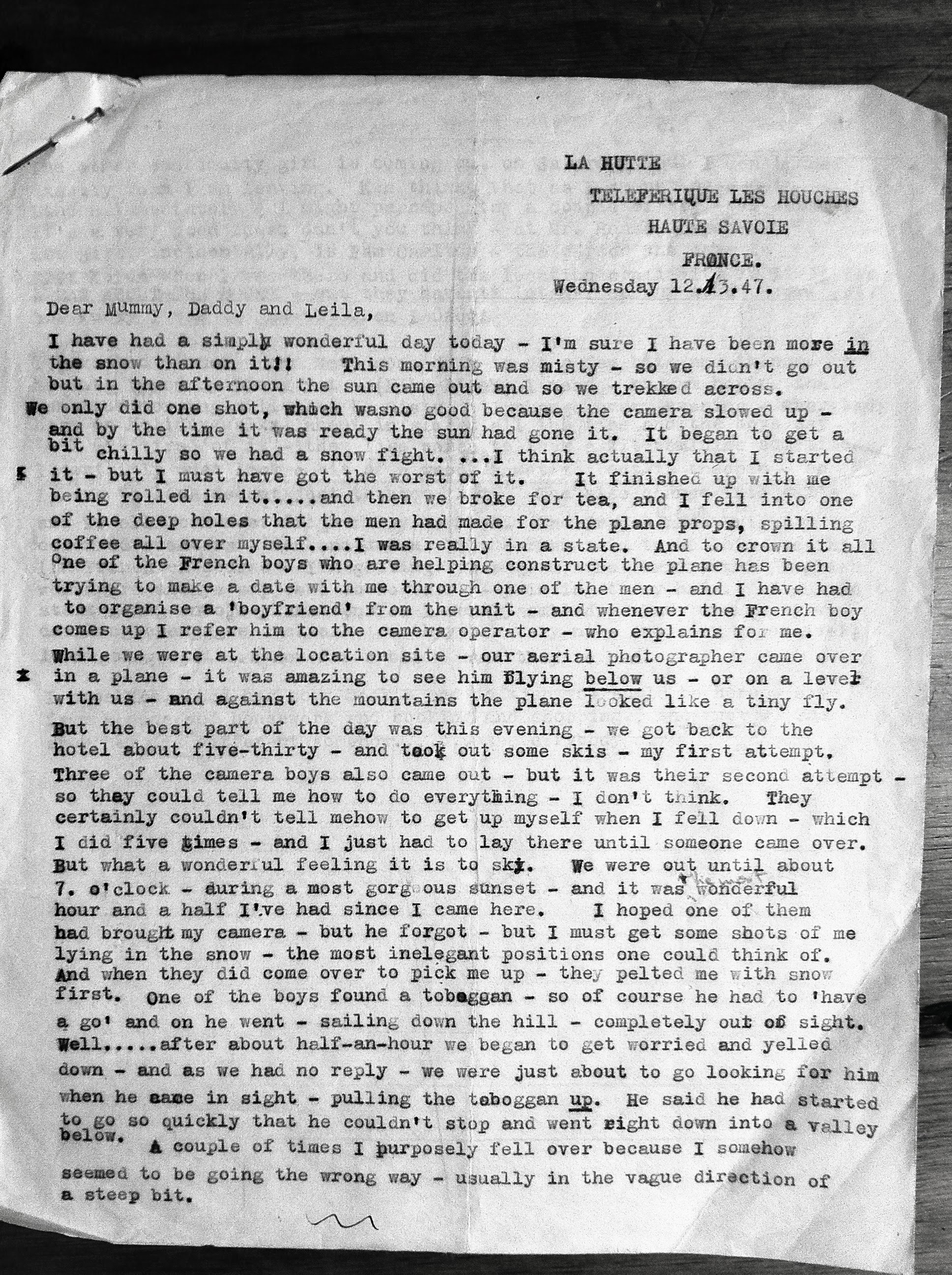
Letter to her parents and sister from ‘The Rescue’ film location in the French Alps. March 1947.
I had decided to ‘have a go’ at clearing the office, and was sorting through and preparing to put into rubbish bags a whole set of files related to the magazine. As I pulled one box file off the top shelf, another file fell out which I managed to catch. This was not a ‘business’ file. It was one of those ‘concertina’ files with about a dozen sections, held together by a band. The hand- written label on the front said: “Special Letters and Journals”, and it only took a glance at the first bundle of documents from the section labelled ‘1940s’ to realise just how special the contents of this file were.
It became clear to me that, particularly since my father passed away in January 2006, my mother had gradually worked her way through all the documents she had written and/or kept so assiduously throughout her long and active life, and had care- fully arranged them in some sort of order. It was fascinating to see a note or clarification, written relatively recently, next to some diary entry or letter from 50 years ago. It was also clear that she had left it to be read, and what convinced me that something ‘needs to be done’ with it was find- ing something she had written in the back of one her early schoolgirl diaries. Along- side the list of books she had read that year and the list of films and concerts she had attended, was a quote from the Italian writer Giuseppe de Lampedusa:
“It should be an obligation upon every citizen, imposed by the State, to keep a record of their lives. Because, if they do not, who will know they ever existed?”
I felt it was important not to leave the record of my mother’s life hidden away in a cupboard. So I determined to find a way to bring her life story to life. It was obvious from the start that writing any form of linear narrative was out of the question. What I had before me was a giant jigsaw and I realised that notion of a website, with its layers, sections, multiple entry points etc. offered a real opportunity to slowly – in fact very slowly- define and create the various pieces that, together, formed the picture of my mother’s life. So that’s what I did and continue to do https://bit.ly/NotesandHopes .
In 2017 BBC Radio 4’s The Film Programme * did a feature on the diaries and letters my mother wrote when she worked in the film industry in the 1940s, and a lot of that material is eventually going to be deposited in the National Film Archive. My mother would have been absolutely chuffed!
Not long after my mother died, a close friend, whose mother had also passed away recently, said to me with a hint of envy, “you don’t just have the things of her life, you also have access to her mind and her heart”. That is certainly and wonderfully true: from the vibrant, idealistic, politically-engaged young woman of the 1940s who was looking forward to the future, to the still vibrant, still idealistic, still politically-engaged family matriarch of 2012 looking back on a life not only lived but also documented to the full.
During a conversation about education with a colleague who is an eminent and well-respected professor of education, he said vehemently ‘I hated school’. Now he and I are probably of a similar generation, but my school experience in the 1960s was rather more positive.
I went to a rather academic boy’s grammar school in London, where corporal punishment had been abolished some years previously. The focus was very much on getting into Oxbridge or at least a ‘decent’ redbrick university. I, however, was interested in becoming an artist.
The art room – run by Mr. Potter – was located at the far end of one wing, up in the roof space. It was, nevertheless, a light and airy space and I enjoyed the many hours spent in there. I wanted to do Art for ‘A’ level and to go to art school. The problem was that the ‘A’ level requirements at that time were stultifyingly restrictive (I don’t think they’ve changed much). One of the requirements was a still-life painting, and I distinctly recall Mr. Potter looking at my somewhat surreal and expressionist rendering and saying, sympathetically, “That’s very interesting, but that will never do”.
When I asked him why, he explained that the A level required an ultra-realist painting. Any other approach would be deemed a failure. But he then said, encouragingly, that if any of the great masters of modern art, the Cubists, the Expressionists, the Surrealists, the Fauves etc had taken ‘A’ level art, not only would they have failed but there would have been a demand for psychiatric testing!
At this stage I knew that the school and the requirements of the exam board were unable to support me in creating a decent portfolio of work to get into art school.
So I went to see the Headmaster: a kindly, liberal man and a much respected leader and teacher. The school was a rugby playing school (I was actually a very good fly-half at the time) and everything stopped on Wednesday afternoons for sports. Not far from the school, in north London, was the then renowned Camden Institute, which had a wonderful reputation for its adult education art classes led by established artists. I asked the Headmaster if, instead of running around the rugby field on a Wednesday afternoon, I could attend the Institute’s art classes. He agreed on the proviso that I would occasionally show him the work I was doing.
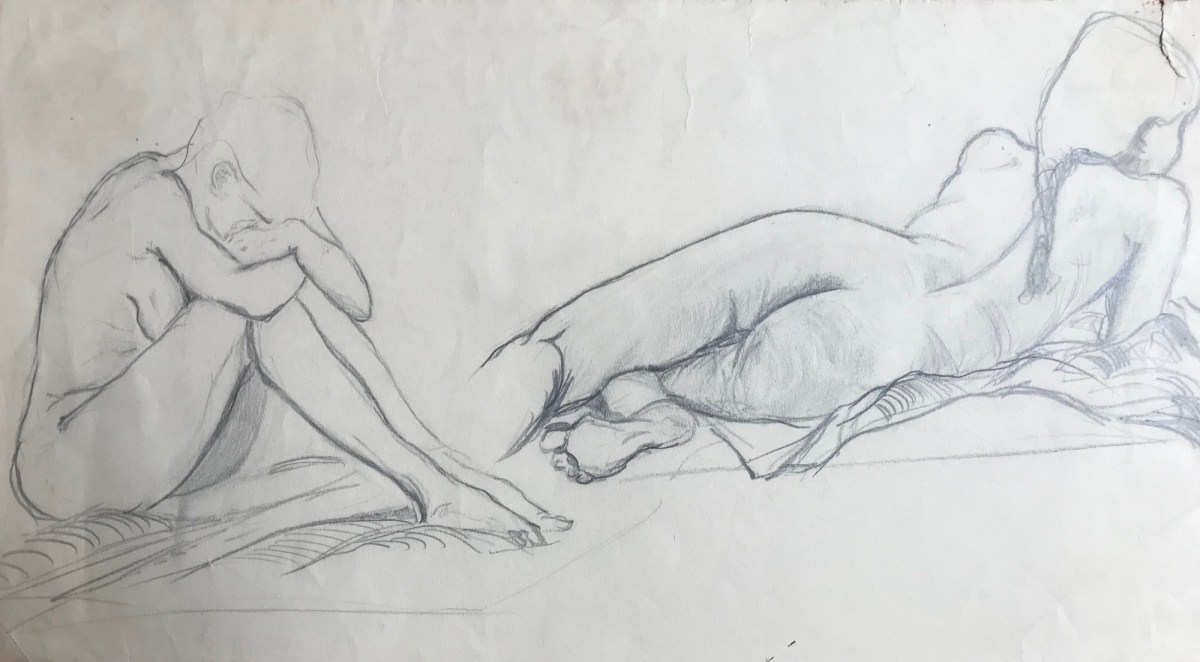
Walking into and taking part in the life class studio on my first visit was a revelation. I don’t think I’d seen a fully naked woman before except in paintings (we also had male models) but not only did I feel immediately welcome and at home, but the whole experience of sitting quietly at an easel, observing the life model very closely, and making marks on paper was extraordinarily powerful. The only sounds in the room were the slight hiss of the gas fire near the model, the occasional sound of charcoal scraping on paper, and the hushed conversation of the tutor and whoever he was talking to.
Fifty plus years later, I still use that ‘sitting quietly, observing or thinking, and making marks on paper’ in my own work, and in the workshops and seminars I run.
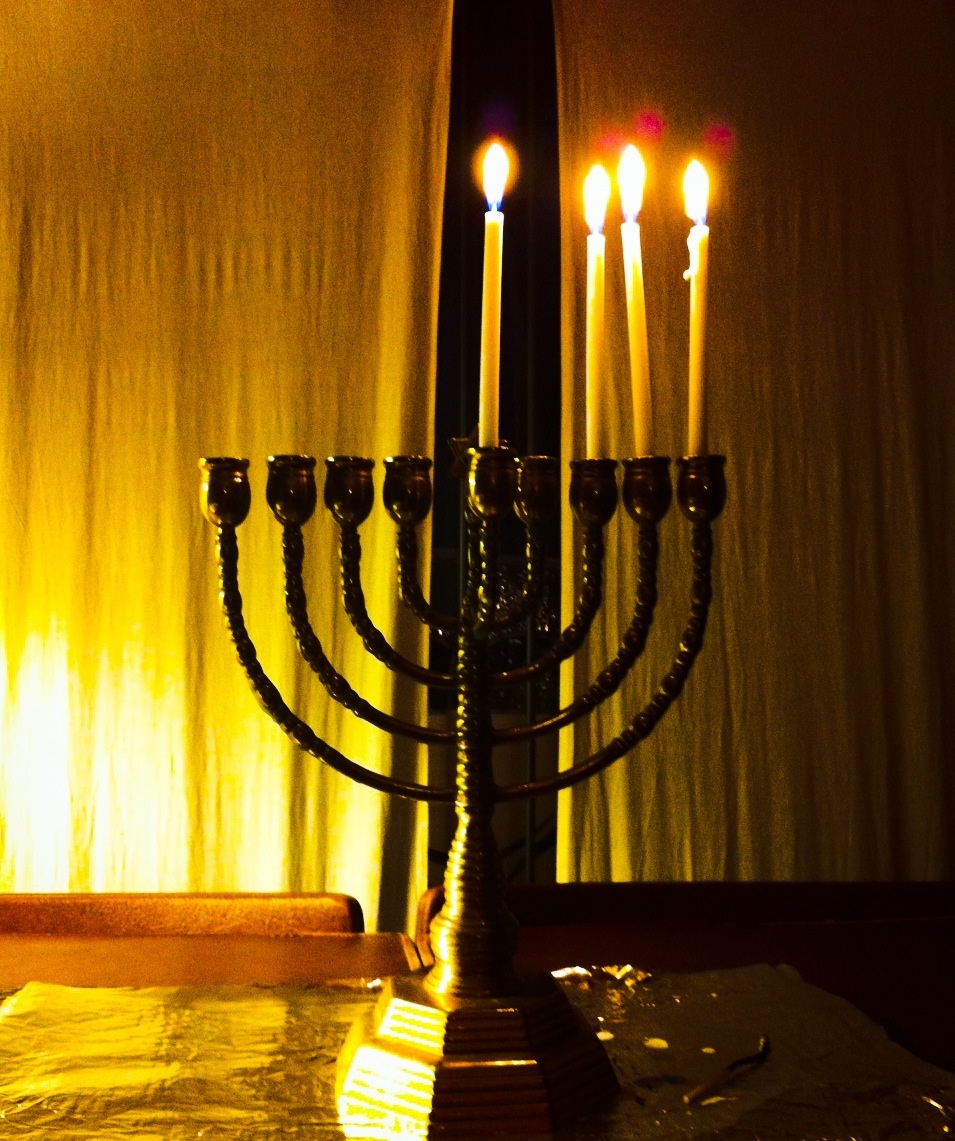
This is one of our menorahs (more properly a chanukiah, a menorah has seven branches, but nearly everyone calls the eight branch version a menorah) ) that we light on Chanukah, the Jewish ‘Festival of Light’ that Jews around the world celebrate. The festival lasts for eight days, and you start lighting one candle on the first night, and end with lighting eight candles on the last night. The candles are lit by a candle known as the shamas.
Menorahs come in all shapes, sizes and materials: from the traditional eight branch candelabra plus the shamas candle made in brass or silver, to ultra-modern designs of great ingenuity and beauty. Essentially anything goes as long as the basics are met i.e. eight candles in some form of row plus the shamas candle, and many designers have taken up the challenge.
We have acquired several menorahs over the years. Some were gifts. Some we’ve inherited from parents and grandparents. A few we’ve bought.
But this menorah, quite large and made of brass, which we call our ‘Irish menorah’ is my favourite one.
Several years ago, when our now adult children were really just children, we were on holiday in the far south west of Ireland. West Cork to be precise. We were staying on a very small island called Long Island in Roaringwater Bay and, as there were no shops, we had to cross over by boat to the small village of Schull on the mainland to get supplies. I say ‘we’, but I have to admit that it was my partner, Jo, who usually went off to do the shopping while I stayed and supervised – from a very relaxed distance – the children, as they played amongst the rock pools and went off with the small gang of other children also staying on the island.
Among the few shops in the village there an ‘antique shop’, which was actually more of a junk shop. Jo stopped one day, and looked into the shop. And there, amongst the usual bric-a-brac, was a brass menorah. She could see the label which said: ‘8 branch candelabra with extra candle holder’. Amazed, and knowing there were very few if any Jews in that part of Ireland, she asked the shop owner where it had come from. The woman didn’t know, and really didn’t know what it was, despite the Star of David in the centre of the menorah. So Jo bought it, for the ridiculous price of £8.00
When we got it back to our little holiday cottage and looked at it closely we realised that it was designed to come apart. By turning the Star of David, which was attached to a long, thin screw, we could unscrew it from the heavy base, and then everything came apart. It was, of course, designed to be taken apart, and the various parts placed in a case – which had obviously disappeared somewhere along the menorah’s long journey to a junk shop window in West Cork.
We reckoned, after a bit of googling, that it was c. 120 years old, had probably originated in Central Europe, and the chances were that it had belonged to one of the many thousands of families – like our own families – who came to the then British Isles and beyond to escape antisemitism, pogroms and persecution and to seek a new life.
Of course we’ll never really know the real story. But as I watch that old brass menorah glow as the candles burn and flicker, I feel a extraordinary link to the past: a link in a chain that remains – despite the tribulations and tragedies of history – unbroken.


 Stumbling with Confidence