Why is it so damn hard to get rid of books?


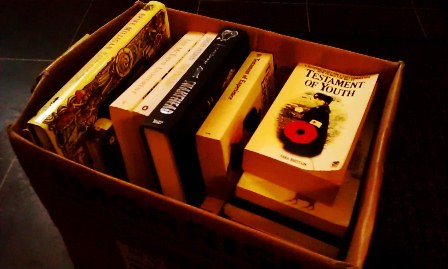
There it sits in the middle of our hallway, awaiting departure to the local charity bookshop. A box full of books. Behind the picture is a tale of heartache and hesitation, each book the cause of ineffable uncertainty.

Why is it so damn difficult?

Stanislavski, the great theatre director, started his ‘method’ of actor training by asking the question ‘What if?’. Well, even the odd duplicate book (e.g. the Vera Brittain ‘Testament of Youth’), which ought to be a straighforward job of straight into the box, proved problematic.

“OK, we don’t need two of the same….but what if?….”. And a whole number of possible scenarios unfold as the book in my hand hangs in limbo between shelf and box.

We have far too many books. No. Correction. We have far too many books for the size of our house (and it’s not a small house). And we have books that we shall never….sorry….that it is highly unlikely that I or we shall ever read again. But yet, as the eye and the hand travel across the serried ranks of fact and fiction, art and science, politics and philosophy, plays and poety, education and entertainment, and a plethora of other categories including miscellaneous, it is so easy to keep on moving, to avoid the obvious decision, to keep the box’s destiny unfulfilled.

Admittedly, there’s one decision that is easy to make: it’s not my book. It’s my wife’s or my daughter’s or my son’s. (The last of those has, anyway, always taken a minimalist approach to books – at least in tangible paper form. The shelves in his room are, however, full…..of my books).

Recently I read an article by someone who had managed to get their collection of several hundred books down to 20. Their ‘light bulb’ moment was the realization that “I was not so much attached to the stories and words themselves, but the physical books sitting on the shelves. Once I had that realization, I began to let go of some of my books”.

My problem is precisely that I AM attached to the fact of the books sitting there on the shelf. Their very presence comforts and reassures me. But it’s a bit more than that. Each one – and I’ve read or certainly delved into all of them at one time or another – contains a little bit of me, my history. Each title contains and reflects back to me a fragment of my life, a moment in time. Each one has – to a lesser or greater degree – a sort of Proustian ‘Madeleine’ biscuit effect, conjuring up the past.

Nevertheless, notwithstanding the above, I managed to fill that single box. The key to selecting those few books (and I inspected every shelf we have) was that each one was entirely silent in relation to my life. A closed book, literally and metaphorically.

It seems once I get beyond the obvious ‘keeps’…and I suspect there’s already too many of them, I’m stuck with ’emotional resonance’ as the key criteria. Perhaps books, like dogs, are “not just for Christmas but for life”.

Why I’m stumbling with confidence

image

A few people have asked me why this blog is called ‘Stumbling with Confidence’?

The phrase stems originally from my research into university teachers’ conceptions and experiences of creativity in relation to learning and teaching, and I have used it in various papers and conference keynotes.

My research entailed interviewing a number of colleagues from across a range of disciplines – from the arts to the sciences and various disciplines in between. I would always start the interview by asking them to tell me about an experience in learning and teaching that they would consider was a creative experience for them. In a number of cases that question prompted a sort of rabbit-in-the-headlight stare, as if to say “What the hell has creativity got to do with teaching?”. But inevitably they would eventually identify and begin to talk about a particular experience.

At some point I always asked them what prompted them to go down that particular road? Almost everyone I interviewed either said, or said something along the lines of ‘I stumbled across something’.

Probing deeper into this revealed that the mere act of ‘stumbling across something’ is not sufficient in itself. After all, we stumble across potentially useful stuff all the time. The key factor in enabling them to seize the moment was a sense of confidence: the confidence to believe it might be the right thing to do, the confidence to believe it might just work, the confidence to believe that it was worth whatever risk was attached to it, the confidence to believe it was worth giving it go.

As the debates swirl around skills v. passing exams, education for life v. training for work, the intrinsic value of education v. its extrinsic worth, very few seem to be talking about attributes like confidence, and asking how we might educate and work in partnership with our young (and often not-so-young) students to enable them to face – with a steadfast eye, a steady hand, and a keen, informed, open mind – the uncertainties that a complex, rapidly-changing world will inevitably throw at them.

The poet Antonio Machado famously wrote:

Wanderer, there is no path.
The path forms itself as you walk it.

Caminante, no hay camino,
se hace camino al andar.

At least one of our tasks as educators is to ensure that we have done our best to enable our students – as each forms amd forges their individual path – to stumble confidently towards not only whatever lies around the next bend but beyond the horizon.