Selma Connections: A King, a Rabbi and a Caution

image      image

Like many, I’ve been watching the commemorations and celebrations of the 50 years since the momentous ‘Bloody Sunday’ on 7 March 1965 in Selma.

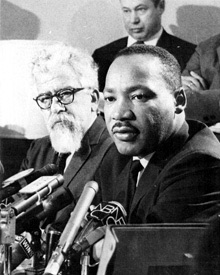
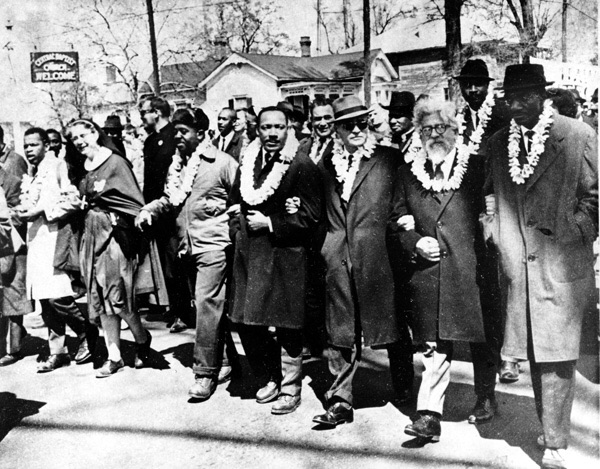
Looking at the various films and photographs from that time and place, you may have noticed that in a number of them, standing or sitting next to Dr. Martin Luther King is an elderly white man, wearing glasses and with a shock of white hair and long beard. His name is Rabbi Abraham Joshua Heschel, which is the anglicised version of his Hebrew name: Avraham Yehoshua Heschel….which was also my father’s Hebrew name. They were both named after a famous 17th century Polish rabbinical mystic.

Rabbi Heschel was a leading figure in American Judaism and also a very active social activist. He believed strongly that one’s spirituality must have legs. At the invitation of Martin Luther King Jr., Heschel participated in the opening day of the 1965 civil rights march from Selma to Montgomery for voting rights. The photograph of Heschel walking alongside King and other religious and political leaders is considered an emblem of the civil rights movement and of Black-Jewish relations of that era.

After the march, Heschel wrote about the experience in a private memo, “I felt my legs were praying.”

Jumping to the present, and the particulars horrors emanating from the so- called Islamic State, with its violent, barbaric intolerance of anyone and anything that does not fit with its particular world view, Heschel’s caution about the dark side of religion has a particular resonance:

“…when religion speaks only in the name of authority rather than with the voice of compassion, its message becomes meaningless.”

ASSIMILATIONISM VS MULTICULTURALISM…and the failure of both.

This, by Kenan Malik, is an important read…..on France, Enlightenment values, assimilation vs. multiculturalism and the failure of both.

Kenan Malik's avatarPandaemonium

(c) Grace Gardner; Supplied by The Public Catalogue Foundation

One of the key debates in European social policy has been that between multiculturalism and assimilationism. French ‘assimilationist’ policies are generally seen as the polar opposite of British-style multiculturalism. French politicians pride themselves in having rejected the divisive consequences of multiculturalism. Unlike in the rest of Europe, they insist, in France every individual is treated as a citizen, not as a member of a particular racial or cultural group.

The question of French social policy, and of social divisions, has come sharply into focus in the wake of the recent tragic events in Paris. Assimilationists have long held multiculturalists policies responsible for nurturing ‘homegrown’ jihadists in Britain. Now, they are forced to answer why such terrorism has been nurtured in assimilationist France, too.

I have long been a critic of British multiculturalism. But I am no more enamoured of French assimilationism. The two outlooks are far more similar than…

View original post 2,015 more words

From out of the educational wilderness…towards what?

Two things became clear to me this week, both connected with education.

The first, I suspect, has been clear to many for quite some time, so I’m just ‘keeping up at the back’ on that one. The second one is far less publicly obvious, but I reckon is rather more insidious than the first.

The first is that the Tories have probably given up on the idea of winning the next election (my predictive text insisted on ‘ejection’!) and forming a government. So they have embarked on a mission to change the educational landscape so fundamentally and significantly that no government will be able to undo or reverse – within the lifetime of that government or even just a lifetime – any of the changes that have been wrought.

The second thing that occurred to me, which became obvious at a meeting I attended at the Department for Education (DfE) on the reform of ‘A’ levels, is that the ideological pressure is now so great that the language of education is being changed fundamentally,  literally as we speak it and write it.

Others have commented – in various and many articles and blogs  – how words and phrases such as ‘child-centred’ and ‘progressive’ that used to have such a positive, hopeful meaning now attract only scorn and derision from those who deign to govern us. There has also been a great deal of concern and comment regarding the constant dismissal and consequent erosion of the arts – which, by their nature, tend to be child-centred and progressive – in the national curriculum and in the media discourses on education. It’s all about STEM: Science, Technology, Engineering, Mathematics.

It’s also worth noting that the academies and free schools, that are so favoured by our government, are not tied to the national curriculum, so other measures (see below) are required to ensure the focus on STEM is maintained.

Recently the ideological focus has expanded to encompass not only the primary and secondary sectors, but also the tertiary sector and higher education (note: Mr. Gove has admitted in print that he would love to have the whole educational system under his guiding wing at the Dept. for Education).

To accompany and support this expanded focus, and to maintain the ideological commitment to STEM, we have had to adopt a new vocabulary of educational double-speak, in which some ‘A’ levels are designated ‘facilitating subjects’ for entry into a ‘good university’, while others – mainly but not only arts subjects – are designated ‘non-facilitating subjects’. In addition, Ofqual (the government agency responsible for all qualifications in the schools’ sector) has decreed that all ‘A’ levels must be designated as either ‘exam-assessed’ or ‘non-exam assessed’, the latter referring to any form of assessment that is not a traditional, sit-down, written examination: a not uncommon phenomenon in the arts. What is astonishing is that the nice, seemingly intelligent people at Ofqual and the DfE insist that there is absolutely no implication of value in that language. They insist that all subjects are regarded as equal, despite the unequivocal evidence that some are clearly more equal than others. The baleful consequences can be seen in the growing list of schools that have deleted arts subjects from the list of A levels they offer.

Our political leaders have taken it upon themselves to lead us out from what they perceive as the desert of educational disaster – in which we have been wandering for at least  40 years – and to enter the promised land flowing with STEM and increased PISA scores. When it comes to education, particularly in England, they are guided not by the evidence provided by years of careful, rigorous research by educational researchers, nor by the evidence provided by scientists in new and potentially paradigm-shifting fields such as educational neuroscience. Rather they stick a finger in the air to see which way the ideological wind is blowing, listen carefully to what their favourite soothsayer has to say on the evils of past educational discourses and practices, check that the pillar of right-teous ire that is the Daily Mail is well and truly behind them and that the pillar of smoke and mirrors is in front of them…and off they go, confident that the caste of pedagogic priests and disciplinarians that they have appointed will ensure obedience and silence dissent.

As we traipse reluctantly behind them, we look back to see the tattered tents and banners of genuine, life-enriching and life-enhancing education left blowin’ in the wind.

Straight to the Core: Gove, the Arts and the Core Curriculum

Nelson Mandela said that “Education is the most powerful weapon which you can use to change the world”, which is why politicians can’t help but meddle.

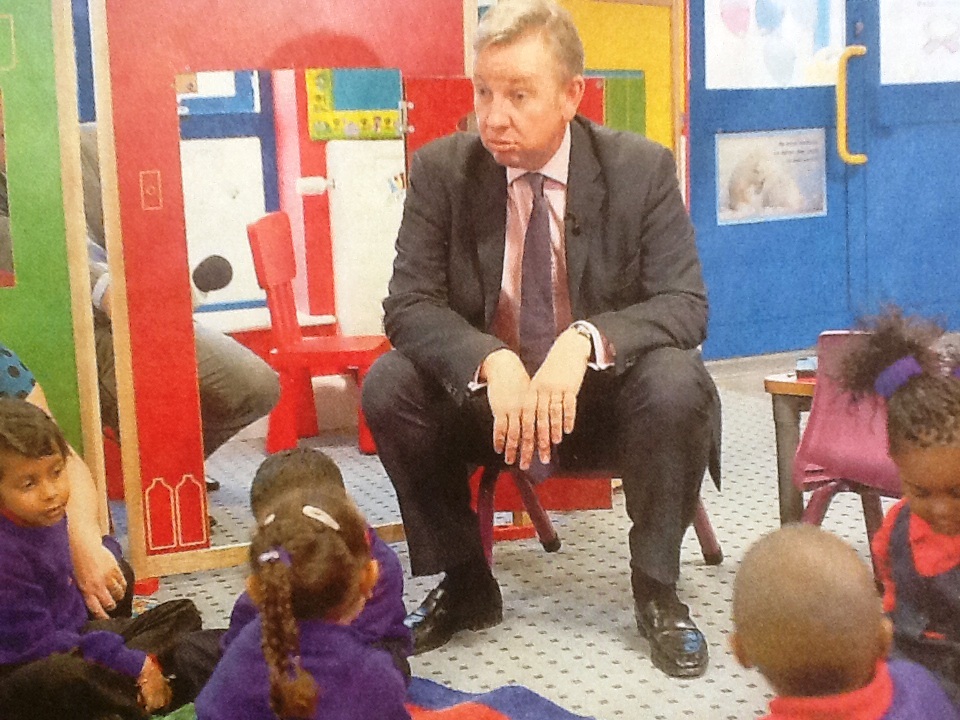
Here in the UK, with a long and – with a few notable exceptions – inglorious history of political meddling in the education of our children and young people, we currently have an über-meddler in the shape of Michael Gove (pictured), the Secretary of State for Education.

Mr. Gove is convinced, with the passion of the true zealot, that our education system is broken and that it needs a complete overhaul. He is particularly obsessed with the need for a ‘core curriculum’ which essentially takes us back to the 3R’s with some science and technology attached. I have nothing personal against young people being able to read, write and count. Actually I think it’s quite important. I think science and technology are important. But I do object strongly when – in order to achieve his ambition – Mr Gove decides that the arts are an irrelevancy when it comes to the content of his ‘core curriculum’.

Mr. Gove is an intelligent man. After all he was a leading journalist on The Times, and therefore ought to be used to ensuring that he quotes his sources accurately. Well, he keeps going on about how his ideas for this arts-free ‘core curriculum’ are informed by his admiration for the Massachusetts Common Core of Learning. As well he might be. The education system in Massachusetts is at the top of the US educational league tables.

Now, I don’t know if Mr. Gove has actually read the Massachusetts Common Core of Learning, or whether – returning to his journalistic habits – he is studiously ignoring the inconvenient truth. But there, in the Massachusetts Common Core of Learning, in stark black and white, is the following:

“All students should:
Acquire, Integrate and Apply Essential Knowledge (in)
– Literature and Language
– Mathematics, Science and Technology
– Social studies, History and Geography
– Visual and Performing Arts
– Health

Under ‘Visual and Performing Arts’ there is:
– Know and understand the nature of the creative process, the characteristics of visual art, music, dance and theatre, and their importance in shaping and reflecting historical and cultural heritage.
– Analyze and make informed judgments regarding the arts.
– Develop skills and participate in the arts for personal growth and enjoyment.

Under Literature and Language:
– Read a rich variety of literary works including fiction, poetry, drama and nonfiction from different time periods and cultures, relating them to human aspirations and life experiences.
– Analyze implications of literary works, and communicate them through speaking, writing, artistic and other means of expression.

All students should:
Use Mathematics, the Arts, Computers and Other Technologies Effectively
– Apply mathematical skills to interpret information and solve problems.
Use the arts to explore and express ideas, feelings and beliefs.
– Use computers and other technologies to obtain, organize and communicate information and to solve problems.
– Develop and present conclusions through speaking, writing, artistic and other means of expression.

In 2006, UNESCO declared: “International declarations and conventions aim at securing for every child and adult the right to education and to opportunities that will ensure full and harmonious development and participation in cultural and artistic life. The basic rationale for making Arts Education an important and, indeed, compulsory part of the educational programme in any country emerges from these rights. Culture and the arts are essential components of a comprehensive education leading to the full development of the individual. Therefore, Arts Education is a universal human right, for all learners” (The Road Map for Arts Education,p3)

Please note the “essential components of a comprehensive education”. Perhaps Mr. Gove’s dislike of arts education derives from his antipathy to the word ‘comprehensive’?