The eminent, and now sadly departed, educationalist Dorothy Heathcote used to say that the most powerful word in education is the word ‘might’.
Asking a student ‘what MIGHT be the answer?’ rather than ‘what IS the answer?’ opens up the possibilities, the questioning, the pondering, the wondering….the creativity.’
Our handbooks say things like (and I know, because I’ve written them as well) “On the completion of this module/course/program the student WILL be able to demonstrate a, b, c, d…..”We don’t write “On completion of this module/ course/ programme the student may be able to do THIS pretty well, but they also might be able to do THAT even better, and what’s more, they may be able to do stuff we haven’t even though of yet”.
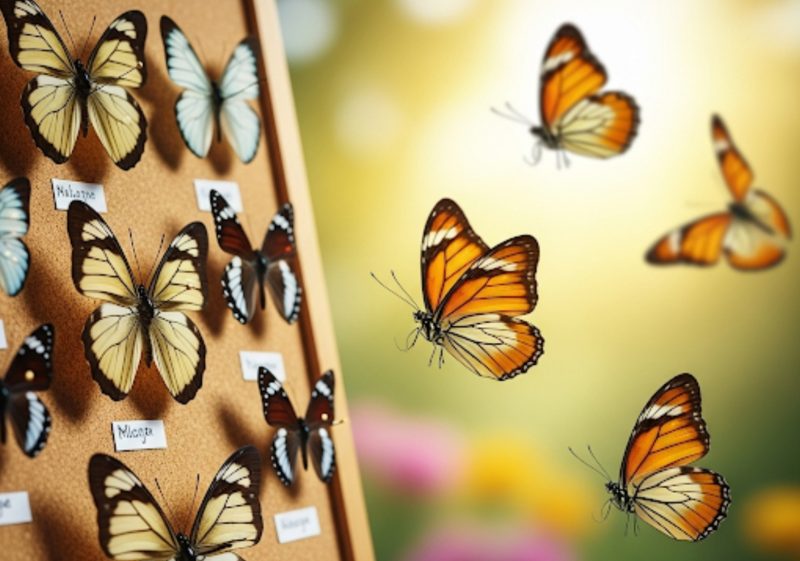
But that sort of language and thinking doesn’t go down too well at the validation board, or with the quality assurance people, or with the policy makers, who require everything to be identified, categorised and pinned down, like a collection of dead butterflies.
How can we/do we – in education – break out of the ever tightening circle of predict and provide, control and compliance?
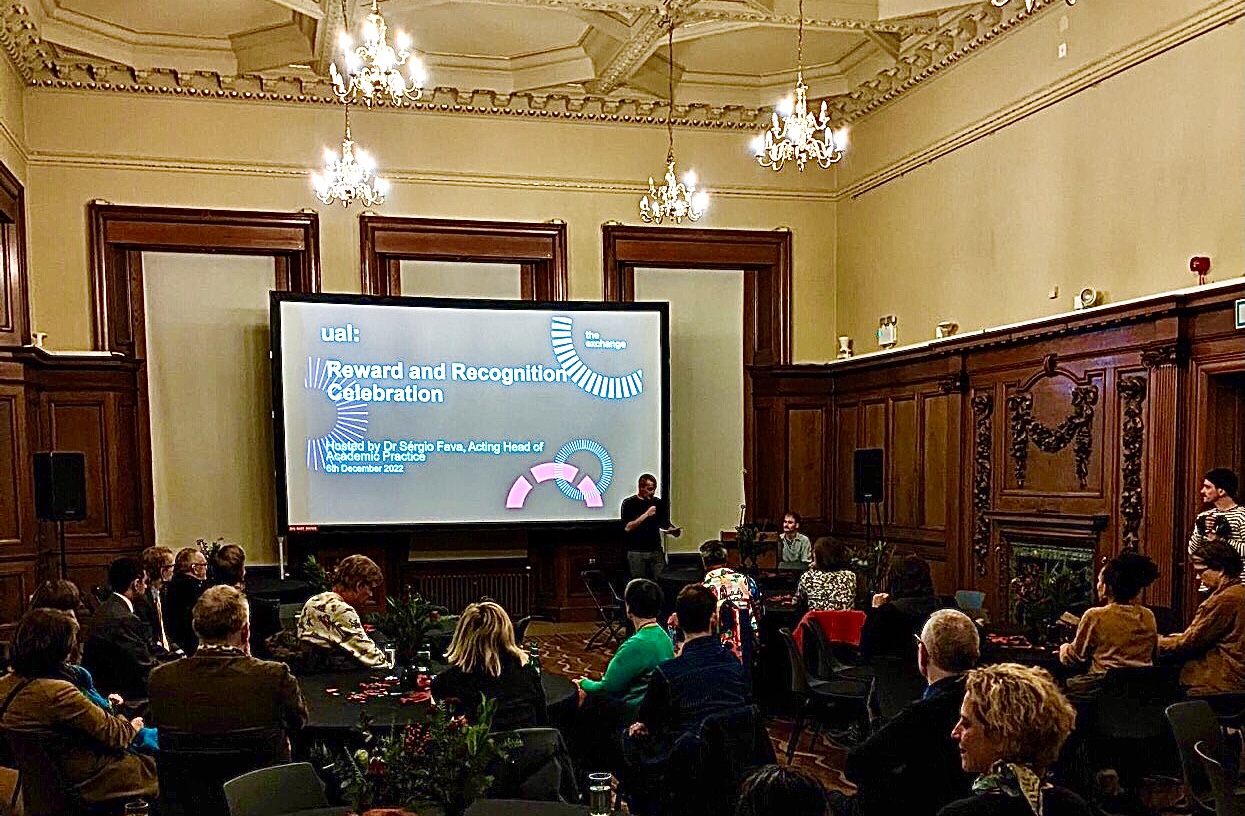
(This is a full transcript of the talk given by Prof. Paul Kleiman at the University of the Arts London’s ‘Reward and Recognition Celebration’ event in the Banqueting Hall at Chelsea College of Art, celebrating the achievements of UAL staff. December 6th 2022)
The event is introduced by Dr. Sérgio Fava, Acting Head of Academic Practice
Good evening everyone.
I’d like to thank UAL for inviting me to speak to you today. It is an honour and a privilege. First of all I’d like to start by congratulating all of you for achieving your various successes whether it’s the PGCert, the Masters degree or Fellowship.
When I was invited to give this address I was asked if I might focus on creativity and assessment as those two topics are not only ‘hot topics’ in higher education but they have been central to my own work and research…and I’ll do my best.
I’ve called this address ‘Stumbling with Confidence: close encounters of the creative kind’. The phrase ‘Stumbling with confidence’ comes from my research into how academics from across a wide range of disciplines across the arts and humanities, social sciences and sciences – how those academics conceptualised creativity in their pedagogic practice.
The research was based on a series of in-depth interviews and I’d start each interview by asking if they could tell me about an experience in regard to teaching their subject that they might regard as a creative experience.
That request was often greeted by what I’d call a sort of rabbit in the headlights stare. You could feel their brain going “Teaching?” “ Creativity?”, frequently accompanied by a long silence.
Now I know silence can be awkward, and there is always a temptation to jump in, to fill the void. There is a Latin term for that: Horor Vacui – fear of empty space. It’s one of the few things I remember from my art history lectures in my student days. We were shown these huge ancient storage jars and vases that were covered head to foot in decoration. One reason for that, so we were told, is the belief that the evil eye enters through empty space. So we fill the void. And when I look at our curricula, our timetables, our workloads that’s what we still do…we fill the void, leaving very little or no space. What are we afraid of?
The Japanese have the concept of ’Ma’ – often translated as ‘negative space’ but it is much more than that. One way of understanding ‘ma’ is as the space between tangible things that gives those things meaning. It is not so much empty or negative space, but rather it a space full of energy, potential and promise.
The great graphic designer, Alan Fletcher, refers to Ma in his book ‘The Art of Looking Sideways’.
“Space is substance. Cézanne painted and modelled space. Giacometti sculpted by “taking the fat off space”. Mallarmé conceived poems with absences as well as words. Ralph Richardson asserted that acting lay in pauses… Isaac Stern described music as “that little bit between each note – silences which give the form”… The Japanese have a word (ma) for this interval which gives shape to the whole. In the West we have neither word nor term. A serious omission.”
Rather than filling the curriculum, timetables and, indeed, our own working week, what if we incorporated ‘Ma’.? Designing in the ‘empty/negative’ spaces that help to make sense of the whole, providing the time and space to step back, to think, to reflect, to create….
But I digress….
Back to silence and the research interviews.…
Many years ago a colleague, who was very interested in Buddhism, taught me that when a question is greeted with silence it usually means people are thinking. Let the silence breathe, embrace it…and an answer will come.
Just as my friend advised, in my interviews, I would wait, let the silence breathe and, sure enough, eventually an answer would come and an often fascinating narrative would emerge.
I would then ask “What made you follow this particular path?” and more often than not the interviewee would say something along the lines of “I stumbled across something and I thought I’d try it”.
What became clear is that though we stumble across stuff constantly the key element is also confidence. Having the confidence to pursue it further, to go ahead, to have a go, to try it out…often in the face of resistance or constraints.
Some of you may be familiar with the now famous Ken Robinson TED-talk (the most watched TED-talk ever!) on the theme of ‘Schools Kill Creativity’. You may agree or disagree with Robinson’s thesis, but there is no doubt in my mind that, certainly, in my own disciplines of the performing and visual arts, many students have managed to keep their creative flame burning despite not because of their school experiences, and many colleagues manage to keep their own creative flame burning despite not because of the systems and environment they work within.
When I was Head of Performance Design at LIPA (the Liverpool Institute for Performing Arts) I often used to refer to the first year as the ‘de-schooling year’. We would set projects and assignments that were designed specifically to encourage creative thinking and to get rid of the expectations and habits acquired through school in order to provide, if nothing else, the confidence to ‘have a go’, ‘to be prepared for things not to work’ (I have an intense dislike for the word ‘failure’). And I designed and implemented an approach to assessment that focussed not on the so-called ‘failure’ but on the learning from that so-called failure. Let’s reward the learning and not penalise the failure.
At LIPA and, I’m sure, here at UAL as well, we attracted some wonderful, highly creative students. Now, if you look at the research into the qualities and attributes of highly creative individuals you find among them:
– High curiosity – High risk taker – Collector of theUnusual – Intellectual playfulness – Lateral thinking and responses – Uninhibited – Radical – Tenacious – Determination to succeed – Intellectual playfulness – Highly self-aware and open to the irrational within themselves – Non-conforming, accepting of chaos, not interested in details – Described as ‘individualistic’ but not afraid of being classified as ‘different’ – Unwilling to accept authoritarian pronouncements
Now, arts-based institutions will have a significant number of students (and staff) who meet some if not all those criteria. We certainly had them at LIPA, and one, in particular, sticks in my mind.
We were in Germany interviewing applicants for the performance design degree course. Amongst those interviewed was a young woman, Eva, and when we saw her portfolio of work and spoke with her she immediately struck me and my co-interviewers as a real ‘creative spark’. It was one of those ‘tingle factor’ moments. It was obvious that she exhibited many of the characteristics that I just listed. We also recognised that if she were to accept the offer of the place that we made, her relationship with the course, the institution and the system would not be unproblematic.
Our assumptions proved entirely correct as Eva challenged, often in a very creative way, the course work and assignments that were set. For example, I would set an assignment based on what I believed to be the best pedagogic principles. Inevitably there would be a knock on my office door.
“Ah, Eva, come in. What can I do for you?”
And Eva would stand there and say something along the lines of:
“This assignment that you have given us…”
Me: “Yes?”
“It is…..(I won’t use the word in polite company but it begins with ‘s’and ends in ‘t’,) I have a better idea.”
And often it was.
And I and my colleagues would be sitting there going “Why didn’t we think of that?”
We were caught in a dilemma. We had in Eva someone who was generally regarded across the institution, which prided itself on its fostering of creativity, innovation, taking risks etc., as one of the most creative students in the building. Yet her refusal to comply with and conform to the regulations and procedures of the university put her at severe risk of failure…of being kicked out.
There was a consensus amongst the course team that we would do all we could to keep Eva on the course, even if it meant bending as far as possible (but not actually breaking) the regulations.
Our reasoning went as follows:
The institution and its courses were designed to attract the most talented and creative students. We taught a subject that placed a high priority on creativity and creative solutions within an institution that declared the same priorities.
As it happens, Ken Robinson was at that time our chief external examiner at LIPA, and in relation to this particular case I remember Ken saying to me that, given our values, if we could not keep someone like Eva on the course, then we had to seriously question ‘what are we doing?’ and ‘why are we doing it?’.
In the end there was a compromise. Eva reluctantly agreed to undertake those parts of the course that were absolutely essential to her staying, and we would endeavour – with the encouragement of Ken Robinson – to ensure that we could fit her work into the assessment system of the validating university.
Eva graduated from LIPA and she is now a very successful artist/designer/performer/creative entrepreneur based in Germany.
We actually had a number of highly creative students that came from Germany and I used to ask them why they came to the UK and to LIPA, and the answer was usually that they could not get what they wanted and needed creatively in Germany.
A couple of years after Eva graduated and I had left LIPA, I was at a conference in Belgium the theme of which was something like ‘the Future of Arts Higher Education in Europe”, and I found myself in the long queue for coffee and pastries standing next to the then German Federal Minister of Education who had just given the keynote address – in English! I thanked him for his keynote and he asked me where I was from.
“I’m from the UK” I said cheerfully.
There was a long pause….and this was several years before Brexit…. “Ah, the UK….an interesting country”.
As we shuffled towards the refreshments he went on to say: “I know I could say a lot about the UK, but I have a serious question to ask about your education system. For several decades your economy has not been in the best shape, and yet as a country you have led the world in many of the creative arts: art and design, music, theatre, dance, architecture, etc.
Over the same period we in Germany have had a very successful economy and yet, with a few notable exceptions, we have had nothing like your creative success. So, what are you doing, or perhaps not doing in your education system that allows that creativity to thrive?”
We were close to the coffee and rapidly disappearing pastries at this point, and I said that I didn’t have an oven-ready, well-researched, evidence-based answer to give him but I did say two things….actually three….but, on reflection, I should have held back from the third one.
First, that we have a long and noble tradition of non-conformity in this country, of sticking two-fingers up to authority and second, sort of related to that, we have a high tolerance of mavericks and eccentrics. I then made the fatal error of going on to say, thirdly, that I thought neither of those were in the German education tradition.
We’d now finally reached the coffee and the few remaining pastrie and he simply said “Ah, that’s very interesting and turned to talk to someone else”.
I often think back to my experiences with Eva, to that conversation with the German Minister and to that series of interviews with colleagues about creativity in teaching when looking at higher education now. And I do wonder whether creativity and creative success often thrives despite not because of the way higher education works. Certainly, in my own research, the notion of creativity in the face of resistance and constraints was a major theme.
In the course of my work with universities I’ve come across numerous wonderful, creative, innovative approaches to teaching and learning. All too often, however, they tend to exist in isolation driven by a particular individual who, in the nicest possible way, has decided not to do what is required or expected of them in the cause of ensuring their students have the best possible learning experiences.
When I first joined Lancaster University I went along to one of its annual internal learning and teaching festival – I think they called it. A lecturer in the department of religious studies talked about having been asked to create a new course on an aspect of Early Christianity that he wasn’t that familiar with. As an excellent academic and committed teacher, he spent the summer researching, writing and preparing his ten lectures and seminars that the course documents required.
Now, there were a number of mature students on the course and after his second or third lecture he was in a local pub and one of those mature students was working behind the bar. As he ordered his drink he asked her, as you would, “How’s it going?” And she said something like “oh it’s fine, though we know you’re just keeping ahead of us”.
He went home totally deflated, and it crossed his mind to throw the masses of research and all his lecture notes in the bin. But he didn’t. Instead he copied a lot of the research and put it into three folders and went back into the next session and divided the students into three groups and gave each group a folder containing masses of research material.
He told them to get their heads around the source material and to produce something in response….and that was completely open. He said that during class time he would be in his office and available to talk about and discuss any aspect of the work.
In the end, one group produced a short play, another group a video, and the third group produced a mini exhibition with posters and artefacts. The lecturer was absolutely delighted at the three responses but was also extremely worried, as the one thing that hadn’t changed and that couldn’t be avoided was the traditional three hour sit down exam the students were required to sit.
As it turned out, he needn’t have worried. Not only did they all pass with flying colours, but the knowledge and understanding they had acquired really stuck. Genuinely deep learning.
What he had done, following his pedagogic instincts, was to engage in what could be terms variously as Problem Based Learning, The Flipped Classroom, Student-centred learning.
He also realised, when it came to assessment, that the sit-down exam, although they all passed, was an inappropriate assessment tool to assess the creative practices and work the students had produced, and he changed it the following year to a viva…which leads me on to assessment.
The word Assessment can be traced back to the Latin ad sedere which means to sit together, to sit beside each other. For a number of reasons, students numbers being amongst them, we’ve lost – particularly at undergraduate level – that sense of assessment being a sitting together, sitting beside each other a dialogic exchange.
When I first started researching and developing innovative approaches to assessment, particularly around the assessment of creative practices. I came across a quote in an article in the Harvard Educational Review. The article in question was a verbatim account of a discussion between several leading academics, all of whom were on the editorial board of the review. The article was called Assessment at the Crossroads: a conversation…and amongst a great deal of fascinating and useful comments, one stood out for me, and it has been a touchstone for much of my work ever since. It was a comment by Walt Haney, then Professor of Education at the Center for the Study of Testing, Evaluation and Educational Policy in Boston. He said:
“You’ve got to involve students actively, not just view them as objects of assessment but as agents of and in their own assessment. This can be done in many ways. One is that you ask students systematically what they have learnt. It’s a simple idea, rarely done. You find that students say some remarkable things”.
Those notions of ‘sitting down together’ and ensuring students are not just objects of our assessment but agent in their own assessment informed the development of a negotiated approach to assessment that I developed and implemented at LIPA and which has been adopted and adapted in several institutions. I understand it played a small part in the development of the approach to assessment that you now use here at UAL.
The work on assessment I have been engaged with has involved, perhaps controversially, a move away from the often fuzzy, threshold statements of learning outcomes and towards setting very clear and concise high expectations.
It also involved creating five or six assessment lenses or assessment fields through which all work….and I mean ALL work….is assessed. And an essential feature is that those fields or lenses could be weighted and negotiated depending on the nature of the assignment and what was expected…or perhaps unexpected, at the end.
I haven’t got time to go into details but if you’re interested, and at the risk of immodesty of you Google my name and either negotiated assessment or a case study called We Don’t Need Those Learning Outcomes there’s more there. Those familiar with the Pink Floyd reference will appreciate that the powers that be wouldn’t let me submit a paper titled: We Don’t Need No Learning Outcomes on the basis that it was ungrammatical!
So, to try and tie all these various strands together.
Even before the pandemic struck I used to talk about the fact that the tectonic plates that underpin higher education are moving dramatically, and the whole system is being shaken down its foundations. The pandemic served to accelerate many of the trends that were already happening, particularly in regard to learning, teaching and assessment. Amidst the panic and the often extreme pressures we saw a veritable explosion of creativity and innovation. Things changed, and changed fast because there was no alternative. Systems, procedures and processes that were seemingly graven in stone suddenly became flexible and malleable. “Oh, we CAN do that!”
Colleagues across the country (and internationally) were thinking seriously about and implementing authentic assessment with the work of individuals like Sally Brown and Kay Sambell inspiring a lot of colleagues. There was, and still is a growing conversation around the idea of ungrading and the work, among others, of Jesse Stommel in the US and Martin Compton here in the UK. If you haven’t come across ungrading before do look it up.
The technological and digital tools that were available were gathered in a creative embrace by staff and students. In my own little patch as an external examiner I saw some truly wonderful and inspiring work not only done by students, but also done by colleagues on behalf of students.
Yes, it was often difficult, painful, exhausting, stressful ….but creativity is often like that. It often thrives in difficult circumstances.
We now have least six different ways students may engage in learning. My colleague Sue Beckingham usefully describes them as in-person, fully distant, hybrid (some classes in-person, some online), hyflex (students choose the mode), blended (in-person with a blend of activities) + self-directed.
The danger is, now we are in the ‘new normality’, that our institutions and we ourselves, simply snap back to what was familiar. It took a pandemic to show us what was actually possible, that change was actually possible.
But this is not change just for change’s sake. And it’s not about novelty or doing something different. It’s about harnessing our creativity to make something better.
The great designer Jony Ive at Apple, talking about design, said “Making something new or different is relatively easy. To make something that is genuinely better is really hard”.
I’d add to that, in regards to higher education, that we are often our own worst enemies when it comes to making creative interventions to enhance learning and teaching. It’s all too easy to falter or just stop in the face of actual or perceived constraints.
But it needn’t be that way.
I was involved, as a consultant, in the development of an MA in interdisciplinary arts at a Russell Group university. It was an exciting, novel and I suppose risky venture for that particular institution. But they had been given lots of money to do it. interestingly, they appointed a creative practitioner as programme director, and I and some others, with experience of higher education, were there to advise and support.
The director had some wonderful creative ideas and vision for the programme which we had to ensure got through the university’s rigorous validation process. The program director and I had some heated exchanges about things like what call module titles. I would be saying things like “I absolutely agree with your vision, ideas and thinking but if you want to get this passed by the validation board you need to call it this and not that.
Anyway, a few months later the program director rang me to say that the program had got through validation.
I, of course, congratulated her, but then asked, after all our discussions: “what did you call the first module? “
She said that she had decided to stick to her guns and the first module was called ‘Adventures in Interdisciplinary Arts’.
I said that was fantastic and then asked what did you call the second module?
She said “‘Further Adventures’, of course”.
And I said “you’ve got that through validation at that university? amazing?”
She said “ yes. All those fuddy-duddy professors sitting round the table seem to love it I was saying things like they would love to do a course like this”
The program was indeed a series of adventures. The students were mature students with jobs and families and care responsibilities. So they would meet on a Friday afternoon, and work intensively right through the weekend with artists musicians filmmakers writers choreographers etc. and produce something on Sunday evening or they might work on the same adventure over a couple of weekends.
Getting that program of adventures through validation was a lightbulb moment for me. I realised that I’d been in the high education game for too long and was too easily, too readily self-censoring myself. I’d become institutionalised!
And I suppose that’s the message I’d like to leave you with.
Not being institutionalised (!) but being prepared take the risk, to have a go, to try something you believe will make things genuinely better.
Actually it’s not a message….that relatively easy. It’s a question.
And on the matter of asking questions, the great drama educationalist Dorothy Heathcote used to say that the most powerful word in education is the word ‘might’. If you ask ‘What is the answer to this question?’ or ‘What will you do?’, it suggests that there is one correct answer or a definite course of action. But if you ask “What might be the answer to this question?” or “What might you do?”… You open up the space, the possibilities, the curiosity, the creativity
So I’ll frame my question in those terms:
Not ‘how will you’ but ‘how might you’ harness your undoubted creativity, confidence and passion for learning and teaching to make things better?
And that might, indeed, involve a great deal of Stumbling with Confidence.
After the UK government promised financial support to other sectors of the economy, and after intense pressure on the Culture Secretary Oliver “I won’t let you down” Dowden, the arts eventually received £1.5bn.
Despite the support, which looks like it is being targeted only at building-based companies, here is a growing feeling that the government is quite prepared to let whole sections of the creative sector ‘go to the wall’ despite the fact that the sector as whole contributes massively to the GDP. More disturbingly, it is not necessarily the whole of the creative sector, which now includes the important and profitable video and computer games industry, but those parts of the sector that are seen to be less ‘valuable’ in economic terms and which, coincidentally, voted in large part against Brexit and against the Tories at the last election. Boris Johnson and his chief adviser Dominic Cummings have a well-deserved (and well-evidenced) reputation for valuing loyalty to Brexit above all other considerations.
The future for the live arts looks very bleak indeed, and I’m reminded of a sentence from a 2015 book by the eminent producer and impresario Michael Kaiser titled ‘Curtains? The Future of the Performing Arts in America’. Examining all the current but pre-Covid trends, Kaiser describes a ‘doomsday scenario’ in which, across America, many theatres, arts centres and other performance venues, hit by the decline in audiences and/or funding, “sit vacant, reminders of a different era, not unlike the Colosseum in Rome and the Parthenon in Athens”. Kaiser was projecting some years into the future, but in the UK the Covid crisis has massively accelerated the onset of that doomsday scenario.
Thinking about all this I was reminded of a book I read years ago, which remains one of my favourite books (it’s also on Neil Gaiman’s list of all-time favourites, so I’m in good company). The book is called Lud-in-the-Mist, written in 1926 by Hope Mirrlees. Mirrlees was a classicist, and much of her work dealt with the contested boundaries of Art and Life.
In Lud-in-the-Mist there are two countries. There is the land of Dorimare, a nation of stolid burghers, merchants and artisans. A rather prim and very proper place, where everyone knows their place, where the motto is essentially ‘it’s the economy, stupid’, and where the arts are relegated to activities such as needlework and country dancing: pursuits for the refinement of gentlewomen and gentlemen.
On the border of Dorimare, however, on the other side of the Debatable Hills, lies the land of Faerie, a strange, dark land full of mysteries and wonders…not all of them pleasant. The upright citizens of Dorimare so fear the land that lies beyond those dread hills, that the word ‘Faerie’ is never to be uttered.
Dorimare’s main city of Lud-in-the-Mist lies at the confluence of two rivers: the Dapple and the Dawl. The Dawl is like any other commercial river, but the Dapple happens to flow out of the land of Faerie, and brings with it fairy fruit, that is smuggled into Dorimare. Eating fairy fruit has a terrible effect on the upright citizens of Lud-in-the-Mist: it causes people to start singing strange songs, to spout poetry, to dance with abandon. In other words, it turns them mad.
The plot revolves around the disappearance of a group of young ladies and the Mayor’s son who have been kidnapped and taken to the land of Faerie, and the attempt of the Mayor, a bumbling, self-important, rather fatuous man to rescue them. (Any resemblance to a real persons is entirely coincidental). As a consequence of that quest, fundamental changes are wrought – to the Mayor and to Dorimare itself.
In Lud-in-the-Mist, Mirrlees is dealing with the division of the world into Apollonian and Dionysian aspects: the homely and the wild. There is also the long battle between Classicism and Romanticism, and Freud’s theories of the conscious and unconscious mind, and the relationship between terror and beauty.
The actor Mark Rylance, in an interview, said that the arts are essentially ‘mysterious’ which is why they frighten politicians and policy-makers, because they can’t control them, they can’t measure them.
I imagine the educational curriculum in Dorimare’s schools is very much what like the one demanded by Gradgrind in Dickens’ Hard Times;
“Now, what I want is Facts. Teach these boys and girls nothing but Facts. Facts alone are wanted in life. Plant nothing else, and root out everything else. You can only form the mind of reasoning animals upon Facts: nothing else will ever be of any service to them.“
And if you think that’s rather extreme, consider this – handed to parents at a primary school in London in 2015:
‘The new programme of study in English is knowledge-based, this means its focus is on knowing facts rather than developing skills and understanding. It is also characterised by an increased emphasis on the technical aspects of language and less on the creative aspects.”
I was once asked, by the then German Federal Minister of Education as it happens, as we stood together in the queue for coffee at a conference on the future of Arts Higher Education in Europe, what it was that had made the UK such a world leader in art, design, fashion, music , theatre, etc? He was comparing the UK with his own country and the fact that, with a few notable exceptions, Germany – with a relatively successful economy compared to the UK – had demonstrated nothing like that level of consistent creative output over the years.
I didn’t have a rigorously researched, evidence-based answer to give him, but I did say that I thought it had something to do with our long history and tradition of non-conformity, of sticking two fingers up to authority, and our high and genuine tolerance of mavericks and eccentrics. Neither of which, I suggested humbly, were common attributes in his own country.
The Minister said ‘Ah, that’s very interesting’…and moved on.
I was thinking about Lud-in-the-Mist because it seems to me we are increasingly living in a country which is becoming more Dorimare-like by the day, where the arts are increasingly banished to the equivalent of the land of Faerie, where creativity is associated with the creation of goods and wealth, where any hint of an artistic or genuinely creative spirit is dismissed as bad influence, and to be actively discouraged and eliminated.
In our education system there is now a very real danger, evidenced by the significant drop in the take-up of arts subjects, of subjects like art, dance, drama and music disappearing entirely from the formal curriculum (to be replaced by an ‘After School Club’?). That already was a flashing danger signal for the wider creative arts sector, cutting off the pipeline of interest, skills and talent on which the sector relies. Now we are faced with the spectre of a cultural wasteland, not unlike Kaiser’s ‘doomsday’ scenario.
A hundred years ago, in Lud-in-the-Mist, Hope Mirrless asked how might we truly embrace the arts in all their wondrous, dangerous, life-affirming glory along with the eccentrics and mavericks? Or are we fated to banish them, their works and deeds, to that strange, wonderful, forbidden land beyond the Debatable Hills?
The final, celebratory chapter of Lud-in-the-Mist, as the citizens of Dorimare throw open the gates of the city to allow those mysterious, dangerous, life-affirming Faeries to enter, provides the answer.
We live in a time of chaos, as rich in the potential for disaster as for new possibilities.
Margaret Wheatley
It is perhaps an understatement to say that, in regard to higher education, we are living in interesting times. This piece is written (in June 2020) during a period of particularly momentous upheavals. We face a series of national and international crises. The impacts of these various crises, and the effects of the various actions taken to deal with them, are felt everywhere, and higher education systems are not immune. The shapes and forms of higher education are being severely shaken and stirred as the tectonic plates upon which they have been built shift dramatically beneath them.
In the UK, the challenges for higher education have been exacerbated by the paradigm shift from the long-standing acceptance of higher education as a public good, largely financed by public funds to regarding it as a lightly regulated market in which consumer demand, in the form of student choice, is sovereign in determining what is offered by service providers (i.e. universities).
So, what might we do, in higher education, to negotiate our way through what many find to be an unfamiliar, discomforting, increasingly complex landscape?
The use of the word ‘might’ in the question above is intentional. The eminent drama teacher and educationalist Dorothy Heathcote used to say that the most important word in education is the word ‘might’. Demand of a child ‘What is the answer to this question or problem?’ and it closes down the possibilities. But ask ‘What might be the answer?’ and it opens up those possibilities, and encourages curiosity, creativity and creative approaches to problem-solving.
One of the things we might usefully do, and which those who make and decide educational policy are frequently criticised for signally failing to do, is to strive to understand the complex and often chaotic nature of what confronts us. Managing complexity and the complex adaptive systems that are our higher education institutions, is now the greatest challenge for institutional leaders, and there are three factors that might provide them with the best opportunity to capitalise on that complexity: creativity, operational dexterity and reinventing the relationship with their students.
Complex adaptive systems are like eco-systems: they are constantly changing and evolving, and their complexity means that the ability of human agents to control them in any meaningful, purposeful way is virtually non-existent. Such systems are adaptive in that they are self-evolving, agile and, importantly, inherently unpredictable. Crucially they rely on disequilibrium and feedback in order to develop and grow. To stay viable, they need to keep themselves off-balance, maintaining themselves in a state of non-equilibrium. A successful complex adaptive system frequently creates or deliberately seeks out feedback and information in the form of perturbances or disturbances that might threaten its stability and knock it off balance, thus producing the disequilibrium that is necessary for growth.
Such systems tend to ‘self-organise’ around changes, and small changes can have big impacts: the well-known ‘butterfly effect’. So, in a time of crisis, when, with the best possible motives of course, we start changing the ways we operate, we may have little or no idea of the possible consequences.
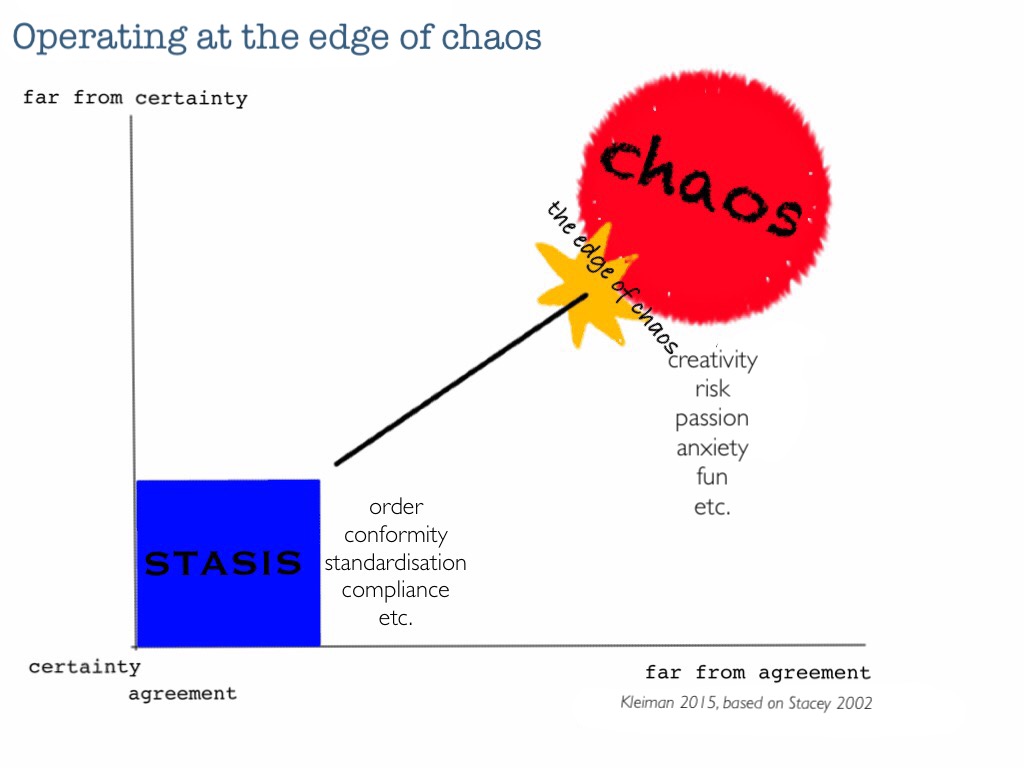
The diagram below illustrates the ‘complexity continuum’ between stasis and chaos. Based on the work of Ralph Stacey and Paul Tosey it illustrates how a system’s search for, or need for, equilibrium in the form of certainty and agreement produces stasis. It also shows how the further one travels away from certainty and agreement, the nearer one approaches a state of chaos. Right at the ‘edge of chaos’ is the point at which a system is poised just before it moves into an actual chaotic state. It is where the components of a system are in a state of flux, never quite locking into place but, at the same time, never quite dissolving into turbulence.
It is there, right on the edge of chaos, where creativity is most potent. It is also an area where levels of energy and emotion are high, where risk-taking, excitement and exhaustion co-exist in a ferment of activity. It is characterised by encounters with uncertainty, anxiety, doubt, chance, error and ‘muddling through’. There is great potential for novel forms of relationships emerging, but there is also the possibility of disintegration.
The problem, for higher education systems (as in many other systems), is that there is a constant ‘gravitational pull’ towards certainty and agreement: towards stasis. That pull exists at all levels, from the macro level of educational policy to the micro level of module learning outcomes, and it requires and takes up a lot energy to resist it. Higher education institutions are also characterised by organised or ‘engrooved’ sets of social and cultural practices. These are long-established, often tacit, patterns of behaviour that are difficult to change and which often act as barriers to operational dexterity as changes often falter and practices ‘snap back’ to old models.
So in what, for many higher education institutions, is a time of existential crisis, survival depends on creativity and the need for individuals and groups who are able to adapt and operate successfully in a highly complex and rapidly changing environments. Those higher education institutions that are tied to models and paradigms of learning and teaching (and the systems that support them) that are designed for a far less complex, more stable, predictable world will, inevitably, struggle.
Fortunately, higher education is full of intelligent, creative people who understand all too well – through their own day-to-day experiences – that learning and teaching is complex and, sometimes, chaotic, and that the systems and processes that we create around that experience, or have created for us, are not always best suited to dealing with that complexity. It is also clear that the professional act of teaching with the still significant but also significantly decreasing autonomy attached to this role, provides fertile conditions for people to be creative in order to confront those complexities and to really enhance students’ learning.
Changes in higher education rarely manifest themselves with dramatic abruptness. More often than not, they creep up silently, diverting the flow of continuing traditions and practices stealthily but resolutely. The coronavirus crisis has fundamentally changed that ‘slow evolution’. It has swept as a tidal wave across and through our educational systems. But there is another wave sweeping through and across our systems: a relentless wave of digitisation and technological innovation, and it is vital to remember that while waves can drown you and currents can drag you away, you can also ride the waves and exploit the currents.
As wave after wave of new technologies have emerged and are still emerging, different ways to creatively interact and collaborate have arisen with them. In this context, play has become a persuasive and powerful tool. The invitation to play can bridge the gap from observation to participation. There is now extraordinary potential for cross-discipline conversations and projects around the vast wealth of possibilities presented by existing and emerging technologies. We will need to draw on our ability to tell stories, to create visually compelling messages and designs, to come up with new ways to organise and synthesise information. The key, however, is to ensure that these playful interactions are not about our relation to technology, but about creating new ways of experiencing education.
Tributes have been pouring in for Bill Mitchell the director, designer, theatre-maker and inspirational founder of the unique landscape theatre company Wildworks, who passed away on the 14th April 2017 at the age of 65. Many people in the U.K. and around the world know of Bill through his extraordinary work with Kneehigh and then, particularly, Wildworks, and there is a wonderful obituary by Lyn Gardner in The Guardian.
I first encountered Bill when we were both studying theatre design at Wimbledon School of Art in the early 1970s. Although I was a year ahead of him, students often worked together across the years, and I was fortunate to work with Bill. His creativity and imagination, as well as his great sense of fun and play, were much in evidence even then. A few years later, in 1979, I joined Bill and his partner Sue Hill in the TIE/Community theatre company Key Perspectives, based in Peterborough. (One the founder members of the company – who had left by the time I joined – was Colin Hicks, who now sits on the Wildworks board).
Key Perspectives was operating in what was TIE’s heyday, and we were just one of many such companies operating around the UK, supported by local authorities and the Arts Council. We were committed to creating and producing high quality theatre and drama-based educational programmes in schools and commmunities, working closely with teachers and students and with the communities in and around Peterborough in which they lived. Bill’s personal and creative engagement with people, place and community that became such a distinctive characteristic of his later work, can be traced back to that early work.
One my clearest and fondest memories of Bill was when we were working on a children’s Christmas show called ‘Oddbod’, which we were creating for the main house at the Key Theatre. Peterborough was then an ancient small city attached to a fast growing new town, and the infant and primary schools, particularly in and around the newly built estates, were full of children who had recently arrived from other towns and cities. Though we worked collectively, Oddbod was very much driven by Bill’s directorial and creative vision and his passion to reflect, truthfully and imaginatively, the experiences of those very young people.
We visited a number of schools, and we listened to and collected the stories that the children told and painted about ‘Oddbod’, about being a ‘stranger in a strange land’, about displacement and arrival, about feeling alone, about making friends, etc. Under Bill’s directorial and visual eye we took all the drawings and pinned them around the walls of our rehearsal space, which we filled with as many pieces of costume, materials and objects that we could find. We then started to use the drawings as starting points with which to create characters and improvise situations.
I remember that Sue Hill was attracted to a particular ‘Oddbod’ painting which consisted of a large oval black blob with a head-like smaller blob attached to it. Above it hovered another large and rather ominous looking black blob. Wrapping herself in a large black blanket, with a large black hat, Sue created a brilliant, funny character that was terrified of everything and anything, whose only utterance was “Any minute! Ooh, it’s goin’ to happen! Any minute!”. Sue reduced Bill and the rest of us to helpless hysteria and, needless to say, Any Minute became one of the ‘stars of the show’.
My particular memory of Bill was when, with our designer hats on, he and I went to buy some large fishing weights which we were going to use to assist in lowering a huge painted backcloth for the final scene. Fishing was ‘big’ in Peterborough and in the surrounding Fens, and Woolworths, in the town centre, had a large fishing section, but the particular half-pound conical weights we needed weren’t on display. So we approached one of the sales staff and asked if they still had any in stock. He went off to the storeroom and then came back saying “Yes, we have some, but we can’t sell them to you because it’s out of season”.
Bill: “But we don’t want them for fishing, we want them for a children’s Christmas show!”.
Salesperson: “You’ll have to speak to the Manager. I’ll get him.”
The manager arrived and Bill explained what we wanted, and the manager repeated that while they had them in stock they couldn’t sell them to us because it was out of season and that it was Woolworth’s policy.
At which point Bill, who was over 6ft and who, with his gold earring and gold tooth, could appear quite fearsome, went into full-on, John Cleese, dead parrot mode:
Bill: “This is a shop, yes? A shop that sells things to customers, yes? I am a customer, yes? I wish to purchase something with this [waves money in manager’ face] that you normally sell and which you currently have stored in a box in your storeroom. I understand that it is not the fishing season, but I don’t want them for bloody fishing, I want them for a Christmas show for the children of this city. Now are you going to allow me to purchase them or not?”
Manager: “How many do you need?”
* * * * * * * * * * *
Wanderer, your footsteps are the road,
and nothing more;
wanderer, there is no road,
the road is made by walking.
By walking one makes the road,
and upon glancing behind
one sees the path that never will be trod again.
Wanderer, there is no road –
only wakes upon the sea.


 Stumbling with Confidence