
Assessment at the Edge 2: Clash of the Paradigms

(or Rumble in the Epistemological Jungle) 

clashoftheparadigms

We operate, on the whole, within education systems that are based on a traditional linear, positivist, computational paradigm that has been the dominant scientific paradigm since Newton et al back in the 17th century. It is a paradigm in which education is perceived as a form of industrial or mechanised process.

It is, essentially, a closed system, which is the sum of its parts (learners, teachers, curriculum, content, delivery, technology, etc.). By controlling these parts, we can regulate the performance of the whole system. Educational systems design is the process of regulating these closed systems. It is a system in which human behaviour and performance are assumed to be predictable within known circumstances, and in which knowledge is assumed to be an external, quantifiable object that can be transmitted to and acquired by learners. This enables patterns of behaviour to be analysed and used to make judgements about how learners are thinking or what they have learned.

It is a system in which a ‘line of determination’ is assumed between cause and effect: for example – teaching predictably causes learning. These assumptions over-simplify the world and tend to reduce human learning, performance and achievement to a repertoire of manipulable behaviours. But learning is far more complex and much less certain than these assumptions infer.

In one corner we have the dominant Positivist or Quantitative Paradigm which is based on the epistemological belief that all true knowledge is ‘scientific’ knowledge. In this paradigm there is a single objective reality ‘out there’ that is orderly, predictable, and can be studied, captured and understood by amassing data and triangulating it (I shall return to the triangle).

The overarching aim is to achieve explanation and control, which is possible because knowledge is objective, measurable, value-free and a quantifiable object that is transmitted by the ‘teacher as expert’ to, and acquired by, learners. Rigour is achieved via the ‘holy trinity’ of validity, reliability and generalisability.

In the other corner we have the Interpretive or Qualitative Paradigm in which subjectivity is inherent and should be acknowledged because complete or pure objectivity is impossible and should never be claimed. For those in this corner ‘truth’ is a matter of consensus amongst informed and sophisticated constructors, not of correspondence with an objective reality. Furthermore, because all measurement is fallible, there is great emphasis on multiple measures and observations in order to able to claim authenticity, and for that authenticity to be recognised.

Those who operate within this paradigm understand that there are multiple realities and that knowledge is subjective, contextualised and value-dependent. They aim for understanding in order to enhance learning, they are openly self-questioning and self-critical, and they welcome scrutiny and debate. Importantly, they view students as co-constructors of their learning, and perceive themselves to be partners and participants in learning as well as guides and mentors. (That position, by the way, does not prevent them from also being experts!).

In order to find a way to deal with all of this epistemological complexity in relation to how we approach assessment, I’m suggesting that one way – and of course there are and will be others – is to approach assessment as a form a qualitative research instead of a quasi-scientific investigation. If we choose to follow the interpretive paradigm in relation to assessment then we need adjust our thinking and our language. Essentially we need to do a form of ‘Find and Replace’.

We need to replace :

  • Validity with Credibility, Coherence, Consistency, Trustworthiness, Authenticity
  • Certainty with Relativity
  • Generalised Explanation with Local Understanding
  • Source Data with Empirical Materials
  • “Is it true?” with “Does it work?”
  • Single Point Perspective with Multiple Perspectives
  • the Triangle with the Crystal

To be continued……

Next instalment coming soon:  Assessment at the Edge 3: Triangles and Crystals

Back to Assessment at the Edge 1

Assessment at the Edge 1: Faultlines

img_4881I know I’m not alone in feeling – increasingly as the years roll by – that all too often the way we assess is at odds with the way our students (and we ourselves) actually learn and experience learning. While I and everyone else round the assessment board table is doing their very best to be professional, to ensure that procedures and regulations are followed, and taking great care to ensure that students are treated fairly and reliably….a bit of my brain is suffering from a form of cognitive dissonance and saying ‘This is nuts!’
There used to be a one of those car stickers that went something like ‘Do Not Adjust Your Mind…There Is A Fault With Reality’. And that’s how it feels. There seems to be a serious disjunction or faultline  between what appears on the hundreds of assessment print outs – actual or virtual – and the actual day-to-day experience of learning and teaching, of creating work, of pursuing ideas, of encouraging and enabling students to really stretch themselves, to try out new things, to fail gloriously, to boldly go.

As teachers we need to – and are required to – ascertain, with as much validity, reliability and fairness as possible, what our students know and understand. For most of us, learning, teaching and assessment is a form of journey along the highways and byways of a particular subject. We, the guided and the guides, explore the landscape of the discipline. Our role as guides, more often than not, is to enable those we guide to understand the meaning and significance of what is seen, what is heard, what is felt, what is experienced.

Occasionally, because as guides we take our work seriously, and there are matters of accountability and responsibility that need to be attended to, we stop and check to see how much those who have entrusted their education to us know and understand, and what they can do.

In order to assess our students we stop acting as guides and essentially become researchers or purposeful explorers. We set out to discover what they know and understand, and what skills they possess. We ask them, demand of them, to demonstrate their knowledge, understanding and skills. We assess them, evaluate them, judge them, measure them against a set of standards or criteria.

If it’s a relatively simple matter of fact or basic competence then it is relatively straightforward to test it. The student either knows who, or what, or when or how…or they don’t. But the landscapes we explore in education are highly complex, intricate, shifting, multi-layered, multi-faceted. Simple straightforward answers and simple straightforward questions are hard to come by. The terrain does not reveal itself easily. Nor should it. In such a landscape meaningful assessment is also highly complex, intricate, shifting, multi-layered and multi-faceted.

If we consider the types of assessment that dot the landscape, we can see a veritable bio-diversity of assessment. But this diversity is also a challenge, and it is worth noting just how many of these types of assessment result in assessment ‘data’ that is qualitative rather than quantative in nature.

But there is may be a problem with this: the more assessment involves qualitative information, the more subjectivity is involved. Now this would be mitigated and we would have improved reliability if we had strict or stricter assessment criteria and also more structured and proscribed content. But, and this is a big ‘but’, if we had those it would obliterate the essence of qualitative assessment in terms of flexibility, personal orientation and authenticity. Which brings us, eventually, to the question of assessment paradigms and to the Clash of the Paradigms.

Next instalment:  Assessment at the Edge 2: Clash of the Paradigms


On beauty and elegance in education

In his book ‘Fearful Symmetry: the search for beauty in modern physics’, Anthony Zee describes how Einstein displayed a supreme disinterest in any proposed formula or solution, no matter how accurate it might be, that he considered ugly.

“As soon as an equation seemed to him to be ugly, he really rather lost interest in it and could not understand why somebody else was willing to spend much time on it. He was quite convinced that beauty was a guiding principle in the search for important results in theoretical physics.”

Today (13 Aug 2014), amongst the usual ugly headlines of death, destruction and disease, Maryam Mirzakhani is being celebrated as the first woman to have been awarded the prestigious Fields Medal – the Nobel Prize for mathematicians. Her work – as described by those who have some grasp of her achievements – has a “breathtaking scope, is technically superb and boldly ambitious”. She herself describes mathematics as full of “beauty and elegance”.

Now, I’d hate to think that beauty and elegance is the sole preserve of mathematicians dealing, like Mirzakhani, in esoteric fields such as complex geodesics, transcendental objects, and differential geometry. I’d argue that we all need at least a bit of beauty and elegance in our lives and work, and we certainly can see people striving for it (though many just don’t care) in many areas: whether it’s the presentation of food, the design of buildings and spaces, the arrangement of an exhibition, the movement of a dancer across the stage, the order and rhythm of words on a page.

So, why not strive for some beauty and elegance in education and in the curricula and learning experiences we design for our students? Yes, it’s often messy and a bit (or very) chaotic. But just as the mathematics of chaos have a certain underpinning beauty and elegance, we – as ‘architects of education’ – should strive to construct and compose learning and teaching experiences that flow and connect in ways that have a certain beauty and elegance about them. It’s not easy, but surely worth the effort.

On history and all that (Part 2): a marvellous lesson

I was once privileged to witness the most marvellous history lesson…taught by a drama teacher.

It was in a comprehensive school. The students, a mixed class of girls and boys, were taking GCSE History, and the theme was England in the 17th century. The ‘teacher’ was Dorothy Heathcote, the eminent and inspirational drama education specialist. (For those who have never heard of her, do read this http://www.mantleoftheexpert.com/community/about-us/dorothy-heathcote/.)

One of the things Dorothy used to say was that the most powerful word in education is the word ‘might’. Ask a child “what IS the answer to this?” pre-supposes there is a single ‘right’ answer. It’s a closed question. But ask “what MIGHT be the answer to this?”, then you open up the possibilities, the curiosity, the imagination.

The environment was a standard classroom, with melamine tables and plastic chairs.

The session started with Dorothy hanging three large blank sheets of paper on the wall. On the top of one she wrote: ‘I know this about the 17th century’. On the second she wrote ‘I think I know this about the 17th century’. On the third she wrote ‘I’d like to know this about the 17th century’.

She then asked the students to fill out each paper. Not a great deal went on the first one. A bit more went on the second one. A quite a bit more on the third one.

Dorothy then quickly went through each one, checking to see if there was any more to be added.

She then asked the students to get into groups of two or three, and gave each group a set of photocopied sheets of paper. They were taken from one of those guides to antique furniture, and contained images and information about 17th century tables and chairs

Dorothy asked each group to look at the images and read the information, and then to select one – either a table or chair.

She then announced that from that moment on the classroom was now Heathcote’s Expert Antique Restoration Workshop. The students were now all experts at restoring antique furniture, and she was in charge. She then, pointing to the classroom tables and chairs, asked the workers to start restoring the piece of furniture they had selected.

Notwithstanding a bit of embarrassed bewilderment, the students started to ‘work’ on their chosen item: inspecting it, discussing what might be wrong with it, what needed repairing, starting to repair it, etc.

Dorothy walked round inspecting the work, and would ask questions. A typical exchange would be as follows:

Dorothy: What have you got there?

Student: It’s an oak dining chair, Miss.

D: Where’s it from?

S: Something Hall, Miss. I think it’s one of those big houses. [they’d read that on the sheet]

D: What’s wrong with it?

S: Er…it’s got a big split. [that wasn’t on the sheet]

D: Any idea how that split might have occurred?

S: Not sure, Miss. But there’s some scorch marks around the split, so we reckon it was in a fire and perhaps got chucked out of a window. [definitely not on the sheet!]

D: And how do you reckon that might have happened?

And you could see the students’ imagination switch into gear, and out came stories about corridors, and candles, and late night trysts, and a chase, and a dropped candle, and the panic, and the servants being woken up and being ordered to save the furniture, and the chair being thrown out of a high window….

Each group created and shared its own story, using what they knew, what they thought they knew, and what they imagined. And slowly but surely, a real sense of 17th century life began to be created and understood.

After a short break, the session re-started. Now two new characters were introduced along with a set of typical everyday ’17th century’ artifacts e.g: a ring, a quill and ink, a bell, a hand written letter, a pamphlet, etc. The characters – played by actors – were the lady of the house, and a male servant. Each sat at each end of the room, and the students – moving between the two – could ask them questions about their lives, and about the various artifacts which they could touch and examine, each of which had a story attached to it.

As in the first session, layer upon layer of knowledge and understanding gradually was created.

At the end of the session, Dorothy returned to the three sheets of paper, and once more asked the students to fill them in. This time round, what had been the sparsely filled ‘I know this…’ sheet was now filled – confidently and, in some cases, passionately – with information.

The obvious lesson, from this history lesson, was that it’s our natural curiosity about people, our ability to imagination the world through a different pair of eyes, and our love of stories, that powers our understanding of history. Facts and chronologies, of themselves, do not an understanding of history make. But engendering curiosity, imagination and, indeed, passion, might well encourage the pursuit of the factual.

Straight to the Core: Gove, the Arts and the Core Curriculum

Nelson Mandela said that “Education is the most powerful weapon which you can use to change the world”, which is why politicians can’t help but meddle.

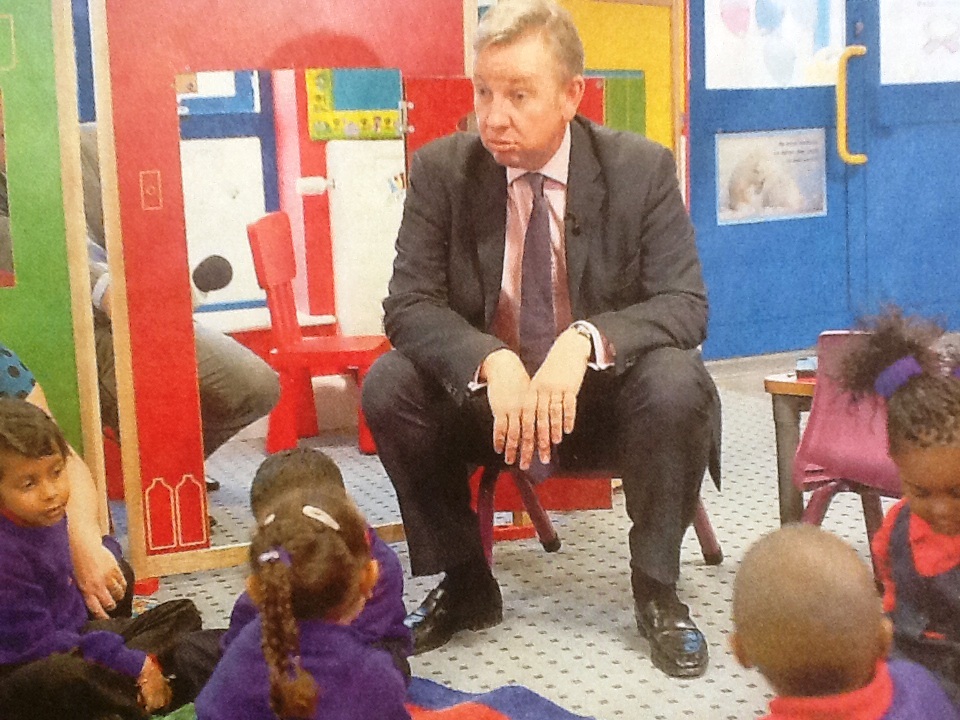
Here in the UK, with a long and – with a few notable exceptions – inglorious history of political meddling in the education of our children and young people, we currently have an über-meddler in the shape of Michael Gove (pictured), the Secretary of State for Education.

Mr. Gove is convinced, with the passion of the true zealot, that our education system is broken and that it needs a complete overhaul. He is particularly obsessed with the need for a ‘core curriculum’ which essentially takes us back to the 3R’s with some science and technology attached. I have nothing personal against young people being able to read, write and count. Actually I think it’s quite important. I think science and technology are important. But I do object strongly when – in order to achieve his ambition – Mr Gove decides that the arts are an irrelevancy when it comes to the content of his ‘core curriculum’.

Mr. Gove is an intelligent man. After all he was a leading journalist on The Times, and therefore ought to be used to ensuring that he quotes his sources accurately. Well, he keeps going on about how his ideas for this arts-free ‘core curriculum’ are informed by his admiration for the Massachusetts Common Core of Learning. As well he might be. The education system in Massachusetts is at the top of the US educational league tables.

Now, I don’t know if Mr. Gove has actually read the Massachusetts Common Core of Learning, or whether – returning to his journalistic habits – he is studiously ignoring the inconvenient truth. But there, in the Massachusetts Common Core of Learning, in stark black and white, is the following:

“All students should:
Acquire, Integrate and Apply Essential Knowledge (in)
– Literature and Language
– Mathematics, Science and Technology
– Social studies, History and Geography
– Visual and Performing Arts
– Health

Under ‘Visual and Performing Arts’ there is:
– Know and understand the nature of the creative process, the characteristics of visual art, music, dance and theatre, and their importance in shaping and reflecting historical and cultural heritage.
– Analyze and make informed judgments regarding the arts.
– Develop skills and participate in the arts for personal growth and enjoyment.

Under Literature and Language:
– Read a rich variety of literary works including fiction, poetry, drama and nonfiction from different time periods and cultures, relating them to human aspirations and life experiences.
– Analyze implications of literary works, and communicate them through speaking, writing, artistic and other means of expression.

All students should:
Use Mathematics, the Arts, Computers and Other Technologies Effectively
– Apply mathematical skills to interpret information and solve problems.
Use the arts to explore and express ideas, feelings and beliefs.
– Use computers and other technologies to obtain, organize and communicate information and to solve problems.
– Develop and present conclusions through speaking, writing, artistic and other means of expression.

In 2006, UNESCO declared: “International declarations and conventions aim at securing for every child and adult the right to education and to opportunities that will ensure full and harmonious development and participation in cultural and artistic life. The basic rationale for making Arts Education an important and, indeed, compulsory part of the educational programme in any country emerges from these rights. Culture and the arts are essential components of a comprehensive education leading to the full development of the individual. Therefore, Arts Education is a universal human right, for all learners” (The Road Map for Arts Education,p3)

Please note the “essential components of a comprehensive education”. Perhaps Mr. Gove’s dislike of arts education derives from his antipathy to the word ‘comprehensive’?