The eminent, and now sadly departed, educationalist Dorothy Heathcote used to say that the most powerful word in education is the word ‘might’.
Asking a student ‘what MIGHT be the answer?’ rather than ‘what IS the answer?’ opens up the possibilities, the questioning, the pondering, the wondering….the creativity.’
Our handbooks say things like (and I know, because I’ve written them as well) “On the completion of this module/course/program the student WILL be able to demonstrate a, b, c, d…..”We don’t write “On completion of this module/ course/ programme the student may be able to do THIS pretty well, but they also might be able to do THAT even better, and what’s more, they may be able to do stuff we haven’t even though of yet”.
But that sort of language and thinking doesn’t go down too well at the validation board, or with the quality assurance people, or with the policy makers, who require everything to be identified, categorised and pinned down, like a collection of dead butterflies.
How can we/do we – in education – break out of the ever tightening circle of predict and provide, control and compliance?
Like many, I am fascinated by Japan and Japanese culture. That fascination, in my case, goes back a long way. My father used to do business in Japan and often visited with my mother. We had Japanese art and artefacts in our house and we often hosted Japanese students who came to study here in the UK. I’ve also had the opportunity to visit Japan myself in the course of my work.
I recently watched James Fox’s series of documentaries about Japanese art and culture and also Monty Don’s programmes about Japanese gardens and garden design. Both presenters commented on the importance of the Japanese idea of ’Ma’ – often translated as ‘negative space’ but it is much more than that. One way of understanding ‘ma’ is as the space between tangible things that gives those things meaning. It is not so much empty or negative space, but rather it a space full of energy, potential and promise. The character for “Ma” (間) combines the character for “gate” 門 with the character for “sun” 日 – an image of light beaming through the empty space of a doorway.
One of Britain’s most influential post war graphic designers, Alan Fletcher, refers to Ma in his introspective book The Art of Looking Sideways
“Space is substance. Cézanne painted and modelled space. Giacometti sculpted by “taking the fat off space”. Mallarmé conceived poems with absences as well as words. Ralph Richardson asserted that acting lay in pauses… Isaac Stern described music as “that little bit between each note – silences which give the form”… The Japanese have a word (ma) for this interval which gives shape to the whole. In the West we have neither word nor term. A serious omission.”
Attic Late Geometric IIa high-necked pitcher, c.735-720 BC Ashmolean Museum, Oxford, UK / bridgemanimages.com
In the western tradition and culture we have nothing like the idea of ‘Ma’. Instead, we dislike a void, and tend to fill it. One of the few things I remember from my student art history days are the large, ancient storage jars called Attic Vases. They are often covered from head to toe in decoration. The reason for that was the belief that the Evil Eye enters through empty space. Perhaps that notion is still hidden deep within our Western psyche?
Having trained as a designer and with my interest in things Japanese, when I started working in higher education I was immediately struck by the fact of just how busy our curricula and timetables are. It’s as if we are afraid of leaving ‘empty space’. Why? In case students get up to ‘mischief’?
Rather than filling the curriculum and timetable void, what if we designed them incorporating the idea (and actualité) of ‘Ma’. Designing in the ‘empty/negative’ spaces that help to make sense of the whole, providing the time and space to step back, to think, to reflect, to make, to create.
This blogpost is adapted from an article that first appeared in a special learning skills supplement of the Times Higher Education.
Employers frequently bemoan graduates’ lack of skills, but the performing arts demonstrate that they can provide students with the variety of ‘soft’ skills coveted by CEOs.
“If I want someone to design and build bridges, I’ll recruit an A-grade engineering graduate, but if I’m looking for potential managers and leaders of this company, I’m more likely to employ the editor of the student magazine or the director of the dramatic society.”
This, said by the chief executive officer of a major engineering company, encapsulates many of the concerns and challenges in the debate on skills in higher education.
Record numbers of young people may be entering highereducation but, according to the British Chambers of Commerce, many do not really understand the work ethic and they lack professionalism. This view is shared by many employers across the industrial, commercial and professional spectrum. They claim graduates are leaving universities lacking a number of the essential skills required by the market-driven, consumer-led, image-focused, technology-intensive, AI-challenged, rapidly changing world of employment in the 21st century.
But are employers right?
There is a tendency, particularly in government and policy-making circles, to accept the employers’ view without question.
However, while there are genuine concerns about skills, the views and statements of employers need to be treated with some caution. 20 years ago a report for UNESCO pointed out the disparities between what employers stated to be the case about skills and their recruitment and selection policies. Not much has changed in the intervening years. The views of employers are often based on ignorance of what goes on in universities.
That UNESCO report did, however, find an “amazing consensus” among employers on the attributes they expected graduate recruits to possess. These included flexibility; an ability to contribute to innovation and creativity; an ability to cope with uncertainty; an interest in life-long learning; social sensitivity and communication skills; an ability to work in teams; an ability to take on responsibilities; and to be entrepreneurial.
These skills fall into the area known as “soft” skills, as opposed to the “hard” skills associated with technical or discipline-specific abilities and the basic skills associated with the 3Rs. Soft skills are also related to what has become known as “emotional intelligence”.
The CEO’s example of the director of the dramatic society as a potential manager or leader confirms the belief that the creative arts generally and the performing arts in particular have the potential to provide students with precisely the types of experiences and skills that employers value. Further evidence can be seen in the phenomenon of large companies bringing in leading practitioners in dance, music and theatre to train and motivate staff. This lucrative line of business has grown to such an extent that a number of arts organisations, such as the Royal Shakespeare Company, created special units to promote and run such courses.
Through the arts, students learn to innovate and think creatively – qualities that are valued by many new and expanding industries. Performing-arts programmes provide opportunities for the exploration and formation of values, the development of feeling and sensitivity and an opportunity to develop social skills that do not occur as naturally in other disciplines.
The performing arts also help to develop self-confidence. A paying audience arriving at a specific time on a particular day to see a performance is great motivation to develop time-management and decision-making skills. Entrepreneurial, problem-solving and negotiation skills are acquired out of necessity when faced with minimum or non-existent budgets, inflexible production managers and recalcitrant health and safety officers.
But there’s no room for complacency. Some areas, such as the long-established acting, dance and music conservatoires, used to focus little on developing transferable, more general skills required to build and sustain a career in an unpredictable and insecure field of work. But in recent years, acknowledging the wider environments their graduates are likely to enter, they have recognised that training to be an artist is not incompatible with training to be employable and that music-making and theatre-making are skills-rich areas of enterprise.
Research I undertook into the non-arts graduate destinations of performing arts graduates revealed a plethora of graduate-level work across many sectors. One that stood out was a drama graduate getting a place on the coveted (and well-paid) management training course of a major international company. She reported that she was up against dozens of business studies graduates but the feedback she received pointed to the fact that the skills she had acquired through her drama training were precisely the skills the company was looking for.
Certainly, the performing arts have the potential to deliver skills that are in demand, but even in that area of work, arts administrators and managers are known to complain that practitioners are often not equipped with effective entrepreneurial, communication and self management skills. Jobs are increasingly demanding a combination of highly developed specialisms. Many of the recruitment difficulties reported relate to finding the right range of skills.
Two contradictory trends are at work: an increasing specialisation of job roles and a need for what are called “magnificent generalists” – people with the skills and experience to cross boundaries.
Perhaps “crossing boundaries” suggests a way forward for those concerned to enhance and broaden the skills of their students. Engaging with the skills that the performing arts have to offer is not about turning accountants into actors or medics into musicians. But it is about exploiting the many and rich opportunities for skills development that the performing arts have to offer.
During a conversation about education with a colleague who is an eminent and well-respected professor of education, he said vehemently ‘I hated school’. Now he and I are probably of a similar generation, but my school experience in the 1960s was rather more positive.
I went to a rather academic boy’s grammar school in London, where corporal punishment had been abolished some years previously. The focus was very much on getting into Oxbridge or at least a ‘decent’ redbrick university. I, however, was interested in becoming an artist.
The art room – run by Mr. Potter – was located at the far end of one wing, up in the roof space. It was, nevertheless, a light and airy space and I enjoyed the many hours spent in there. I wanted to do Art for ‘A’ level and to go to art school. The problem was that the ‘A’ level requirements at that time were stultifyingly restrictive (I don’t think they’ve changed much). One of the requirements was a still-life painting, and I distinctly recall Mr. Potter looking at my somewhat surreal and expressionist rendering and saying, sympathetically, “That’s very interesting, but that will never do”.
When I asked him why, he explained that the A level required an ultra-realist painting. Any other approach would be deemed a failure. But he then said, encouragingly, that if any of the great masters of modern art, the Cubists, the Expressionists, the Surrealists, the Fauves etc had taken ‘A’ level art, not only would they have failed but there would have been a demand for psychiatric testing!
At this stage I knew that the school and the requirements of the exam board were unable to support me in creating a decent portfolio of work to get into art school.
So I went to see the Headmaster: a kindly, liberal man and a much respected leader and teacher. The school was a rugby playing school (I was actually a very good fly-half at the time) and everything stopped on Wednesday afternoons for sports. Not far from the school, in north London, was the then renowned Camden Institute, which had a wonderful reputation for its adult education art classes led by established artists. I asked the Headmaster if, instead of running around the rugby field on a Wednesday afternoon, I could attend the Institute’s art classes. He agreed on the proviso that I would occasionally show him the work I was doing.
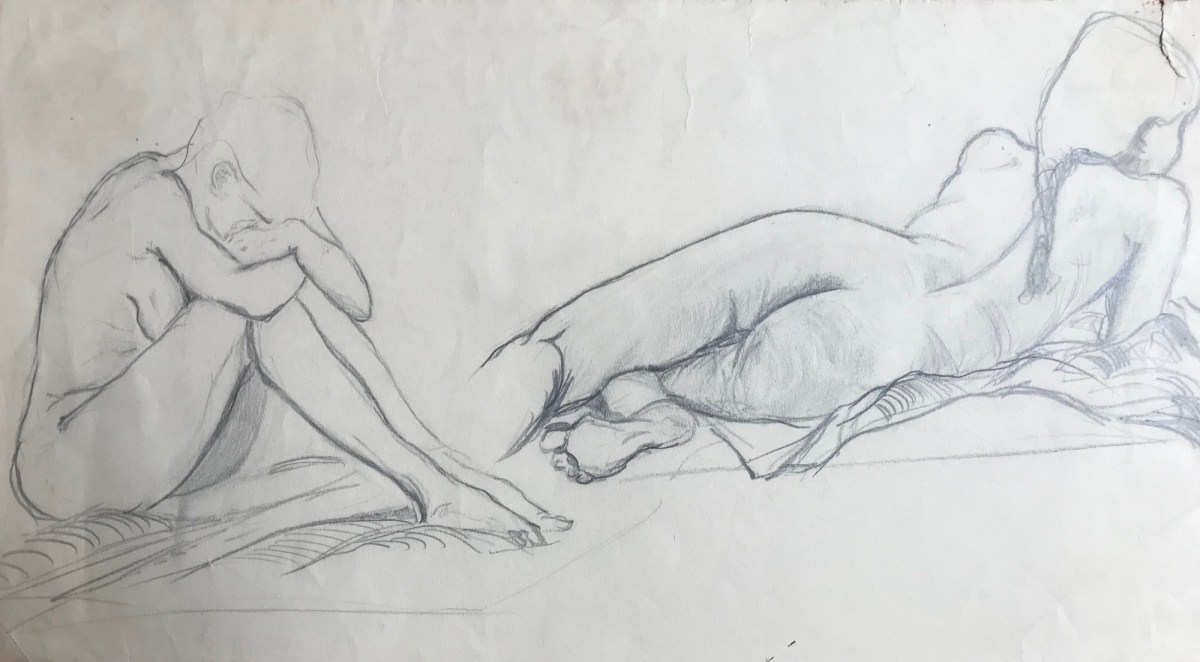
Walking into and taking part in the life class studio on my first visit was a revelation. I don’t think I’d seen a fully naked woman before except in paintings (we also had male models) but not only did I feel immediately welcome and at home, but the whole experience of sitting quietly at an easel, observing the life model very closely, and making marks on paper was extraordinarily powerful. The only sounds in the room were the slight hiss of the gas fire near the model, the occasional sound of charcoal scraping on paper, and the hushed conversation of the tutor and whoever he was talking to.
Fifty plus years later, I still use that ‘sitting quietly, observing or thinking, and making marks on paper’ in my own work, and in the workshops and seminars I run.
In higher education (and in education generally) we obsess about excellence. So what does excellence mean?
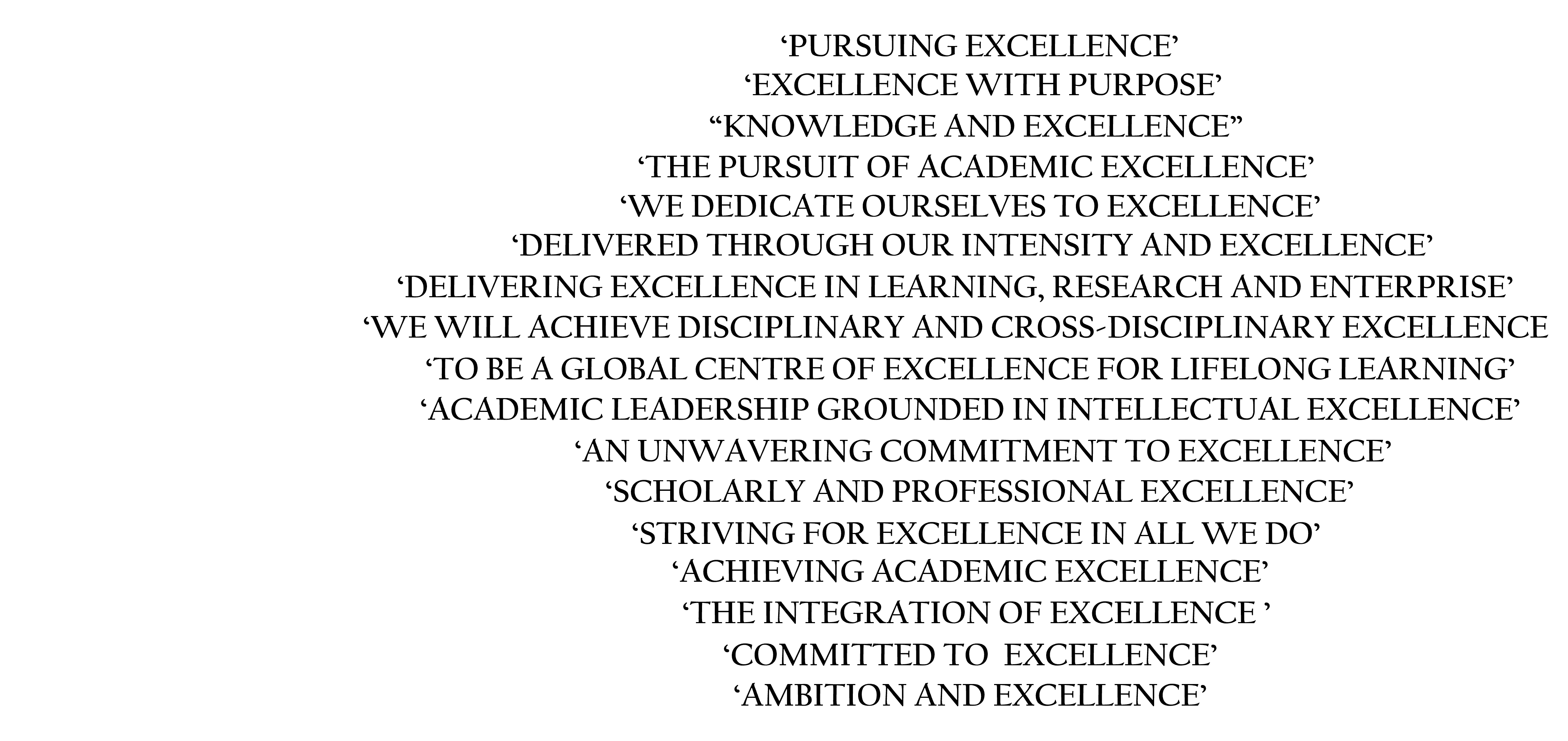
Going by the result of the debate on excellence at an academic conference, there is a clear majority who feel that the term has lost credibility and value. When all institutions are either ‘excellent’ or, at the very least, ‘striving for excellence’ (see university mission statements below) then we are witnessing a lot of sound, but hopefully not fury, signifying nothing. Excellence, in Bill Readings’1 memorable term, has become ‘de-referentialised’. Turning to the dictionary provides little assistance. In the Concise Oxford ‘to excel’ is defined as to surpass or to be pre-eminent (i.e. to be better than the majority), whereas ‘excellence’ is defined as ‘very good’.
University Mission Statements
Whatever meaning ‘excellence’ once had has become lost in a blizzard of hyperbole. The fate of excellence follows in the tradition of other terms such as ‘community’ and, more recently, ‘creativity’, whose meaning has become devalued and decontextualised through over- and inappropriate use.
In the arts, the term excellence is rarely if ever used as a descriptor except – and this may be relevant in considering educational achievement – in relation to the application or demonstration of skill or craft. Academics, students and arts practitioners tend to avoid the ‘E’ word. The theatrical cliché has never been: “You were excellent, darling”. ‘Wonderful’ is truly a much better word than ‘excellent’ to describe high artistic achievement. Rather than excellent’s rather hard-edged, triumphalist implication of being better than others, ‘wonderful’, i.e. full of wonder, has a sense of the remarkable, the extraordinary, the truly successful that is the mark of the highest quality work.
Excellence, it must be said, is much favoured by arts politicians and bureaucrats who use it both aspirationally and as a justification for funding. Excellence attracts rewards and prizes. But the use of the term has more to do with product branding (as it has in higher education) than with a real concern with the subtle complexities of quality and value.
Here is a typical example: one of our leading UK arts funding bodies, in its mission statement, states: “We believe the arts to be the foundation of a confident and cultured society. They challenge and inspire us. They bring beauty, excitement and happiness into our lives. They help us to express our identity as individuals, as communities and as a nation”.
Wonderful! But then they go and ruin it by reverting to corporate-speak and saying they are going to “serve the people … by fostering arts of excellence through funding, development, research and advocacy”. An external examiner I knew, having seen what was – by general consensus – a remarkable, successful, extraordinary, inspiring … yes, wonderful piece of final-year practical work was dismayed to find that the two internal examiners, who also thought the work was remarkable, successful etc had agreed a mark of 75%. He asked them to start at 100%, and argue persuasively for marks to be deducted. With the assessment criteria in their hands they struggled to get below 95%. To describe that work as merely ‘excellent’ would have been insufficient. It was beyond excellence.
That is perhaps what we should be striving for and, in doing so, we need to look beyond our obsession with trying to define, achieve, assess and reward excellence.
As the old saying goes: education is, or ought to be, a wonder-full thing.
References
1 Readings, B. (1997) The University in Ruins. Harvard University Press




 Stumbling with Confidence