Among HE’s dark academic mills

image

A recent anonymous long diatribe in the Guardian Higher Education from a “semi-employed thirtysomething on a zero-hours contract, sitting at home in pyjamas, staring at a hopeless pile of marking, as hopes of making it to the shops for a pint of milk today fade” complaining bitterly about the conditions under which they are forced to work, provoked a storm of comment – some supportive, some not – from other academics. At the same time the lecturers’ union, the UCU, has called a two-day strike about pay and conditions, after an overwhelming ‘Yes’ ballot. This just happened to coincide with the publication of Vice Chancellors’ salaries which showed an average increase of 6.1% (with one VC of a small specialist arts institution being awarded a 25% increase) against the lecturer’s offered pay rise of 1.1%. Other statistics showed that the overall pay of those same lectures has fallen by 14.5% in real terms since 2010.

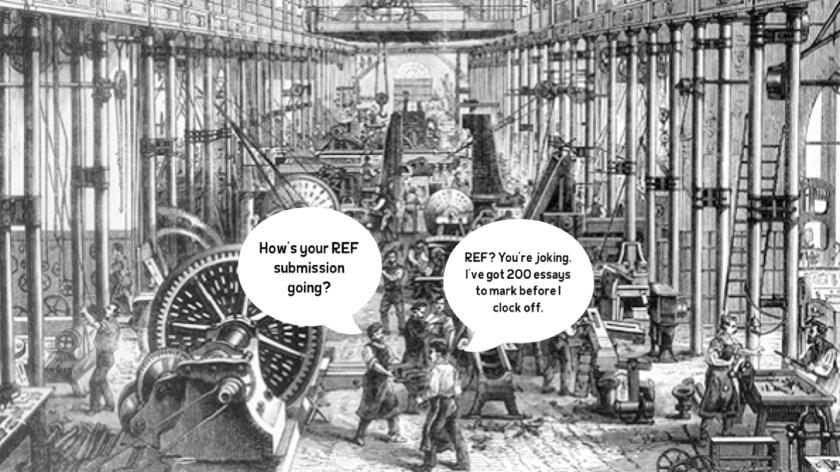
The reference in the title of this piece to William Blake’s 1808 poem is deliberate. As  our HE system, in the course of a couple of generations, has shifted from an ‘elite’ to a ‘mass’system, the parallels with what happened two hundred years ago during the course of the Industrial Revolution, though by no means identical, are still striking (no pun intended).

Consider this:

Factories began to replace small “cottage” industries. Manufacturers realized that bulk production was cheaper, more efficient and provided the quantity of items needed. As a result more and more factories sprang up. Skilled workers, such as hand weavers, saw their talents and experience become useless because they could not compete with the efficiency of the new textile machines. In 1832, one observer saw how the skilled hand weavers had lost their way and were reduced to starvation. “It is truly lamentable to behold so many thousands of men who formerly earned 20 to 30 shillings per week, now compelled to live on 5, 4, or even less”. (from Social Studies: The Industrial Revolution)

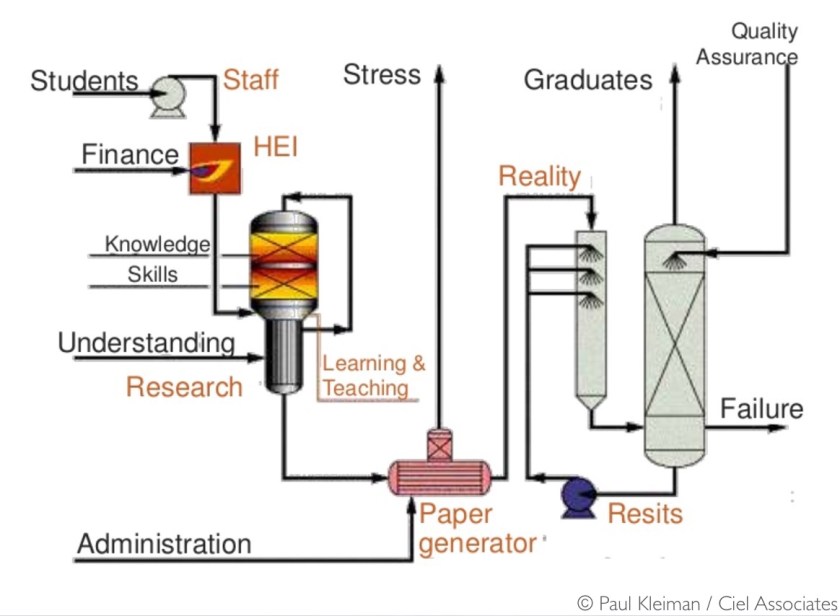
Our universities have become education factories, and many skilled and experienced academics are the equivalent of the hand weavers, struggling to adapt to life in the Age of the Educational Machine. And it’s not just education. What is the junior doctors’ dispute if it isn’t a row about industrial efficiency being placed above genuine healthcare and family life?

The Vice Chancellors, on the other hand, resemble the early factory and mill owners, happy to exploit their positions of power (protected by the ersatz probity  of the ‘Remuneration Committee’) demonstrating scant regard for common sense and decency in the drive to ensure their educational-industrial complexes thrive in the ultra-competitive and expanding world market for educational goods and services.

Consider this from 1776:

We rarely hear, it has been said, of the combination of masters, though frequently of those of workmen. But whoever imagines, upon this account, that masters rarely combine, is as ignorant of the world as of the subject. Masters are always and everywhere in a sort of tacit, but constant and uniform combination, not to raise the wages of labor above their actual rate…When workers combine, masters … never cease to call aloud for the assistance of the civil magistrate, and the rigorous execution of those laws which have been enacted with so much severity against the combination of servants, labourers and journeymen.” (from Adam Smith The Wealth of Nations)

OK, I might be pushing the industrial revolution analogy and hyperbole a bit too far: Higher Education in the UK  was never a cottage industry and has its origins in a closeted and cosseted elite, unlike the craft based practices that were subsumed by the industrial revolution*. But the hand loom weavers, like academics, certainly saw themselves and were seen as elite workers, with high degrees of autonomy over how and when they worked – as long as their ‘pieces’ were delivered in time. That autonomy was rudely taken away by mill and factory work where, in some establishments, it was a sackable offence to bring a timepiece to work because the mill and factory owners literally owned and controlled one’s time.

It’s difficult to avoid the sense that we are – and have been for a while – in a very interesting, challenging and possibly paradigm shifting period. The words of another William, this time Yeats, come to mind: “things fall apart, the centre cannot hold” (from The Second Coming). We are caught between two models and two conceptualisation of higher education. One is the industrial model that harks back to that earlier traditional model, and the other is the post-industrial model: digitised, customised, individualised, connected, fast-changing, non-linear, super-complex, occasionally chaotic.

It is not coincidental that the companies and organisations that are thriving tend to be those that have shifted away from the traditional model: creative, not risk-averse, with lean, flexible systems enabling them to move very fast when the opportunity arises.

There is, of course, no easy answer. The exploited self-employed lecturer on zero-hours and relatively low wages faced with an unmanageable pile of marking is the inevitable consequence (and victim) of the logic of that old industrial model. Many academics, like the hand weavers of old, are faced with a stark choice: accept the conditions of work or else someone else will. There is of course the recourse to collective industrial action by the trade union (another model that traces its roots to the early days of industrial revolution) which may or may not result in a positive result.

But in an Age of Uncertainty and Complexity (let alone Austerity) the question of whether the old model of higher education can still ‘hold’ is perhaps a moot point. What new forms may emerge from out of this transformative  moment are yet to be established. Meanwhile, the education factories increase the output from their academic machine-shops and production lines, and academics fight hard to maintain the values, discourses and practices of genuine, meaningful, life-enhancing education in the face of the obsession with industrial  effectiveness and efficiency that now permeates higher education’s mean unpleasant land.

* My thanks to Prof. Carole-Anne Upton for her comments.

image

Arts Education: banished beyond the Debatable Hills?

We have replaced wonder with tick-box excellence, and mystery with an impact case study.

If you collect the many dozens of articles written in the last few years about the state and future of the arts in education and place them on a pair of positive/negative scales, there’d be very little – if anything – on the positive side.

Thinking about this I was reminded of a book I read years ago, which remains one of my favourite books (it’s also on Neil Gaiman’s list of all-time favourites, so I’m in good company). The book is called Lud-in-the-Mist, written in 1926 by Hope Mirrlees. Mirrlees was a classicist, and much of her work dealt with the contested boundaries of Art and Life.

In Lud-in-the-Mist there are two countries. There is the land of Dorimare, a nation of stolid burghers, merchants and artisans. A rather prim and very proper place, where everyone knows their place, where the motto is essentially, ‘it’s the economy, stupid’ , and where the arts are relegated to activities such as needlework and country dancing: pursuits for the refinement of gentlewomen and gentlemen.

On the border of Dorimare, however, on the other side of the Debatable Hills, lies the land of Faerie, a strange, dark land full of mysteries and wonders…not all of them pleasant. The upright citizens of Dorimare so fear the land that lies beyond those dread hills, that the word ‘Faerie’ is never to be uttered.

Dorimare’s main city of Lud-in-the-Mist lies at the confluence of two rivers: the Dapple and the Dawl. The Dawl is like any other commercial river, but the Dapple happens to  flow out of the land of Faerie, and brings with it fairy fruit, that is smuggled into Dorimare.  Eating fairy fruit has a terrible effect: it causes people to start singing strange songs, to spout poetry, to dance with abandon. In other words, it turns them mad.

The plot revolves around the disappearance of a group of young ladies and the Mayor’s son who have been kidnapped and taken to the land of Faerie, and the attempt of the Mayor, a bumbling, self-important, rather fatuous man to rescue them.  As a consequence of that quest, fundamental changes are wrought – to the Mayor and to Dorimare itself.

In Lud-in-the-Mist, Mirrlees is dealing with the division of the world into Apollonian and Dionysian aspects: the homely and the wild. There is also the long battle between Classicism and Romanticism, and Freud’s theories of the conscious and unconscious mind, and the relationship between terror and beauty.

The actor Mark Rylance, in an interview, said that the arts are essentially  ‘mysterious’ which is why they frighten  politicians and policy-makers, because they can’t control them, they can’t measure them.

I imagine the educational curriculum in Dorimare’s schools is very much what like the one demanded by  Gradgrind in Dickens’ Hard Times;

“Now, what I want is Facts. Teach these boys and girls nothing but Facts. Facts alone are wanted in life. Plant nothing else, and root out everything else. You can only form the mind of reasoning animals upon Facts: nothing else will ever be of any service to them.

And if you think that’s rather extreme, consider this – handed to parents at a primary school in London in 2015:

‘The new programme of study in English is knowledge-based, this means its focus is on knowing facts rather than developing skills and understanding. It is also characterised by an increased emphasis on the technical aspects of language and less on the creative aspects.”

I was once asked, by the then German Federal Minister of Education as it happens, as we stood together in the queue for coffee at a conference on the future of Arts Education in Europe, what it was that had made the UK such a world leader in art, design, fashion, music , theatre, etc.  He was comparing the UK  with his own country and the fact that, with a few notable exceptions, Germany – with a relatively successful economy compared to the UK –  had demonstrated nothing like that level of consistent creative output over the years.

I didn’t have a rigorously researched, evidence-based answer to give him, but I did say that I thought it had something to do with our long history and tradition of non-conformity, of sticking two fingers up to authority, and our high and genuine tolerance of eccentricity. Neither of which, I suggested humbly, were common attributes in his own country.

The Minister said ‘Ah, that’s very interesting’…and moved on.

I was thinking about Lud-in-the-Mist because it seems to me we are increasingly living in a country which is becoming more Dorimare-like by the day, where the arts are increasingly banished to the equivalent of the land of Faerie, where creativity is associated with the creation of goods and wealth, where any hint of an artistic or genuinely creative spirit is dismissed as bad influence, and to be actively discouraged and eliminated.

In our education system there is now a very real danger of replacing genuine creativity with skills acquisition, wonder with tick-box excellence, and mystery with an impact case study.

So, how might we truly embrace the arts and our creative non-conformists, eccentrics and mavericks, or are we fated to banish them, their works and deeds, to that strange, mysterious, wonderful land beyond the Debatable Hills?

The final, celebratory chapter of Lud-in-the-Mist provides the answer.

On beauty and elegance in education

In his book ‘Fearful Symmetry: the search for beauty in modern physics’, Anthony Zee describes how Einstein displayed a supreme disinterest in any proposed formula or solution, no matter how accurate it might be, that he considered ugly.

“As soon as an equation seemed to him to be ugly, he really rather lost interest in it and could not understand why somebody else was willing to spend much time on it. He was quite convinced that beauty was a guiding principle in the search for important results in theoretical physics.”

Today (13 Aug 2014), amongst the usual ugly headlines of death, destruction and disease, Maryam Mirzakhani is being celebrated as the first woman to have been awarded the prestigious Fields Medal – the Nobel Prize for mathematicians. Her work – as described by those who have some grasp of her achievements – has a “breathtaking scope, is technically superb and boldly ambitious”. She herself describes mathematics as full of “beauty and elegance”.

Now, I’d hate to think that beauty and elegance is the sole preserve of mathematicians dealing, like Mirzakhani, in esoteric fields such as complex geodesics, transcendental objects, and differential geometry. I’d argue that we all need at least a bit of beauty and elegance in our lives and work, and we certainly can see people striving for it (though many just don’t care) in many areas: whether it’s the presentation of food, the design of buildings and spaces, the arrangement of an exhibition, the movement of a dancer across the stage, the order and rhythm of words on a page.

So, why not strive for some beauty and elegance in education and in the curricula and learning experiences we design for our students? Yes, it’s often messy and a bit (or very) chaotic. But just as the mathematics of chaos have a certain underpinning beauty and elegance, we – as ‘architects of education’ – should strive to construct and compose learning and teaching experiences that flow and connect in ways that have a certain beauty and elegance about them. It’s not easy, but surely worth the effort.

From out of the educational wilderness…towards what?

Two things became clear to me this week, both connected with education.

The first, I suspect, has been clear to many for quite some time, so I’m just ‘keeping up at the back’ on that one. The second one is far less publicly obvious, but I reckon is rather more insidious than the first.

The first is that the Tories have probably given up on the idea of winning the next election (my predictive text insisted on ‘ejection’!) and forming a government. So they have embarked on a mission to change the educational landscape so fundamentally and significantly that no government will be able to undo or reverse – within the lifetime of that government or even just a lifetime – any of the changes that have been wrought.

The second thing that occurred to me, which became obvious at a meeting I attended at the Department for Education (DfE) on the reform of ‘A’ levels, is that the ideological pressure is now so great that the language of education is being changed fundamentally,  literally as we speak it and write it.

Others have commented – in various and many articles and blogs  – how words and phrases such as ‘child-centred’ and ‘progressive’ that used to have such a positive, hopeful meaning now attract only scorn and derision from those who deign to govern us. There has also been a great deal of concern and comment regarding the constant dismissal and consequent erosion of the arts – which, by their nature, tend to be child-centred and progressive – in the national curriculum and in the media discourses on education. It’s all about STEM: Science, Technology, Engineering, Mathematics.

It’s also worth noting that the academies and free schools, that are so favoured by our government, are not tied to the national curriculum, so other measures (see below) are required to ensure the focus on STEM is maintained.

Recently the ideological focus has expanded to encompass not only the primary and secondary sectors, but also the tertiary sector and higher education (note: Mr. Gove has admitted in print that he would love to have the whole educational system under his guiding wing at the Dept. for Education).

To accompany and support this expanded focus, and to maintain the ideological commitment to STEM, we have had to adopt a new vocabulary of educational double-speak, in which some ‘A’ levels are designated ‘facilitating subjects’ for entry into a ‘good university’, while others – mainly but not only arts subjects – are designated ‘non-facilitating subjects’. In addition, Ofqual (the government agency responsible for all qualifications in the schools’ sector) has decreed that all ‘A’ levels must be designated as either ‘exam-assessed’ or ‘non-exam assessed’, the latter referring to any form of assessment that is not a traditional, sit-down, written examination: a not uncommon phenomenon in the arts. What is astonishing is that the nice, seemingly intelligent people at Ofqual and the DfE insist that there is absolutely no implication of value in that language. They insist that all subjects are regarded as equal, despite the unequivocal evidence that some are clearly more equal than others. The baleful consequences can be seen in the growing list of schools that have deleted arts subjects from the list of A levels they offer.

Our political leaders have taken it upon themselves to lead us out from what they perceive as the desert of educational disaster – in which we have been wandering for at least  40 years – and to enter the promised land flowing with STEM and increased PISA scores. When it comes to education, particularly in England, they are guided not by the evidence provided by years of careful, rigorous research by educational researchers, nor by the evidence provided by scientists in new and potentially paradigm-shifting fields such as educational neuroscience. Rather they stick a finger in the air to see which way the ideological wind is blowing, listen carefully to what their favourite soothsayer has to say on the evils of past educational discourses and practices, check that the pillar of right-teous ire that is the Daily Mail is well and truly behind them and that the pillar of smoke and mirrors is in front of them…and off they go, confident that the caste of pedagogic priests and disciplinarians that they have appointed will ensure obedience and silence dissent.

As we traipse reluctantly behind them, we look back to see the tattered tents and banners of genuine, life-enriching and life-enhancing education left blowin’ in the wind.

On history and all that (Part 2): a marvellous lesson

I was once privileged to witness the most marvellous history lesson…taught by a drama teacher.

It was in a comprehensive school. The students, a mixed class of girls and boys, were taking GCSE History, and the theme was England in the 17th century. The ‘teacher’ was Dorothy Heathcote, the eminent and inspirational drama education specialist. (For those who have never heard of her, do read this http://www.mantleoftheexpert.com/community/about-us/dorothy-heathcote/.)

One of the things Dorothy used to say was that the most powerful word in education is the word ‘might’. Ask a child “what IS the answer to this?” pre-supposes there is a single ‘right’ answer. It’s a closed question. But ask “what MIGHT be the answer to this?”, then you open up the possibilities, the curiosity, the imagination.

The environment was a standard classroom, with melamine tables and plastic chairs.

The session started with Dorothy hanging three large blank sheets of paper on the wall. On the top of one she wrote: ‘I know this about the 17th century’. On the second she wrote ‘I think I know this about the 17th century’. On the third she wrote ‘I’d like to know this about the 17th century’.

She then asked the students to fill out each paper. Not a great deal went on the first one. A bit more went on the second one. A quite a bit more on the third one.

Dorothy then quickly went through each one, checking to see if there was any more to be added.

She then asked the students to get into groups of two or three, and gave each group a set of photocopied sheets of paper. They were taken from one of those guides to antique furniture, and contained images and information about 17th century tables and chairs

Dorothy asked each group to look at the images and read the information, and then to select one – either a table or chair.

She then announced that from that moment on the classroom was now Heathcote’s Expert Antique Restoration Workshop. The students were now all experts at restoring antique furniture, and she was in charge. She then, pointing to the classroom tables and chairs, asked the workers to start restoring the piece of furniture they had selected.

Notwithstanding a bit of embarrassed bewilderment, the students started to ‘work’ on their chosen item: inspecting it, discussing what might be wrong with it, what needed repairing, starting to repair it, etc.

Dorothy walked round inspecting the work, and would ask questions. A typical exchange would be as follows:

Dorothy: What have you got there?

Student: It’s an oak dining chair, Miss.

D: Where’s it from?

S: Something Hall, Miss. I think it’s one of those big houses. [they’d read that on the sheet]

D: What’s wrong with it?

S: Er…it’s got a big split. [that wasn’t on the sheet]

D: Any idea how that split might have occurred?

S: Not sure, Miss. But there’s some scorch marks around the split, so we reckon it was in a fire and perhaps got chucked out of a window. [definitely not on the sheet!]

D: And how do you reckon that might have happened?

And you could see the students’ imagination switch into gear, and out came stories about corridors, and candles, and late night trysts, and a chase, and a dropped candle, and the panic, and the servants being woken up and being ordered to save the furniture, and the chair being thrown out of a high window….

Each group created and shared its own story, using what they knew, what they thought they knew, and what they imagined. And slowly but surely, a real sense of 17th century life began to be created and understood.

After a short break, the session re-started. Now two new characters were introduced along with a set of typical everyday ’17th century’ artifacts e.g: a ring, a quill and ink, a bell, a hand written letter, a pamphlet, etc. The characters – played by actors – were the lady of the house, and a male servant. Each sat at each end of the room, and the students – moving between the two – could ask them questions about their lives, and about the various artifacts which they could touch and examine, each of which had a story attached to it.

As in the first session, layer upon layer of knowledge and understanding gradually was created.

At the end of the session, Dorothy returned to the three sheets of paper, and once more asked the students to fill them in. This time round, what had been the sparsely filled ‘I know this…’ sheet was now filled – confidently and, in some cases, passionately – with information.

The obvious lesson, from this history lesson, was that it’s our natural curiosity about people, our ability to imagination the world through a different pair of eyes, and our love of stories, that powers our understanding of history. Facts and chronologies, of themselves, do not an understanding of history make. But engendering curiosity, imagination and, indeed, passion, might well encourage the pursuit of the factual.