
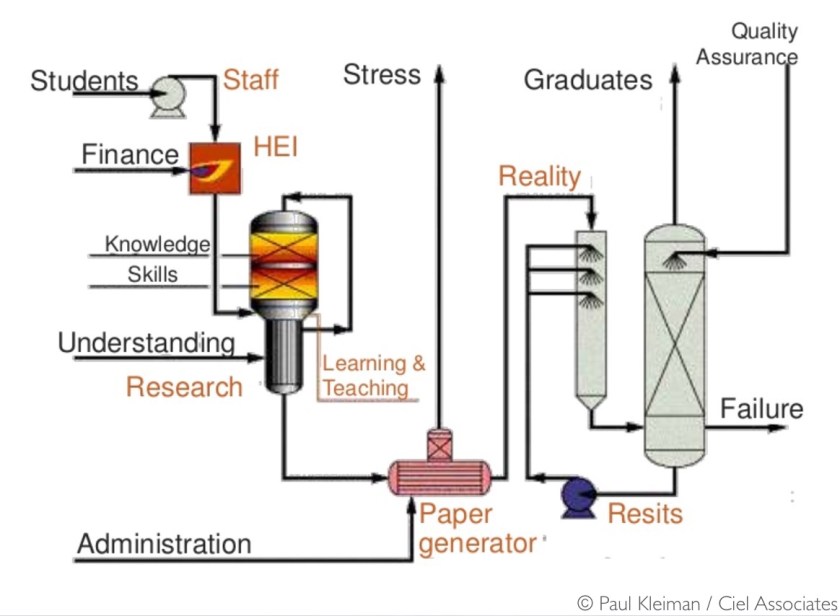
Among HE’s dark academic mills

image

A recent anonymous long diatribe in the Guardian Higher Education from a “semi-employed thirtysomething on a zero-hours contract, sitting at home in pyjamas, staring at a hopeless pile of marking, as hopes of making it to the shops for a pint of milk today fade” complaining bitterly about the conditions under which they are forced to work, provoked a storm of comment – some supportive, some not – from other academics. At the same time the lecturers’ union, the UCU, has called a two-day strike about pay and conditions, after an overwhelming ‘Yes’ ballot. This just happened to coincide with the publication of Vice Chancellors’ salaries which showed an average increase of 6.1% (with one VC of a small specialist arts institution being awarded a 25% increase) against the lecturer’s offered pay rise of 1.1%. Other statistics showed that the overall pay of those same lectures has fallen by 14.5% in real terms since 2010.

The reference in the title of this piece to William Blake’s 1808 poem is deliberate. As  our HE system, in the course of a couple of generations, has shifted from an ‘elite’ to a ‘mass’system, the parallels with what happened two hundred years ago during the course of the Industrial Revolution, though by no means identical, are still striking (no pun intended).

Consider this:

Factories began to replace small “cottage” industries. Manufacturers realized that bulk production was cheaper, more efficient and provided the quantity of items needed. As a result more and more factories sprang up. Skilled workers, such as hand weavers, saw their talents and experience become useless because they could not compete with the efficiency of the new textile machines. In 1832, one observer saw how the skilled hand weavers had lost their way and were reduced to starvation. “It is truly lamentable to behold so many thousands of men who formerly earned 20 to 30 shillings per week, now compelled to live on 5, 4, or even less”. (from Social Studies: The Industrial Revolution)

Our universities have become education factories, and many skilled and experienced academics are the equivalent of the hand weavers, struggling to adapt to life in the Age of the Educational Machine. And it’s not just education. What is the junior doctors’ dispute if it isn’t a row about industrial efficiency being placed above genuine healthcare and family life?

The Vice Chancellors, on the other hand, resemble the early factory and mill owners, happy to exploit their positions of power (protected by the ersatz probity  of the ‘Remuneration Committee’) demonstrating scant regard for common sense and decency in the drive to ensure their educational-industrial complexes thrive in the ultra-competitive and expanding world market for educational goods and services.

Consider this from 1776:

We rarely hear, it has been said, of the combination of masters, though frequently of those of workmen. But whoever imagines, upon this account, that masters rarely combine, is as ignorant of the world as of the subject. Masters are always and everywhere in a sort of tacit, but constant and uniform combination, not to raise the wages of labor above their actual rate…When workers combine, masters … never cease to call aloud for the assistance of the civil magistrate, and the rigorous execution of those laws which have been enacted with so much severity against the combination of servants, labourers and journeymen.” (from Adam Smith The Wealth of Nations)

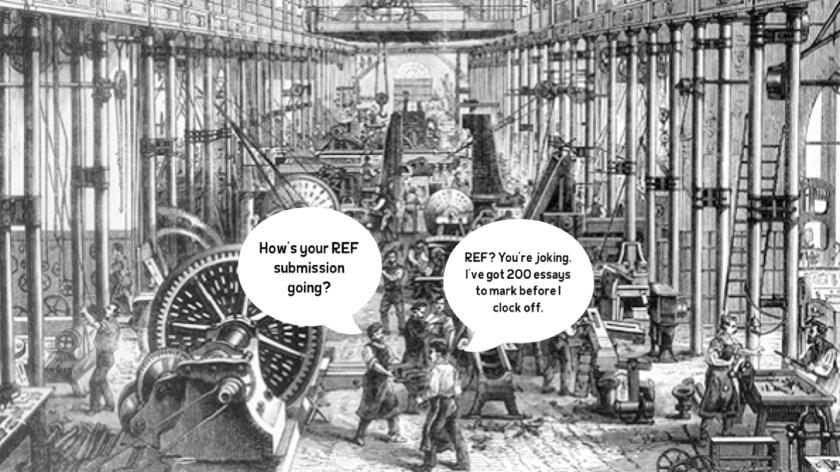
OK, I might be pushing the industrial revolution analogy and hyperbole a bit too far: Higher Education in the UK  was never a cottage industry and has its origins in a closeted and cosseted elite, unlike the craft based practices that were subsumed by the industrial revolution*. But the hand loom weavers, like academics, certainly saw themselves and were seen as elite workers, with high degrees of autonomy over how and when they worked – as long as their ‘pieces’ were delivered in time. That autonomy was rudely taken away by mill and factory work where, in some establishments, it was a sackable offence to bring a timepiece to work because the mill and factory owners literally owned and controlled one’s time.

It’s difficult to avoid the sense that we are – and have been for a while – in a very interesting, challenging and possibly paradigm shifting period. The words of another William, this time Yeats, come to mind: “things fall apart, the centre cannot hold” (from The Second Coming). We are caught between two models and two conceptualisation of higher education. One is the industrial model that harks back to that earlier traditional model, and the other is the post-industrial model: digitised, customised, individualised, connected, fast-changing, non-linear, super-complex, occasionally chaotic.

It is not coincidental that the companies and organisations that are thriving tend to be those that have shifted away from the traditional model: creative, not risk-averse, with lean, flexible systems enabling them to move very fast when the opportunity arises.

There is, of course, no easy answer. The exploited self-employed lecturer on zero-hours and relatively low wages faced with an unmanageable pile of marking is the inevitable consequence (and victim) of the logic of that old industrial model. Many academics, like the hand weavers of old, are faced with a stark choice: accept the conditions of work or else someone else will. There is of course the recourse to collective industrial action by the trade union (another model that traces its roots to the early days of industrial revolution) which may or may not result in a positive result.

But in an Age of Uncertainty and Complexity (let alone Austerity) the question of whether the old model of higher education can still ‘hold’ is perhaps a moot point. What new forms may emerge from out of this transformative  moment are yet to be established. Meanwhile, the education factories increase the output from their academic machine-shops and production lines, and academics fight hard to maintain the values, discourses and practices of genuine, meaningful, life-enhancing education in the face of the obsession with industrial  effectiveness and efficiency that now permeates higher education’s mean unpleasant land.

* My thanks to Prof. Carole-Anne Upton for her comments.
image

The Emperor’s Folderol or Tales of the TEF

(with apologies to Hans Christian Andersen, adapted from the translation by Jean Hersholt.)

Many years ago there was an Emperor so exceedingly fond of excellence in everything and everyone  that he spent all his time and money on ensuring that everything and everyone was, indeed, truly excellent. He cared for nothing else. He had a test and a metric for everything and everyone, and instead of saying, as one might, about any other ruler, “The King’s in council,” here they always said. “The Emperor’s pursuing excellence.”

One day the Emperor announced that he wanted to create a magnificent and complex  instrument – to be called The Emperor’s Folderol – that would tell him quickly and accurately who and what was excellent and, importantly, who and what was not excellent. Those who were found to be excellent were to be amply rewarded, while those who were found to be unable to meet the Emperor’s expectations of excellence were to be punished severely.

The many courtiers surrounding the Emperor could not be bothered to pronounce ‘The Emperor’s Folderol’ in full, and so proceeded to refer to it as the ‘TEF’.

In the great city where the Emperor lived, life was always dynamic. Every day many strangers came to town (despite strict border controls) and among them one day came two swindlers. They let it be known they were expert Folderol constructors, and they said they could create the most magnificent TEF imaginable. Not only were the tests, metrics and materials they used uncommonly fine, but a TEF made from them had a wonderful way of becoming invisible to anyone who was unfit for his or her office, or who was unusually stupid.

“That would be just the Folderol for me,” thought the Emperor. “If I used it I would be able to discover which institutions and people in my empire are unfit for their purpose and posts. And I could separate the wheat from the chaff, the good from the bad, and the elite from the hoi polloi. Yes, I certainly must get a Folderol constructed of those special materials made for me right away.” He paid the two swindlers a large sum of money to start work at once.

They set up a large workshop with two imposing looking machines and pretended to construct the TEF, though the machines in fact produced nothing at all. All the fees and costs which they demanded went into their traveling bags, while they worked the machines far into the night.

“I’d like to know how those constructors are getting on with the TEF,” the Emperor thought, but he felt slightly uncomfortable when he remembered that those who were unfit for their position would not be able to see the product. It couldn’t have been that he doubted himself, yet he thought he’d rather send someone else to see how things were going. The whole town knew about the TEF’s peculiar power, and all were impatient to find out how stupid their neighbours were.

“I’ll send my honest old minister to the TEF workshop.” the Emperor decided. “He’ll be the best one to tell me how it looks, for he’s a sensible man and no one does his duty better.”

So the honest old minister went to the room where the two swindlers sat working away at the machines, producing nothing.

“Heaven help me,” he thought as his eyes flew wide open, “I can’t see anything at all”. But he did not say so.

Both the swindlers begged him to be so kind as to come near to approve the excellent tests, the beautiful metrics. They pointed to the machines, and the poor old minister stared as hard as he dared. He couldn’t see anything, because there was nothing to see. “Heaven have mercy,” he thought. “Can it be that I’m a fool? I’d have never guessed it, and not a soul must know. Am I unfit to be the minister? It would never do to let on that the TEF doesn’t appear to exist at all.”

“Don’t hesitate to tell us what you think of it,” said one of the constructors.

“Oh, it’s beautiful – it’s magnificent.” The old minister peered through his spectacles. “Such a comprehensive system of tests, what excellent metrics of genuine value and utility, such exquisite workmanship! I’ll be sure to tell the Emperor how delighted I am with it.”

“We’re pleased to hear that,” the swindlers said. They proceeded to name all the tests and to explain the intricate metrics. The old minister paid the closest attention, so that he could tell it all to the Emperor. And so he did.

The swindlers at once asked for more money, more fees and more costs, to get on with the construction of the TEF. But it all went into their pockets. Not a single useful component went into the machines, though they worked at the machines as hard as ever.

The Emperor presently sent another trustworthy official to see how the work progressed and how soon it would be ready. The same thing happened to him that had happened to the minister. He looked and he looked, but as there was nothing to see coming out of the machines he couldn’t see anything.

“Isn’t it a beautiful piece of work?” the swindlers asked him, as they displayed and described their imaginary construction.

“I know I’m not stupid,” the man thought, “so it must be that I’m unworthy of my good office. That’s strange. I mustn’t let anyone find it out, though.” So he praised the intricate workings he could not see. He declared he was delighted with the beautiful tests and the exquisite metrics. To the Emperor he said, “It held me spellbound.”

All the town was talking of this splendid TEF, and the Emperor wanted to see it for himself while it was still in the workshop. Attended by a band of chosen men, among whom were his two old trusted officials – the ones who had been sent to see what was going on – he set out to see the two swindlers. He found them working the machines with might and main, but producing nothing that he could see.

“Magnificent,” said the two officials already duped. “Just look, Your Majesty, what tests! What a design! What craftsmanship!” They pointed to the machines, each supposing that the others could what the machines were producing.

“What’s this?” thought the Emperor. “I can’t see anything. This is terrible! Am I a fool? Am I unfit to be the Emperor? What a thing to happen to me of all people! – Oh! It’s exquisite. So elegant.” he said. “It has my highest endorsement.” And he nodded approval at the empty loom. Nothing could make him say that he couldn’t see anything.

His whole retinue stared and stared. One saw no more than another, but they all joined the Emperor in exclaiming, “Oh! It’s wonderful,” and they advised him to place the TEF on the grandest carriage at the front of the great procession he was soon to lead. “Magnificent! Excellent! Unsurpassed!” were bandied from mouth to mouth, and everyone did his best to seem well pleased. The Emperor gave each of the swindlers a cross to wear in his buttonhole, and declared them to be ‘Knights of the Order of the TEF’.

Before the procession the swindlers sat up all night and burned more than six candles, to show how busy they were finishing the TEF. They pretended to move the machine into the centre of the workshop, and they spent hours pretending to polish it. And at last they said, “Now The Emperor’s Folderol is ready for him.”

Then the Emperor himself came with his noblest noblemen, and the swindlers stood either side of their imaginary machine and pointed to it. They said, “Here is the testing instrumentation, and here is the metric matrix, and here is the excellence calculator which is linked dynamically to the financial reward generator. All the components are made of the lightest and finest materials. No expense has been spared. The machine runs absolutely silently, and one would almost think there was nothing there, but that’s the whole point.”

“Exactly,” all the noblemen agreed, though they could see nothing, for there was nothing to see.

“If Your Imperial Majesty will condescend to accept our humble construction,” said the swindlers, “we will now demonstrate how it works, and after the parade we will provide you with detailed instructions on how to operate it.”

The Emperor nodded his assent, and the swindlers pretended to operate the machine. Turning a dial here. Switching a switch there. They invited each of the noblemen to enter the machine and stand between them. After more imaginary turning of dials and switching of switches, and taking great care to check the imaginary results, the TEF contructors declared each nobleman to be truly excellent and they congratulated the Emperor on his choice of courtiers.

And the courtiers said: “What a wonderful machine!”, “How clever your Majesty is to have thought of it!” “Those metrics, so perfect! Those tests, so suitable! It is a magnificent machine!”

Then the minister of public processions announced: “Your Majesty, the procession is waiting outside.”

“Well, if not now, when?” the Emperor said, and gave orders for the TEF machine to be carefully lifted and placed on the lead carriage. “It is a remarkable machine, isn’t it?”

The noblemen stooped low and reached for the floor as if they were picking up an exceedingly heavy object. “No, remember it’s extraordinarily light. Just be very careful” said one of the constructors.  Then they pretended to lift and hold it high. They didn’t dare admit they had nothing to hold.

So off went the Emperor in procession, sitting in his throne behind the TEF machine, while several noblemen stood around the machine as it wound through the city. Everyone in the streets and the windows said, “Oh, what a wonderful machine! Look at the exquisite workmanship! What a truly excellent Emperor!” Nobody would confess that he couldn’t see anything, for that would prove him either unfit for his position, or a fool. No machine the Emperor had ever had built before was ever such a complete, excellent success.

“But there’s nothing there!” a little child said.

“Did you ever hear such innocent prattle?” said its mother. And one person whispered to another what the child had said, “There’s nothing there. A child says there’s nothing there.”

“But there’s nothing there!” the whole town cried out at last.

The Emperor felt his blood run cold, for he suspected they were right. But he thought, “This procession has got to go on, there is far too much at stake.” So he waved at the crowds more enthusiastically than ever, as his noblemen stood proudly alongside The Emperor’s Folderol that wasn’t there at all. And the excellent procession continued.