Beyond excellence…..towards wonder


In higher education (and in education generally) we obsess about excellence. So what does excellence mean?

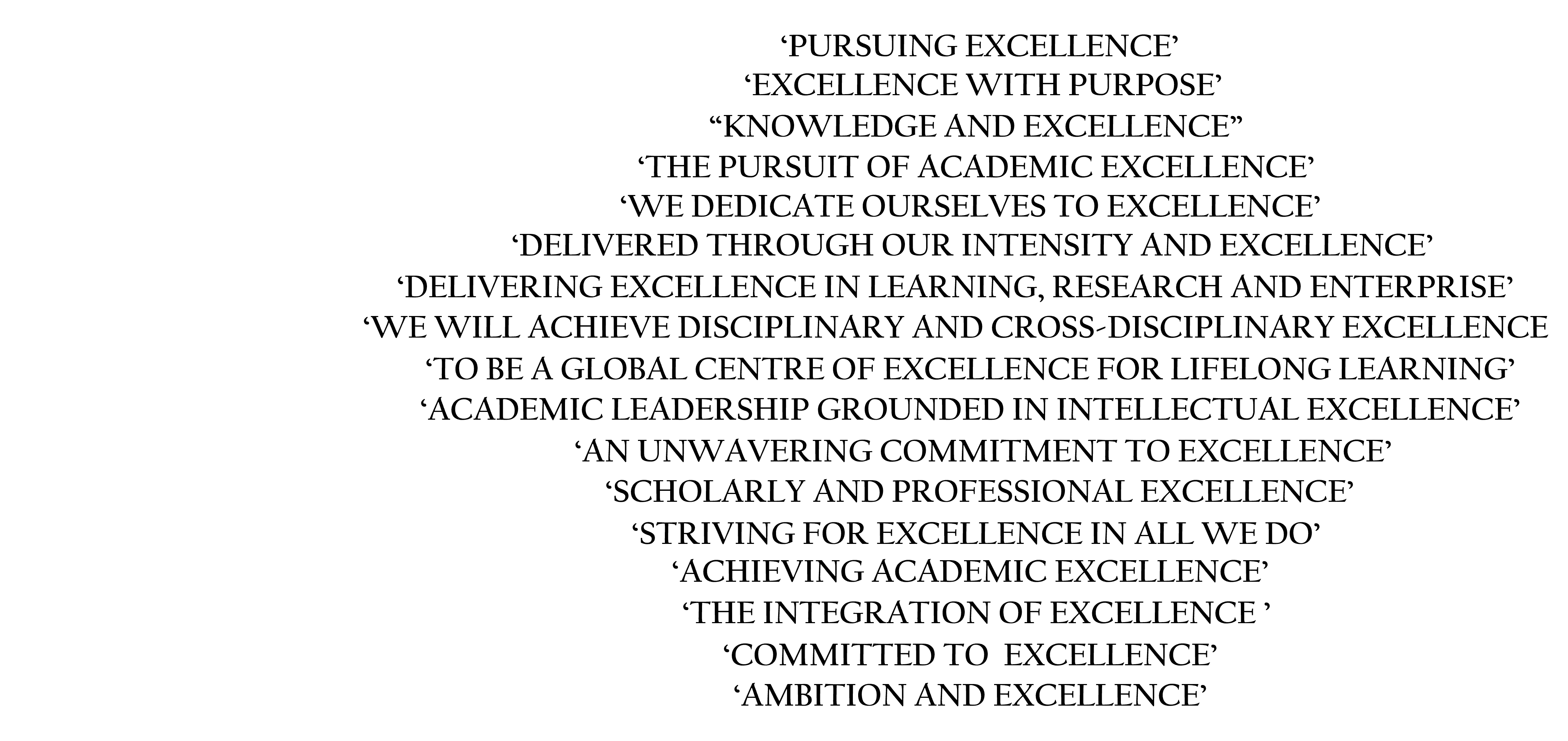
Going by the result of the debate on excellence at an academic conference, there is a clear majority who feel that the term has lost credibility and value. When all institutions are either ‘excellent’ or, at the very least, ‘striving for excellence’ (see university mission statements below) then we are witnessing a lot of sound, but hopefully not fury, signifying nothing. Excellence, in Bill Readings’1 memorable term, has become ‘de-referentialised’. Turning to the dictionary provides little assistance. In the Concise Oxford ‘to excel’ is defined as to surpass or to be pre-eminent (i.e. to be better than the majority), whereas ‘excellence’ is defined as ‘very good’.

University Mission Statements

Whatever meaning ‘excellence’ once had has become lost in a blizzard of hyperbole. The fate of excellence follows in the tradition of other terms such as ‘community’ and, more recently, ‘creativity’, whose meaning has become devalued and decontextualised through over- and inappropriate use.

In the arts, the term excellence is rarely if ever used as a descriptor except – and this may be relevant in considering educational achievement – in relation to the application or demonstration of skill or craft. Academics, students and arts practitioners tend to avoid the ‘E’ word. The theatrical cliché has never been: “You were excellent, darling”. ‘Wonderful’ is truly a much better word than ‘excellent’ to describe high artistic achievement. Rather than excellent’s rather hard-edged, triumphalist implication of being better than others, ‘wonderful’, i.e. full of wonder, has a sense of the remarkable, the extraordinary, the truly successful that is the mark of the highest quality work.

Excellence, it must be said, is much favoured by arts politicians and bureaucrats who use it both aspirationally and as a justification for funding. Excellence attracts rewards and prizes. But the use of the term has more to do with product branding (as it has in higher education) than with a real concern with the subtle complexities of quality and value.

Here is a typical example: one of our leading UK arts funding bodies, in its mission statement, states: “We believe the arts to be the foundation of a confident and cultured society. They challenge and inspire us. They bring beauty, excitement and happiness into our lives. They help us to express our identity as individuals, as communities and as a nation”.

Wonderful! But then they go and ruin it by reverting to corporate-speak and saying they are going to “serve the people … by fostering arts of excellence through funding, development, research and advocacy”. An external examiner I knew, having seen what was – by general consensus – a remarkable, successful, extraordinary, inspiring … yes, wonderful piece of final-year practical work was dismayed to find that the two internal examiners, who also thought the work was remarkable, successful etc had agreed a mark of 75%. He asked them to start at 100%, and argue persuasively for marks to be deducted. With the assessment criteria in their hands they struggled to get below 95%. To describe that work as merely ‘excellent’ would have been insufficient. It was beyond excellence.

That is perhaps what we should be striving for and, in doing so, we need to look beyond our obsession with trying to define, achieve, assess and reward excellence.

As the old saying goes: education is, or ought to be, a wonder-full thing.

References

1 Readings, B. (1997) The University in Ruins. Harvard University Press

The Emperor’s Folderol or Tales of the TEF

(with apologies to Hans Christian Andersen, adapted from the translation by Jean Hersholt.)

Many years ago there was an Emperor so exceedingly fond of excellence in everything and everyone  that he spent all his time and money on ensuring that everything and everyone was, indeed, truly excellent. He cared for nothing else. He had a test and a metric for everything and everyone, and instead of saying, as one might, about any other ruler, “The King’s in council,” here they always said. “The Emperor’s pursuing excellence.”

One day the Emperor announced that he wanted to create a magnificent and complex  instrument – to be called The Emperor’s Folderol – that would tell him quickly and accurately who and what was excellent and, importantly, who and what was not excellent. Those who were found to be excellent were to be amply rewarded, while those who were found to be unable to meet the Emperor’s expectations of excellence were to be punished severely.

The many courtiers surrounding the Emperor could not be bothered to pronounce ‘The Emperor’s Folderol’ in full, and so proceeded to refer to it as the ‘TEF’.

In the great city where the Emperor lived, life was always dynamic. Every day many strangers came to town (despite strict border controls) and among them one day came two swindlers. They let it be known they were expert Folderol constructors, and they said they could create the most magnificent TEF imaginable. Not only were the tests, metrics and materials they used uncommonly fine, but a TEF made from them had a wonderful way of becoming invisible to anyone who was unfit for his or her office, or who was unusually stupid.

“That would be just the Folderol for me,” thought the Emperor. “If I used it I would be able to discover which institutions and people in my empire are unfit for their purpose and posts. And I could separate the wheat from the chaff, the good from the bad, and the elite from the hoi polloi. Yes, I certainly must get a Folderol constructed of those special materials made for me right away.” He paid the two swindlers a large sum of money to start work at once.

They set up a large workshop with two imposing looking machines and pretended to construct the TEF, though the machines in fact produced nothing at all. All the fees and costs which they demanded went into their traveling bags, while they worked the machines far into the night.

“I’d like to know how those constructors are getting on with the TEF,” the Emperor thought, but he felt slightly uncomfortable when he remembered that those who were unfit for their position would not be able to see the product. It couldn’t have been that he doubted himself, yet he thought he’d rather send someone else to see how things were going. The whole town knew about the TEF’s peculiar power, and all were impatient to find out how stupid their neighbours were.

“I’ll send my honest old minister to the TEF workshop.” the Emperor decided. “He’ll be the best one to tell me how it looks, for he’s a sensible man and no one does his duty better.”

So the honest old minister went to the room where the two swindlers sat working away at the machines, producing nothing.

“Heaven help me,” he thought as his eyes flew wide open, “I can’t see anything at all”. But he did not say so.

Both the swindlers begged him to be so kind as to come near to approve the excellent tests, the beautiful metrics. They pointed to the machines, and the poor old minister stared as hard as he dared. He couldn’t see anything, because there was nothing to see. “Heaven have mercy,” he thought. “Can it be that I’m a fool? I’d have never guessed it, and not a soul must know. Am I unfit to be the minister? It would never do to let on that the TEF doesn’t appear to exist at all.”

“Don’t hesitate to tell us what you think of it,” said one of the constructors.

“Oh, it’s beautiful – it’s magnificent.” The old minister peered through his spectacles. “Such a comprehensive system of tests, what excellent metrics of genuine value and utility, such exquisite workmanship! I’ll be sure to tell the Emperor how delighted I am with it.”

“We’re pleased to hear that,” the swindlers said. They proceeded to name all the tests and to explain the intricate metrics. The old minister paid the closest attention, so that he could tell it all to the Emperor. And so he did.

The swindlers at once asked for more money, more fees and more costs, to get on with the construction of the TEF. But it all went into their pockets. Not a single useful component went into the machines, though they worked at the machines as hard as ever.

The Emperor presently sent another trustworthy official to see how the work progressed and how soon it would be ready. The same thing happened to him that had happened to the minister. He looked and he looked, but as there was nothing to see coming out of the machines he couldn’t see anything.

“Isn’t it a beautiful piece of work?” the swindlers asked him, as they displayed and described their imaginary construction.

“I know I’m not stupid,” the man thought, “so it must be that I’m unworthy of my good office. That’s strange. I mustn’t let anyone find it out, though.” So he praised the intricate workings he could not see. He declared he was delighted with the beautiful tests and the exquisite metrics. To the Emperor he said, “It held me spellbound.”

All the town was talking of this splendid TEF, and the Emperor wanted to see it for himself while it was still in the workshop. Attended by a band of chosen men, among whom were his two old trusted officials – the ones who had been sent to see what was going on – he set out to see the two swindlers. He found them working the machines with might and main, but producing nothing that he could see.

“Magnificent,” said the two officials already duped. “Just look, Your Majesty, what tests! What a design! What craftsmanship!” They pointed to the machines, each supposing that the others could what the machines were producing.

“What’s this?” thought the Emperor. “I can’t see anything. This is terrible! Am I a fool? Am I unfit to be the Emperor? What a thing to happen to me of all people! – Oh! It’s exquisite. So elegant.” he said. “It has my highest endorsement.” And he nodded approval at the empty loom. Nothing could make him say that he couldn’t see anything.

His whole retinue stared and stared. One saw no more than another, but they all joined the Emperor in exclaiming, “Oh! It’s wonderful,” and they advised him to place the TEF on the grandest carriage at the front of the great procession he was soon to lead. “Magnificent! Excellent! Unsurpassed!” were bandied from mouth to mouth, and everyone did his best to seem well pleased. The Emperor gave each of the swindlers a cross to wear in his buttonhole, and declared them to be ‘Knights of the Order of the TEF’.

Before the procession the swindlers sat up all night and burned more than six candles, to show how busy they were finishing the TEF. They pretended to move the machine into the centre of the workshop, and they spent hours pretending to polish it. And at last they said, “Now The Emperor’s Folderol is ready for him.”

Then the Emperor himself came with his noblest noblemen, and the swindlers stood either side of their imaginary machine and pointed to it. They said, “Here is the testing instrumentation, and here is the metric matrix, and here is the excellence calculator which is linked dynamically to the financial reward generator. All the components are made of the lightest and finest materials. No expense has been spared. The machine runs absolutely silently, and one would almost think there was nothing there, but that’s the whole point.”

“Exactly,” all the noblemen agreed, though they could see nothing, for there was nothing to see.

“If Your Imperial Majesty will condescend to accept our humble construction,” said the swindlers, “we will now demonstrate how it works, and after the parade we will provide you with detailed instructions on how to operate it.”

The Emperor nodded his assent, and the swindlers pretended to operate the machine. Turning a dial here. Switching a switch there. They invited each of the noblemen to enter the machine and stand between them. After more imaginary turning of dials and switching of switches, and taking great care to check the imaginary results, the TEF contructors declared each nobleman to be truly excellent and they congratulated the Emperor on his choice of courtiers.

And the courtiers said: “What a wonderful machine!”, “How clever your Majesty is to have thought of it!” “Those metrics, so perfect! Those tests, so suitable! It is a magnificent machine!”

Then the minister of public processions announced: “Your Majesty, the procession is waiting outside.”

“Well, if not now, when?” the Emperor said, and gave orders for the TEF machine to be carefully lifted and placed on the lead carriage. “It is a remarkable machine, isn’t it?”

The noblemen stooped low and reached for the floor as if they were picking up an exceedingly heavy object. “No, remember it’s extraordinarily light. Just be very careful” said one of the constructors.  Then they pretended to lift and hold it high. They didn’t dare admit they had nothing to hold.

So off went the Emperor in procession, sitting in his throne behind the TEF machine, while several noblemen stood around the machine as it wound through the city. Everyone in the streets and the windows said, “Oh, what a wonderful machine! Look at the exquisite workmanship! What a truly excellent Emperor!” Nobody would confess that he couldn’t see anything, for that would prove him either unfit for his position, or a fool. No machine the Emperor had ever had built before was ever such a complete, excellent success.

“But there’s nothing there!” a little child said.

“Did you ever hear such innocent prattle?” said its mother. And one person whispered to another what the child had said, “There’s nothing there. A child says there’s nothing there.”

“But there’s nothing there!” the whole town cried out at last.

The Emperor felt his blood run cold, for he suspected they were right. But he thought, “This procession has got to go on, there is far too much at stake.” So he waved at the crowds more enthusiastically than ever, as his noblemen stood proudly alongside The Emperor’s Folderol that wasn’t there at all. And the excellent procession continued.

Anthem for Doomed Academics

(This has been written as the momentous results of the Research Excellence Framework, known to all and sundry as the dreaded REF, are about to be announced, and as careers hang in the balance depending on who are the winners and losers.)

Anthem for Doomed Academics

(with apologies to Wilfred Owen)

What lasting hell for these who try as authors?
Only the monstrous anger of the dons.
Only the stuttering academic’s crippled cursor
Can patter out career horizons.
No metrics now for them; no citations nor reviews;
Nor any voice of warning save the choirs, –
The shrill, demented choirs of wailing peers;
And lost opportunities calling them from sad HEIs.
What meetings may be held to speed them all?
Not in the hand of managers but in their eyes
Shall shine the unholy glimmers of goodbyes.
The cost of student fees shall be their pall;
Their inheritance the frustrations of indebted minds,
And each damned REF a drawing-down of blinds.

The Elixir of Wonder

Yesterday I spent the morning discussing future strategies and scenarios in higher education. What struck me was that over the course of three hours the words education, teaching, and learning were never used.

In the evening I was a guest at the opening night of the Royal Northern College of Music’s production of Donizetti’s opera ‘The Elixir of Love’ to be sung in Italian and featuring – in the cast and orchestra – students from right across the undergraduate and post-graduate provision.

I have to admit that opera generally – and particularly early 19th century Italian comic opera – does not feature on my list of favourite ‘must see’ genres. In fact it’s probably well along the ‘must avoid’ end of the continuum. However, I’d been invited by colleagues I like and respect, and there was a pre-show dinner at the RNCM’s excellent restaurant.

There was a full house, so the building was humming. There’s something great about that pre-show foyer buzz as people arrive, meet, greet, drink, chat, etc. As Richard Schechner pointed out many years ago, the trouble with too many shows is that what happens in the foyer, bars and social spaces before, at the interval, and after a show is all too frequently the most interesting phenomena of the evening.

We took our seats as the orchestra tuned up. Again there’s that wonderful expectancy as the various instruments tune in to that plaintive A on the oboe.

Then it was curtain up and straight into what, from the start to the finish, was a hugely enjoyable, visually seductive and witty, brilliantly performed and played production. 24 hours later, as I write this, I am still smiling because of it.

However this is not a review of the production. But rather, thinking back to my rather dry and ‘education-free’ meeting – about higher education – in the morning, a reflection on how our much disparaged and ‘useless’ disciplines of dance, drama and music in education (all present in this production) provide opportunities for students and also staff to engage in the creation of truly wonderful work. This is something that too many of those who are in control of our education systems, with their obsessions with protocols and standardisation and compliance and conformity and league tables and graduate employability and sustainability and an infinite host of other -isations and -ilities, just don’t get!

I’ve written before how our obsession with the somewhat triumphalist notion of ‘excellence’ has blinded us to that which is so obvious about genuine, transformative education: it’s not excellence we should be pursuing…it is wonder-full education.

The RNCM show provided that Elixir of Wonder.

Forget Excellence…we need wonder!

Paul Kleiman

(First published in the Higher Education Academy’s EXCHANGE MAGAZINE, Issue 7, 2008)

Excellence! Everyone is writing, talking, researching, obsessing about it. But what is it?

Some years ago PALATINE, the Subject Centre for Dance, Drama and Music, undertook an enquiry into the use of the full range of marks in assessing the performing arts in higher education. As well as provoking the centre’s biggest and most heated electronic postbag, a number of respondents described the distinct discomfort they experienced when considering the assessment of work at the very top of the range. One memorably wrote: “I feel the increasingly heavy pull of gravity on my pen as I get to 75%.”

The response supported research that found that the extremities of the percentage scale are perceived as insecure territory for the assessors of qualitative subject matter. There is a strong sense, in the arts and humanities, that nothing can be that good or, for that matter, that bad, and the research revealed that most marking in the arts and humanities ranged between c. 35% to 75% which, in the eccentric and esoteric honours grading system we use in the UK, still manages to cover everything from a Fail to a First!

Undoubtedly one of the assessment challenges we have set for ourselves in performing arts disciplines is requiring students to demonstrate achievement in a wide range of practical, scholarly and creative modes. High achievement in one is rarely sustained across the breadth of an assessment régime in our disciplines, and we have to work to ensure that ‘excellent’ achievement is reflected in the aggregated marks at module and degree level. This is a pedagogic challenge which is not shared by other, more traditional arts and humanities subjects.

So what does excellence mean in this context?

Going by the result of the debate on excellence at an academic conference, there is a clear majority who feel that the term has lost credibility and value. When all institutions are either ‘excellent’ or, at the very least, ‘striving for excellence’ then we are witnessing a lot of sound (but hopefully not fury) signifying nothing. Excellence has become ‘de-referentialised’. Turning to the dictionary provides little assistance. In the Concise Oxford ‘to excel’ is defined as to surpass or to be pre-eminent (i.e. to be better than the majority), whereas ‘excellence’ is defined as ‘very good’.

Whatever meaning ‘excellence’ once had has become lost in a blizzard of hyperbole. The fate of excellence follows in the tradition of other terms such as ‘community’ and, more recently, ‘creativity’, whose meaning has become devalued and decontextualised through over- and inappropriate use.

In the arts, the term excellence is rarely if ever used as a descriptor except – and this may be relevant in considering educational achievement – in relation to the application or demonstration of skill or craft. Academics, students and arts practitioners tend to avoid the ‘E’ word. The theatrical cliché has never been: “You were excellent, darling”. ‘Wonderful’ is truly a much better word than ‘excellent’ to describe high artistic achievement. Rather than excellent’s rather hard-edged, triumphalist implication of being better than others, ‘wonderful’, i.e. full of wonder, has a sense of the remarkable, the extraordinary, the truly successful that is the mark of the highest quality work.

Excellence, it must be said, is much favoured by arts politicians and bureaucrats who use it both aspirationally and as a justification for funding. Excellence attracts rewards and prizes. But the use of the term has more to do with product branding (as it has in higher education) than with a real concern with the subtle complexities of quality and value.

Here is a typical example: one of our leading UK arts funding bodies, in its mission statement, states: “We believe the arts to be the foundation of a confident and cultured society. They challenge and inspire us. They bring beauty, excitement and happiness into our lives. They help us to express our identity as individuals, as communities and as a nation”.

Wonderful! But then they go and ruin it by reverting to corporate-speak and saying they are going to “serve the people … by fostering arts of excellence through funding, development, research and advocacy”. An external examiner I knew, having seen what was – by general consensus – a remarkable, successful, extraordinary, inspiring … yes, wonderful piece of final-year practical work was dismayed to find that the two internal examiners, who also thought the work was remarkable, successful etc had agreed a mark of 75%. He asked them to start at 100%, and argue persuasively for marks to be deducted. With the assessment criteria in their hands they struggled to get below 95%. To describe that work as merely ‘excellent’ would have been insufficient. It was beyond excellence.

That is perhaps what we should be striving for and, in doing so, we need to look beyond our obsession with trying to define, achieve, assess and reward excellence.

As the old saying goes: education is, or ought to be, a wonderful thing.