Among HE’s dark academic mills

image

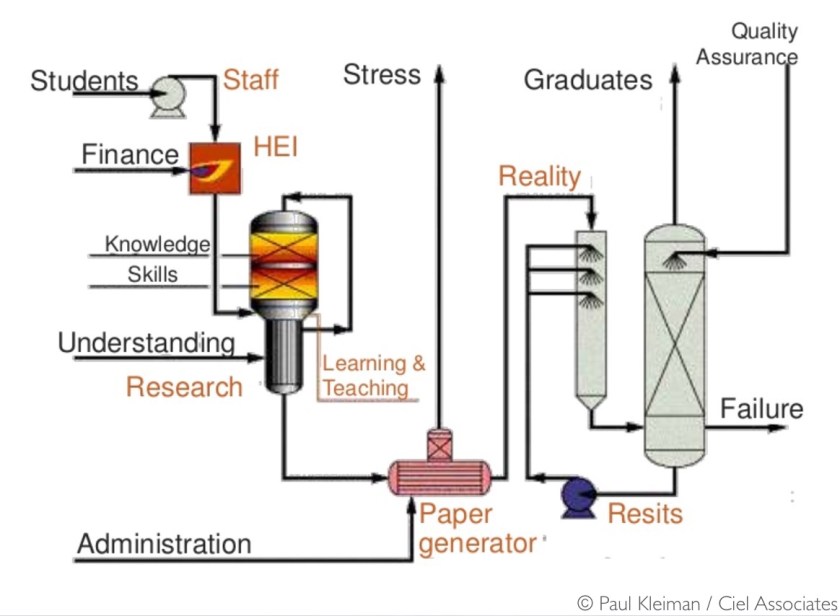
A recent anonymous long diatribe in the Guardian Higher Education from a “semi-employed thirtysomething on a zero-hours contract, sitting at home in pyjamas, staring at a hopeless pile of marking, as hopes of making it to the shops for a pint of milk today fade” complaining bitterly about the conditions under which they are forced to work, provoked a storm of comment – some supportive, some not – from other academics. At the same time the lecturers’ union, the UCU, has called a two-day strike about pay and conditions, after an overwhelming ‘Yes’ ballot. This just happened to coincide with the publication of Vice Chancellors’ salaries which showed an average increase of 6.1% (with one VC of a small specialist arts institution being awarded a 25% increase) against the lecturer’s offered pay rise of 1.1%. Other statistics showed that the overall pay of those same lectures has fallen by 14.5% in real terms since 2010.

The reference in the title of this piece to William Blake’s 1808 poem is deliberate. As  our HE system, in the course of a couple of generations, has shifted from an ‘elite’ to a ‘mass’system, the parallels with what happened two hundred years ago during the course of the Industrial Revolution, though by no means identical, are still striking (no pun intended).

Consider this:

Factories began to replace small “cottage” industries. Manufacturers realized that bulk production was cheaper, more efficient and provided the quantity of items needed. As a result more and more factories sprang up. Skilled workers, such as hand weavers, saw their talents and experience become useless because they could not compete with the efficiency of the new textile machines. In 1832, one observer saw how the skilled hand weavers had lost their way and were reduced to starvation. “It is truly lamentable to behold so many thousands of men who formerly earned 20 to 30 shillings per week, now compelled to live on 5, 4, or even less”. (from Social Studies: The Industrial Revolution)

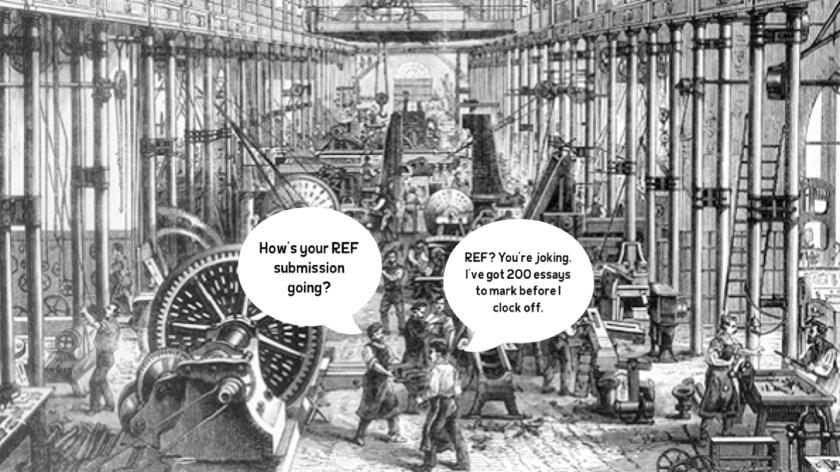
Our universities have become education factories, and many skilled and experienced academics are the equivalent of the hand weavers, struggling to adapt to life in the Age of the Educational Machine. And it’s not just education. What is the junior doctors’ dispute if it isn’t a row about industrial efficiency being placed above genuine healthcare and family life?

The Vice Chancellors, on the other hand, resemble the early factory and mill owners, happy to exploit their positions of power (protected by the ersatz probity  of the ‘Remuneration Committee’) demonstrating scant regard for common sense and decency in the drive to ensure their educational-industrial complexes thrive in the ultra-competitive and expanding world market for educational goods and services.

Consider this from 1776:

We rarely hear, it has been said, of the combination of masters, though frequently of those of workmen. But whoever imagines, upon this account, that masters rarely combine, is as ignorant of the world as of the subject. Masters are always and everywhere in a sort of tacit, but constant and uniform combination, not to raise the wages of labor above their actual rate…When workers combine, masters … never cease to call aloud for the assistance of the civil magistrate, and the rigorous execution of those laws which have been enacted with so much severity against the combination of servants, labourers and journeymen.” (from Adam Smith The Wealth of Nations)

OK, I might be pushing the industrial revolution analogy and hyperbole a bit too far: Higher Education in the UK  was never a cottage industry and has its origins in a closeted and cosseted elite, unlike the craft based practices that were subsumed by the industrial revolution*. But the hand loom weavers, like academics, certainly saw themselves and were seen as elite workers, with high degrees of autonomy over how and when they worked – as long as their ‘pieces’ were delivered in time. That autonomy was rudely taken away by mill and factory work where, in some establishments, it was a sackable offence to bring a timepiece to work because the mill and factory owners literally owned and controlled one’s time.

It’s difficult to avoid the sense that we are – and have been for a while – in a very interesting, challenging and possibly paradigm shifting period. The words of another William, this time Yeats, come to mind: “things fall apart, the centre cannot hold” (from The Second Coming). We are caught between two models and two conceptualisation of higher education. One is the industrial model that harks back to that earlier traditional model, and the other is the post-industrial model: digitised, customised, individualised, connected, fast-changing, non-linear, super-complex, occasionally chaotic.

It is not coincidental that the companies and organisations that are thriving tend to be those that have shifted away from the traditional model: creative, not risk-averse, with lean, flexible systems enabling them to move very fast when the opportunity arises.

There is, of course, no easy answer. The exploited self-employed lecturer on zero-hours and relatively low wages faced with an unmanageable pile of marking is the inevitable consequence (and victim) of the logic of that old industrial model. Many academics, like the hand weavers of old, are faced with a stark choice: accept the conditions of work or else someone else will. There is of course the recourse to collective industrial action by the trade union (another model that traces its roots to the early days of industrial revolution) which may or may not result in a positive result.

But in an Age of Uncertainty and Complexity (let alone Austerity) the question of whether the old model of higher education can still ‘hold’ is perhaps a moot point. What new forms may emerge from out of this transformative  moment are yet to be established. Meanwhile, the education factories increase the output from their academic machine-shops and production lines, and academics fight hard to maintain the values, discourses and practices of genuine, meaningful, life-enhancing education in the face of the obsession with industrial  effectiveness and efficiency that now permeates higher education’s mean unpleasant land.

* My thanks to Prof. Carole-Anne Upton for her comments.
image

‘See me. Feel me. Touch me.’ (Pt. 1)

Object lessons and reflections on the HEA Arts & Humanities conference 2016

Brighton-HEA3

Early March. Brighton is an alluring place, despite the chill in the air.  The sun is shining, the sea is blue, the promenade and beach lie temptingly just across the road from the conference venue, and the esoteric shops, cafés and bars of The Lanes are just a couple of minute’s walk away. So it was a testament to the commitment of the participants and the quality of the many and varied sessions on offer that so many were able to resist the temptation to ‘skip school’.

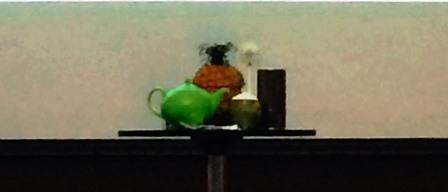
While, in some sessions and in Jonathan Worth’s fascinating keynote on the second day, there was an inevitable and valuable focus on the digital and the virtual, the most powerful message – for me – was the extraordinary pedagogic power of the physical, tangible object. From Kirsten Hardie’s opening keynote with accompanying green plastic teapot, pineapple ice bucket and toilet brush, to the Lego sessions of Contemplative Pedagogies, by way of Simon Heath’s wonderful drawings (see image below) that captured the essences of the whole event, it was the object that held centre stage. And there were plenty more sessions that focused on making and doing as a pedagogic activity, not just a practical or physical one.

Photo left: Hannah Cobb @ArchaeoCobb


I have written elsewhere (‘On history and all that’ ) on the power of objects to engage the imagination, to generate stories and lines of enquiry, to provoke philosophical, political, ethical debates, and to provide learning experiences that really ‘stick’. I still recall clearly the ‘History of Decoration’ seminars from my art student days when ‘Simi’ (Ms. Simeon the lecturer) would enliven her lectures on, say, Ancient Egypt, by taking a vase or piece of jewellery or some other artefact out of the cardboard box she always brought. She would casually hand the object to someone to examine and then pass around the room with the words ‘Do try to be careful, dear, that’s three and half thousand years’ old’. This would be repeated every session, whether the topic was Ancient Rome (jewellery), Medieval Europe (a crucifix) or Tudor England (a lace ruff). I only realised what we had been passing round  when I heard that, on her death , Simi’s large collection of “just something to look at while I’m talking” had been bequeathed to and enthusiastically accepted by the V&A museum.

What also became clear during the conference, is that ‘object lessons’ are not just the preserve of the creative arts community. Every discipline clearly has its associated artefacts which can be used not only to enhance the teaching of an ‘academic’ subject, but to act as foci for the characteristics and qualities of the sort of learning that Kirsten Hardie talked about: learning that engages, amazes, provokes, exhilarates, takes risk, liberates.

imageOne of the things I remember from those, now distant, art history sessions is something I frequently refer to in my work on curriculum design and assessment. In one her first seminars, Simi passed round an Ancient Greek vase that was covered head to foot in decoration. The reason, she said, for filling every possible square inch was ‘horor vacui’ – fear of open space – because it was through open space that the ‘Evil Eye’ enters the world. That might well be one of the reasons (though I would avoid mentioning the ‘Evil Eye’ or the Devil in module specifications and handbooks) why we insist on filling our curricula with content: ‘Idle hands make the devil’s workshop’ and all that. But we also know that deep learning, creativity and innovation require time and space to incubate and develop.


Objects, importantly, enable us to slow down time: to observe, to really look, to touch, to feel, to explore. Simon Piasecki, at the conference, talked about how he gets his performance students to slow right down and focus on the minutiae of what they are doing, and the artist Marina Abramovich – one of whose concerns is the fact that we don’t stop to really look any more –  has a number of exercises she uses with those who come to view her work to achieve the same slowing down. When I worked at the Liverpool Institute of Performing Arts (LIPA), one of the first year ‘options’ that I established – open to any student – was a traditional life-drawing class. All the students that participated in that quiet, contemplative two hours on a Wednesday evening, amidst an extraordinarily hectic timetable (‘horor vacui’!), reported that they understood that it wasn’t about being able to draw. It was about having the time and space to slow down and really observe not only the ‘object’ (usually another student) but also themselves….and to ‘take a line for a walk’ in Paul Klee’s famous phrase.

Ken Robinson, in his now famous TEDTalk on creativity and education, jokes about academics generally seeing their bodies as a form of transportation to get them to meetings. He, among others, stresses the importance of mind and body, the intellectual and the emotional, the psychological and the physiological. What came through so strongly at the HEA Arts and Humanities conference was that objects – in all their glorious variety – and our close interactions with them, provide a means to engage powerfully in deep, meaningful learning experiences.  Objects both inhabit space and create space. We just need the space,  the time and, impotently, the confidence to engage in our own object lessons.

Brighton- HEA2

Photos by Paul Kleiman unless otherwise stated
Conference Twitter hashtag: #HEAArts16

Higher Education and the Myth of the Level Playing Field

For as long as I can remember, the idea that the many and diverse higher education institutions in the UK are playing, and must continue to play, on a single, level playing field has been one of the key tenets of our HE sector. The phrase appears in virtually every major policy document in regard to higher education, and it underpins many of the debates and discussions about its future. The idea of the single level playing field underpins notions such as a 2:1 from institution x is the exactly the same as a 2:1 from every other institution in the sector.

Really?

I find I am not alone in my scepticism. Back in 2012, Paul Greatrix reported that “Steve Egan, Deputy Chief Executive at HEFCE, at a recent AHUA (Association of Heads of University Administration) event, was rather dismissive of the idea of a single level playing field, preferring to imagine number of different playing fields. However, it was not clear if these were side by side or one on top of each other or indeed whether they were marked up for the same game or which teams were playing on each”.

To answer Paul Greatrix, of course there are a number of different playing fields, and though everyone is playing the same game, the pitches are marked up for different versions of the game. Think football. There’s 11-a-side, 6-a-side, 5-a-side, Futsal, beach football, etc. There are outdoor pitches and indoor pitches. There are different types and sizes of pitches, different markings, different goal sizes. There are different rules…..but it’s all still, clearly football.

It is patently absurd to believe that a small, specialist, world-leading music conservatoire is playing the same game, on the same pitch, as a large, multi-subject, research-intensive, world-leading university. They may have ‘world-leading’ in common, but that’s about it. It is similarly absurd to imagine that a university that successfully specialises in widening participation and recruits from the lower social percentiles is playing the same ‘game’ with the same outcomes as an elite-focused university that recruits mainly from the top social percentiles. Mission, values, teaching styles, staff-student ratios, the student body, student experience on campus and external, research profiles and output, employability, etc. are all very different.

The problem we have in the UK was elegantly expressed by David Eastwood, the Chair of the Russell Group, at the recent Parliamentary Select Committee meeting into teaching quality in higher education: “We have a genius for turning difference into hierarchy”. That is certainly one reason we are loath to let go of the myth of the single level playing field. The fear is that once we admit there are different playing fields in higher education, we will immediately begin to construct hierarchies and league tables, with all the consequent gaming of the system (and academics are expert gamers), triumphalism and desperation.

It was also pointed out at the Select Committee meeting that the sheer diversity of UK higher education is one of its greatest strengths. Prof. Joy Carter, Chair of GuildHE, spoke about importance of having and maintaining ‘Excellence in Diversity’ (which just happens to be the title of the report I wrote for Guild HE). The different playing fields lie together on a hierarchy-less plane, each displaying excellence in different forms. Any hierarchy is in the eye of the beholder, and that excellence in diversity is something that ought to be celebrated and sustained by intelligent, informed policies and strategies, not threatened by simplistic, unfit-for-purpose, one-size-fits all metrics. The maintenance and enhancement of the UK’s world-leading sector requires sophisticated evidence-based policies, not policy-based evidence.

The Emperor’s Folderol or Tales of the TEF

(with apologies to Hans Christian Andersen, adapted from the translation by Jean Hersholt.)

Many years ago there was an Emperor so exceedingly fond of excellence in everything and everyone  that he spent all his time and money on ensuring that everything and everyone was, indeed, truly excellent. He cared for nothing else. He had a test and a metric for everything and everyone, and instead of saying, as one might, about any other ruler, “The King’s in council,” here they always said. “The Emperor’s pursuing excellence.”

One day the Emperor announced that he wanted to create a magnificent and complex  instrument – to be called The Emperor’s Folderol – that would tell him quickly and accurately who and what was excellent and, importantly, who and what was not excellent. Those who were found to be excellent were to be amply rewarded, while those who were found to be unable to meet the Emperor’s expectations of excellence were to be punished severely.

The many courtiers surrounding the Emperor could not be bothered to pronounce ‘The Emperor’s Folderol’ in full, and so proceeded to refer to it as the ‘TEF’.

In the great city where the Emperor lived, life was always dynamic. Every day many strangers came to town (despite strict border controls) and among them one day came two swindlers. They let it be known they were expert Folderol constructors, and they said they could create the most magnificent TEF imaginable. Not only were the tests, metrics and materials they used uncommonly fine, but a TEF made from them had a wonderful way of becoming invisible to anyone who was unfit for his or her office, or who was unusually stupid.

“That would be just the Folderol for me,” thought the Emperor. “If I used it I would be able to discover which institutions and people in my empire are unfit for their purpose and posts. And I could separate the wheat from the chaff, the good from the bad, and the elite from the hoi polloi. Yes, I certainly must get a Folderol constructed of those special materials made for me right away.” He paid the two swindlers a large sum of money to start work at once.

They set up a large workshop with two imposing looking machines and pretended to construct the TEF, though the machines in fact produced nothing at all. All the fees and costs which they demanded went into their traveling bags, while they worked the machines far into the night.

“I’d like to know how those constructors are getting on with the TEF,” the Emperor thought, but he felt slightly uncomfortable when he remembered that those who were unfit for their position would not be able to see the product. It couldn’t have been that he doubted himself, yet he thought he’d rather send someone else to see how things were going. The whole town knew about the TEF’s peculiar power, and all were impatient to find out how stupid their neighbours were.

“I’ll send my honest old minister to the TEF workshop.” the Emperor decided. “He’ll be the best one to tell me how it looks, for he’s a sensible man and no one does his duty better.”

So the honest old minister went to the room where the two swindlers sat working away at the machines, producing nothing.

“Heaven help me,” he thought as his eyes flew wide open, “I can’t see anything at all”. But he did not say so.

Both the swindlers begged him to be so kind as to come near to approve the excellent tests, the beautiful metrics. They pointed to the machines, and the poor old minister stared as hard as he dared. He couldn’t see anything, because there was nothing to see. “Heaven have mercy,” he thought. “Can it be that I’m a fool? I’d have never guessed it, and not a soul must know. Am I unfit to be the minister? It would never do to let on that the TEF doesn’t appear to exist at all.”

“Don’t hesitate to tell us what you think of it,” said one of the constructors.

“Oh, it’s beautiful – it’s magnificent.” The old minister peered through his spectacles. “Such a comprehensive system of tests, what excellent metrics of genuine value and utility, such exquisite workmanship! I’ll be sure to tell the Emperor how delighted I am with it.”

“We’re pleased to hear that,” the swindlers said. They proceeded to name all the tests and to explain the intricate metrics. The old minister paid the closest attention, so that he could tell it all to the Emperor. And so he did.

The swindlers at once asked for more money, more fees and more costs, to get on with the construction of the TEF. But it all went into their pockets. Not a single useful component went into the machines, though they worked at the machines as hard as ever.

The Emperor presently sent another trustworthy official to see how the work progressed and how soon it would be ready. The same thing happened to him that had happened to the minister. He looked and he looked, but as there was nothing to see coming out of the machines he couldn’t see anything.

“Isn’t it a beautiful piece of work?” the swindlers asked him, as they displayed and described their imaginary construction.

“I know I’m not stupid,” the man thought, “so it must be that I’m unworthy of my good office. That’s strange. I mustn’t let anyone find it out, though.” So he praised the intricate workings he could not see. He declared he was delighted with the beautiful tests and the exquisite metrics. To the Emperor he said, “It held me spellbound.”

All the town was talking of this splendid TEF, and the Emperor wanted to see it for himself while it was still in the workshop. Attended by a band of chosen men, among whom were his two old trusted officials – the ones who had been sent to see what was going on – he set out to see the two swindlers. He found them working the machines with might and main, but producing nothing that he could see.

“Magnificent,” said the two officials already duped. “Just look, Your Majesty, what tests! What a design! What craftsmanship!” They pointed to the machines, each supposing that the others could what the machines were producing.

“What’s this?” thought the Emperor. “I can’t see anything. This is terrible! Am I a fool? Am I unfit to be the Emperor? What a thing to happen to me of all people! – Oh! It’s exquisite. So elegant.” he said. “It has my highest endorsement.” And he nodded approval at the empty loom. Nothing could make him say that he couldn’t see anything.

His whole retinue stared and stared. One saw no more than another, but they all joined the Emperor in exclaiming, “Oh! It’s wonderful,” and they advised him to place the TEF on the grandest carriage at the front of the great procession he was soon to lead. “Magnificent! Excellent! Unsurpassed!” were bandied from mouth to mouth, and everyone did his best to seem well pleased. The Emperor gave each of the swindlers a cross to wear in his buttonhole, and declared them to be ‘Knights of the Order of the TEF’.

Before the procession the swindlers sat up all night and burned more than six candles, to show how busy they were finishing the TEF. They pretended to move the machine into the centre of the workshop, and they spent hours pretending to polish it. And at last they said, “Now The Emperor’s Folderol is ready for him.”

Then the Emperor himself came with his noblest noblemen, and the swindlers stood either side of their imaginary machine and pointed to it. They said, “Here is the testing instrumentation, and here is the metric matrix, and here is the excellence calculator which is linked dynamically to the financial reward generator. All the components are made of the lightest and finest materials. No expense has been spared. The machine runs absolutely silently, and one would almost think there was nothing there, but that’s the whole point.”

“Exactly,” all the noblemen agreed, though they could see nothing, for there was nothing to see.

“If Your Imperial Majesty will condescend to accept our humble construction,” said the swindlers, “we will now demonstrate how it works, and after the parade we will provide you with detailed instructions on how to operate it.”

The Emperor nodded his assent, and the swindlers pretended to operate the machine. Turning a dial here. Switching a switch there. They invited each of the noblemen to enter the machine and stand between them. After more imaginary turning of dials and switching of switches, and taking great care to check the imaginary results, the TEF contructors declared each nobleman to be truly excellent and they congratulated the Emperor on his choice of courtiers.

And the courtiers said: “What a wonderful machine!”, “How clever your Majesty is to have thought of it!” “Those metrics, so perfect! Those tests, so suitable! It is a magnificent machine!”

Then the minister of public processions announced: “Your Majesty, the procession is waiting outside.”

“Well, if not now, when?” the Emperor said, and gave orders for the TEF machine to be carefully lifted and placed on the lead carriage. “It is a remarkable machine, isn’t it?”

The noblemen stooped low and reached for the floor as if they were picking up an exceedingly heavy object. “No, remember it’s extraordinarily light. Just be very careful” said one of the constructors.  Then they pretended to lift and hold it high. They didn’t dare admit they had nothing to hold.

So off went the Emperor in procession, sitting in his throne behind the TEF machine, while several noblemen stood around the machine as it wound through the city. Everyone in the streets and the windows said, “Oh, what a wonderful machine! Look at the exquisite workmanship! What a truly excellent Emperor!” Nobody would confess that he couldn’t see anything, for that would prove him either unfit for his position, or a fool. No machine the Emperor had ever had built before was ever such a complete, excellent success.

“But there’s nothing there!” a little child said.

“Did you ever hear such innocent prattle?” said its mother. And one person whispered to another what the child had said, “There’s nothing there. A child says there’s nothing there.”

“But there’s nothing there!” the whole town cried out at last.

The Emperor felt his blood run cold, for he suspected they were right. But he thought, “This procession has got to go on, there is far too much at stake.” So he waved at the crowds more enthusiastically than ever, as his noblemen stood proudly alongside The Emperor’s Folderol that wasn’t there at all. And the excellent procession continued.

Dialogues of the TEF: considering teaching excellence

Amongst the plethora of analyses, critiques, diatribes etc. concerning the recent HE Green Paper, and particularly the introduction of the Teaching Excellence Framework (TEF), it’s worth considering – in relation to the complex and very slippery notion of ‘teaching excellence’ – the valuable and comprehensive 2014 report by Vicky Gunn and Anna Fisk: Considering teaching excellence in higher education: 2007-2013 A literature review since the CHERI report 2007  (The Higher Education Academy, 2014).

Here is the final concluding chapter of that report in full,  which ought to be required reading at BIS and for anyone who has a genuine desire a) to get to grips with the notion of teaching excellence, and b) to help create and implement something genuinely useful and valuable.


Conclusions and recommendations

Perhaps the first thing to note in this conclusion is: the higher education sector has, through over a decade of initiatives, shifted significantly in terms of the professionalisation of university teaching. With regards to the UK specifically, this is clearly illustrated in the research literature but also from the evaluation of the high-level group on the modernisation of higher education which has just reported to the European Commission. Indeed, from a European perspective, UK approaches to teaching development and enhancement are now deemed effective enough to be worthy of emulation. This does not mean, however, that there is space for complacency. The level of impact of these initiatives has been patchy in some places and finding ways of ensuring top-down and bottom-up engagement is critical.

Additionally, changes to academic roles represented within institutions demand continued attention in terms of implications for defining excellent teaching and its relation to student learning. These changes also require a level of sophisticated understanding of how the way academics inhabit their disciplinary spaces in terms of the roles and identities they construct for themselves (and increasingly have constructed for them) influences the way they engage with notions of teaching excellence.

What is clear in the research and grey literature since the CHERI 2007 report, however, is:

  1. there is a lack of articulation around the differences between threshold quality and teaching excellence. Shared repertoires, if not consensus, around qualitatively variable concepts of threshold quality, good teaching, and excellence are largely absent. (And there is little evidence of engagement with Gibbs & Habershaw’s distinctions between competency in basic tasks, excellence at new and more demanding tasks, and leadership and scholarship: as outlined in the CHERI report, p.20)
  2. there is a lack of sophistication in conceptualisation of university teaching excellence both generally but more particularly in terms of changing expectations over a career. The absence of sophisticated theorising is particularly acute in terms of leadership in teaching excellence;
  3. in terms of the differentiated nature of the HE sector, there is a lack of representatively diverse conceptualisation of how teaching excellence is defined and plays out (it tends to be portrayed as uniform), as well as little evidencebased discussion on the relationships between researcher and teacher excellence and how the status of each is balanced and recognised within differing clusters of institutions;
  4. at least in the research literature, there is a significant gap between recognition of the dynamic engagement of academics and students in teaching enhancement and innovation, on the one hand, and some educational theorists who view teaching excellence as part of a neoliberal, inherently ‘performative’ agenda, on the other.

Overall, from the higher education research literature as it stands, it would still be hard for institutional teams, individual academics, and students to get a sense of the qualitative and quantitative differences between university teaching that is satisfactory and teaching that is excellent. What is demonstrated clearly by teaching excellence awards is that individual excellence has primarily been defined by initiatives and individuals which have come to be recognised as excellent, rather than as having been identified through theoretically robust, systematic or strategic models. Gibbs (2008) noted this and there has been little change. One of the difficulties this presents universities with, however, is that such a retrospective qualitative process does not necessarily allow for either a transfer of a readily adaptable framework to evaluate rapid changes in teaching practice (such as in the case of MOOCs) or mainstreaming approaches which take local activity and enhance practice beyond the locality. While the absence of systematic and transferable principles and conceptualisations has enabled or forced (depending on one’s world view) institutionally-generated responses to excellence to emerge, it has not addressed how we might develop comparative mechanisms for exploring excellence that would allow:

  • effective cross-institutional benchmarking as an enabling process in response to the need for some institutions to improve their engagement with teaching enhancement;
  • internal benchmarking to ensure reward and recognition processes are perceived and experienced as fair and robust across the institution;
  • research-informed, student development of teaching excellence criteria in reflection of their own generation of criteria for the student-led teaching excellence awards;
  • clear messages to the external environment concerning levels of and engagement with teaching excellence within universities.

Recommendations for further research

In terms of research there is a clear need for:

  1. the development of robust methodologies for analysing the links between teaching excellence and student learning outcomes, which are able to explore the impact of roles and stages within an academic career, including the links between excellent student learning and excellent leading in teaching;
  2. an analysis of the relationships and intersections between vocational service virtues as excellence identified in educational research (also implied in some teaching excellence awards) and the ethics and ethos of the disciplines, including both implicit and explicit virtues and vices represented in universities and through which teaching excellence is manifested. This needs to be done to properly identify the dissonances between the two and how in turn these dissonances impact on the success of educational endeavours, including those related to enhancing student learning. Research is particularly needed on the impact of these relationships in terms of:

–  academic orientations to the various educational outcomes expected of university programmes of study and how they might move academics away or towards systematically imposed definitions of teaching excellence;

–  student learning outcomes. Excellence in student learning was the primary focus of the CHERI report and since 2007 there has been a growing literature on teaching and curricular redesigns aimed at enhancing student engagement and learning outcomes. The headline initiatives responding to this have been: research-teaching linkages, employability, graduate attributes, student as co-producers, students as co-curricular designers. It is clear from the literature, however, that bigger questions are being asked regarding what an undergraduate education is for and whether there is a responsibility on the part of the university sector to play a more significant role in the socialisation of students. This is particularly seen in terms of citizenship (global and democratic) as well as approaches to learning which enable graduates in the future to respond to ‘worlds of constant change’. What this means for how teaching excellence comes to be defined needs to be analysed, as does how we would demonstrate a rigorous and defendable link between teaching excellence and excellent student learning in these areas;

3.  theorising which challenges the universalising (and culturally predicated) tendencies around teaching excellence;

4.  longitudinal projects which study the educational orientations, performance and impact of leadership as related to learning and teaching, particularly in terms of the impact on student learning, and their place within broader academic leadership and management;

5. rigorously analysing the dialectic between external needs and internal institutional dynamics in how excellence comes to be defined, incentivised, and measured;

6.  research on the definition and operationalisation of teaching excellence and teacher excellence in the areas of interprofessional educational development activity, transnational education, learning analytics and disruptive innovations.

Recommendations for policy

In terms of policy, the over-riding focus needs to be on developing a shared repertoire around teaching and teacher excellence which fulfils the requirements of the range of internal and external groups invested in facilitating excellent learning outcomes.

  1.  At a national or sector-wide level, the development of a usable/convincing taxonomy which considers teaching excellence is required. This literature review suggests that such a taxonomy would need to address:

− academic role profile;

− career stages;

 − the relationship of these to the broader educational demands on universities in      terms of learning outcomes; disciplinary needs; institutional missions.

The success of such a taxonomy may depend on its capacity to demonstrate alignment with/ integration of researcher excellence taxonomies and teaching quality processes.

To design the architecture of such a taxonomy is not easy but this literature review suggests elements drawn from the review process which might be useful for initiating a sector-wide discussion.

2. Finally, there is also a need for strategic direction to be reached concerning the ethical use of learning analytics to facilitate teaching excellence and demonstrate excellent student learning outcomes.

Conceptualising what lies behind the judgement of good teaching was undertaken by Trigwell 2010. His idea is adapted below to provide an introduction to the minimum components necessary for the composition of a taxonomy of teaching excellence. Thus the two underlying preoccupations in designing a taxonomy would be:

• qualitatively identifiable variation in approach (classified as excellent, recognisably different from threshold and good) and relevant to different types of academic career profile and stage of career;

• how well an institution, discipline, individual academic informs, demonstrates, and judges that variation.


Elements for developing the architecture of a teaching excellence taxonomy (adapted from Trigwell 2010)

These would underlie four dimensions, with each dimension having four components.

Dimension 1 – Achieving educational demands on universities: extent to which excellent learning outcomes in response to the relevant educational demands are defined and illustrated.

  1. Providing context in which disciplinary mastery is achieved by students
  2. Providing a context in which student learning development (both discipline mastery and generic attributes) is achieved
  3. Providing a context in which the students experience an education which enables fitfor-purpose entry into a determined career/ profession
  4. Providing a context for the development of ways of being, doing, and acting associated with life-wide career opportunities as well as appropriate economic, financial, sociocultural, and ethical attitudes.

Dimension 2 – Excellent structures: level of quality of the approaches of different domains promoting teaching excellence in universities

  1. National strategic approaches: • National recognition schemes • Establishing national bodies to oversee teaching excellence • Establishing national centres for teaching excellence • Enhancement approaches within quality assurance frameworks
  2. Institutional • Teaching excellence awards • Linked top-down and bottom-up institutional-wide enhancement initiatives
  3. Disciplinary • Signature pedagogies • Teaching and learning regimes
  4. Students • Student-led teaching excellence awards • Active student participation

Dimension 3 – Demonstrating individual excellence: degrees of success in demonstrating excellence in teaching practice

  1. Planning and delivery • Curriculum design • Knowledge of the subject • Ability to inspire and motivate • Respect, care and kindness for students as individuals • Active and group learning • Critical and scholarly
  2. Assessment • Conscientious use of formative feedback • Creative and innovative approaches to feedback • Offering students a range of assessments to assess their mastery
  3. Contributing to the profession • Innovation in delivery, assessment, feedback, evaluation, technology • Significant contribution to curriculum renewal and reform • SoTL • Participation in formal networks focused on teaching excellence • Leadership in teaching
  4. Reflection and evaluation • Reflecting on inadequacies of own teaching • Degree of diligence in actively engaging with and responding to student and peer feedback and evaluations

Dimension 4 – Quality of evidence: levels of quality of evidencing individual teacher excellence

  1. Peer observation/review of teaching • Documentary evidence of peerinvolved developmental processes • Report of peer review of teaching • Summative assessment of teaching practice through certificated programmes
  2. Pedagogical competences portfolio – Focus on personal philosophy of teaching, evidencing how this is then operationalised in a variety of ways. (It is likely to include evidence from the three other quadrants.)
  3. Scholarship of Teaching & Learning • Process of, dissemination of outcomes from learning and teaching projects • Publication of outcomes of initiatives (with a recognition that this does not equate primarily with peer review international journals as required in research excellence frameworks)
  4. Evaluations and letters of support • Students • Alumni • Learning analytics – this particular data-revolution can allow for rapid performance management and might come to play a significant role in the assessment of academics’ teaching quality

Final word

Both the literature and the grey material demonstrate that supplying a quality higher education for students is at the core of university identity (even though the notions of quality are themselves ambiguous and contestable). In this, providing a high standard of teaching is afforded the status of a threshold activity for most universities and by most scholars.

The question increasingly, however, is how excellence can be singled out and is achieved in an organisational environment in which role diversification and associated specialisation means that:

• what it is ‘to be an academic’ is becoming increasingly contested and, in some cases, fluid over a career-span;

• the time to experiment, imagine and innovate in teaching is squeezed between other demands established by alternative research and quality focused taxonomies.

Managing both externally recommended and internally generated concepts of teaching excellence so that they do not become unsustainable burdens within an already stratified context is critical. Experimentation, imagination and innovation are areas of excellence that need time and space. Any framework of teaching excellence needs to address this as well as the professional virtues, strategies and practices excellent teaching academics in different disciplines, roles, and at different stages of the career bring to their institutions.

[END]

extended extract, with permission, from Gunn, V. &  Fisk,A: (2014) Considering teaching excellence in higher education: 2007-2013 A literature review since the CHERI report 2007  York:HEA pp.47-52, d