Grief crept up on me, unexpectedly: a story of Christmas Eve.

As a Jewish family, we don’t really do Christmas. Yes, we’ll gather together, have a big meal, play board games, and watch far too much television. But that’s because it’s a holiday, everything is closed, and there’s not much else to do.  Coming up to Christmas that year we’d just had some building work done, and there was still loads of cleaning up, making good, re-decorating to do. So it was looking like a DIY Christmas and new year.

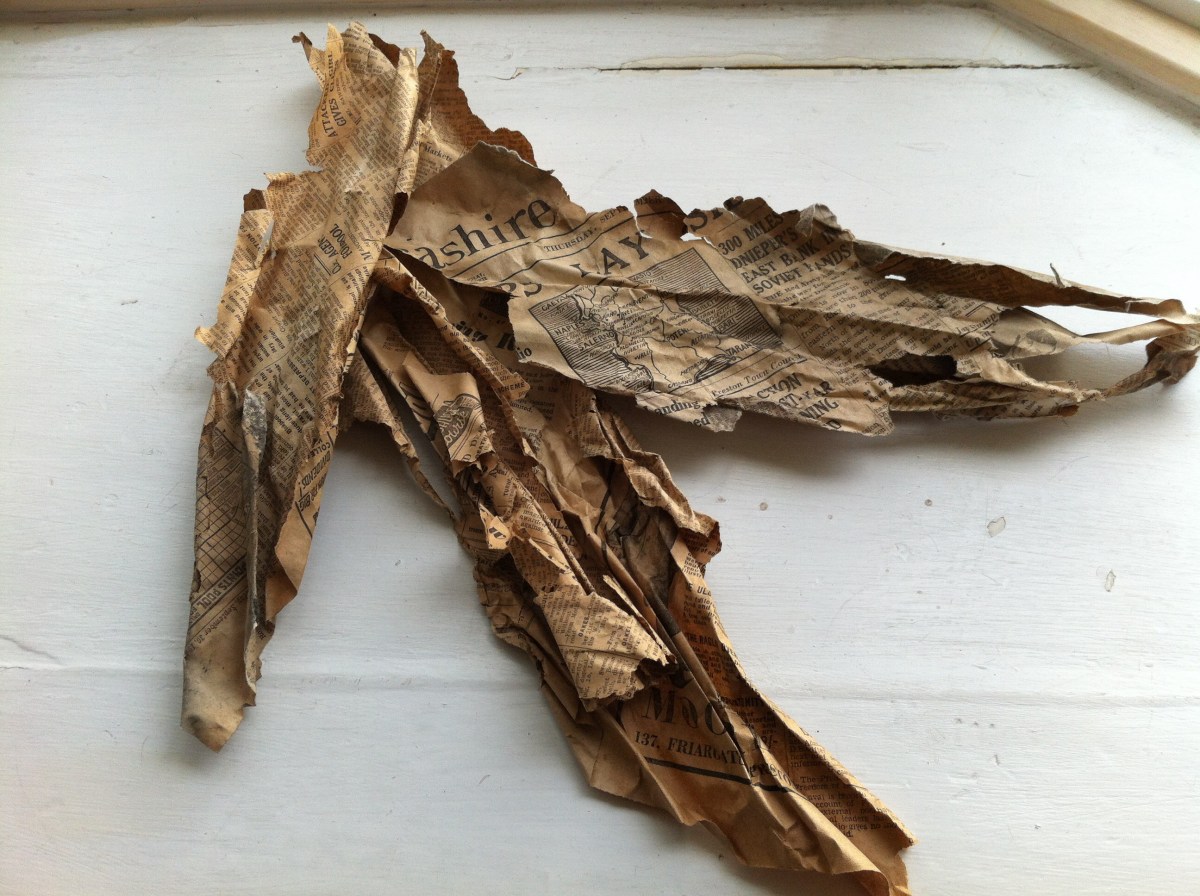
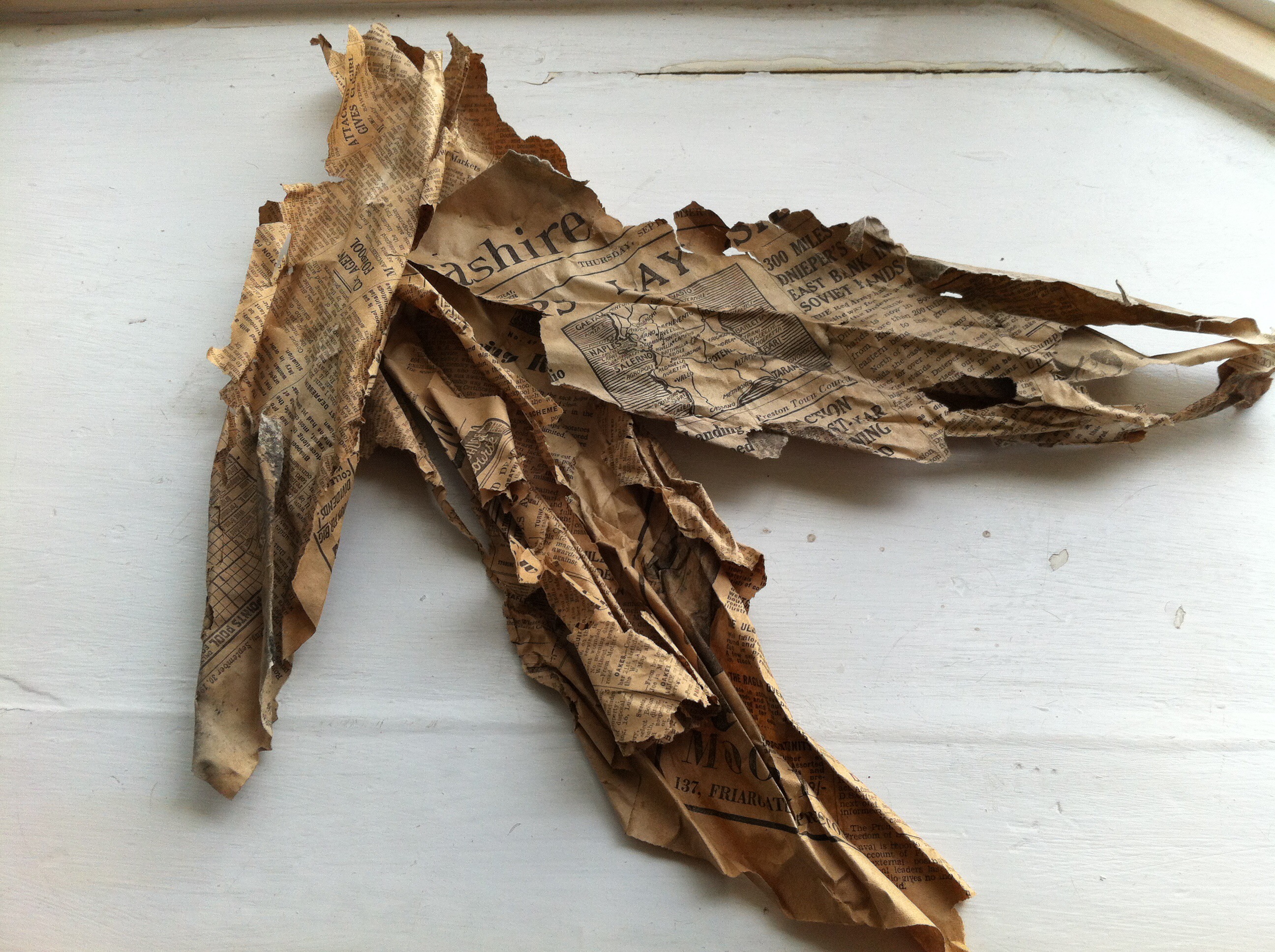
As it happens, the builders had found an old, crumpled newspaper stuffed into the gap between the window and the wall our bedroom. When they first found it, it reminded me of a dead bird.

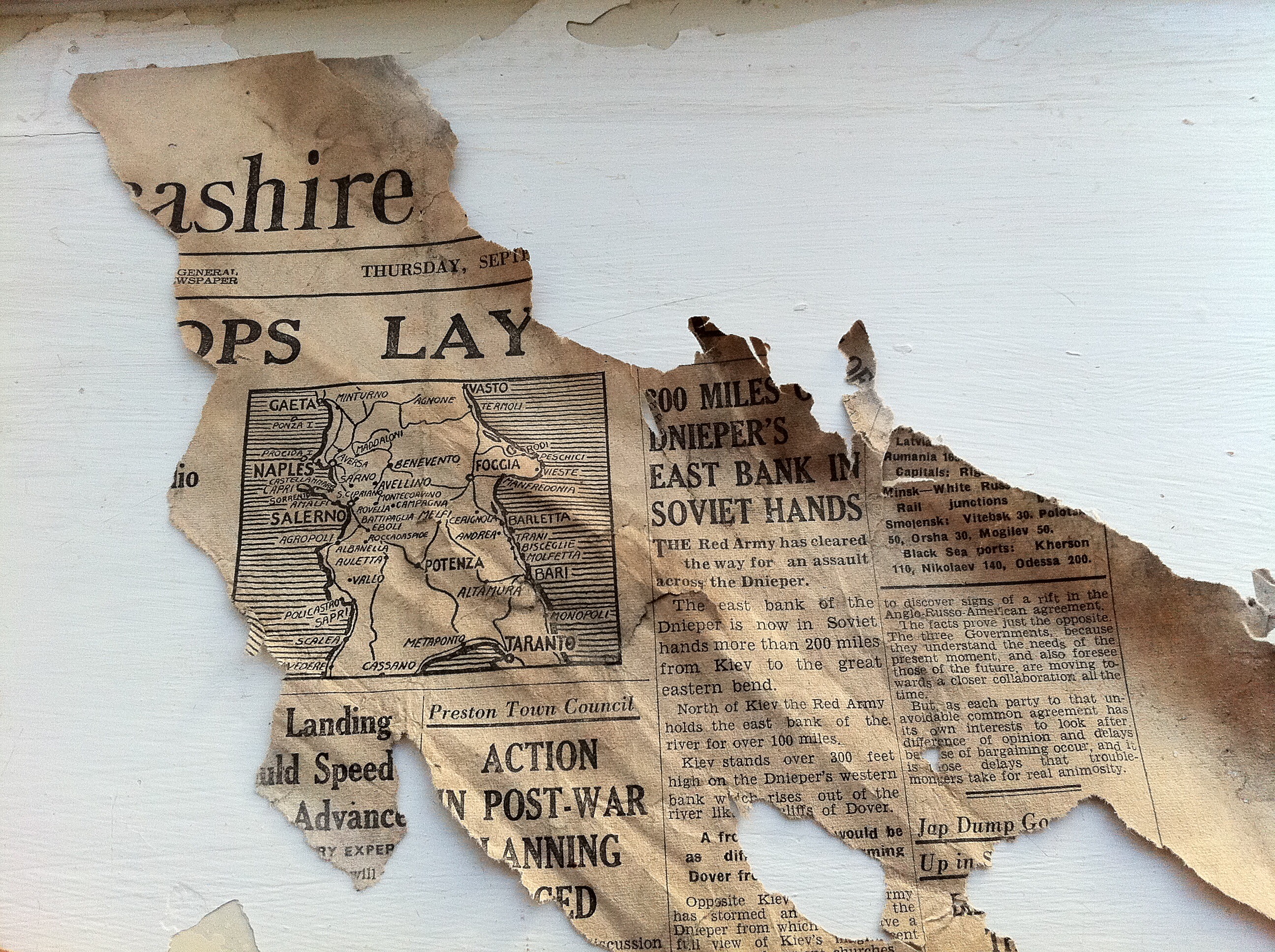
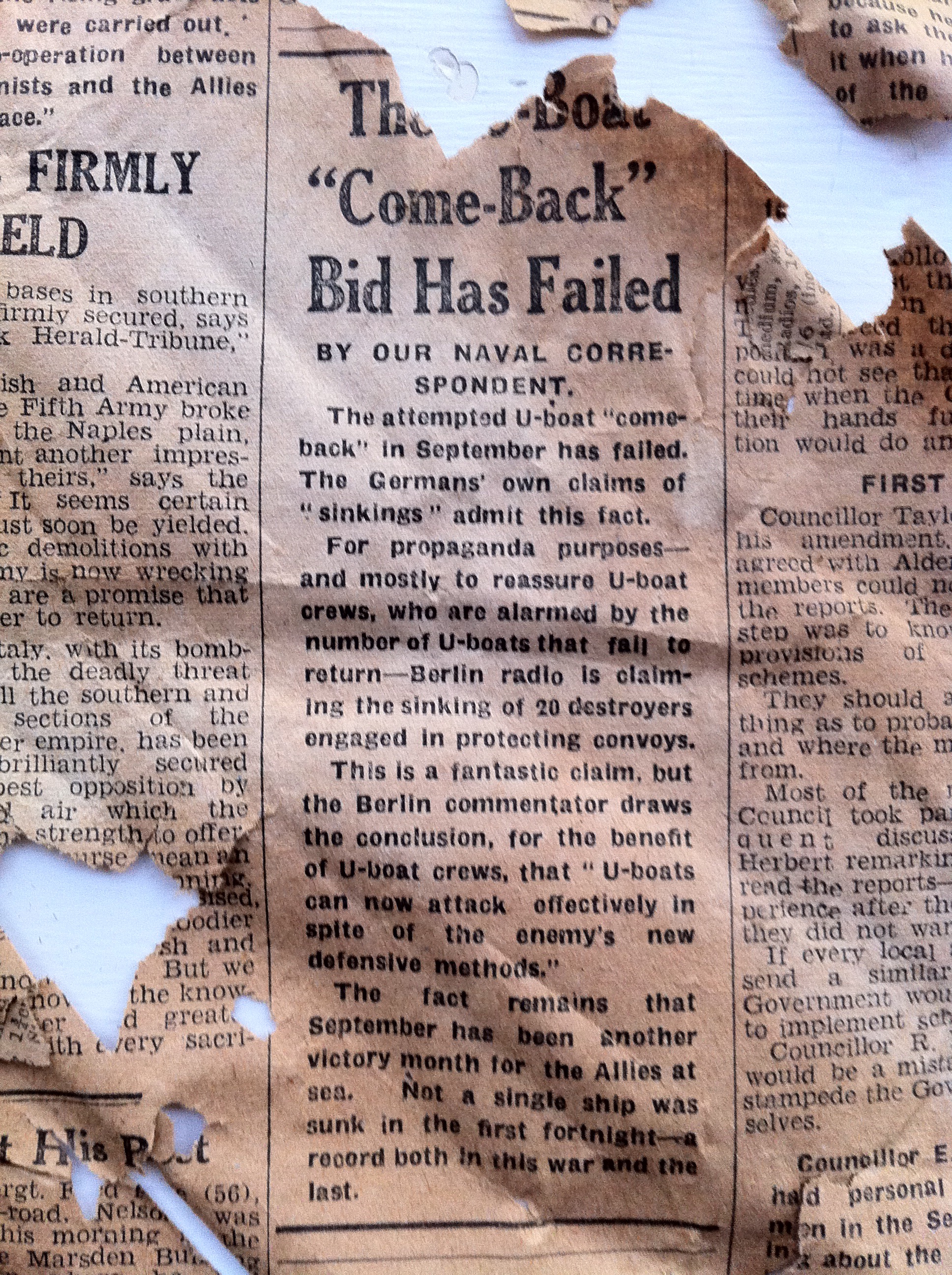
On the afternoon of Christmas Eve I decided to have a go at ‘uncrumpling’ it using our steam iron. It turned out to be the Lancashire Post from 30th September 1943. The paper was very fragile – I suspect they didn’t use the best quality newspaper during the war years – and I became absorbed in the task of slowly but surely flattening the paper one careful centimetre at a time. I wasn’t even aware that the radio was burbling quietly away on the other side of the room.

As each piece revealed its flattened secrets, I read about the Fifth Army’s losses in North Africa, the Russian advances along the Dneiper, a successful bombing raid over Germany (only eight missing in action). I also read about a local woman fined for fiddling ration books, and a Polish aircraft man convicted of drunk driving.

6B36571F-B19A-4FAF-9A7A-0D972EE9726C

There was also a small item about how the German U-boats had failed to sink a single ship in the previous month. 70 years later, on Christmas Eve, the newspapers and television were full of the news about the Royal pardon given to Alan Turing, the man who had ‘cracked’ the German Enigma code used by the U-boats and, by doing so, had in no doubt saved thousands of lives and perhaps helped to end the war. But Turing was gay at a time when it was illegal, and had been found guilty of gross indecency, jailed, chemically castrated, and forbidden to undertake any work linked to national security. He was and should have been hailed as a national hero. Instead, he committed suicide two years later in 1954, and full recognition has only come very recently.

Those U-boat failures, reported on the front page of that 1943 Lancashire Post, were a direct result of the work Turing had undertaken at Bletchley Park.

7D82AF71-CB37-4FD9-91B3-88A0DF5D6033

Absorbed in the task and on this fascinating window on history, I suddenly became aware of a beautiful, solo treble voice filling the room, singing “Once in Royal David’s City….”. It was three o’clock in the afternoon and the start of that wonderful, traditional Christmas Eve ‘Festival of Nine Lessons and Carols’ from King’s College Chapel in Cambridge. And as that pure, high voice soared…..I burst into uncontrollable sobs. A veritable tsunami of grief poured over, into and through me: disturbing and disruptive in its power and intensity.

It took me a while to realise what it was.

When my mother died, I cried no more than a couple of times, and that was around the time when it all happened and usually  in response to an individual’s kindness and sympathy. But nothing like this.

Though, obviously, Jewish and very proud of her traditions, my mother also had a deep love for many things that were quintessentially English. Among them she had a particularly high regard for and interest in the great cathedrals and churches of England. After she passed away I discovered, amidst the thousands of documents she left, a neatly stacked pile of guides to virtually all the English cathedrals and some other churches, all annotated with her distinctive handwriting. I always smile when I see those guides as my father did not approve of my mother’s interest in Christianity, and I know he would not step inside a church. So I have a very clear picture of my mother wandering around inside with her guide, no doubt quizzing whoever she could find about the history of the building and making notes, while my father sat patiently on a nearby bench doing his Times crossword.

Just before three o’clock in the afternoon on Christmas eve, without fail, and though Jews – on the whole – don’t do Christmas, my mother would sit herself in her favourite chair, turn on the radio, quite loudly, and wait until that beautiful, soaring, solo treble voice filled the room, singing the first verse of the carol, followed by the choir and then the congregation. Earlier in the day she would have called me to remind me NOT to call her between 3pm and 5pm.

As that deep pang of grief and my sobbing subsided, and I was able to collect my thoughts, I wondered how that boy’s voice could trigger such intense emotion. I remembered how some of Mark Rothko’s last paintings, those gigantic fields of deep colour, have a similar effect on some individuals, and I recalled that in some therapeutic contexts music and song are used to enable individuals and groups to confront severe trauma.

In my case, that moment triggered an intense ‘remembrance of things past’ and a huge sense of both loss and love. I suspect we all have those triggers, those Proustian ‘Madeleine biscuit’ moments, when something – perhaps completely unexpected – plunges us into the deep well of memory, love and loss.

That afternoon, as I ironed that old newspaper (something my mother would have loved – the newspaper not the ironing!) and listened to that young boy singing those famous words, I probably missed her more than I’ve done at any other time.

Grief crept up on me on Christmas Eve….unexpectedly.

As a Jewish family, we don’t really do Christmas. Yes, we’ll gather together, have a big meal, play board games, and watch far too much television. But that’s because it’s a holiday, everything is closed, and there’s not much else to do.  Coming up to Christmas that year we’d just had some building work done, and there was still loads of cleaning up, making good, re-decorating to do. So it was looking like a DIY Christmas and new year.

As it happens, the builders had found an old, crumpled newspaper stuffed into the gap between the window and the wall our bedroom. When I first saw it lying on the floor where they had dropped it, I thought they had found a dead bird.

E09A2B69-4E25-468E-B831-7B66BF619E8D

On the afternoon of Christmas Eve I decided to have a go at ‘uncrumpling’ it using our steam iron. It turned out to be the Lancashire Post from 30th September 1943. The paper was very fragile – I suspect they didn’t use the best quality newspaper during the war years – and I became absorbed in the task of slowly but surely flattening the paper one careful centimetre at a time. I wasn’t even aware that the radio was burbling quietly away on the other side of the room.

As each piece revealed its flattened secrets, I read about the Fifth Army’s losses in North Africa, the Russian advances along the Dneiper, a successful bombing raid over Germany (only eight missing in action). I also read about a local woman fined for fiddling ration books, and a Polish aircraft man convicted of drunk driving.

6B36571F-B19A-4FAF-9A7A-0D972EE9726C


There was also a small item about how the German U-boats had failed to sink a single ship in the previous month. 70 years later, on Christmas Eve, the newspapers and television were full of the news about the Royal pardon given to Alan Turing, the man who had ‘cracked’ the German Enigma code used by the U-boats and, by doing so, had in no doubt saved thousands of lives and perhaps helped to end the war. But Turing was gay at a time when it was illegal, and had been found guilty of gross indecency, jailed, chemically castrated, and forbidden to undertake any work linked to national security. He was and should have been hailed as a national hero. Instead, he committed suicide two years later in 1954.

Those U-boat failures, reported on the front page of that 1943 Lancashire Post, were a direct result of the work Turing had undertaken at Bletchley Park.

7D82AF71-CB37-4FD9-91B3-88A0DF5D6033

Absorbed in the task and on this fascinating window on history, I suddenly became aware of a beautiful, solo treble voice filling the room, singing ‘Once in Royal David’s City….”. It was three o’clock in the afternoon and the start of that wonderful, traditional Christmas Eve ‘Festival of Nine Lessons and Carols’ from King’s College Chapel in Cambridge. And as that pure, high voice soared…..I burst into uncontrollable sobs. A veritable tsunami of grief poured over, into and through me; disturbing and disruptive in its power and intensity.

It took me a while to realise what it was.

When my mother died the year before, I cried no more than a couple of times, and that was around the time when it all happened and in response to an individual’s kindness and sympathy. But nothing like this.

Though, obviously, Jewish and very proud of her traditions, my mother also had a deep love for many things that were quintessentially English. Among them she had a particularly high regard for and interest in the great cathedrals and churches of England. After she passed away I discovered, amidst the thousands of documents she left, a neatly stacked pile of guides to virtually all the English cathedrals and some other churches, all neatly annotated with her distinctive handwriting. I always smile when I see those guides as my father did not approve of my mother’s interest in Christianity, and I know he would not step inside a church. So I have a very clear picture of my mother wandering around inside with her guide, no doubt quizzing whoever she could find about the history of the building, while my father is sitting on a park bench nearby doing his Times crossword.

Just before three o’clock in the afternoon on Christmas eve, without fail, and though Jews – on the whole – don’t do Christmas, my mother would sit herself in her favourite chair, turn on the radio, quite loudly, and wait until that beautiful, soaring, solo treble voice filled the room, singing the first verse of the carol, followed by the choir and then the congregation. Earlier in the day she would have called me to remind me NOT to call her between 3pm and 5pm.

As that deep pang of grief and my sobbing subsided, and I was able to collect my thoughts, I wondered how that boy’s voice could trigger such intense emotion. I remembered the reports of how some of Mark Rothko’s last paintings, those gigantic fields of deep colour, have a similar effect on some individuals. I recalled that in some therapeutic contexts music and song are used to enable individuals and groups to confront severe trauma.

In my case, it triggered an intense ‘remembrance of things past’ and a huge sense of both loss and love. I suspect we all have those triggers, those Proustian ‘Madeleine biscuit’ moments, when something – perhaps completely unexpected – plunges us into the deep well of memory, love and loss.

That afternoon, as I ironed that old newspaper (something my mother would have loved – the newspaper not the ironing!) and listened to that young boy singing those famous words, I probably missed her more than I’ve done at any other time.

Among HE’s dark academic mills

image

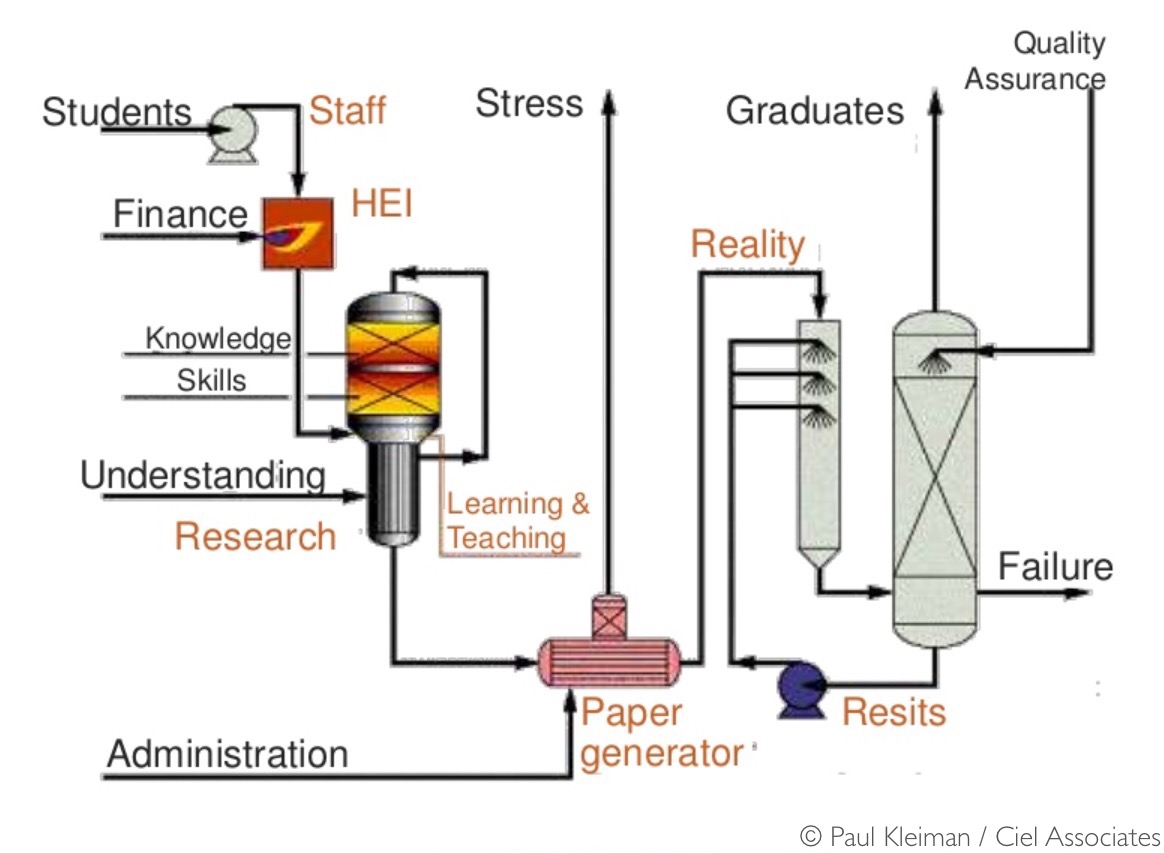
A recent anonymous long diatribe in the Guardian Higher Education from a “semi-employed thirtysomething on a zero-hours contract, sitting at home in pyjamas, staring at a hopeless pile of marking, as hopes of making it to the shops for a pint of milk today fade” complaining bitterly about the conditions under which they are forced to work, provoked a storm of comment – some supportive, some not – from other academics. At the same time the lecturers’ union, the UCU, has called a two-day strike about pay and conditions, after an overwhelming ‘Yes’ ballot. This just happened to coincide with the publication of Vice Chancellors’ salaries which showed an average increase of 6.1% (with one VC of a small specialist arts institution being awarded a 25% increase) against the lecturer’s offered pay rise of 1.1%. Other statistics showed that the overall pay of those same lectures has fallen by 14.5% in real terms since 2010.

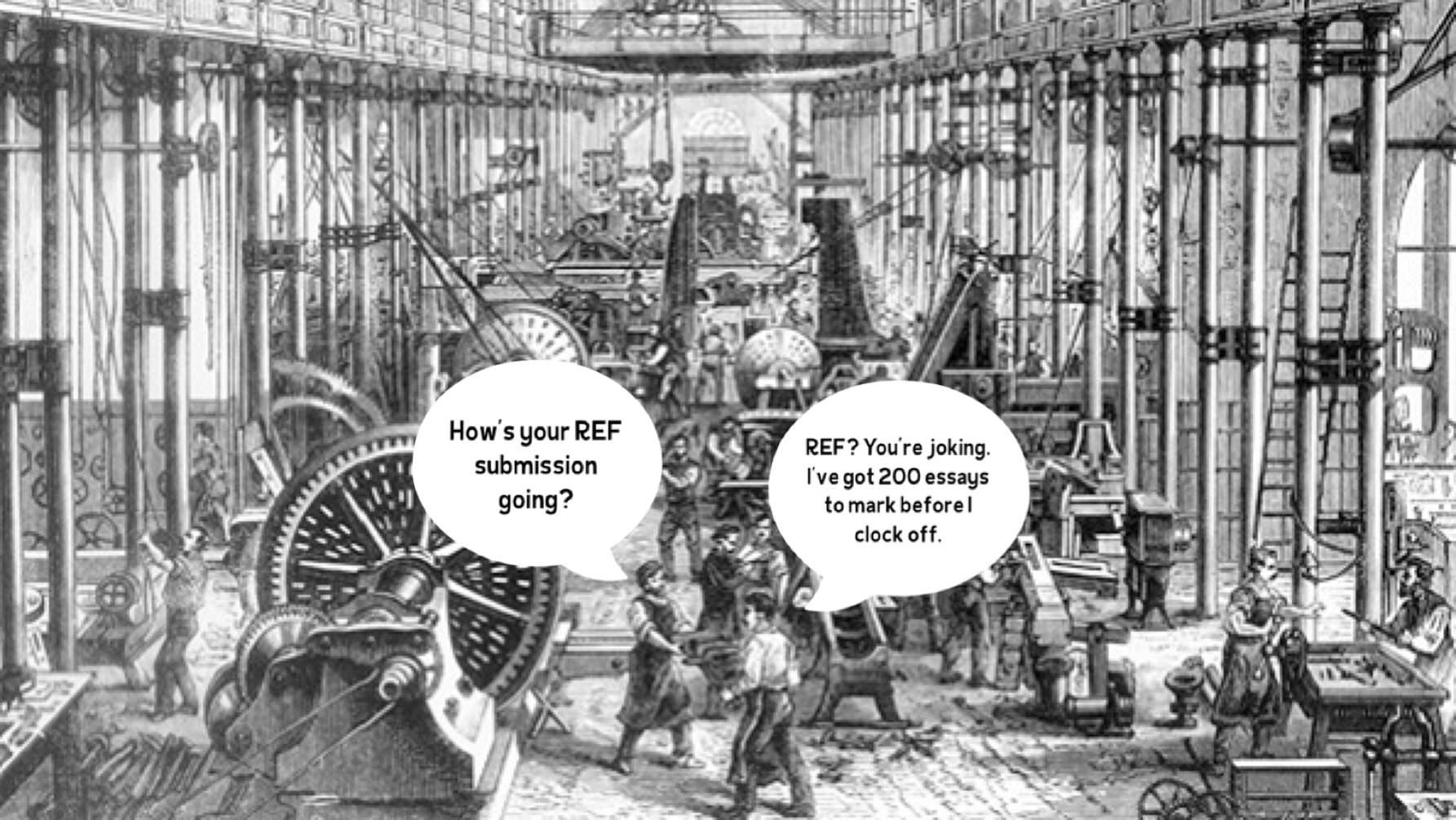
The reference in the title of this piece to William Blake’s 1808 poem is deliberate. As  our HE system, in the course of a couple of generations, has shifted from an ‘elite’ to a ‘mass’system, the parallels with what happened two hundred years ago during the course of the Industrial Revolution, though by no means identical, are still striking (no pun intended).

Consider this:

Factories began to replace small “cottage” industries. Manufacturers realized that bulk production was cheaper, more efficient and provided the quantity of items needed. As a result more and more factories sprang up. Skilled workers, such as hand weavers, saw their talents and experience become useless because they could not compete with the efficiency of the new textile machines. In 1832, one observer saw how the skilled hand weavers had lost their way and were reduced to starvation. “It is truly lamentable to behold so many thousands of men who formerly earned 20 to 30 shillings per week, now compelled to live on 5, 4, or even less”. (from Social Studies: The Industrial Revolution)

Our universities have become education factories, and many skilled and experienced academics are the equivalent of the hand weavers, struggling to adapt to life in the Age of the Educational Machine. And it’s not just education. What is the junior doctors’ dispute if it isn’t a row about industrial efficiency being placed above genuine healthcare and family life?

The Vice Chancellors, on the other hand, resemble the early factory and mill owners, happy to exploit their positions of power (protected by the ersatz probity  of the ‘Remuneration Committee’) demonstrating scant regard for common sense and decency in the drive to ensure their educational-industrial complexes thrive in the ultra-competitive and expanding world market for educational goods and services.

Consider this from 1776:

We rarely hear, it has been said, of the combination of masters, though frequently of those of workmen. But whoever imagines, upon this account, that masters rarely combine, is as ignorant of the world as of the subject. Masters are always and everywhere in a sort of tacit, but constant and uniform combination, not to raise the wages of labor above their actual rate…When workers combine, masters … never cease to call aloud for the assistance of the civil magistrate, and the rigorous execution of those laws which have been enacted with so much severity against the combination of servants, labourers and journeymen.” (from Adam Smith The Wealth of Nations)

OK, I might be pushing the industrial revolution analogy and hyperbole a bit too far: Higher Education in the UK  was never a cottage industry and has its origins in a closeted and cosseted elite, unlike the craft based practices that were subsumed by the industrial revolution*. But the hand loom weavers, like academics, certainly saw themselves and were seen as elite workers, with high degrees of autonomy over how and when they worked – as long as their ‘pieces’ were delivered in time. That autonomy was rudely taken away by mill and factory work where, in some establishments, it was a sackable offence to bring a timepiece to work because the mill and factory owners literally owned and controlled one’s time.

It’s difficult to avoid the sense that we are – and have been for a while – in a very interesting, challenging and possibly paradigm shifting period. The words of another William, this time Yeats, come to mind: “things fall apart, the centre cannot hold” (from The Second Coming). We are caught between two models and two conceptualisation of higher education. One is the industrial model that harks back to that earlier traditional model, and the other is the post-industrial model: digitised, customised, individualised, connected, fast-changing, non-linear, super-complex, occasionally chaotic.

It is not coincidental that the companies and organisations that are thriving tend to be those that have shifted away from the traditional model: creative, not risk-averse, with lean, flexible systems enabling them to move very fast when the opportunity arises.

There is, of course, no easy answer. The exploited self-employed lecturer on zero-hours and relatively low wages faced with an unmanageable pile of marking is the inevitable consequence (and victim) of the logic of that old industrial model. Many academics, like the hand weavers of old, are faced with a stark choice: accept the conditions of work or else someone else will. There is of course the recourse to collective industrial action by the trade union (another model that traces its roots to the early days of industrial revolution) which may or may not result in a positive result.

But in an Age of Uncertainty and Complexity (let alone Austerity) the question of whether the old model of higher education can still ‘hold’ is perhaps a moot point. What new forms may emerge from out of this transformative  moment are yet to be established. Meanwhile, the education factories increase the output from their academic machine-shops and production lines, and academics fight hard to maintain the values, discourses and practices of genuine, meaningful, life-enhancing education in the face of the obsession with industrial  effectiveness and efficiency that now permeates higher education’s mean unpleasant land.

* My thanks to Prof. Carole-Anne Upton for her comments.

image

Selma Connections: A King, a Rabbi and a Caution

image      image

Like many, I’ve been watching the commemorations and celebrations of the 50 years since the momentous ‘Bloody Sunday’ on 7 March 1965 in Selma.

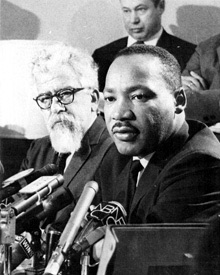
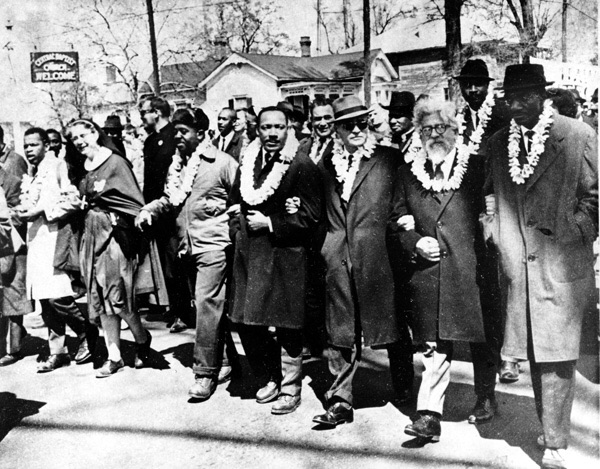
Looking at the various films and photographs from that time and place, you may have noticed that in a number of them, standing or sitting next to Dr. Martin Luther King is an elderly white man, wearing glasses and with a shock of white hair and long beard. His name is Rabbi Abraham Joshua Heschel, which is the anglicised version of his Hebrew name: Avraham Yehoshua Heschel….which was also my father’s Hebrew name. They were both named after a famous 17th century Polish rabbinical mystic.

Rabbi Heschel was a leading figure in American Judaism and also a very active social activist. He believed strongly that one’s spirituality must have legs. At the invitation of Martin Luther King Jr., Heschel participated in the opening day of the 1965 civil rights march from Selma to Montgomery for voting rights. The photograph of Heschel walking alongside King and other religious and political leaders is considered an emblem of the civil rights movement and of Black-Jewish relations of that era.

After the march, Heschel wrote about the experience in a private memo, “I felt my legs were praying.”

Jumping to the present, and the particulars horrors emanating from the so- called Islamic State, with its violent, barbaric intolerance of anyone and anything that does not fit with its particular world view, Heschel’s caution about the dark side of religion has a particular resonance:

“…when religion speaks only in the name of authority rather than with the voice of compassion, its message becomes meaningless.”

On history and all that (Part 2): a marvellous lesson

I was once privileged to witness the most marvellous history lesson…taught by a drama teacher.

It was in a comprehensive school. The students, a mixed class of girls and boys, were taking GCSE History, and the theme was England in the 17th century. The ‘teacher’ was Dorothy Heathcote, the eminent and inspirational drama education specialist. (For those who have never heard of her, do read this http://www.mantleoftheexpert.com/community/about-us/dorothy-heathcote/.)

One of the things Dorothy used to say was that the most powerful word in education is the word ‘might’. Ask a child “what IS the answer to this?” pre-supposes there is a single ‘right’ answer. It’s a closed question. But ask “what MIGHT be the answer to this?”, then you open up the possibilities, the curiosity, the imagination.

The environment was a standard classroom, with melamine tables and plastic chairs.

The session started with Dorothy hanging three large blank sheets of paper on the wall. On the top of one she wrote: ‘I know this about the 17th century’. On the second she wrote ‘I think I know this about the 17th century’. On the third she wrote ‘I’d like to know this about the 17th century’.

She then asked the students to fill out each paper. Not a great deal went on the first one. A bit more went on the second one. A quite a bit more on the third one.

Dorothy then quickly went through each one, checking to see if there was any more to be added.

She then asked the students to get into groups of two or three, and gave each group a set of photocopied sheets of paper. They were taken from one of those guides to antique furniture, and contained images and information about 17th century tables and chairs

Dorothy asked each group to look at the images and read the information, and then to select one – either a table or chair.

She then announced that from that moment on the classroom was now Heathcote’s Expert Antique Restoration Workshop. The students were now all experts at restoring antique furniture, and she was in charge. She then, pointing to the classroom tables and chairs, asked the workers to start restoring the piece of furniture they had selected.

Notwithstanding a bit of embarrassed bewilderment, the students started to ‘work’ on their chosen item: inspecting it, discussing what might be wrong with it, what needed repairing, starting to repair it, etc.

Dorothy walked round inspecting the work, and would ask questions. A typical exchange would be as follows:

Dorothy: What have you got there?

Student: It’s an oak dining chair, Miss.

D: Where’s it from?

S: Something Hall, Miss. I think it’s one of those big houses. [they’d read that on the sheet]

D: What’s wrong with it?

S: Er…it’s got a big split. [that wasn’t on the sheet]

D: Any idea how that split might have occurred?

S: Not sure, Miss. But there’s some scorch marks around the split, so we reckon it was in a fire and perhaps got chucked out of a window. [definitely not on the sheet!]

D: And how do you reckon that might have happened?

And you could see the students’ imagination switch into gear, and out came stories about corridors, and candles, and late night trysts, and a chase, and a dropped candle, and the panic, and the servants being woken up and being ordered to save the furniture, and the chair being thrown out of a high window….

Each group created and shared its own story, using what they knew, what they thought they knew, and what they imagined. And slowly but surely, a real sense of 17th century life began to be created and understood.

After a short break, the session re-started. Now two new characters were introduced along with a set of typical everyday ’17th century’ artifacts e.g: a ring, a quill and ink, a bell, a hand written letter, a pamphlet, etc. The characters – played by actors – were the lady of the house, and a male servant. Each sat at each end of the room, and the students – moving between the two – could ask them questions about their lives, and about the various artifacts which they could touch and examine, each of which had a story attached to it.

As in the first session, layer upon layer of knowledge and understanding gradually was created.

At the end of the session, Dorothy returned to the three sheets of paper, and once more asked the students to fill them in. This time round, what had been the sparsely filled ‘I know this…’ sheet was now filled – confidently and, in some cases, passionately – with information.

The obvious lesson, from this history lesson, was that it’s our natural curiosity about people, our ability to imagination the world through a different pair of eyes, and our love of stories, that powers our understanding of history. Facts and chronologies, of themselves, do not an understanding of history make. But engendering curiosity, imagination and, indeed, passion, might well encourage the pursuit of the factual.