We’d never get away with it now!

6 problems and developing creative confidence in students 

LIPA (Liverpool Institute for Performing Arts) welcomed its first students in 1996. In those early days, as a very rare brand new higher education institution, LIPA had many of the typical characteristics of a ‘start-up’: exciting, risk-taking, a bit of a roller-coaster. Looking back at that time, we were certainly operating on the edge of chaos. 

I was Head of Performance Design and had designed and written most of the Performance Design curriculum. One of the things I was really keen on was the idea of ‘de-schooling’: getting the new first year students out of the more creativity inhibiting habits and expectations they had arrived with.

So, during induction week, alongside the usual introductory sessions, the handing out of timetables, module handbooks, etc., we set the students six visual  ‘problems’ that they had to solve before the end of that first semester.

There were some interesting strings attached to that assignment: 

  • the students were on their own, they could not discuss the problems with their fellow students or with any of their tutors
  • their work would not be assessed
  • all their ‘solutions’ would be shown in an exhibition at the end of the semester which would have a proper opening and an invited guest list. 

A number of colleagues, when they heard about this, thought we were mad, confident that the students would never do it as it wasn’t being assessed.

The six problems included the following:

  • Create a self-portrait in any medium. 
  • Create a map of how you get from your bed to the studio in the morning
  • Take three matchboxes and create an object or objects using all the contents and the boxes themselves
  • The Black Square Problem: using six black squares against a white ground illustrate a series of words e.g. chaos, love, kindness, growth etc. 

(To be honest, nearly thirty years on, I can’t remember the other two problems! One, I think,  was something to do with delineating space, and I have no idea what the sixth one was. I was hoping it might come to me as I was writing this).

The day the students came in to set up the exhibition was an extraordinary day. As each student brought in their work, their peers gathered round to see and discuss what was before them. The sense of collegiality and excitement was palpable as was the sense of creativity and imagination at play. 

Some  of those solutions remain clear in my mind to this day. Here are just three: 

J., a German student who had grown up in East Germany before unification, had taken the three matchboxes. She had flattened out the three drawers and stuck them together to make a flat sheet. On the sheet, she had drawn three musical staves (five lines each) using the ends of some burnt matches. Then, using the matches as musical notes, she stuck them along the staves in such a way as to create the opening bars of Beethoven’s ‘Ode to Joy’. The remaining matches were stuck around the sheet to make a frame. Two of the outer matchbox containers were used as labels for the work. But where was the third? It was stuck on the back of the sheet and used to hang the sheet onto a hook on the wall.

(I know I have a photograph of it somewhere!) 
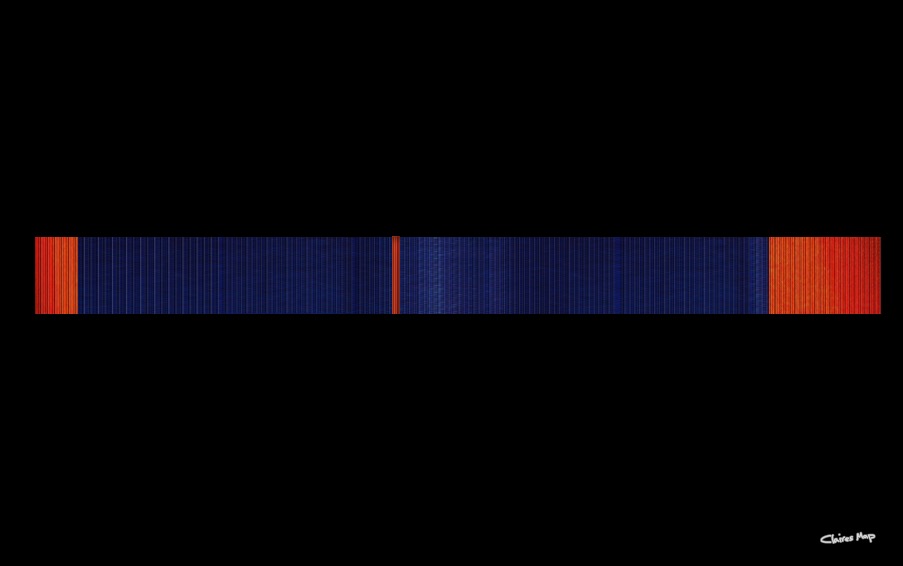
C. had attached a very large, rectangle of black card on the wall. It was in landscape format and across the middle, horizontally, ran a c.4cm strip of paper which was covered in dozens of identical, narrow vertical stripes of red, orange, light blue and dark blue. It looked like a beautiful spectrogram. In the bottom right hand corner was written  ‘C’s map’.  I remember staring at this with a colleague and wondering what did this map represent. Eventually, we called C. over and asked her to explain. It turned out that she lived about 2 miles from LIPA and it was a very cold day when she started making the map. What she had done was to walk from her warm bedroom, through the cold streets to LIPA taking a temperature reading every 20m or so. The different colours represented different temperatures. Red/Orange = warm, Light Blue/Dark Blue=cool/cold. When we asked what the warm strip right in the centre was, C. answered that her measured steps had taken to her to a hot air outlet of a shop.

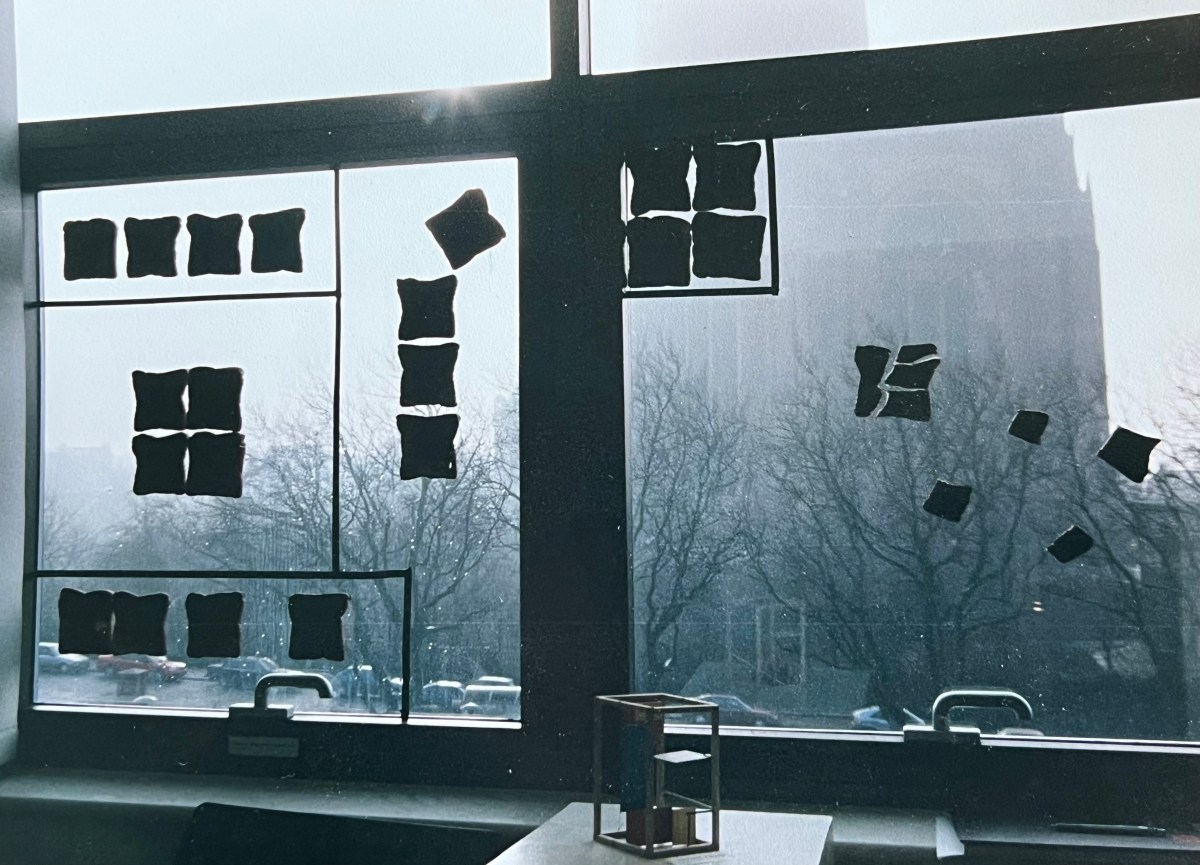
T. had really struggled with the Black Square problem. Just couldn’t get his head around it. Sitting at breakfast a day or so before the exhibition opening, he was pondering the problem to the extent that he forgot he’d put a slice of bread in the toaster. Suddenly out popped a square of blackened toast. It was one of those Eureka moments. T. had found his solution to the black square problem. His solution consisted of illustrating the words using a series of four pieces of square black toast stuck to the windows of the exhibition space. 

The exhibition opening was a great success. All the students managed to produce a creative solution to each of the problems…some of them truly extraordinary. There were 2D works, 3D works, video, audio, animation. Some made one laugh. Others, particularly some of the self-portraits, were rather disturbing. The strange, bloodied doll in the box which had a peep hole haunts me still! 
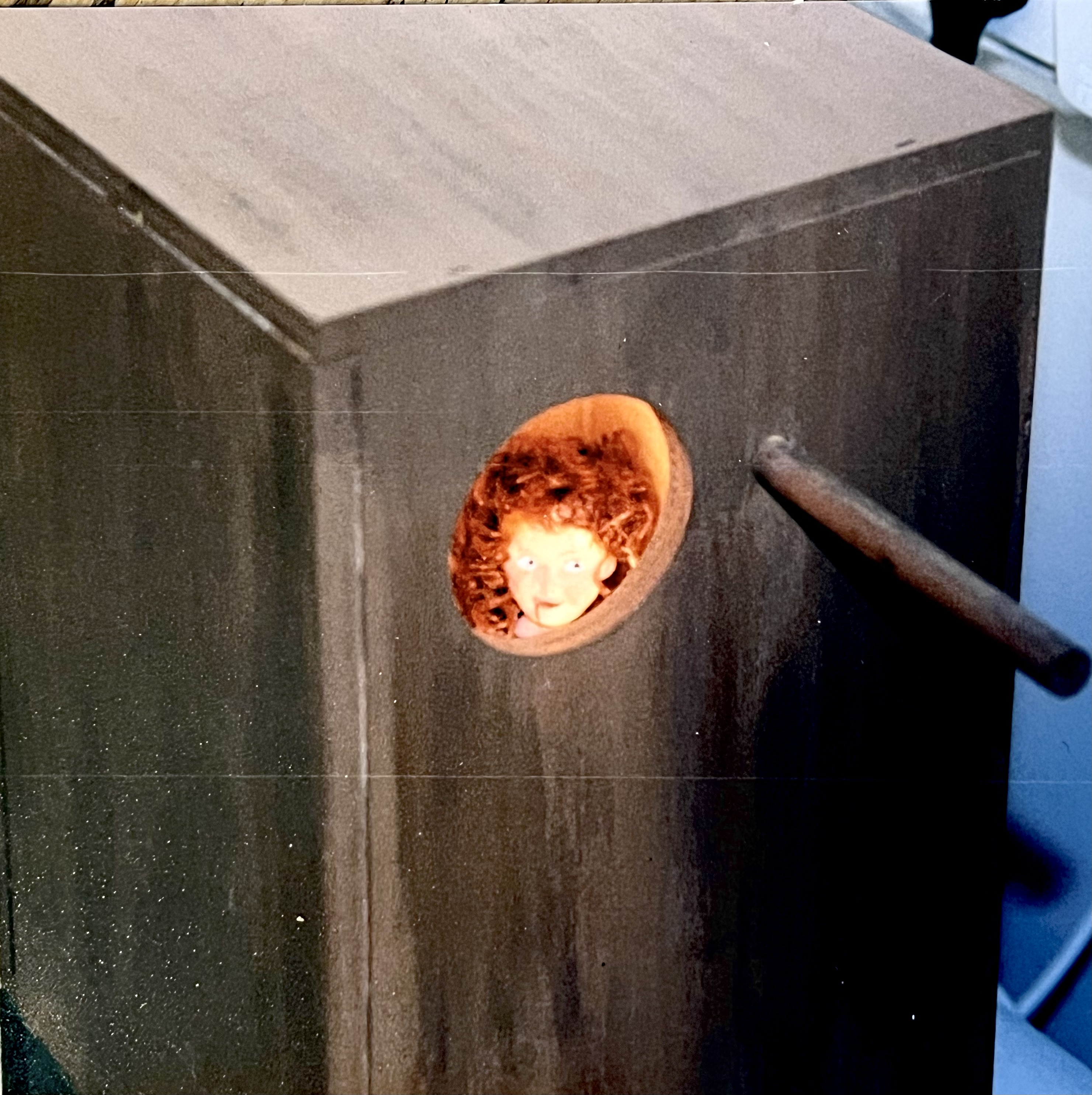
Art work. Wooden bok with peep hole. Through the peephole you see a doll sitting in the corner of the box, with a dribble of blood coming from her mouth.

All the art works were presented and lit beautifully. The purpose of the whole enterprise was, of course, nothing to do with the actual problems or the exhibition of work. It was all about confidence, enabling the students to realise that not only did they have some wonderful creative ideas but they could work on their own and create and produce wonder-full work.

The offer of the exhibition was key to getting the students motivated and committed to the project despite there being no assessment. The exhibition made it clear that we valued their ideas and the work they produced. Too often, work into which students have poured their heart and soul is simply handed in or submitted electronically without even a ‘thank you’. I recall one department in another institution where essays and dissertations were simply posted into a box fixed to the wall near the departmental office. 

The six visual problems project demonstrated that if you create interesting assignments and make it clear that you really care about the work students produce, assessment isn’t a given. In recent decades, higher education has developed to the point where the culture is one of ‘if it moves, assess it!’. The solving and exhibiting of the six visual problems proved that need not, necessarily, always be the case.

Could we get away with it now? 

Performing assessment: are you an assessment Cavalier or Roundhead (or Innocent)?

There I am, sitting in my favourite balcony seat in the institute’s auditorium, pen in hand, notebook discreetly balanced on my knee, preparing to watch and assess a performance by final-year performing arts students.

Not only am I audience and critic, but examiner too: I have to assess and assign individual grades to each of those students.

As the show is late going up (do I have to assess that as well?), I have time to consider just some of the variables and imponderables around the assessment of performance. The students may be acting and/or singing and/or dancing and/or playing instruments. The text may be extant or devised. The success of the performance will depend on a team effort – both onstage and offstage – yet, I am required to assess and grade each individual. The visual and acoustic environment may enhance or hinder the perception and reception of the show. The director may have been able to encourage each individual to work to their maximum potential – or they may have destroyed any creativity and enthusiasm.

As the prospect of a list stretching to infinity and beyond looms, I am grateful that the house lights dim and I am eager but nervous about handing out assessment justice to each of the individuals who contributed to the production.

I am comforted by the thought that there is another member of staff (or two) sitting somewhere else in the auditorium also with a notebook and with probably the same thoughts, and there are colleagues in dance, drama and music departments around the country grappling with the same issues.

How do we do it? On what basis? And is it valid or fair or reliable anyway?

My fellow academic assessors and I seem to divide into three main sub-groups:

There are the assessment Roundheads: those fully committed to the assessment world order of modularisation (dividing a programme of study into easily digestible chunks); explicitly stated learning outcomes (making sure the student and the teacher both know what they are aiming towards and what the student is expected to achieve); and criterion-referencing (a set of clearly defined standards against which the student’s work is assessed).

Assessment for the Roundheads, is generally a matter of ensuring that the protocols and criteria are properly set up in the first place, and then following them using one’s professional skills as an educator and practitioner.

Then there are the Cavaliers: those who believe that creativity and artistic endeavour cannot simply (or complicatedly) be reduced to sets of protocols, learning outcomes and assessment criteria. They prefer approaches such as holistic assessment, allowing provision for unexpected outcomes and non-conformist processes, and, in some cases, involving the students in their own assessment and that of their peers.

Lastly, there are the Innocents: often highly experienced and skilled professional practitioners who have recently entered what appears to them to be the overly bureaucratic, esoteric, parallel universe of assessment in higher education.

No longer can their critique of a performance or performer be contained in the cliched and stereotypical “You were wonderful, darling” type of comment. They now have to assess and grade individuals, use assessment protocols, provide detailed formative and summative feedback, and justify their marks to external examiners and assessment boards.

As I sit in the balcony watching the show and attempting to scribble down some notes in the darkness that will be at least partly legible in daylight and, after 15 years of teaching, assessing and chairing various assessment boards, I am certainly not among the innocents. But am I an assessment Cavalier or a Roundhead?

My natural instincts are those of the Cavalier. I know that there is something about good and particularly great work that resists categorisation. It goes by various names such as “the tingle factor” or “the wow moment”. It is that individual or collective feeling that one is experiencing something out of the ordinary (which is surely one of the qualities art aspires to) and that, at the same time, resists description or explanation. Yet, I also know that way subjective madness lies and, in extremis , assessment can consist solely of the preferences and prejudices of individual tutors.

So I put aside the plumed hat and put on the solid helmet of the assessment Roundhead. I immediately feel on safer ground. I have the module handbook, which lays out in precise detail what is expected of the student, what the expected learning outcomes are, what the assessment criteria are, the weighting percentages and the grading criteria. Using the assessment pro forma that has been provided, I can go down the list of criteria statements and, using my knowledge, skills and experience, I can answer questions such as “To what extent does the student demonstrate x, or, y, or z?” with a range of answers from “not at all” to “excellently”.

Turning to the grading criteria, I can then convert my various responses into a number. I can add up all the numbers, apply the weightings (if any) and arrive at a total. I finish by writing some constructively critical comments in the box provided.

This approach satisfies everybody. The students each get a piece of paper with marks and comments that they can share and compare with their peers.

There is also a sense that the tutors are working off the same assessment “script”.

The tutor, under the time pressure of at least dozens if not hundreds of assessments, has got a clear system to work within and to.

The institution can demonstrate that assessment is open and transparent and that there is an assessment paper trail that can be audited by any external body. It also has comprehensive documentary evidence in the case of any appeal.

And the parent – who increasingly has a financial as well as a familial interest – can see that their investment is being taken seriously and is reaping dividends.

So where is the problem?

“Surely,” the Roundheads state with some justification, “this is a far better, fairer, more reliable, more valid and more transparent approach than the old ‘I-feel-a-first-coming-on’ days.”

It is hard, admittedly, to argue against a view that fits so well in an educational world view that always has one eye firmly fixed on Quality Assurance Agency visits, funding council audits, reviews and such like, and that is constantly playing to a gallery in which government perceptions of and policies towards higher education are prominent.

The nagging doubt about all of this centres on those treacherous terms “creativity” and “innovation”. If the teaching of performing arts is about working within rather than extending or working beyond existing forms and boundaries; if it is based around the development and application of craft skills; if it works within and to accepted notions of good practice, then the Roundhead approach is undoubtedly the correct one.

But, if the deserved reputation for creativity and innovation in the arts that this country enjoys is to be maintained, then it might just be that we need some of that creativity and innovation applied to the way we teach and assess those who will become the artistic creators and innovators of the future.

One thing is certain: the collective experience of hundreds of tutors assessing students in performances of different types of dance, drama and music over many years, in many different venues and circumstances, amounts to a vast reservoir of knowledge, experience and skill.

Despite the differences in philosophies, methodologies and practices of assessment, I am always impressed by the immense care, concern and thought of my colleagues around the country, and their willingness to engage in free and open debate.

So, as the applause dies, the house lights come on and I head for the bar before I attempt to decipher my hieroglyphs, I consider that, actually, when it comes to assessment we are certainly worth a 2:1 at least.

(This article first appeared in the Times Higher Education)

The plagiarism (and plagiarised) iceberg

I once attended a conference on academic integrity. Full of academics and university managers all concerned about the rising tide of plagiarism, cheating and the exponential growth of services and products aimed at providing their users the means with which to ‘game’ the system. 

As is customary at such gatherings, there was a keynote presentation from an expert in such matters. In this case it was a senior academic and university leader talking about the way their university had approached the ‘problem’. The presentation, accompanied by the inevitable Powerpoint slides of charts and bullet points, was going well and had my full attention until the first photographic image appeared. It was a stunning image of an iceberg, showing the relatively small, visible above water section in contrast to the immense invisible section below the water line, used to illustrate the point that what we see and catch in terms of plagiarism, cheating, collusion etc. is only the ‘tip of the iceberg’.

I immediately recognised the image, and if you Google ‘iceberg’ and select ‘images’ you’ll see it amongst the first set of images. It’s also – because it’s a great image – promiscuously plagiarised on dozens of websites and blogs. I recognised it, because I’ve also ‘stolen’ it for a satiric poster…but that’s another story.

But here we had a patently plagiarised image, with no acknowledgment as to its source, being used to illustrate a presentation on tackling and preventing plagiarism, given by an expert in the field at a large conference where the ‘fair use’ conditions don’t apply.

A wee bit ironic.

But the thing is, I’m sure we’ve all done it at some point. Let’s ‘spice up’ our otherwise visually boring Powerpoint presentations with some nice ‘visuals’. Isn’t that what we’re encouraged to do? And doesn’t something like Google images or Flickr make it so easy? 

But is it so hard (and ignoring, for the moment, issues of copyright and fair use) to acknowledge one’s sources? There’s even less excuse when there are now several websites ( e.g. Unsplash, Openverse, Creative Commons, Freerange, Pixabay etc.)  that provide access to millions of images that are free to use but usually request that you cite the source.

Perhaps, when it comes to plagiarism, we should try just a bit harder to practise what we preach when we present our work – whether to students or colleagues. 

 Image: “Iceberg in the Arctic with its underside exposed” by AWeith is licensed under CC BY-SA 4.0.

 ~~~~~~~~~~~~

(See also ‘Is a picture worth a thousand words? Incorporating the visual into your teaching https://stumblingwithconfidence.wordpress.com/2023/12/15/2095/

Higher Education, Creativity and the German Minister (+Coffee & Pastries)

Some years ago, before Brexit,  I happened to be standing and chatting to the then German Federal Minister for Education. We were in the (long) coffee queue during a break at an ELIA (European League of Institutes of Art) conference, the theme of which was the future of arts higher education in Europe in the light of Bologna, and he had just given a keynote address.

I  thanked him for his keynote, and he asked me my name and where I was from, and what what I did. When I said I was from the UK and worked in higher education performing arts, he smiled and said “Ah, the UK….”

There was a pause.

Then he said, as we shuffled down towards the coffee and pastries: “Let’s put our differences to one side for moment. I have have a serious question for the UK. For the past 40 years or so, your economy has not always been in the best shape – to put it mildly. Yet during that period you managed to lead the world in areas such art, design, fashion, music, theatre,  etc. Over the same period we have had a relatively successful economy but, with a few exceptions, have produced nothing like that sort of consistent, high-level creative output. So, my question is, what are you doing, or perhaps NOT doing, in your education system that enables that sort of creativity to flourish?”

Standing there, eyeing from afar the rapidly diminishing plate of pastries, I did not have a clear, rigorously-argued, well-researched, evidence-based answer to give him. But two thoughts did occur, then I added a third which, on hindsight, perhaps I should have avoided.

I said to him: “I do think it may have something to do with our long tradition of non-conformity, of sticking two fingers up to authority, and also our high tolerance of eccentricity. We like our mavericks and eccentrics……”

I should have stopped there but added “…..neither of which – in my limited experience – you have in Germany”.

At which point we had reached the coffee and the few remaining pastries.

The minister frowned and simply said: “Ah, interesting” and we went our separate ways.

I often think about that conversation as I witness the virulent spread and baleful effects of compliance, conformity and standardisation throughout our systems of learning and teaching. Of course, given our traditions in the UK, many do stick two-fingers in the air and manage to develop and provide wonderful, creative learning experiences. But all too often they occur despite not because of the systems in place, and  they frequently happen in isolation. So,  while eccentricity and creativity still survive and occasionally thrive, we keep quiet about it, hoping that ‘they’ won’t notice the students having a wonderful time and learning a great deal, while ‘they’ obsess about ensuring that the institutional metrics will pass muster, that the quality assurance boxes are appropriately ticked,  that the student ‘customer surveys’ return the ‘correct’ results, that the data to put in the Key Information Set shows shows the institution in the best possible light. It’s worth remembering that KIS also means Keep It Simple!

On Creativity: is ‘might’ the answer…as well as the question?

The eminent, and now sadly departed, educationalist Dorothy Heathcote used to say that the most powerful word in education is the word ‘might’.

Asking a student ‘what MIGHT be the answer?’ rather than ‘what IS the answer?’ opens up the possibilities, the questioning, the pondering, the wondering….the creativity.’

Our handbooks say things like (and I know, because I’ve written them as well) “On the completion of this module/course/program the student WILL be able to demonstrate a, b, c, d…..”We don’t write “On completion of this module/ course/ programme the student may be able to do THIS pretty well, but they also might be able to do THAT even better, and what’s more, they may be able to do stuff we haven’t even though of yet”.

But that sort of language and thinking doesn’t go down too well at the validation board, or with the quality assurance people, or with the policy makers, who require everything to be identified, categorised and pinned down, like a collection of dead butterflies.

How can we/do we – in education – break out of the ever tightening circle of predict and provide, control and compliance?

* * * * *
(Dorothy Heathcote’s obituary in The Guardian)