Adventures in HE: time for a Skunk Works?

A few years ago, a UK university established a new initiative with funding from central government. The initiative was one of about 70 such initiatives across the HE sector which were established in the hope that, within the five years of the funding, the universities involved would have taken risks and pioneered innovative learning approaches that could be adopted and/or adapted across the sector. 

The university in question established a project with the aim of developing  more practice-based arts provision within the university, establishing more links between the university and external artists and arts organisations, and to increase the links between the subject areas within the creative  and performing arts programmes within the university. The project rapidly established a reputation within the university for taking risks and for hav­ing a different way of looking at things. It was also known for having a different way of talk­ing about things and even a different way of naming things, for example, modules. A critical factor in the project’s ability to forge an innovative path was that its director had been brought in from outside academia, and was relatively and refreshingly unencumbered by things like history and precedence and the engrooved customs, practices and discourses of the institution.

The director had created a Skunk Works.

Skunk Works are, typically, small and loosely structured groups of people who research and develop a project for the sake of innovation. There are several important and essential features of a Skunk Works: one is that it operates independently of the normal research and development operations of the company or organisation; another is that, in order to achieve unusual results, the people working on the project work in ways that are outside the normal ways of working. 

One of the major projects initiated by the director was the development of a pilot MA in interdisciplinary arts practice. The aims of the course were to explore and extend the boundaries of various arts disciplines, and all aspects of the course were designed to be innovative and radical – the curriculum, the delivery, and the assessment. As with all courses, the proposal had to go through the university’s validation process and there were intense discussions about what might or might not be acceptable, especially given the relatively traditional academic culture of the university. The director stuck to her guns and, much to the surprise and, indeed, chagrin of some colleagues, the university validated a course that included modules called ‘Adventures in Interdisciplinarity’ and ‘Further Adventures in Interdisciplinarity’ in which the course participants– a mixture of recent graduates and mature, part-time students– gathered on a Friday and worked intensively through the weekend on various experimental projects and exploratory assignments with artists, directors, film-makers and composers. 

These ‘Adventures’ were designed to provide unusual, typically hazardous (creatively, intellectually, etc.), experiences or activities.  Calling the modules ‘Adventures’ was a very deliberate move and was highly resonant of Ronald Barnett’s call to educators to ‘hang onto a language of delight, wonder, care, excitement, fun, engagement and love– the language in which a student is caught and even entranced’ (Barnett, 2008).

At a time of particularly rapid change with a host of serious challenges facing higher education, perhaps establishing a Skunk Works and investing in the space to breathe, to invent, to imagine, to innovate, and to create something that is different, exciting, and genuinely transformational might be a very good and beneficial move.


Barnett, R. 2008. A will to learn. London: Open University Press.

Image created by AI

About me:

I am an independent higher education consultant and co-founder of the educational consultancy Ciel Associates specialising in organisational and transformational change and enhancing learning, teaching and assessment. I have over thirty years experience in a wide range of higher education providers both as a consultant and, before that, in a number of management, leadership and strategic roles. My work is informed by my belief in the transformational power of education and a commitment to enabling institutions to create meaningful and sustainable change. Contact me at Ciel Associates .
When something(s) need to change…

When a higher education provider calls in a consultant, it’s usually because they want and need some thing or things to change. Usually, at least some people in the institution know precisely what the problem is and what needs to change. But bringing in a consultant can provide validation and confirmation of what needs to done by digging deep into the problems, asking some awkward questions, and providing the hard evidence to support the change event.

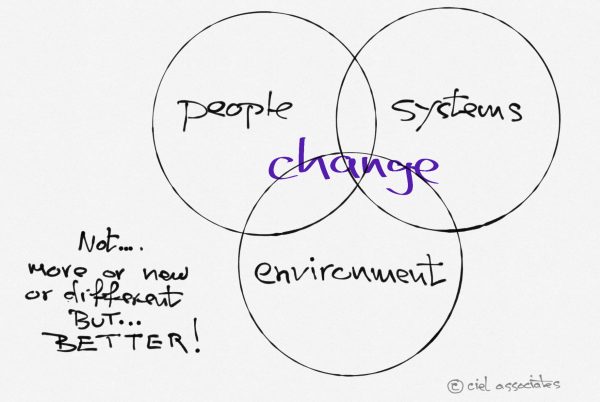
Change, of course, can be challenging, awkward and divisive, and there’s the old cliche about people liking the idea of change as long as they don’t have to change themselves. But change isn’t just about people. For genuine, effective, sustainable change to happen, three things need to be addressed simultaneously: People, Systems and Environment. Changing one or even two of those will lead to whatever change is envisaged either not working as well it could or not at all.

An example:

A university’s STEM departments were scattered around the campus. The university commissioned a prize-winning architect to design a new ‘stand out’ building that would house all the various departments. There would be a beautiful atrium in the centre of the building with a café and colleagues from different departments would gather there and all sorts of wonderful ideas (and possible patents) would emerge from the exchange of ideas.

What actually happened was that while the university clearly changed the environment, nothing was done to address the people and systems involved. Within a very short time the building was re-compartmentalised into separate departments who kept their own coffee machines. The atrium remained a beautiful, empty, silent space.

The PSE framework informs much of our consultancy work. It enables us to explore the potential and practicalities of change through those three ‘lenses’, always asking and seeking ‘What will make this better?’


About me:

I am an independent higher education consultant and co-founder of the educational consultancy Ciel Associates specialising in organisational and transformational change and enhancing learning, teaching and assessment.. My work is informed by my belief in the transformational power of education and a commitment to helping institutions achieve meaningful and sustainable change. Contact me at Ciel Associates .
Beyond excellence…..towards wonder


In higher education (and in education generally) we obsess about excellence. So what does excellence mean?

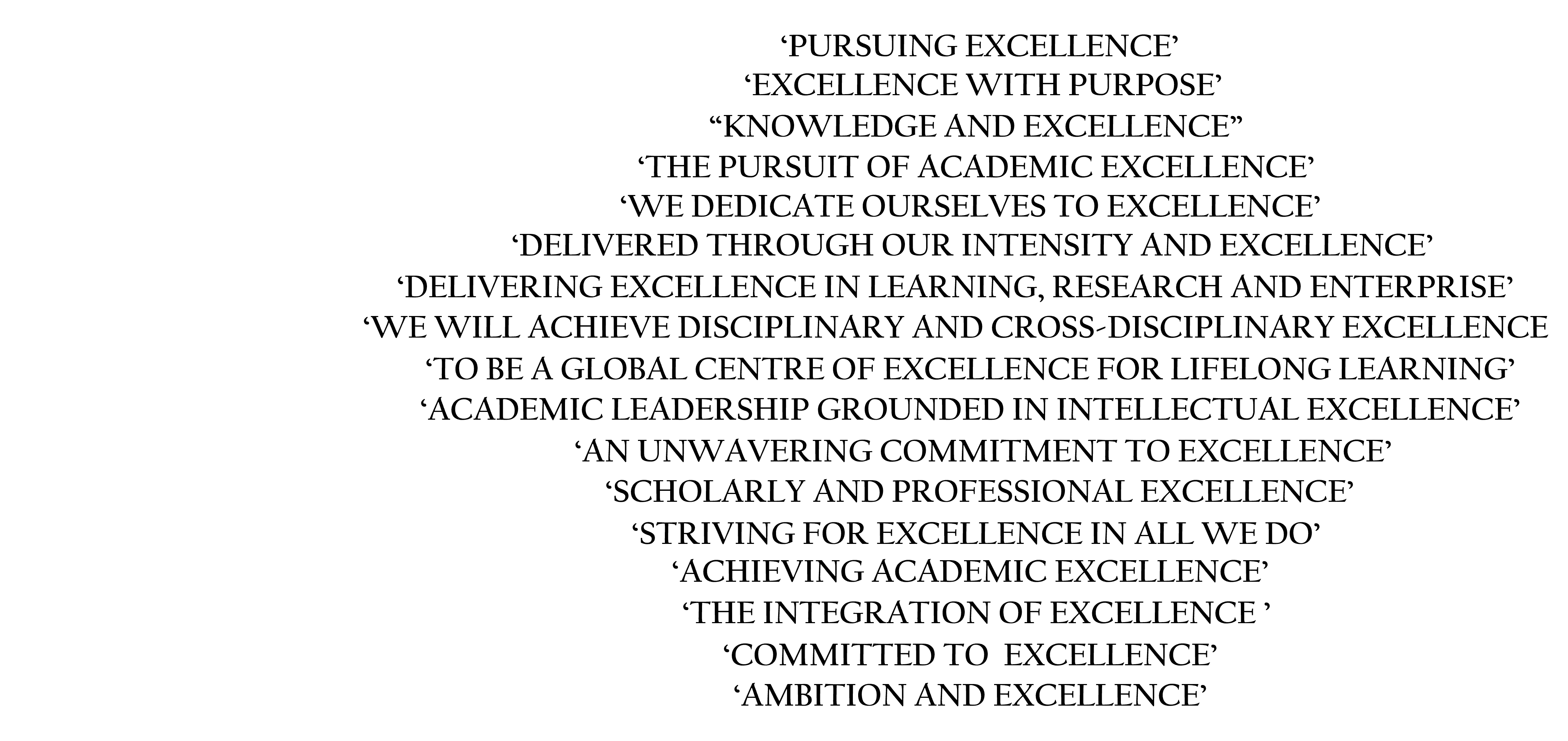
Going by the result of the debate on excellence at an academic conference, there is a clear majority who feel that the term has lost credibility and value. When all institutions are either ‘excellent’ or, at the very least, ‘striving for excellence’ (see university mission statements below) then we are witnessing a lot of sound, but hopefully not fury, signifying nothing. Excellence, in Bill Readings’1 memorable term, has become ‘de-referentialised’. Turning to the dictionary provides little assistance. In the Concise Oxford ‘to excel’ is defined as to surpass or to be pre-eminent (i.e. to be better than the majority), whereas ‘excellence’ is defined as ‘very good’.

University Mission Statements

Whatever meaning ‘excellence’ once had has become lost in a blizzard of hyperbole. The fate of excellence follows in the tradition of other terms such as ‘community’ and, more recently, ‘creativity’, whose meaning has become devalued and decontextualised through over- and inappropriate use.

In the arts, the term excellence is rarely if ever used as a descriptor except – and this may be relevant in considering educational achievement – in relation to the application or demonstration of skill or craft. Academics, students and arts practitioners tend to avoid the ‘E’ word. The theatrical cliché has never been: “You were excellent, darling”. ‘Wonderful’ is truly a much better word than ‘excellent’ to describe high artistic achievement. Rather than excellent’s rather hard-edged, triumphalist implication of being better than others, ‘wonderful’, i.e. full of wonder, has a sense of the remarkable, the extraordinary, the truly successful that is the mark of the highest quality work.

Excellence, it must be said, is much favoured by arts politicians and bureaucrats who use it both aspirationally and as a justification for funding. Excellence attracts rewards and prizes. But the use of the term has more to do with product branding (as it has in higher education) than with a real concern with the subtle complexities of quality and value.

Here is a typical example: one of our leading UK arts funding bodies, in its mission statement, states: “We believe the arts to be the foundation of a confident and cultured society. They challenge and inspire us. They bring beauty, excitement and happiness into our lives. They help us to express our identity as individuals, as communities and as a nation”.

Wonderful! But then they go and ruin it by reverting to corporate-speak and saying they are going to “serve the people … by fostering arts of excellence through funding, development, research and advocacy”. An external examiner I knew, having seen what was – by general consensus – a remarkable, successful, extraordinary, inspiring … yes, wonderful piece of final-year practical work was dismayed to find that the two internal examiners, who also thought the work was remarkable, successful etc had agreed a mark of 75%. He asked them to start at 100%, and argue persuasively for marks to be deducted. With the assessment criteria in their hands they struggled to get below 95%. To describe that work as merely ‘excellent’ would have been insufficient. It was beyond excellence.

That is perhaps what we should be striving for and, in doing so, we need to look beyond our obsession with trying to define, achieve, assess and reward excellence.

As the old saying goes: education is, or ought to be, a wonder-full thing.

References

1 Readings, B. (1997) The University in Ruins. Harvard University Press