
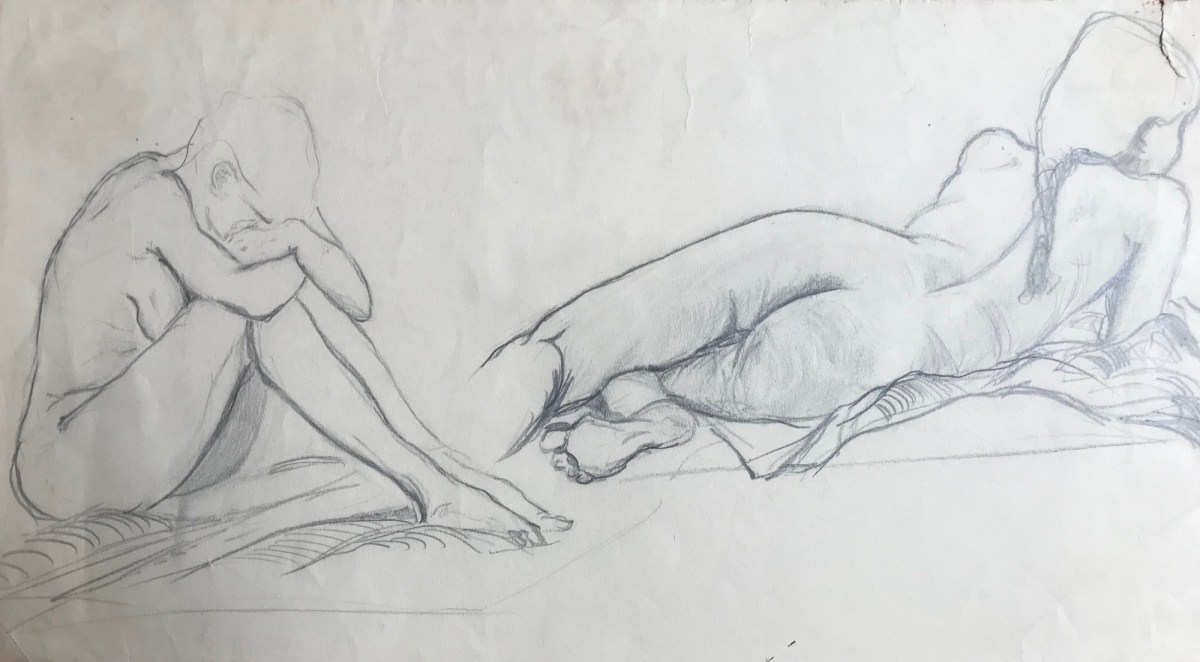
My first attempt at life drawing c. 1968
During a conversation about education with a colleague who is an eminent and well-respected professor of education, he said vehemently ‘I hated school’. Now he and I are probably of a similar generation, but my school experience in the 1960s was rather more positive.
I went to a rather academic boy’s grammar school in London, where corporal punishment had been abolished some years previously. The focus was very much on getting into Oxbridge or at least a ‘decent’ redbrick university. I, however, was interested in becoming an artist.
The art room – run by Mr. Potter – was located at the far end of one wing, up in the roof space. It was, nevertheless, a light and airy space and I enjoyed the many hours spent in there. I wanted to do Art for ‘A’ level and to go to art school. The problem was that the ‘A’ level requirements at that time were stultifyingly restrictive (I don’t think they’ve changed much). One of the requirements was a still-life painting, and I distinctly recall Mr. Potter looking at my somewhat surreal and expressionist rendering and saying, sympathetically, “That’s very interesting, but that will never do”.
When I asked him why, he explained that the A level required an ultra-realist painting. Any other approach would be deemed a failure. But he then said, encouragingly, that if any of the great masters of modern art, the Cubists, the Expressionists, the Surrealists, the Fauves etc had taken ‘A’ level art, not only would they have failed but there would have been a demand for psychiatric testing!
At this stage I knew that the school and the requirements of the exam board were unable to support me in creating a decent portfolio of work to get into art school.
So I went to see the Headmaster: a kindly, liberal man and a much respected leader and teacher. The school was a rugby playing school (I was actually a very good fly-half at the time) and everything stopped on Wednesday afternoons for sports. Not far from the school, in north London, was the then renowned Camden Institute, which had a wonderful reputation for its adult education art classes led by established artists. I asked the Headmaster if, instead of running around the rugby field on a Wednesday afternoon, I could attend the Institute’s art classes. He agreed on the proviso that I would occasionally show him the work I was doing.
Walking into and taking part in the life class studio on my first visit was a revelation. I don’t think I’d seen a fully naked woman before except in paintings (we also had male models) but not only did I feel immediately welcome and at home, but the whole experience of sitting quietly at an easel, observing the life model very closely, and making marks on paper was extraordinarily powerful. The only sounds in the room were the slight hiss of the gas fire near the model, the occasional sound of charcoal scraping on paper, and the hushed conversation of the tutor and whoever he was talking to.
Fifty plus years later, I still use that ‘sitting quietly, observing or thinking, and making marks on paper’ in my own work, and in the workshops and seminars I run.
 Stumbling with Confidence