One of our engrooved or deep-seated beliefs in higher education is that grades are important because they motivate students to do the work. Take them away, and students won’t do anything.
But oddly, for a discipline that says it relies on evidence-based research, there is little to no evidence or research that demonstrates that grades make students learn more or work harder. In fact, there is ample evidence that grades actually do the opposite: They hurt academic motivation and inhibit learning.
We’ve known for a long time, well before Covid, that the way we do assessment is damaged and creaking at the seams. But over what is now several decades of well-researched, evidence-based critiques of assessment, insitutions and academics are still assessing the same old way….with a few enhancing tweaks. Plus ça change, plus c’est la même chose. Covid started to point the way, and now GenerativeAI is providing the catalst and impetus we need to let go of outdated, obsolete practices that are well past their sell-by date, and embrace those that are genuuinely fit for purpose to meet the challenges we and our students face.
What we do know is that students – and we are all students, lifelong learners – work harder, learn more and are much more likely to thrive and achieve when we are intrinsically motivated. When we have some real autonomy, real choices. When we feel we are in control of our learning. It means being given meaningful choices and engaging, authentic tasks to choose from. It means feeling empowered to choose, as students, where to invest our time and energy. It also means feeling encouraged and supported even if that means, receiving feedback that is uncomfortable but honest and that comes from a good place.
Autonomy also means that our own autonomy, our own academic identity has to shift, from the keepers and transmitters of knowledge to facilitators of learning.
Also, we all like to feel we are continually growing, improving, developing new skills and understandings. Our own students are no different, so the question for us as teachers and assessors is how best can we focus both our and our students’ skills, time and energy on helping them build the skills they are genuinely motivated to learn and practise?
A sense of relatedness, a sense of genuine belonging is also critical. We desperately need to find ways of enabling our students to understand they are not just a number, not just cogs in a vast machine but valued as individuals and as part of a larger community… that they matter far more than their grades. If we can do that, they will respond and realise they don’t need the carrot and stick of grades, warning and penalties to care about their learning.
So…let’s leave grading to recede in the rear-view mirror, and focus on the road ahead and where that might lead.
“You just get this one idea, which might, at first, seem a bit daft. But something just holds you back from thinking it is completely daft. It was the artist Paul Klee who talked about painting being about taking a line for a walk. And that was the thing about it. What it was like….it was like taking an idea for a walk. You know, the more you just did it….it might just work.” (Interview)
It had been a long day. I had spent it interviewing several academics – from new lecturers to emeritus professors, across a range of disciplines – about their conceptions and experiences of creativity in relation to learning and teaching. Even though I was recording it all, it was still hard work maintaining focus and enthusiasm for each of the 45 minute sessions, and ensuring – as one is obliged to do in phenomenographic research – that I had obtained deep and rich responses to my questions.
I always started with the same question: Could you tell me about an occasion that was a creative experience for you in terms of learning and teaching higher education?
All too often that question would be greeted by silence, and what I came to call the ‘rabbit in the headlight’ look: as if why on earth would I think that there might possibly be a connection between creativity and teaching?
But I’d learned, from my training and work in drama, not to be afraid of silence and to avoid the temptation to ‘jump in’ in order to avoid embarrassment. As a drama therapist once told me: “silence IS golden: it usually means they’re thinking”; and sure enough, after a short while, a story would emerge, and I would gently probe the whats, hows and whys of that particular experience.
The last interview of the day was with a vastly experienced educational developer, with a PhD in linguistics, who had taught in China. After the usual hesitant start, he began to tell me how he had developed a successful student-centred, experiential and problem-based learning experience which was the antithesis of the teacher-centred, conformist, ‘micro-teaching’ that was the normal and expected practice. It was he who described the experience with the Paul Klee ‘taking a line for a walk’ quote above.
Thinking back to those interviews, a number of ‘moments’ stand out:
The eminent, soon-to-retire historian bemoaning the conformity and lack of risk-taking in his younger colleagues, and finally – as his last ‘hurrah’ – running a ‘visual history’ course on 18th century England as seen through a number of key objects that he had always wanted to run but never had the nerve… until now when he was leaving. (This was way before Neil McGregor’s renowned BBC series on the objects of the British Museum).
The management school professor in a 5* research rated department who, much to the annoyance of his colleagues, had won a prestigious national prize for his innovative teaching methods. Apparently they couldn’t understand why he was wasting his time on enhancing his learning and teaching expertise when he ought to be enhancing his (and the department’s) research reputation and ranking.
There was the young, early career lecturer, genuinely committed to teaching, tears rolling down her face as she recounted the frustrations of having her creative ideas about teaching rudely quashed by her senior male colleagues: “I feel restricted, I feel frightened….the constant ‘don’t bother about the teaching, just focus on your research’….it makes me so angry, but I don’t dare say anything”.
And there was the language lecturer whose creative ‘Damascene’ moment occurred serendipitously as a result of being very late for a class she was meant to be teaching in parallel with other identical classes. When she finally turned up at the end of the session she found that the group, who normally “sat like puddings” while she presented the set material in the set textbooks, were still there and that “the atmosphere in the room was buzzing…they were talking to each other, they had a problem to solve. So we spent the last couple of minutes talking about how we were going to keep that going now”.
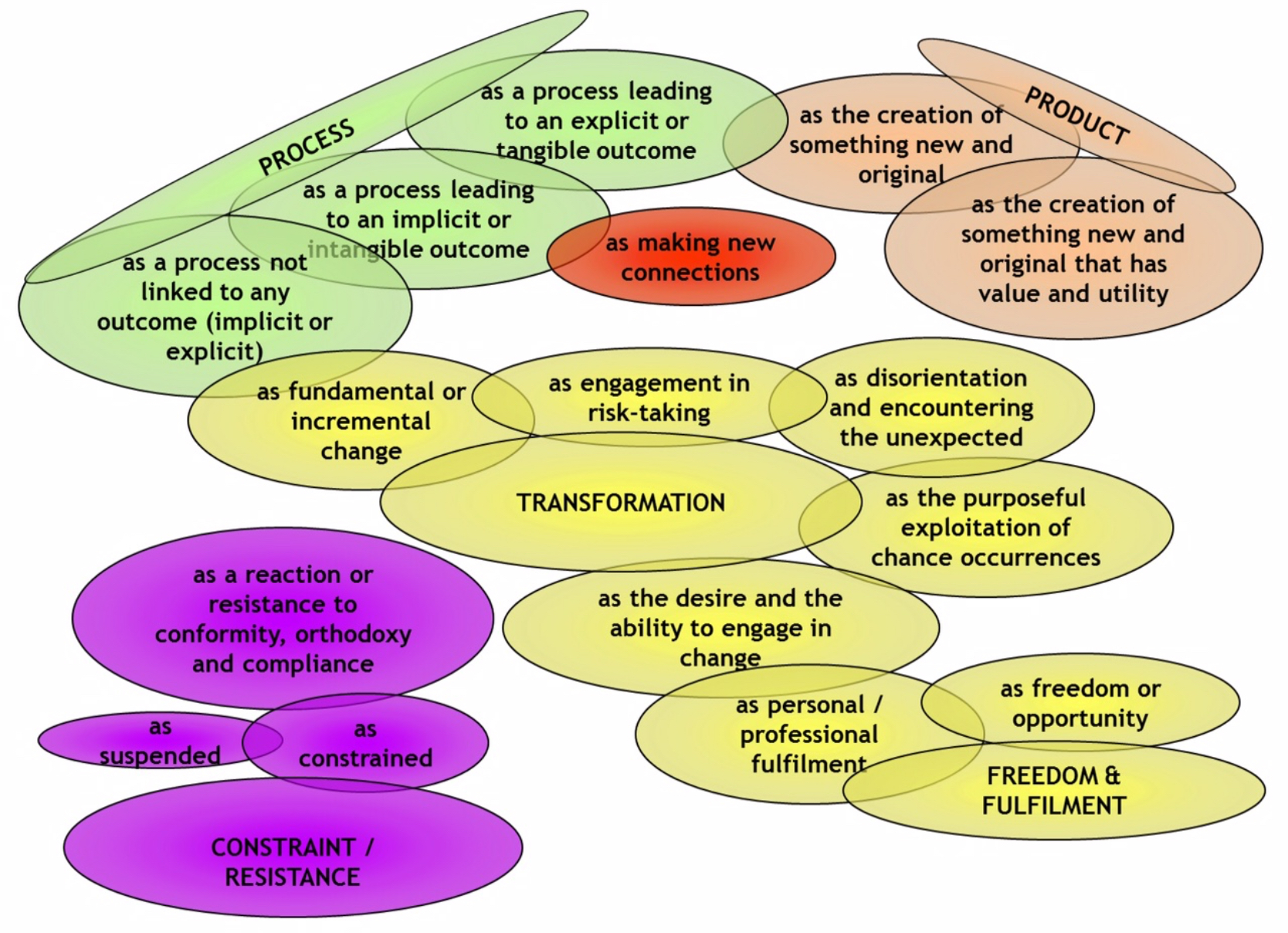
There were many such moments in all the interviews, and after personally transcribing all the interviews (extraordinarily tiring, but so valuable in being able to get ‘inside the source material’), I began to search for patterns of thoughts and behaviour. Slowly but surely, after a long and rigorous iterative process, the many and varied experiences of creativity in higher education began to coalesce around five main conceptual categories. I attempted to capture them in the following map:
1. Creativity can be a CONSTRAINT-focused experience, where the constraints and specific limitations tend to encourage rather than discourage it. Creativity occurs despite and/or because of the constraints;
2. Creativity can be a PROCESS-focused experience; that may lead to an explicit or tangible outcome…or may not;
3. Creativity can be a PRODUCT-focused experience where the whole point is to produce something;
4. Creativity can be a TRANSFORMATION-focused experience where the experience frequently transforms those involved in it;
5. Creativity can be a FULFILMENT-focused experience where there is a strong element of personal fulfilment derived from the process/production of a creative work.
As well as the development and identification of these five categories (later to be reduced to three – but that’s another story), a number of significant outcomes and observations sprang from the research. It was clear that university teachers experienced creativity in learning and teaching in complex and rich ways, and certainly the ones I interviewed – once they got going – exhibited great enthusiasm for, and an interest in, creativity.
I was struck, particularly, in response to my exploring the reasons why an individual pursued a particular creative course, by the number of times someone said ‘I stumbled across something’ or something similar. The example of the very late lecturer (above) is a typical example. The frequency and consistency with which the opportunity to exploit the consequences of ‘stumbling upon something’ played a critical part in the various self-narratives of creativity in learning and teaching is clearly important, and it has obvious significance for those interested and engaged in learning and teaching. Firstly it is important to realise that there are several distinct but linked elements in this. One is the ‘stumbling’, and another is the ability or opportunity to exploit it. However, as one of the university teachers interviewed said, people stumble across things all the time but rarely act: “So it’s not just stumbling upon it, it’s finding that the thing has a use”.
Then, beyond finding that whatever it is might have some use, one needs the confidence to be able to engage in an action that exploits – in the best sense of the word – that situation. The notion of confidence constitutes a significant and expanding thematic element through all the five categories. In many of the interviews – and it is one reason why actual face-to-face interviews are so important – as the individual began to explain and explore their own creativity (some said it was really the first time they’d ever really thought about it) – I both heard and observed the growing sense of confidence both vocally and physically: they became animated, they smiled and they laughed.
Confidence clearly plays a critical role in enabling university teaches to engage creatively in their pedagogic practice. However, in the research into conceptions of learning and teaching, little attention seems to be paid to the subject of confidence and other affective aspects of the teacher’s role and identity. A number of researchers comment on this apparent gap in the research literature, and explain it by saying that dealing with the emotional and attitudinal aspects of learning and teaching is rather antithetical to the prevailing analytic/ critical academic discourse.
During the course of those interviews there was a strong sense of people transformed. It is also clear that the centrality of creativity-as-transformation in relation to learning and teaching, and the importance of creativity in relation to personal and/or professional fulfilment, poses a series of challenges. There is much more to the experience of creativity in learning and teaching than simply ‘being creative’. Furthermore, a focus on academics’ experience of creativity separated from their larger experience of being a teacher may encourage over simplification of the phenomenon of creativity, particularly in relation to their underlying intentions when engaged in creative activity.
The transformational power of creativity poses a clear challenge to organisational systems and institutional frameworks that rely, often necessarily, on compliance and constraint, and it also poses a challenge to approaches to learning, teaching and assessment that promote or pander to strategic or surface approaches to learning. Academics need to be perceived and involved as agents in their own and their students’ creativity, rather than as objects of or, more pertinently, deliverers of a particular ‘creativity agenda’.. For higher education institutions (and the government) creativity is seen as the means to an essentially more productive and profitable future. But for university teachers, creativity is essentially about the transformation of their students…and themselves.
(‘Creativity’ image created by Paul Kleiman with the assistance of AI)
6 problems and developing creative confidence in students
LIPA (Liverpool Institute for Performing Arts) welcomed its first students in 1996. In those early days, as a very rare brand new higher education institution, LIPA had many of the typical characteristics of a ‘start-up’: exciting, risk-taking, a bit of a roller-coaster. Looking back at that time, we were certainly operating on the edge of chaos.
I was Head of Performance Design and had designed and written most of the Performance Design curriculum. One of the things I was really keen on was the idea of ‘de-schooling’: getting the new first year students out of the more creativity inhibiting habits and expectations they had arrived with.
So, during induction week, alongside the usual introductory sessions, the handing out of timetables, module handbooks, etc., we set the students six visual ‘problems’ that they had to solve before the end of that first semester.
There were some interesting strings attached to that assignment:
the students were on their own, they could not discuss the problems with their fellow students or with any of their tutors
their work would not be assessed
all their ‘solutions’ would be shown in an exhibition at the end of the semester which would have a proper opening and an invited guest list.
A number of colleagues, when they heard about this, thought we were mad, confident that the students would never do it as it wasn’t being assessed.
The six problems included the following:
Create a self-portrait in any medium.
Create a map of how you get from your bed to the studio in the morning
Take three matchboxes and create an object or objects using all the contents and the boxes themselves
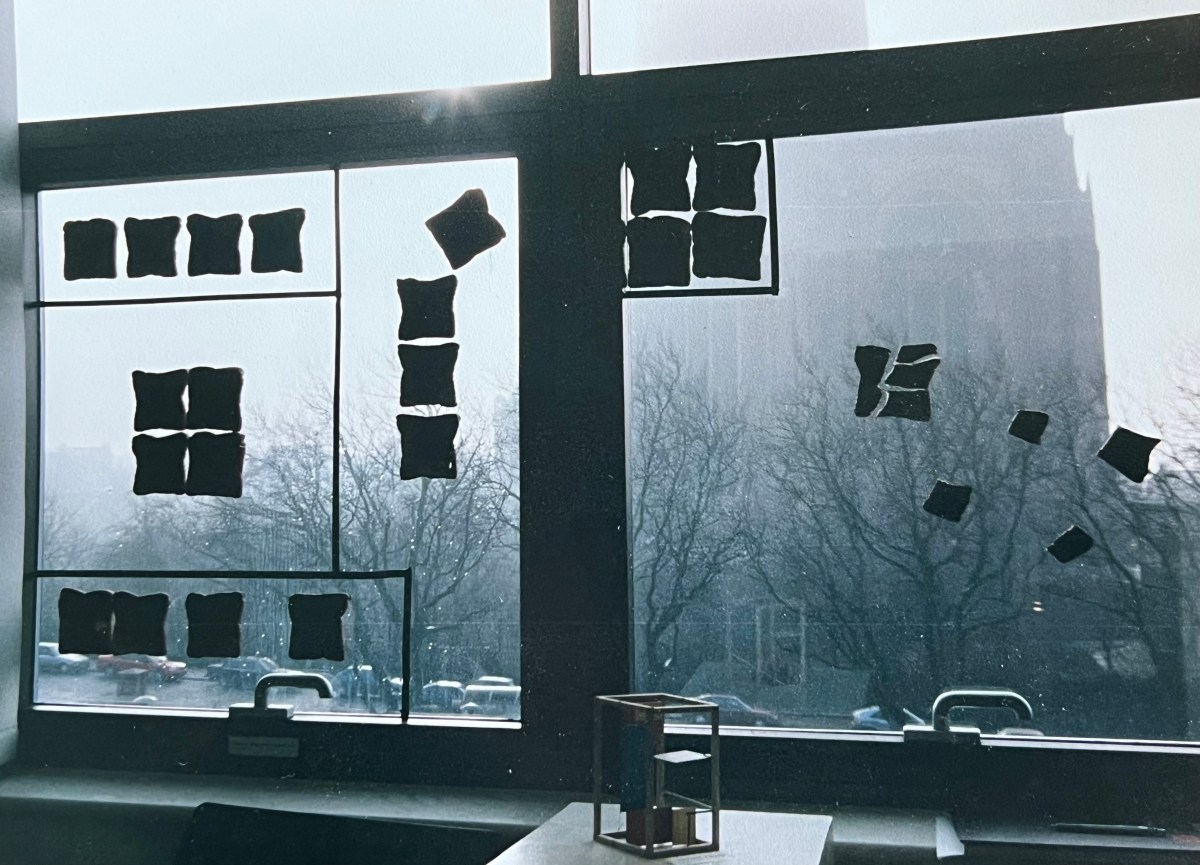
The Black Square Problem: using six black squares against a white ground illustrate a series of words e.g. chaos, love, kindness, growth etc.
(To be honest, nearly thirty years on, I can’t remember the other two problems! One, I think, was something to do with delineating space, and I have no idea what the sixth one was. I was hoping it might come to me as I was writing this).
The day the students came in to set up the exhibition was an extraordinary day. As each student brought in their work, their peers gathered round to see and discuss what was before them. The sense of collegiality and excitement was palpable as was the sense of creativity and imagination at play.
Some of those solutions remain clear in my mind to this day. Here are just three:
J., a German student who had grown up in East Germany before unification, had taken the three matchboxes. She had flattened out the three drawers and stuck them together to make a flat sheet. On the sheet, she had drawn three musical staves (five lines each) using the ends of some burnt matches. Then, using the matches as musical notes, she stuck them along the staves in such a way as to create the opening bars of Beethoven’s ‘Ode to Joy’. The remaining matches were stuck around the sheet to make a frame. Two of the outer matchbox containers were used as labels for the work. But where was the third? It was stuck on the back of the sheet and used to hang the sheet onto a hook on the wall.
(I know I have a photograph of it somewhere!)
C. had attached a very large, rectangle of black card on the wall. It was in landscape format and across the middle, horizontally, ran a c.4cm strip of paper which was covered in dozens of identical, narrow vertical stripes of red, orange, light blue and dark blue. It looked like a beautiful spectrogram. In the bottom right hand corner was written ‘C’s map’. I remember staring at this with a colleague and wondering what did this map represent. Eventually, we called C. over and asked her to explain. It turned out that she lived about 2 miles from LIPA and it was a very cold day when she started making the map. What she had done was to walk from her warm bedroom, through the cold streets to LIPA taking a temperature reading every 20m or so. The different colours represented different temperatures. Red/Orange = warm, Light Blue/Dark Blue=cool/cold. When we asked what the warm strip right in the centre was, C. answered that her measured steps had taken to her to a hot air outlet of a shop.
T. had really struggled with the Black Square problem. Just couldn’t get his head around it. Sitting at breakfast a day or so before the exhibition opening, he was pondering the problem to the extent that he forgot he’d put a slice of bread in the toaster. Suddenly out popped a square of blackened toast. It was one of those Eureka moments. T. had found his solution to the black square problem. His solution consisted of illustrating the words using a series of four pieces of square black toast stuck to the windows of the exhibition space.
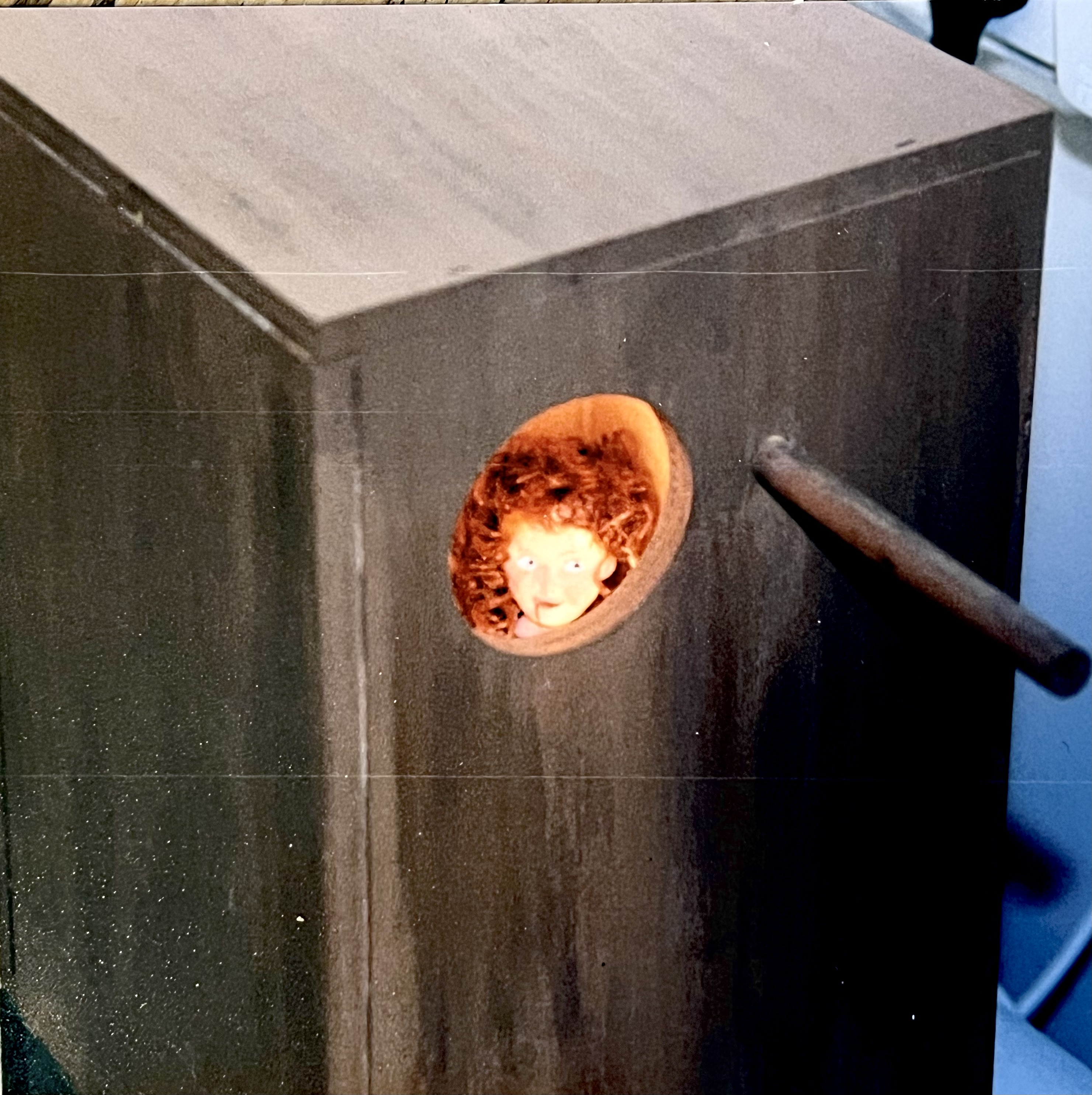
The exhibition opening was a great success. All the students managed to produce a creative solution to each of the problems…some of them truly extraordinary. There were 2D works, 3D works, video, audio, animation. Some made one laugh. Others, particularly some of the self-portraits, were rather disturbing. The strange, bloodied doll in the box which had a peep hole haunts me still!
All the art works were presented and lit beautifully. The purpose of the whole enterprise was, of course, nothing to do with the actual problems or the exhibition of work. It was all about confidence, enabling the students to realise that not only did they have some wonderful creative ideas but they could work on their own and create and produce wonder-full work.
The offer of the exhibition was key to getting the students motivated and committed to the project despite there being no assessment. The exhibition made it clear that we valued their ideas and the work they produced. Too often, work into which students have poured their heart and soul is simply handed in or submitted electronically without even a ‘thank you’. I recall one department in another institution where essays and dissertations were simply posted into a box fixed to the wall near the departmental office.
The six visual problems project demonstrated that if you create interesting assignments and make it clear that you really care about the work students produce, assessment isn’t a given. In recent decades, higher education has developed to the point where the culture is one of ‘if it moves, assess it!’. The solving and exhibiting of the six visual problems proved that need not, necessarily, always be the case.





 Stumbling with Confidence