
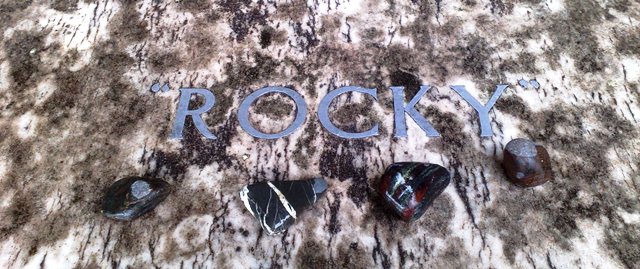
A stone for Rocky

On a visit to the cemetery and the kindness of strangers. Our story for Baby Loss Awareness Week.

The cemetery where our baby son is buried is a relatively new one, and for a number of years his grave lay alone in the children’s section, by the fence on the far side of the cemetery, well away from the small but slowly increasing number of adult graves.

If we decide to visit – which we do once or perhaps twice a year – then we’ll bring our thoughts, some cleaning materials, and four small stones. Our thoughts are our own, but we’ll use the cleaning stuff to clear away the debris and discolourations left by the seasons, the overhanging trees, and the local wildlife – both animal and human.

And when we’re ready to leave, and as flowers are not encouraged, we’ll follow Jewish custom and place the four stones on the grave: one each for my wife, myself and our two surviving children as a sign of respect and remembrance.

Some time ago, at the same cemetery, I attended the funeral of an elderly member of our community. At the end of the service, as people drifted away, I headed across the open expanse of grass towards the childrens’ section and our baby’s grave. We hadn’t visited for a long while, and I was expecting to see the usual untidiness. However, as I approached I noticed that the grave looked particularly clean and tidy. As I got nearer I saw that someone had left a single stone by our son’s name. This perplexed me as I knew that the stones we’d left ages before would have disappeared, and I knew of no one else who might wish to visit.

Standing there, lost in thought, I became aware of someone approaching. I turned to see an elderly lady who must have been at the funeral. She touched my arm and asked, in a precise English still tinged with the German of her youth “Are you the father?”.

Managing to suppress the urge – even in that situation – to make a smart-alec and totally inappropriate response, I answered simply that I was.

She smiled and said, “I’m so glad. I wasn’t sure if there was family, and I couldn’t bear the thought of this little chap all alone over here”.

It turned out that on her regular visits to her husband’s grave, she would come over to our baby’s grave, clean up what she could, say a little prayer, and leave a stone as a sign that someone had visited , that someone cared.

In a time of increasing fear for ourselves and for the world at large, it is all-too-easy to turn in on ourselves and focus on that which is ours. We forget at our peril that it is so often the kindness of strangers, the selfless reaching out to help others, that is a real force for good in the world. If, when doing nothing is by far the easier option, we each made that extra effort to help the stranger, to welcome the ‘other’ then we might go some way to mend at least some of the many wounds and sorrows of our age and our planet.

(We were wonderfully supported by and have supported Sands, the Stillbirth and Neo-Natal Death charity http://www.sands.org.uk)

The Elixir of Wonder

Yesterday I spent the morning discussing future strategies and scenarios in higher education. What struck me was that over the course of three hours the words education, teaching, and learning were never used.

In the evening I was a guest at the opening night of the Royal Northern College of Music’s production of Donizetti’s opera ‘The Elixir of Love’ to be sung in Italian and featuring – in the cast and orchestra – students from right across the undergraduate and post-graduate provision.

I have to admit that opera generally – and particularly early 19th century Italian comic opera – does not feature on my list of favourite ‘must see’ genres. In fact it’s probably well along the ‘must avoid’ end of the continuum. However, I’d been invited by colleagues I like and respect, and there was a pre-show dinner at the RNCM’s excellent restaurant.

There was a full house, so the building was humming. There’s something great about that pre-show foyer buzz as people arrive, meet, greet, drink, chat, etc. As Richard Schechner pointed out many years ago, the trouble with too many shows is that what happens in the foyer, bars and social spaces before, at the interval, and after a show is all too frequently the most interesting phenomena of the evening.

We took our seats as the orchestra tuned up. Again there’s that wonderful expectancy as the various instruments tune in to that plaintive A on the oboe.

Then it was curtain up and straight into what, from the start to the finish, was a hugely enjoyable, visually seductive and witty, brilliantly performed and played production. 24 hours later, as I write this, I am still smiling because of it.

However this is not a review of the production. But rather, thinking back to my rather dry and ‘education-free’ meeting – about higher education – in the morning, a reflection on how our much disparaged and ‘useless’ disciplines of dance, drama and music in education (all present in this production) provide opportunities for students and also staff to engage in the creation of truly wonderful work. This is something that too many of those who are in control of our education systems, with their obsessions with protocols and standardisation and compliance and conformity and league tables and graduate employability and sustainability and an infinite host of other -isations and -ilities, just don’t get!

I’ve written before how our obsession with the somewhat triumphalist notion of ‘excellence’ has blinded us to that which is so obvious about genuine, transformative education: it’s not excellence we should be pursuing…it is wonder-full education.

The RNCM show provided that Elixir of Wonder.

Forget Excellence…we need wonder!

Paul Kleiman

(First published in the Higher Education Academy’s EXCHANGE MAGAZINE, Issue 7, 2008)

Excellence! Everyone is writing, talking, researching, obsessing about it. But what is it?

Some years ago PALATINE, the Subject Centre for Dance, Drama and Music, undertook an enquiry into the use of the full range of marks in assessing the performing arts in higher education. As well as provoking the centre’s biggest and most heated electronic postbag, a number of respondents described the distinct discomfort they experienced when considering the assessment of work at the very top of the range. One memorably wrote: “I feel the increasingly heavy pull of gravity on my pen as I get to 75%.”

The response supported research that found that the extremities of the percentage scale are perceived as insecure territory for the assessors of qualitative subject matter. There is a strong sense, in the arts and humanities, that nothing can be that good or, for that matter, that bad, and the research revealed that most marking in the arts and humanities ranged between c. 35% to 75% which, in the eccentric and esoteric honours grading system we use in the UK, still manages to cover everything from a Fail to a First!

Undoubtedly one of the assessment challenges we have set for ourselves in performing arts disciplines is requiring students to demonstrate achievement in a wide range of practical, scholarly and creative modes. High achievement in one is rarely sustained across the breadth of an assessment régime in our disciplines, and we have to work to ensure that ‘excellent’ achievement is reflected in the aggregated marks at module and degree level. This is a pedagogic challenge which is not shared by other, more traditional arts and humanities subjects.

So what does excellence mean in this context?

Going by the result of the debate on excellence at an academic conference, there is a clear majority who feel that the term has lost credibility and value. When all institutions are either ‘excellent’ or, at the very least, ‘striving for excellence’ then we are witnessing a lot of sound (but hopefully not fury) signifying nothing. Excellence has become ‘de-referentialised’. Turning to the dictionary provides little assistance. In the Concise Oxford ‘to excel’ is defined as to surpass or to be pre-eminent (i.e. to be better than the majority), whereas ‘excellence’ is defined as ‘very good’.

Whatever meaning ‘excellence’ once had has become lost in a blizzard of hyperbole. The fate of excellence follows in the tradition of other terms such as ‘community’ and, more recently, ‘creativity’, whose meaning has become devalued and decontextualised through over- and inappropriate use.

In the arts, the term excellence is rarely if ever used as a descriptor except – and this may be relevant in considering educational achievement – in relation to the application or demonstration of skill or craft. Academics, students and arts practitioners tend to avoid the ‘E’ word. The theatrical cliché has never been: “You were excellent, darling”. ‘Wonderful’ is truly a much better word than ‘excellent’ to describe high artistic achievement. Rather than excellent’s rather hard-edged, triumphalist implication of being better than others, ‘wonderful’, i.e. full of wonder, has a sense of the remarkable, the extraordinary, the truly successful that is the mark of the highest quality work.

Excellence, it must be said, is much favoured by arts politicians and bureaucrats who use it both aspirationally and as a justification for funding. Excellence attracts rewards and prizes. But the use of the term has more to do with product branding (as it has in higher education) than with a real concern with the subtle complexities of quality and value.

Here is a typical example: one of our leading UK arts funding bodies, in its mission statement, states: “We believe the arts to be the foundation of a confident and cultured society. They challenge and inspire us. They bring beauty, excitement and happiness into our lives. They help us to express our identity as individuals, as communities and as a nation”.

Wonderful! But then they go and ruin it by reverting to corporate-speak and saying they are going to “serve the people … by fostering arts of excellence through funding, development, research and advocacy”. An external examiner I knew, having seen what was – by general consensus – a remarkable, successful, extraordinary, inspiring … yes, wonderful piece of final-year practical work was dismayed to find that the two internal examiners, who also thought the work was remarkable, successful etc had agreed a mark of 75%. He asked them to start at 100%, and argue persuasively for marks to be deducted. With the assessment criteria in their hands they struggled to get below 95%. To describe that work as merely ‘excellent’ would have been insufficient. It was beyond excellence.

That is perhaps what we should be striving for and, in doing so, we need to look beyond our obsession with trying to define, achieve, assess and reward excellence.

As the old saying goes: education is, or ought to be, a wonderful thing.